
Poll sets new Tsipras party well ahead of opposition pack
Left-wing former prime minister Alexis Tsipras’ new Greek Left Alliance, or ELAS, party has drawn almost ten percentage points ahead of its nearest competitor for main opposition party to conservative New Democracy, a poll indicated Wednesday. The RealPolls survey for the Protagon.gr website projected that ND would receive some 28.3% of the vote were elections to be held now, Tsipras’ ELAS 21.4% – more than 5 percentage points up from the last poll in May – and railway safety activist Maria Karystianou’s new Hope for Democracy 11.9%. Socialist PASOK, currently the main opposition party, was projected to get 9.9%.
Gov’t spokesperson says Avramopoulos should have spoken to Belgian authorities
Dimitris Avramopoulos, a former European commissioner named in a Belgian arrest warrant in connection with an ongoing probe into the Qatargate scandal, should have appeared before the country’s authorities when he was first summoned almost a year ago, government spokesperson Pavlos Marinakis said Wednesday. He also denied Avramopoulos’ claim that he was informed of the arrest warrant by the prime minister’s office. “Such a thing is not true because the regular timeframes were followed…The prime minister could not have done anything,” he said.
Ruling party faces pushback on presidential terms
A disagreement within Greece’s governing party over a proposed constitutional amendment on presidential terms drew attention Tuesday during parliamentary discussions on constitutional revision. Former Foreign Minister Dora Bakoyannis expressed reservations about a proposal by the ruling New Democracy party to replace the current system with a single six-year presidential term. She said Article 30 of the Constitution should remain unchanged, arguing that the provision allowing two terms has proven useful in practice.
https://www.ekathimerini.com/politics/1307554/ruling-party-faces-pushback-on-presidential-terms
Supreme Court rejects EPPO’s appeal against shortened terms of Greek delegated prosecutors
The Administrative Plenary of Greece’s Supreme Court on Wednesday dismissed an appeal by the European Public Prosecutor’s Office (EPPO), which asked it to annul a decision by Greek justices that truncates the terms of the three Greek European Delegated Prosecutors to just two years instead of the normal five. In a closed session, the Supreme Court Plenary dismissed the appeal lodged by the EPPO, headed by European Chief Prosecutor Laura Kövesi, by 72 votes to 10. Representing EPPO before the Plenary, constitutional law professor Spyros Vlachopoulos argued that European Union law takes precedence over national legislation. He stressed that the five-year renewal of mandates had been decided collectively for all European Delegated Prosecutors by the EPPO College in Luxembourg, and that individual member-states could not unilaterally determine the duration of such renewals, as this would jeopardise the institutional unity of the EPPO.
ATHEX: Minor decline as concerns multiply
Wednesday’s session at the Greek bourse was a mixed one, with the main indexes posting minor losses while mid-caps enjoyed moderate gains. Markets across the eurozone appeared reserved, regarding the course of US-Iran talks and the valuation of technology stocks, while the Greek market was more focused on corporate developments such as the new public offering of Attica Department Stores and the listing of the new ADMIE shares.
https://www.ekathimerini.com/economy/1307682/athex-minor-decline-as-concerns-multiply




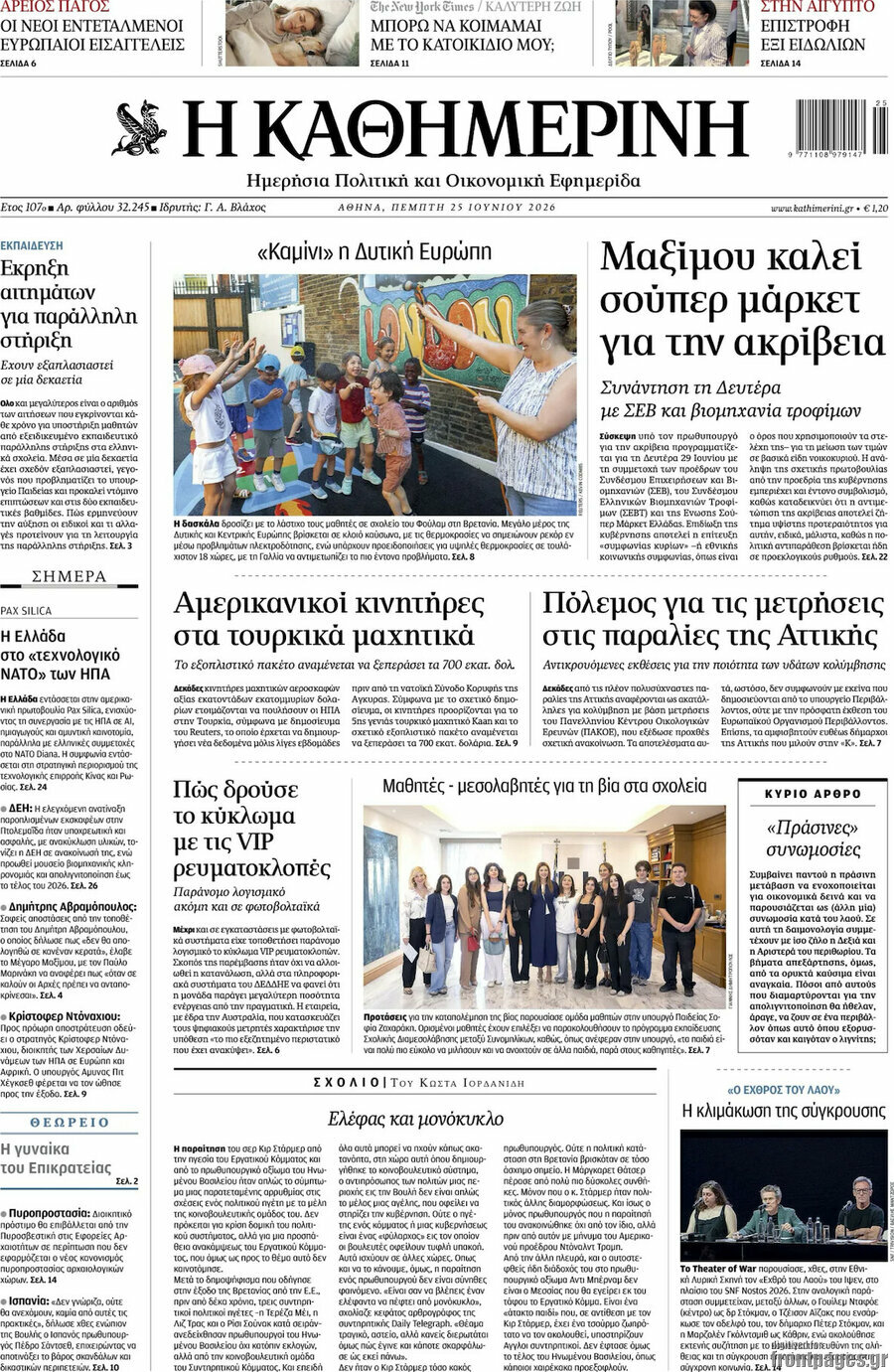
KATHIMERINI: PM’s office calls on super markets to discuss high prices
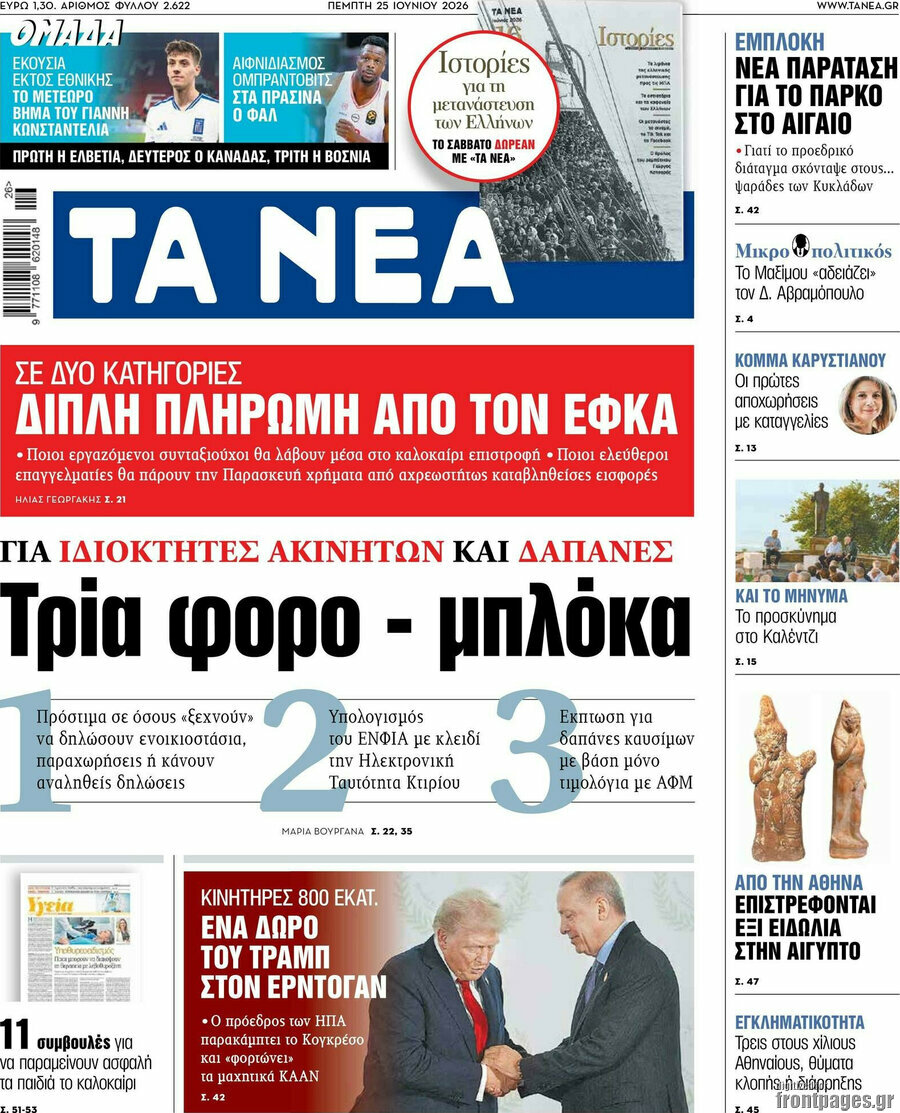
TA NEA: Three tax-blockades for owners and tax-deductible expenditure
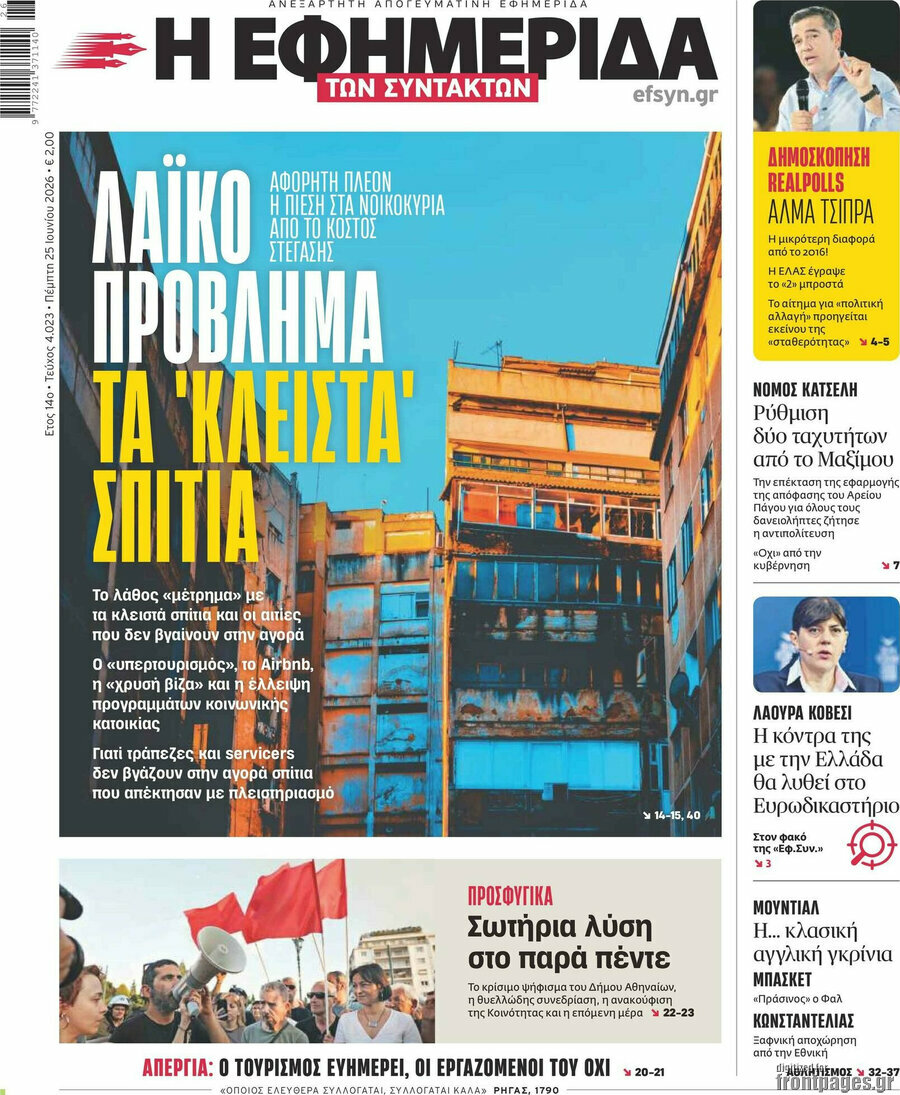
EFIMERIDA TON SYNTAKTON: Closed apartments are a major issue for simple folks
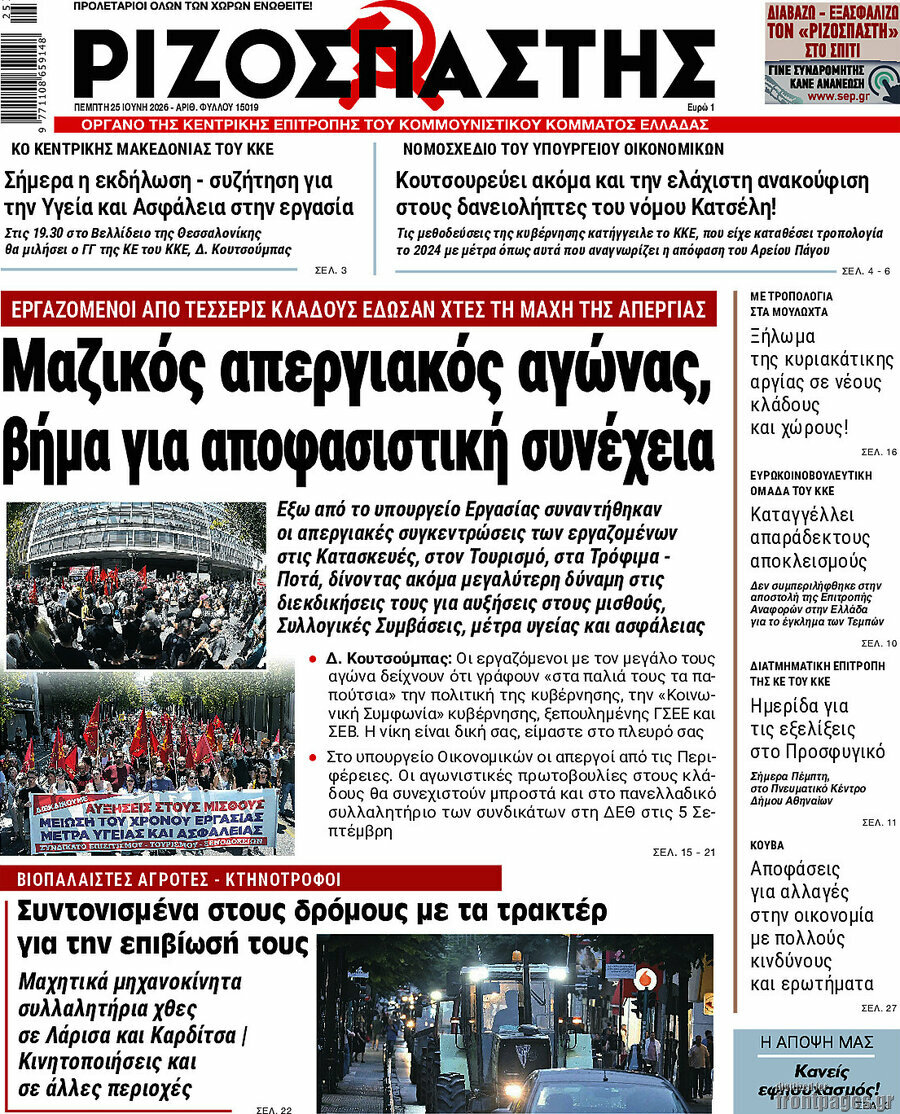
RIZOSPASTIS: Massive strike
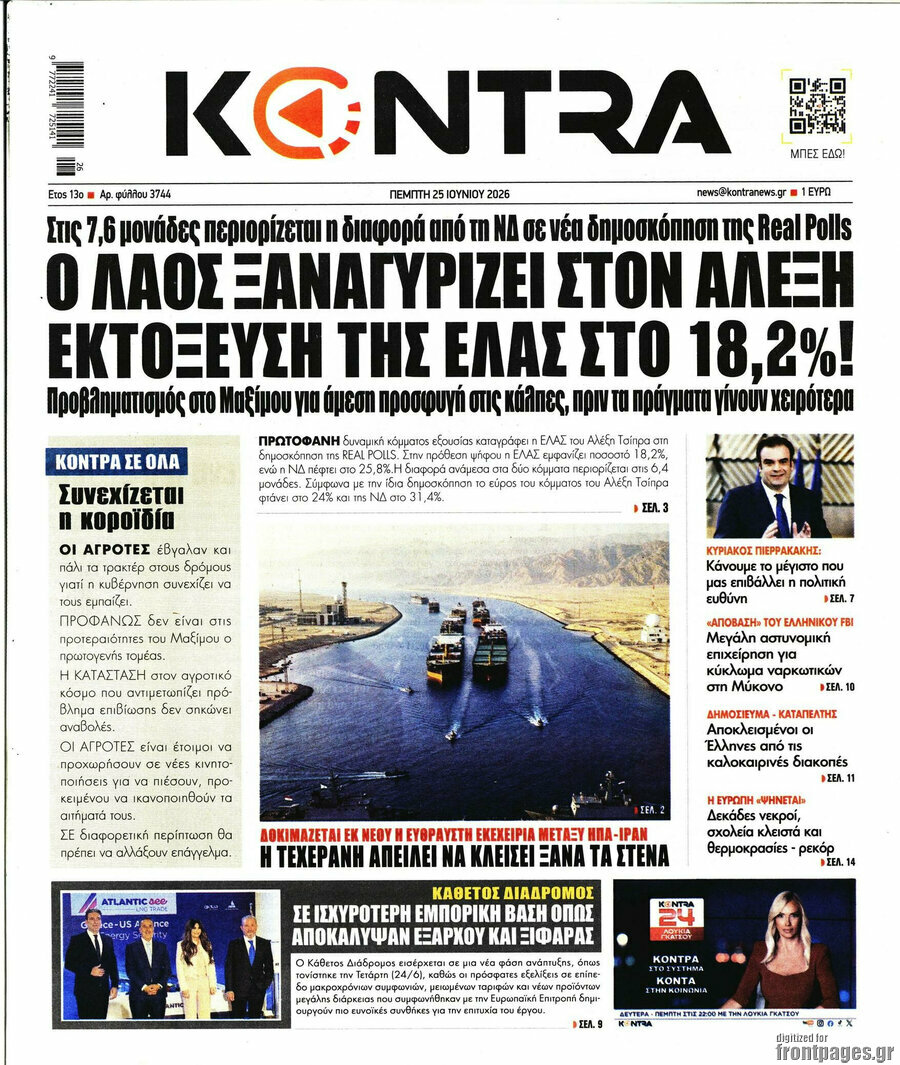
KONTRA NEWS: The people turn to Alexis once again – ELAS spikes at 18,2%
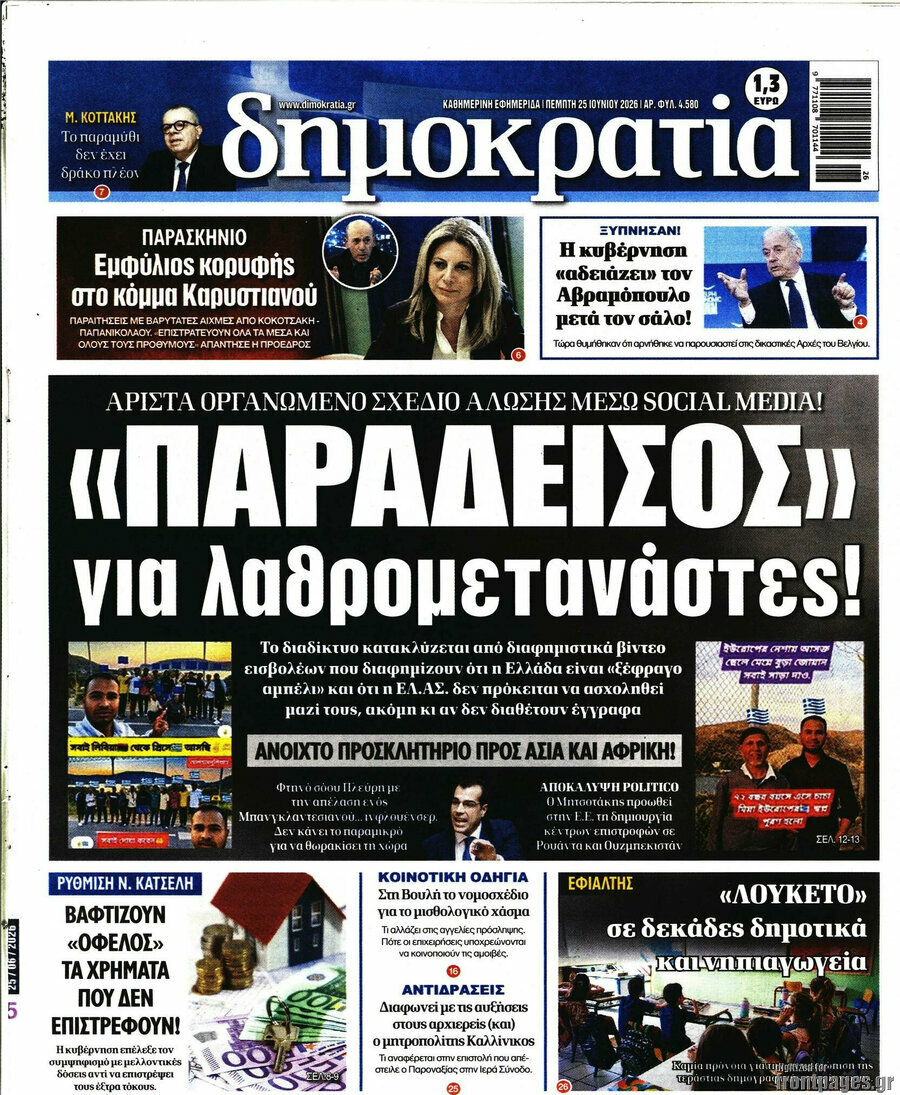
DIMOKRATIA: Plan through social media: A “paradise” for illegal migrants
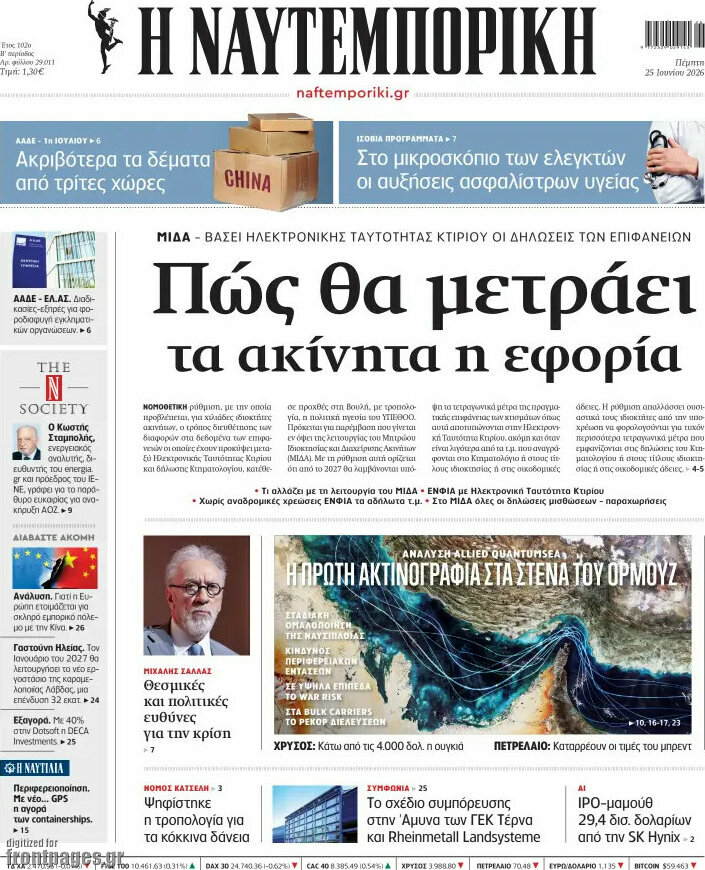
NAFTEMPORIKI: How the tax office will calculate real estate assets

DRIVING THE DAY
UKRAINE’S RECOVERY MEETS POLAND’S HISTORY: Politicians, investors, businesses and civil society groups gather in Gdańsk today for the start of the two-day Ukraine Recovery Conference — but the political rupture between Kyiv and Warsaw is threatening to overshadow the EU’s show of support.
What to watch: The conference starts at 10 a.m. with addresses by Polish Prime Minister Donald Tusk, Ukrainian PM Yulia Svyrydenko, European Commission President Ursula von der Leyen and European Council President António Costa, Playbook’s own Zoya Sheftalovich reports from Gdańsk.
Preview: Von der Leyen will make the case for investing in Ukraine now, an EU official told Zoya. Costa will underline the EU’s long-term commitment to Kyiv, pairing calls for continued pressure on Russia with a vision of Ukraine’s reconstruction and EU accession moving hand in hand. “We know what is at stake and what that means to the Ukrainian people,” another EU official said.
“This year’s URC is more than just a conference — it’s a symbol of our support,” Enlargement Commissioner Marta Kos told Gabriel Gavin ahead of the gathering. As Ukraine becomes “an ever-stronger military power,” she argued, the EU must work “to anchor it firmly inside the European Union.”
Defense is, for the first time, a major part of the conference, with organizers aiming to mobilize €3 billion in private investment, roughly one-third of it for security and defense projects. “Every euro invested in Ukraine’s defense industry is an investment in Europe’s security,” Kos said.
Shadow over Gdańsk: Ukrainian President Volodymyr Zelenskyy had been expected in Gdańsk but now won’t attend following his public dispute with Polish President Karol Nawrocki over the Ukrainian Insurgent Army (UPA). The UPA was responsible for killing tens of thousands of Poles from 1943 to 1945 in what Poland has consistently called a genocide. In May, Zelenskyy named a military unit after it.
Talk of the town: In conversations on Wednesday, Zoya repeatedly heard Ukrainian and Polish officials discussing the UPA row. One Ukrainian MP, granted anonymity to speak candidly, called the episode “stupid,” lamenting that a historical dispute is drawing attention away from what matters.
That concern is particularly acute now, with Kyiv expanding deep-strike operations against targets inside Russia while Moscow continues to bombard Ukrainian cities. A Polish MP, also granted anonymity, said despite the issue being politicized, Warsaw’s focus on delivering help and investment to Ukraine would not change.
The spat is “purely political,” said Olena Sotnyk, managing director of Rasmussen Global Ukraine and an adviser to Deputy PM Taras Kachka. But that makes it no less dangerous, Sotnyk told Zoya. “Internal politics influencing external outcomes — I think that’s the main problem.”
Crucially: Poland isn’t walking away. Tusk and Nawrocki stressed that Warsaw’s support for Ukraine remains unchanged. That reflects a strategic reality: Ukraine’s resistance keeps Russian forces farther from Poland’s border and NATO territory. As Sotnyk put it, Poland remains Ukraine’s most important logistics hub — “the biggest transferring zone” for humanitarian and military support — while Kyiv’s forces defend “not just Ukraine but the whole eastern flank.”
BIG AND BREAKING
ONLY FANS: The Council wants influencers to cover EU summits — but not if they question the bloc’s values, Mari Eccles reports.
NEW EEAS CHIEF: Former Dutch Defense Minister Kajsa Ollongren will become secretary-general of the European External Action Service, the EU’s diplomatic arm. She replaces Belén Martínez Carbonell as the top official under Kaja Kallas.
13TH FLOOR JOB MOVE: Ursula von der Leyen’s defense adviser Thomas Lunau is leaving the Commission president’s cabinet — and Brussels — after a little over a year to return to Denmark and take up a role in the military.
THE GREAT RECONCILER: Emmanuel Macron and Giorgia Meloni will meet on the French Riviera today for their first — and probably last — bilateral summit. After years of bitter clashes, the pair may finally find themselves on the same page: united against Donald Trump.
GIVE US A WARNING: France says it can live with a reduced American military presence in Europe — but it could do without the surprise announcements about troop and asset withdrawals, its deputy defense minister tells POLITICO.
EUROPE TO TRUMP — WE GOT THIS: The leaders of Germany, France, Italy, the U.K. and Poland pledged to beef up NATO’s European pillar ahead of alliance chief Mark Rutte’s meeting with Trump last night.
Rutte deployed flattery and gentle pushback in the Oval Office, while the U.S. president complained NATO had been too slow to back Washington during the Iran war. “I just want their loyalty,” he said, per the FT.
OMNIBUS PILEUP
SEEING RED OVER RED TAPE: The EU is facing a major bottleneck in its efforts to cut bureaucracy, with just four working months left for envoys to agree on six whole “omnibuses” — the instruments used to slash legislation deemed too burdensome for businesses. And a deadlock over environmental rules makes the job even harder.
Gridlock: Ambassadors failed at a meeting Wednesday to produce a full-blown agreement on the environmental file, envoys said. Two diplomats warned that the bulk of the work now won’t be complete before Cyprus hands over the rotating Council presidency to Ireland at the end of the month. Dublin will be left to try to make progress before the end of the year.
Don’t start from here: Poland’s deregulation minister Maciej Berek told Playbook the EU’s efforts to cut burdensome legislation will never be fast enough. Instead, he says Brussels needs to apply that thinking when making new laws if it wants European businesses to compete with the U.S. and China. “We have to build in the system, in the legislative process, a kind of filter — how not to over-regulate each time we make new legislation.”
20-SECOND PLAYBOOK PRIMER
There’s a spat in the European Parliament over President Roberta Metsola inviting member countries to approve a bill on scanning child abuse content online, which the Parliament voted down. When Council and Parliament have their say on proposed laws, it’s called the ordinary legislative procedure. How does it work? The European Commission comes up with a proposal for a new law, then the Council and Parliament examine it (this is called a reading) and can propose amendments. If both sides agree, the law is adopted. If they don’t agree during the course of three readings, it’s not. However, most of the time, laws are negotiated during informal, behind-closed-doors meetings called trilogues between all three main institutions.
CHAIR POLITICS
THE SEAT SWITCH THAT CAUSED A STIR: Bjoern Seibert’s decision to sit at the leaders’ table during last week’s European Council — instead of the seats at the back, where the chief of staff to the Commission president would usually be found — is being talked about by diplomats as a classic power move by one of the EU executive’s top political operators.
What’s in a chair? At summits of EU leaders, chiefs of staff are usually in the room but behind their principals. The seats at the top table are generally reserved for leaders and, where applicable, the institutions’ most senior officials. Seibert took the seat normally occupied by Commission Secretary-General Ilze Juhansone, two diplomats, an EU official and a diplomatic note confirmed.
Getting involved: The move comes amid growing talk in Brussels about the influence of Ursula von der Leyen’s team over the Commission’s Secretariat-General — the administrative nerve center of the EU executive that is currently being beefed up. Critics argue that the offices getting too close could blur the lines between the institutional machinery and the president’s political cabinet, a dynamic Brussels veterans associate with the era of Martin Selmayr, Jean-Claude Juncker’s powerful former chief of staff.
Holding sway: “Between the two [Seibert and Juhansone], it’s clear who has more power,” said a third diplomat, granted anonymity like others to discuss the internal dynamics. Another senior diplomat said the SG has become Seibert’s “back office.”
Seibert took the seat during the discussion on China, a dossier he has long overseen, as leaders were debating a tougher line toward Beijing. “It’s a message,” said the first diplomat, adding that this was Seibert’s way of signaling ownership.
Or maybe it’s not that deep: Since leaders were talking about Beijing, it was perfectly natural for one of the architects of the EU’s approach to China to be at the table at that moment, the second diplomat noted. “Everyone knows Seibert is the China expert [so it] makes sense he is in rooms when the strategic direction on this is being discussed,” said an EU official close to von der Leyen’s team.
DASHBOARD
SWELTERING BRUSSELS: Environment ministers meet in Luxembourg today to discuss climate impacts like the scorching heat now baking Western Europe, Zia Weise reports (for Morning Energy subscribers). It comes as forecasts suggest that tonight could be Belgium’s hottest on record. Buildings in Brussels will struggle to cool down before temperatures climb again in the morning, Hanne Cokelaere writes. With its mass of concrete masses, lack of green spaces and poor housing stock, the city tends to be 3C warmer than the rural areas surrounding it, bringing higher nighttime temperatures and three times more periods of intense heat, according to Brussels’ environment administration.
 |
5 MORE THINGS GETTING US TALKING
QUANTITATIVE SEIZING: The ECB’s election committee sanctioned a candidate in a staff committee race over a campaign email sent to all employees promising a “Supreme Consultative Dictatorship.”
JUST LIKE WORLD CUP FOOTBALLERS … The European Trade Union Confederation will call on the Commission to give workers the right to paid cooling breaks, water and shade during heatwaves in a new model directive to be presented today.
THAT’S ALL FOLKS: Brussels won’t stand in the way of Paramount’s $111 billion marriage with Warner Bros., brushing aside concerns from cinemas and campaigners who warned the Hollywood megadeal could squeeze European productions and media diversity.
BUNGA-BUNGA BUYER: Silvio Berlusconi’s Sardinian villa — the setting for some of the most infamous parties in modern Italian politics — has reportedly been sold to the Qatari royal family for €350 million.
LAST-DAY SURPRISE FOR CYPRUS: As Cyprus wraps up its Council presidency, one final, completely unrelated, high-profile gathering is set to take place on the island: Donald Trump’s Gaza Board of Peace will convene at a Cypriot resort on June 30 to “adjust its strategy.”