
Greece officially joins SAFE
European Commissioner for Defense and Space Andrius Kubilius has announced that Greece has signed its participation in SAFE (Security Action for Europe), an EU program providing long-term financing to members, plus Ukraine and European Economic Association members Norway, Iceland and Liechtenstein, to boost investments in their defense industries.
https://www.ekathimerini.com/politics/foreign-policy/1306662/greece-officially-joins-safe
Newly-appointed cabinet ministers sworn in
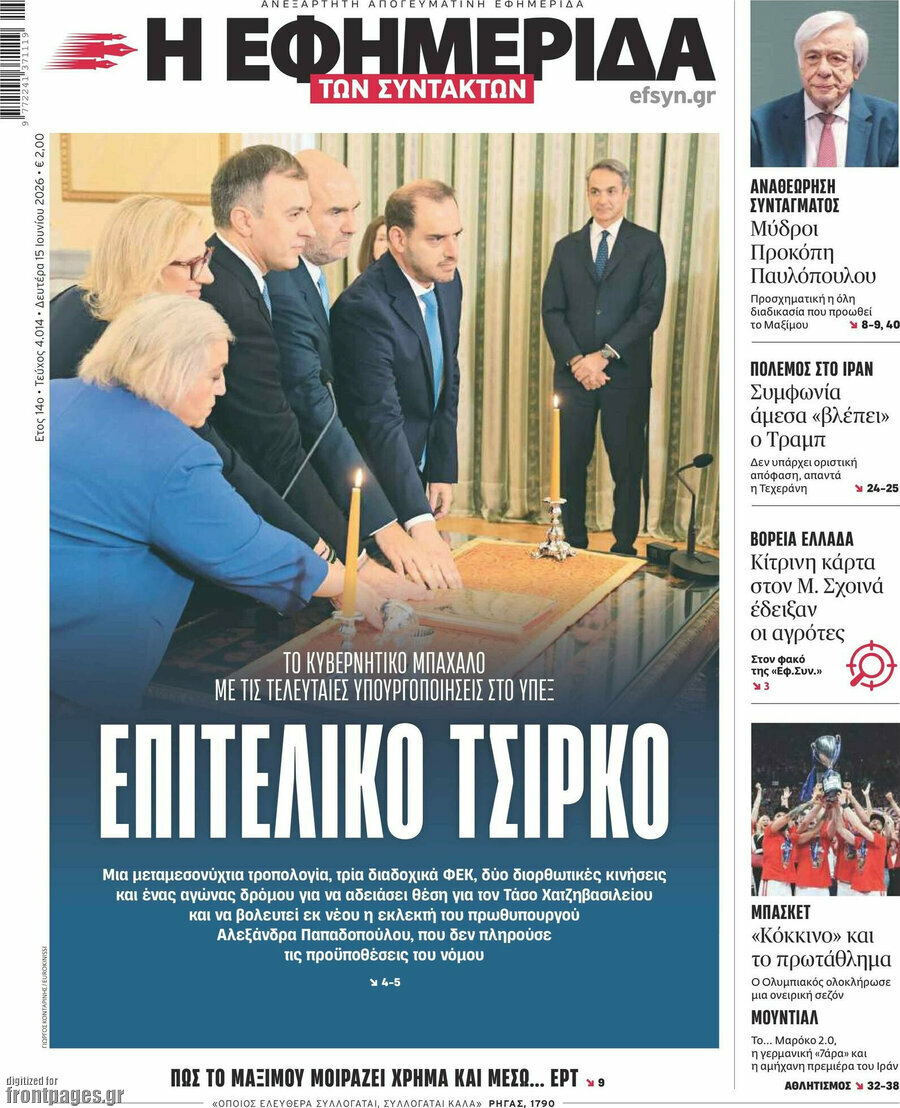
The newly appointed cabinet ministers created following a recent cabinet reshuffle were sworn in on Friday. The ministers entering or taking up new positions in the cabinet are Georgios Kotsiras, as Alternate Minister of Infrastructure and Transport; Dimitrios Markopoulos as Deputy Minister of National Economy and Finance; Anastasios Chatzivasileiou as Deputy Minister of Foreign Affairs; Maria Eleni Soukouli-Viliali as Deputy Minister of Environment and Energy; and Alexandra Papadopoulou as Permanent Deputy Minister of Foreign Affairs.
https://www.amna.gr/en/article/1000355/Newly-appointed-cabinet-ministers-sworn-in
Did the Greek State vouch for Predator? New report suggests official backing
Fresh allegations have injected new momentum into Greece’s long-running Predator spyware scandal, with a report claiming that the company behind the surveillance software obtained official endorsements from Greek state authorities to support exports to third countries. According to the newspaper To Vima, representatives of Israeli businessman Tal Dilian, the founder of Intellexa, say they possess documents issued by Greek government agencies that effectively functioned as “letters of recommendation,” certifying the successful operational use of Predator in Greece. The documents were allegedly used to facilitate sales of the spyware to foreign governments.
Androulakis pledges free public transport for under-25s in Athens and Thessaloniki
Main opposition PASOK-KINAL leader Nikos Androulakis pledged that a future PASOK government would introduce free access to public transport for all young people up to the age of 24 in Athens and Thessaloniki.
ATHEX: Bourse on highs unseen since 2009
The Greek stock market got the final push it needed on Friday to take its benchmark to its highest point in over 16 years, with a peace deal between Washington and Tehran looking closer than ever, and local banks feeling at their strongest point since the outbreak of the Greek debt crisis, also 16 years ago. Unlike other weekends, before which traders were more cautious, this time they appeared more confident and committed to purchases.
https://www.ekathimerini.com/economy/1306559/athex-bourse-on-highs-unseen-since-2009



SUNDAY PAPERS
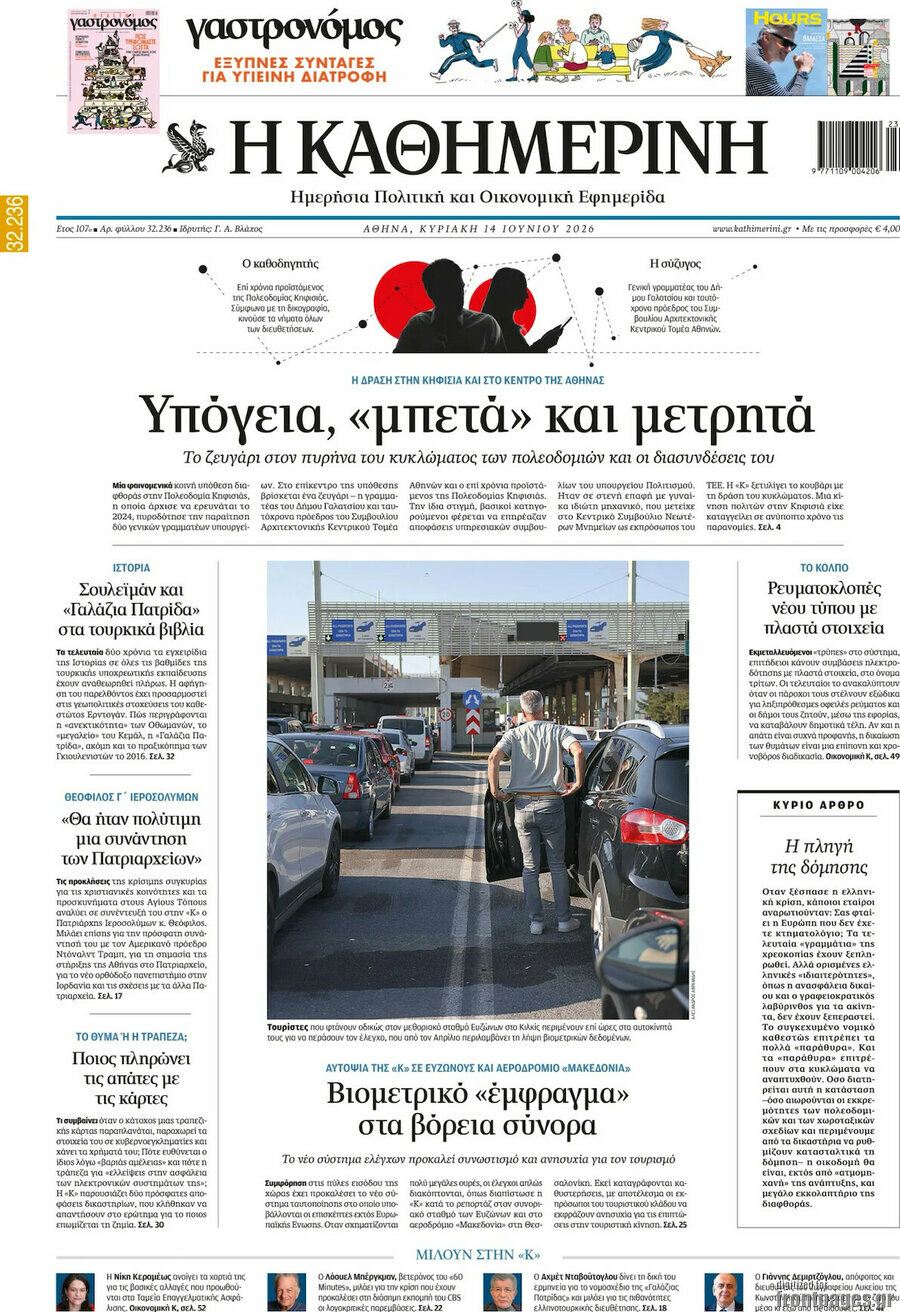
KATHIMERINI: The actions of the criminal ring that operated in urban planning offices
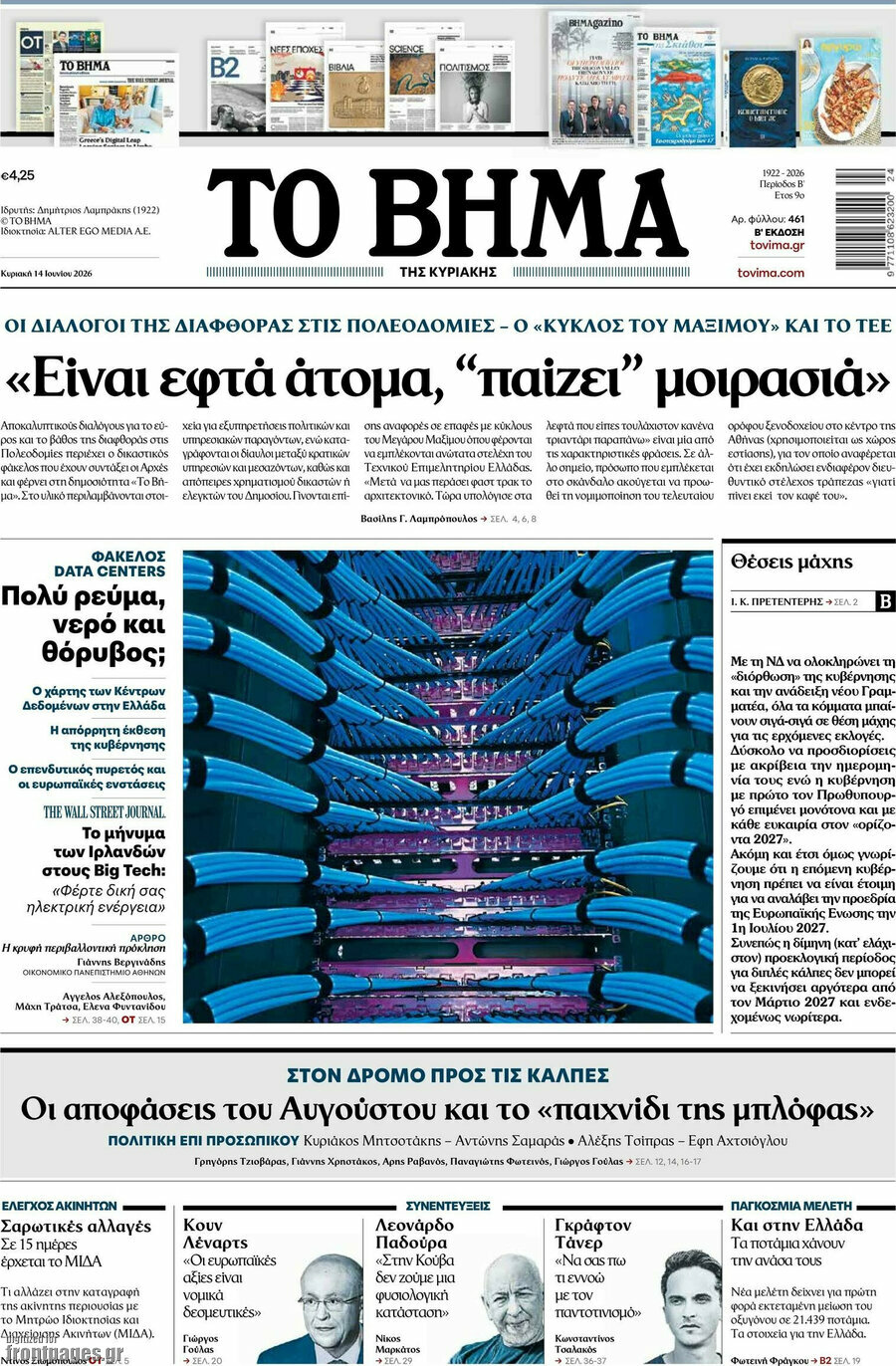
TO VIMA: Revealing dialogues of the criminal ring that operated in urban planning offices
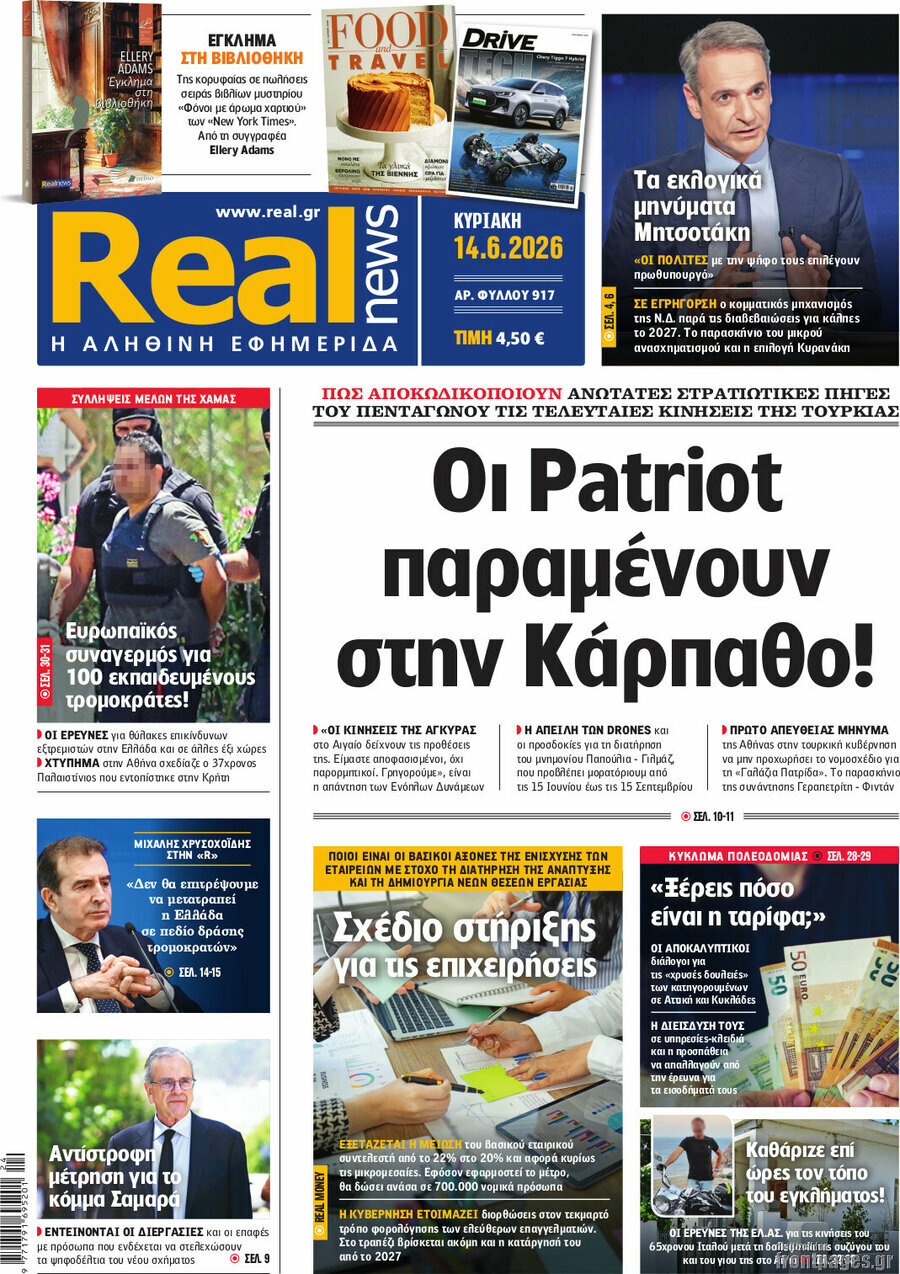
REAL NEWS: The Patriot missiles will remain in Karpathos!
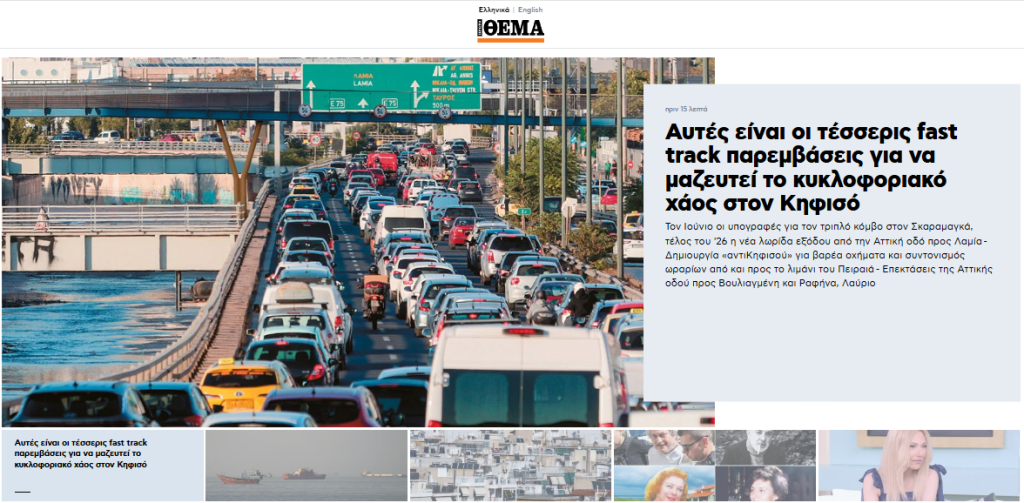
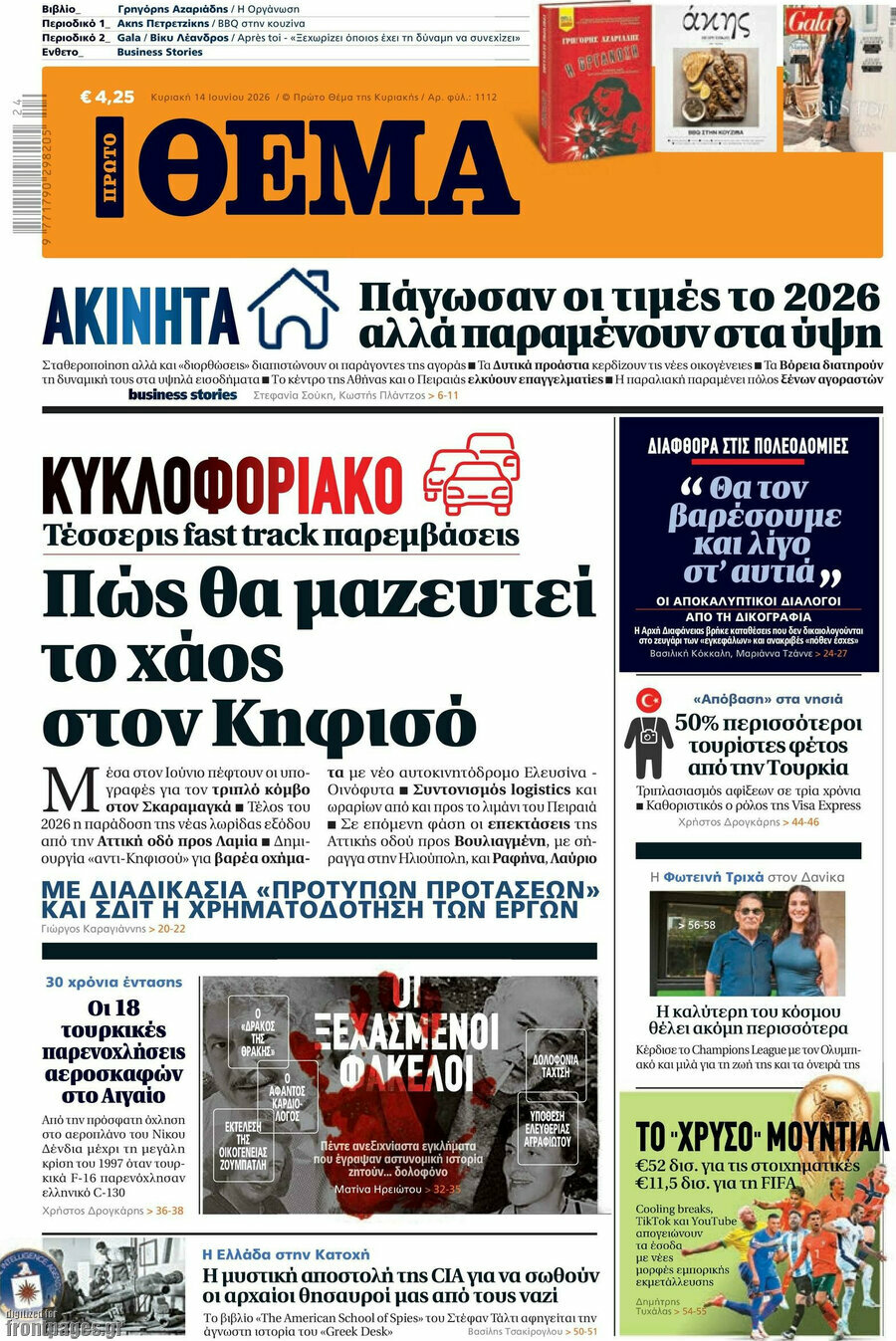
PROTO THEMA: Traffic chaos: How the congestion in Kifissos will be dealt with
MONDAY PAPERS:
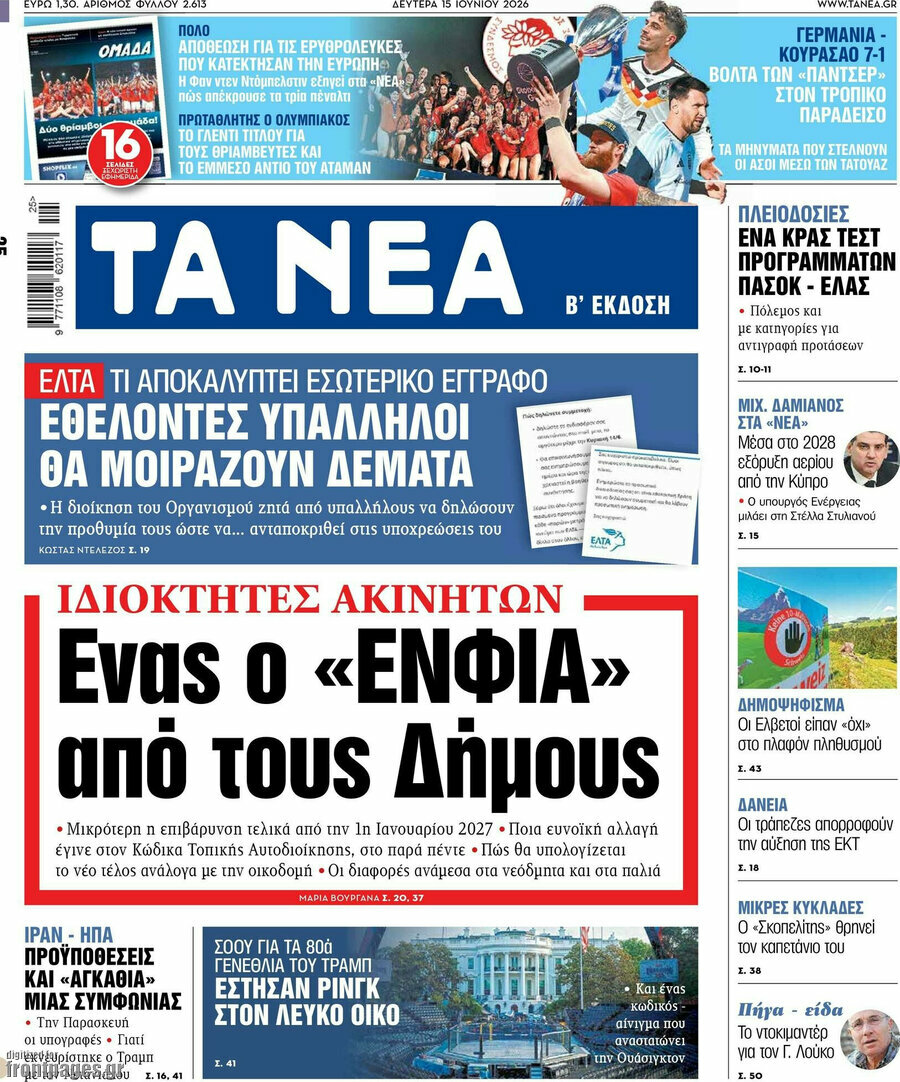
TA NEA: Single ENFIA [real estate] tax from Municipalities
EFIMERIDA TON SYNTAKTON: Executive circus
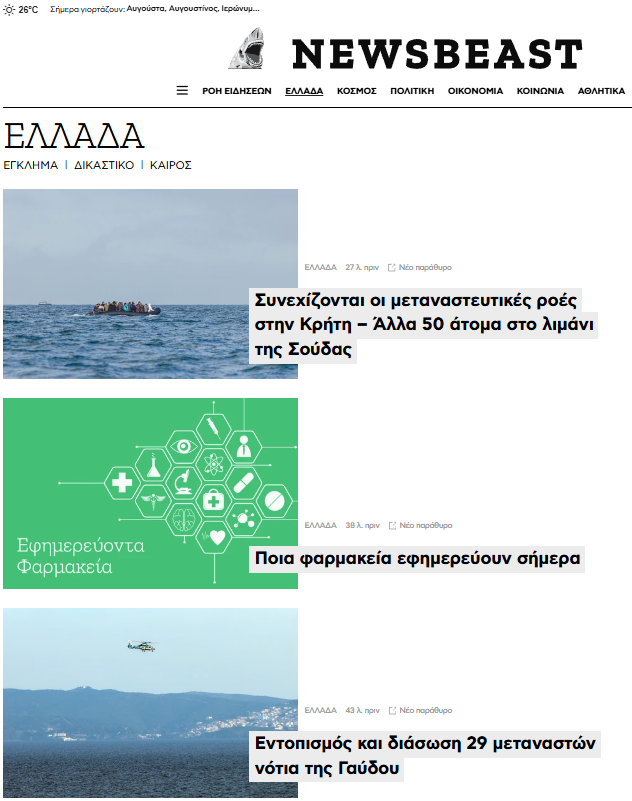
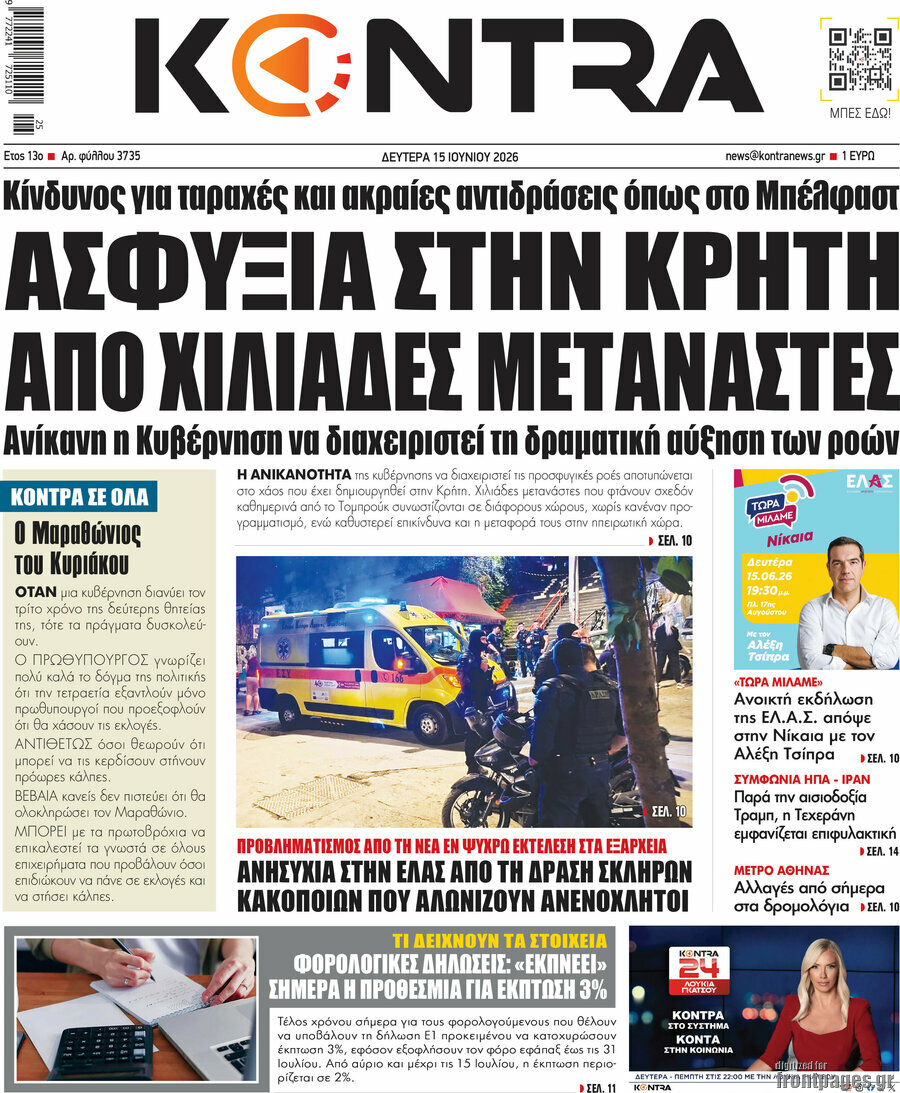
KONTRA NEWS: Asphyxiation in Crete due to the arrival of thousands of migrants
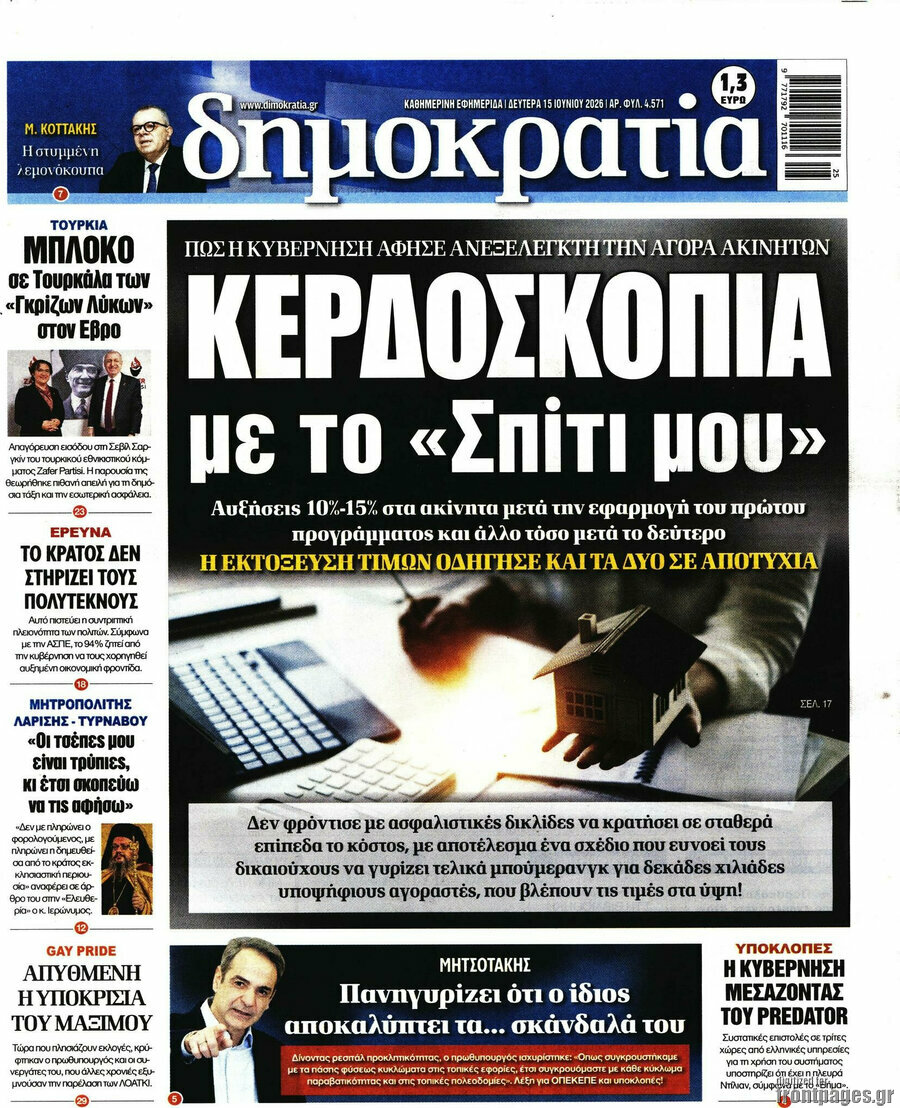
DIMOKRATIA: Profiteering linked to “Spiti mou” housing program
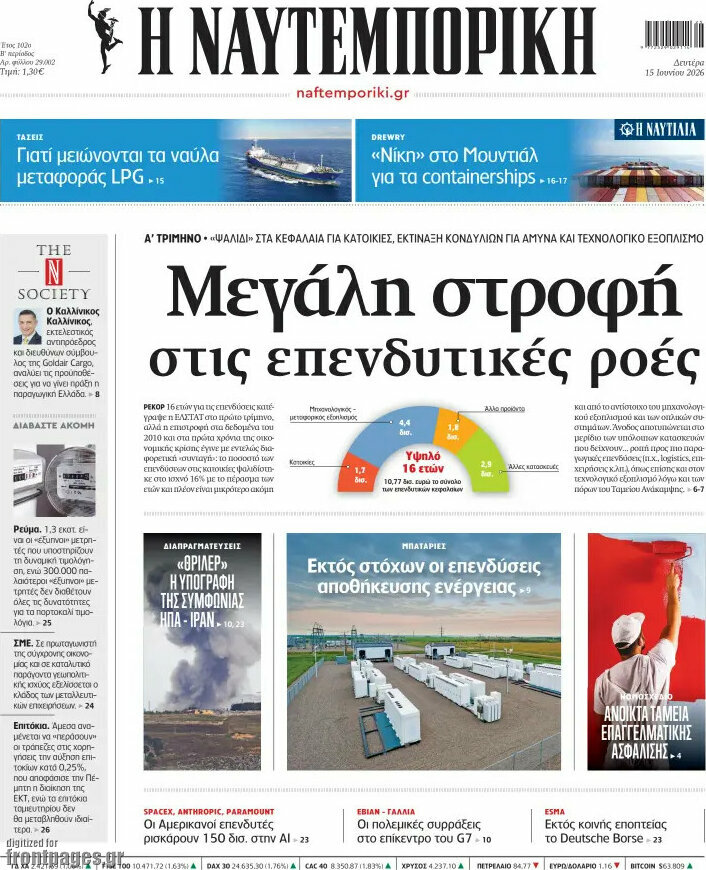
NAFTEMPORIKI: Great shift in investment flows

DRIVING THE DAY
ISRAEL AGAIN SPLITS EUROPE: A new push to sanction Israeli Cabinet minister Itamar Ben-Gvir over the treatment of Gaza flotilla activists is set to collide with opposition from Germany, Czechia, Austria and others at a gathering of foreign ministers in Luxembourg today, according to three EU diplomats.
The clash shows that Israel policy is still straining European unity, despite a rare agreement earlier this year to sanction violent settlers.
The case for action: One senior EU diplomat insisted that a sanctions listing against Benjamin Netanyahu’s national security minister “has to happen,” pointing to European leaders’ condemnation of Ben-Gvir after footage last month showed him taunting detained activists as “terrorists.” German Foreign Minister Johann Wadephul was among them, denouncing Ben-Gvir’s behavior as “completely unacceptable” and fundamentally opposed to German values. Several countries went further, imposing travel bans on Ben-Gvir.
Since then, though, the outrage in some capitals seems to have cooled. Berlin is concerned about the precedent of sanctioning a sitting Cabinet minister — and the risk that Ben-Gvir, leader of the hardline Otzma Yehudit (Jewish Power) party, could use it as a badge of honor ahead of Israeli elections scheduled for October 2026, according to diplomats familiar with the German government’s thinking.
And it’s not just Berlin: Czechia opposes new sanctions against Israel. Austria, Bulgaria and Slovakia may also be in the “no” camp, per the diplomats cited above. Berlin’s stance may be decisive, as other countries would likely follow its lead.
Another angle to watch today: Some countries are also arguing for trade measures against West Bank settlers, as Playbook reported Friday. But the European Commission has so far pushed back against that, arguing that tariffs would amount to sanctions — which needs unanimous backing.
Foreign ministers will hear competing legal opinions: The European Council, which represents EU capitals, has argued that trade measures are appropriate and can be approved by a qualified majority of EU states. The Commission is due to argue the opposite in a letter to foreign ministers today.
The bottom line: Europe had a brief moment of unity on Israel after Hungary’s election, when sanctions were agreed targeting violent West Bank settlers. But that’s looking like a one-off.
WHAT ELSE TO WATCH: Ukraine and Moldova will take their first official steps into the European Union with the opening of their first negotiation “cluster” due to be approved at an intergovernmental conference immediately after the FAC.
“I’m calling it Mega Monday because it surely must be the best day for EU enlargement since Croatia joined in 2013,” Enlargement Commissioner Marta Kos will say, per comments shared with Playbook.
BIG AND BREAKING
TRUMP LOOMS OVER G7: The Group of 7 summit kicks off today in Evian-les-Bains, France, where French President Emmanuel Macron will try to hold Donald Trump’s attention … EU leaders will look for common ground on China … and Ukraine’s Volodymyr Zelenskyy will do his best to keep Washington engaged in the war against Russia.
Watch it like a pro: Everything you need to know about Macron’s lakeside summit.
SPAIN WANTS A WIN WHERE IT HURTS: Spanish Prime Minister Pedro Sánchez has become Trump’s bête noire in Europe — and that would make a World Cup victory even sweeter, his supporters say.
NATO RAMPS UP HYBRID FIGHT: Private companies and military assets are being drafted into the fight against Russian aggression.
UKRAINE UNDER FIRE: Russian strikes overnight killed five people in Kharkiv, wounded at least 20 in Kyiv, left tens of thousands without power and set fire to one of Ukraine’s most significant religious landmarks. PM Yulia Svyrydenko called the damage to the Kyiv-Pechersk Lavra monastery a “brutal assault on our people and our heritage.”
SPOKESPERSON DENIES EXIT
REPORTS OF PINHO’S DEPARTURE GREATLY EXAGGERATED: For days, Playbook has been speaking to EU officials who’ve been absolutely convinced that the European Commission’s chief spokesperson, Paula Pinho,is leaving her post, Gerardo Fortuna writes.
A perfect move? For them, a vacancy posted a few days ago was akin to Colonel Mustard in the library with a candlestick. A position as head of the Commission’s representation in Portugal opened up when incumbent Sofia Moreira de Sousa was appointed EU ambassador to Albania two weeks ago as part of a diplomatic reshuffle. It followed that for Pinho, who is Portuguese, this would be the ideal way out.
The grapevine went into overdrive. One senior official was definitive: “She is expected to head the representation in Lisbon,” they told us. Another said the move was likely after the summer. A third was even more categorical: “She will clearly go to Lisbon. Definitely a promotion in terms of quality of life.”
Then there were the “leaving drinks” … An out-of the-blue invitation last week from Pinho to spokespersons from member countries’ permanent representations for a June 27 gathering fueled fresh speculation, with some well-placed EU officials wondering whether the event might double as a farewell for the chief spokesperson.
The trouble is, it wasn’t true. “Nonsense,” as Pinho put it to Gerardo. She told us she’s happy leading the Commission’s spokesperson service and has no interest in the Lisbon posting.
Make it make sense: Yet there’s a reason why rumors of Pinho’s departure won’t go away. Whispers have been going around the Commission for months, two officials close to the top of the institution said. Both suggested relations have cooled between Pinho and Commission President Ursula von der Leyen’s powerful head of cabinet, Bjoern Seibert.
Wider irritation: Frustration between the rest of the Commission and its media department have been building for a while and extend far beyond any one individual, a separate official said. “There is increasing discontent with how the service operates,” the official said. “Most people agree the problem is not the staff — they are very competent. The problem is the structure.”
20-SECOND PLAYBOOK PRIMER
The Group of Seven (G7) meeting starts today in France. The seven members are Canada, France, Germany, Italy, Japan, the U.K. and the U.S. So what’s the EU’s role? The EU is a “non-enumerated member,” which means it’s a full participant but isn’t counted as one of the seven members because it’s not a nation. The EU has taken part in G7 (and G8, back when Russia was in the club) meetings since 1981 and is represented by the presidents of the European Commission and European Council.
TALK TO PLAYBOOK: On the Brussels Playbook Podcast, Zoya asked for your views on Brussels’ decision to ban shared e-scooters. Whatsapp us on +32 491 050629 and listen from 7 a.m. to hear if we give you a shoutout.
BUDGET BATTLE
SUNDAY BLUES: The EU’s 27 envoys yesterday weighed in for the first time on the budget negotiating document presented last week by the Cypriot Council presidency. As expected, northern countries criticized Nicosia’s proposed 2 percent cuts as too limited, while southern and eastern countries broadly backed the approach, according to one EU diplomat.
“No one is moving on the MFF,” said a second diplomat, noting that “everyone is very entrenched.” France, meanwhile, complained that Cyprus had cut competitiveness-related spending while increasing funding for regional programs, the first diplomat said.
Taste of what’s to come: The exchanges underscored how difficult it will be for governments to bridge deep divisions and meet an ambitious year-end deadline for a political agreement on the EU’s next seven-year budget, my colleagues Gregorio Sorgi and Zoya Sheftalovich write in to report.
Better news: Ministers for European affairs are expected to approve the rules governing three key pillars of the next MFF at Tuesday’s General Affairs Council: the national and regional Partnership Plans, the European Competitiveness Fund and the Global Europe fund. The agreement concerns only the architecture of the funds; EU leaders will still need to settle overall spending levels and other politically sensitive questions in the months ahead.
PUTIN’S TROOPS
EU CLOSING IN ON “NO-BRAINER” BAN ON RUSSIAN SOLDIERS: Brussels is advancing plans to bar former Russian soldiers from entering the EU, after the Commission presented a proposal to ambassadors last week, Zoya reports.
Experts from member countries are now examining the plan, which requires countries to deny visas to anyone who has fought in Moscow’s war against Ukraine as part of the bloc’s 21st sanctions package. A high-ranking EU official said they expect the sanctions package, including the ban, to be adopted before the summer break.
All aboard: When Estonia first raised the soldier ban earlier this year, it met resistance from countries concerned about the practical challenge. Now there’s broad support, with no delegation raising major objections during last week’s discussion among ambassadors, according to two diplomats and the EU official. “It’s a no-brainer,” one diplomat said.
5 MORE THINGS GETTING US TALKING
STILL HERE, KEIR? Britain’s PM Keir Starmer will be among the leaders gathering in the French Alps today — but allies are already exchanging nervous glances as they ask how much longer he’ll be in the job.
EVEN FRANCE IS FRETTING: Paris has told Brussels it is “very concerned” about plans to exempt green investments from the EU’s public spending rules, two diplomats told my colleague Bjarke Smith-Meyer.
SCOOP — INSIDE THE WHITE HOUSE’S ANTHROPIC MOVE: The Trump administration imposed sweeping export controls on Anthropic after a frantic 24-hour effort by senior officials to convince the company to voluntarily pull a new AI model that officials believed posed security risks.
SWISS SAY NO: Voters in Switzerland rejected a proposal to limit the country’s population to 10 million by 2050, avoiding a clash with Brussels over free movement.
TRY AGAIN: Romanian President Nicușor Dan has nominated center-right politician Adrian Veștea to be the country’s next prime minister, after MEP Eugen Tomac failed to win enough support to form a technocratic government.