Ankara expected to delay the ‘Blue Homeland’ bill
Turkey’s planned “Blue Homeland” legislation is now expected to be delayed until October, with Turkish sources attributing the postponement to technical and bureaucratic reasons rather than a policy shift. According to well-informed sources, the bill defining Turkey’s maritime areas has not been included on the agenda of parliamentary committees for June.
Poll: ND in double-digit lead, but 69% want another govt
Another opinion poll has confirmed that left-wing former prime minister Alexis Tsipras’ new ELAS has quickly become the country’s most popular opposition party, although the governing conservatives still enjoy a double-digit lead. But the survey by GPO for private Star television also indicated that the vast majority of Greeks wants to see a change in government.
https://www.ekathimerini.com/politics/1305584/poll-nd-in-double-digit-lead-but-69-want-another-govt
PM Mitsotakis: Official end to all surveillance as Greece leaves crisis-era chapter behind
Prime Minister Kyriakos Mitsotakis, in a social media post, referred to the European Commission’s announcement that Greece is to be removed from the list of countries with macroeconomic imbalances. “This also marks the official end of all surveillance,” he stressed.
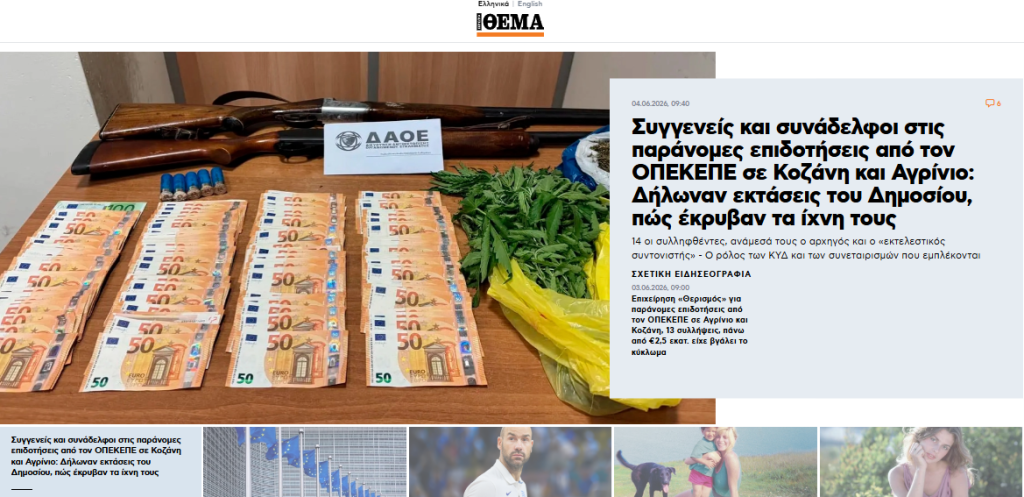
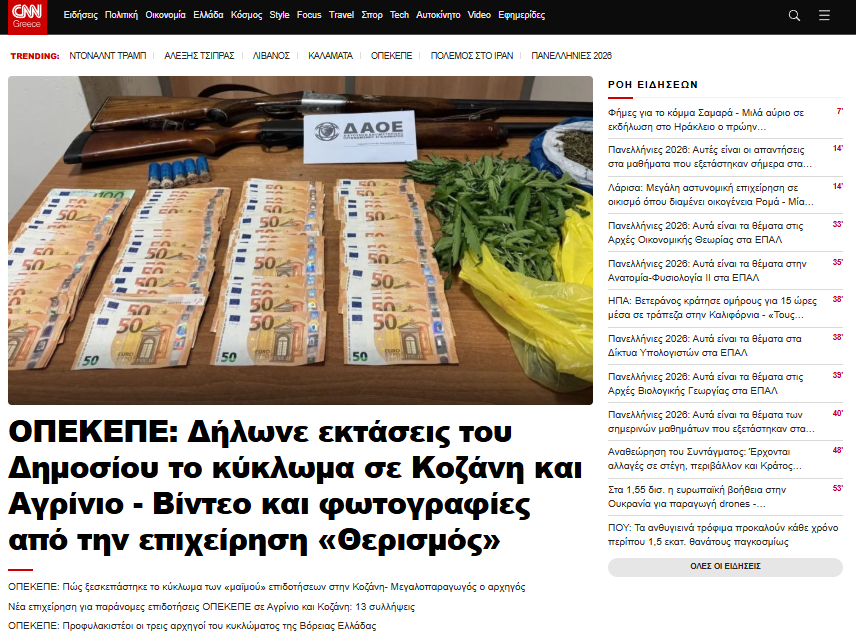
Police reveals how €2.5 million OPEKEPE subsidy racket operated
The Greek police on Thursday released details regarding the operations of an alleged criminal network believed to have fraudulently obtained nearly €2.5 million in agricultural subsidies through the country’s payments agency, OPEKEPE.
ATHEX: Arms offer pretext for profit taking
Just like last week, the renewed military activity in the Persian Gulf gave traders the perfect pretext for some profit taking at the Greek stock market, following the price growth of the previous days. As usual, banks had their firm hand on the tiller, as the losses were moderate enough not to worry observers about a medium-term trend. The decline in turnover would also contain significance in Wednesday’s southward move.
https://www.ekathimerini.com/economy/1305601/athex-arms-offer-pretext-for-profit-taking


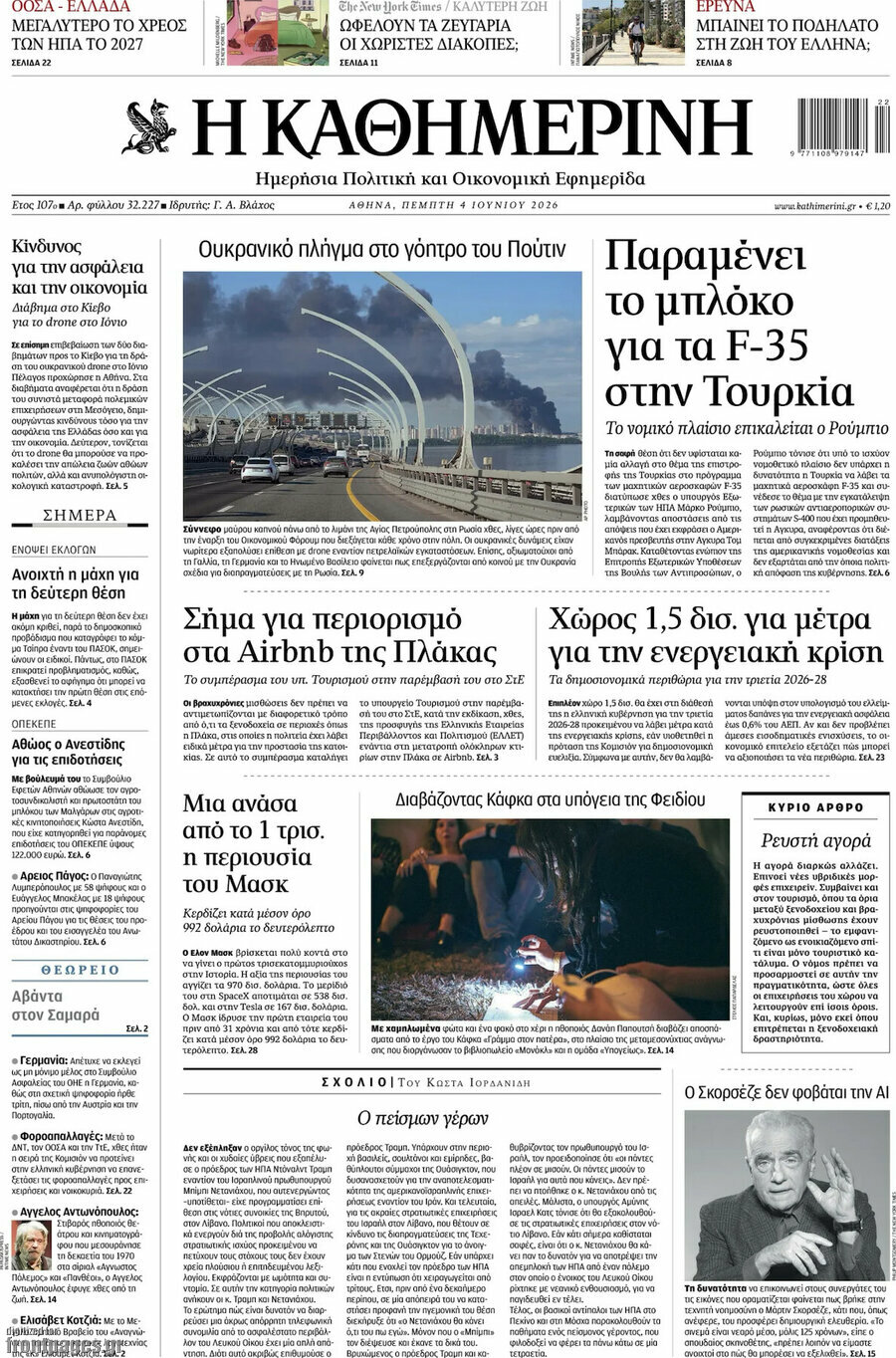
KATHIMERINI: The blockade regarding F-35 jetfighters for Turkey remains
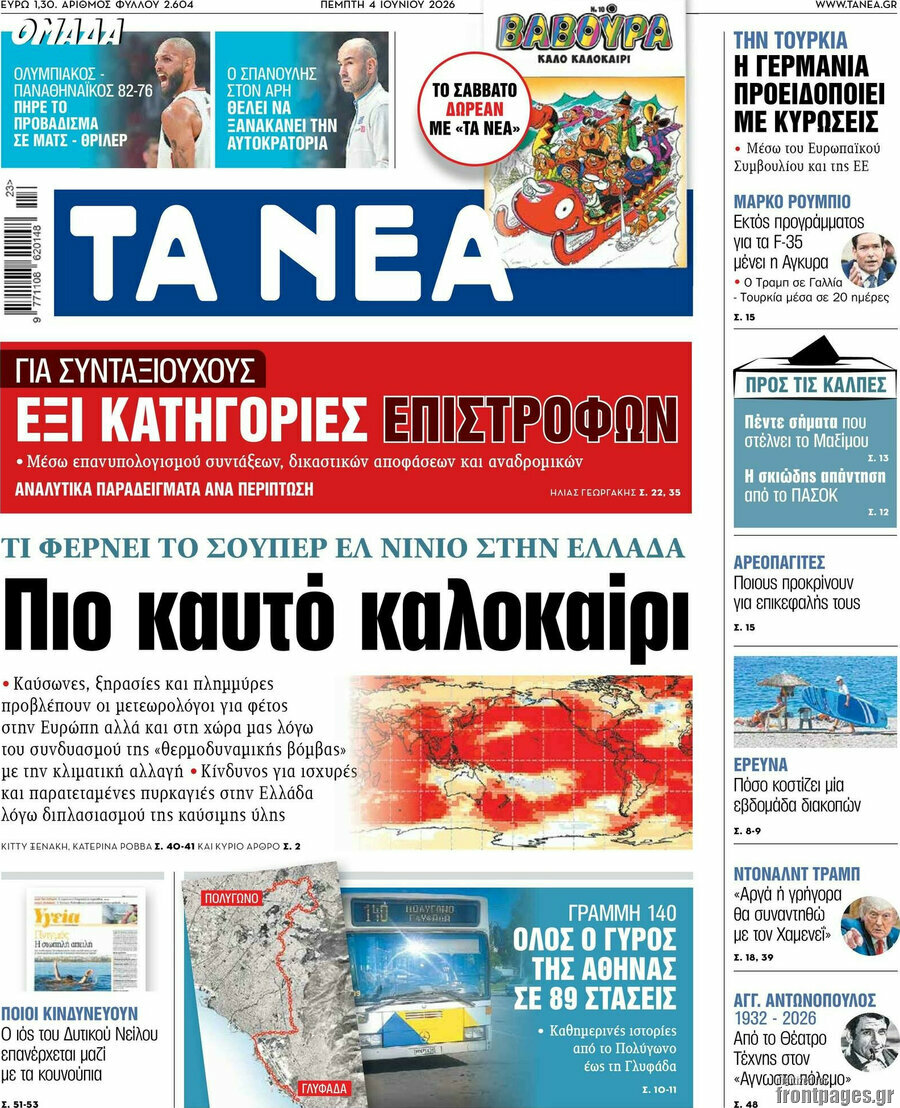
TA NEA: A hotter summer ahead
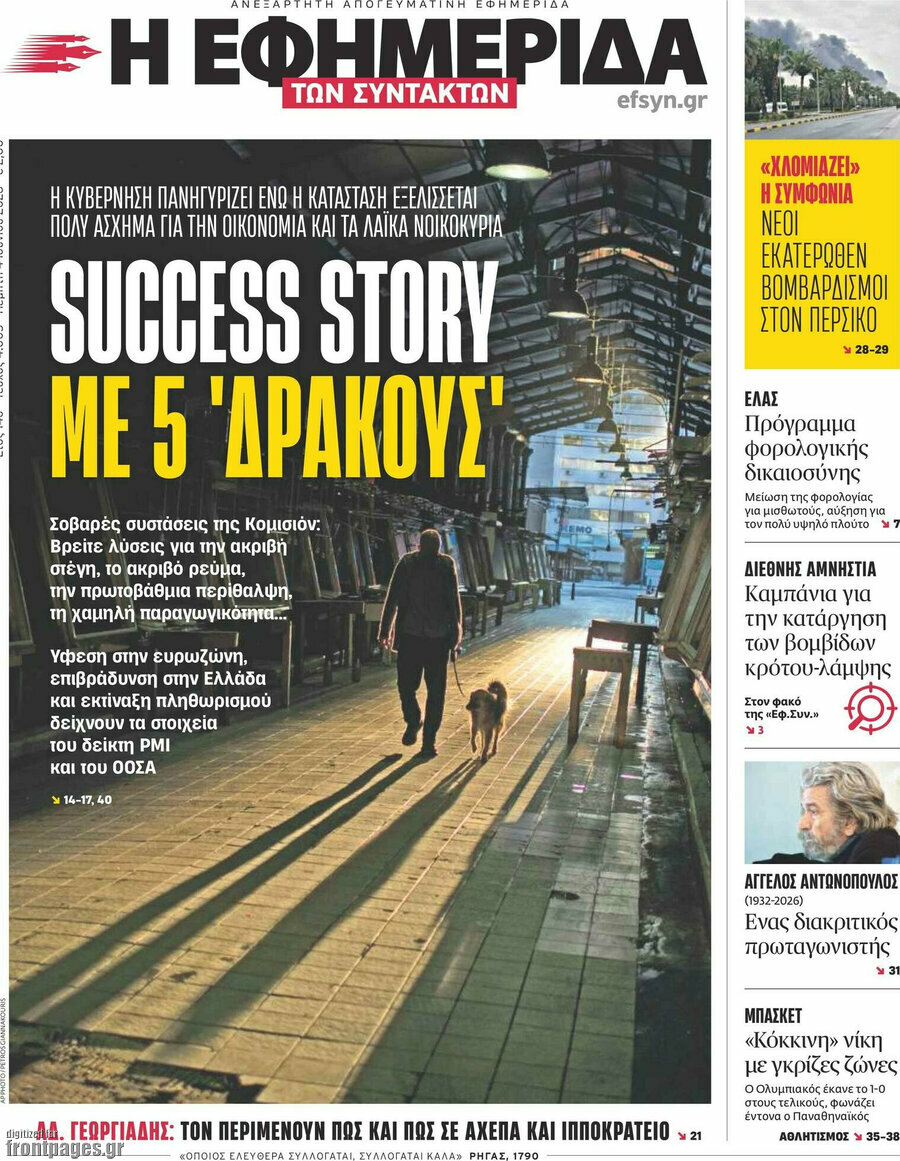
EFIMERIDA TON SYNTAKTON: The government’s success story has 5 dragons
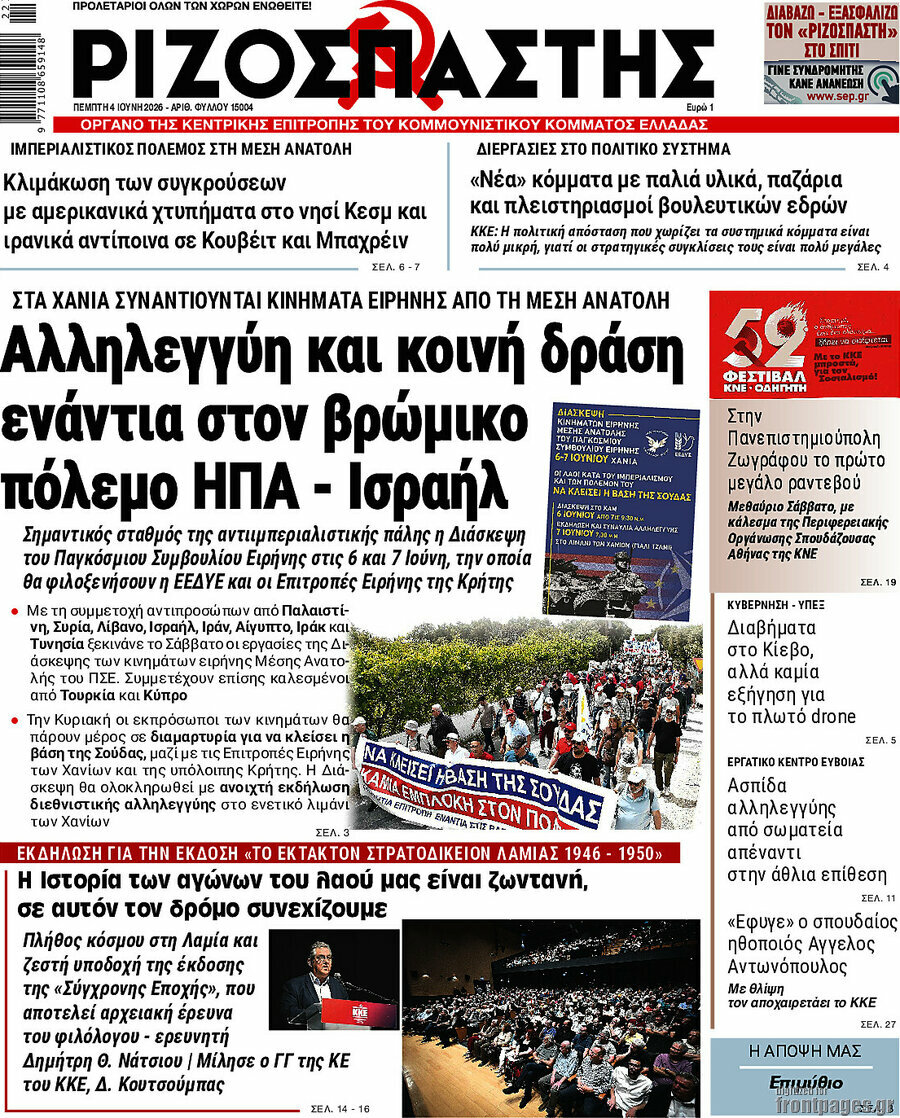
RIZOSPASTIS: Solidarity and joint action against the dirty war of USA-Israel
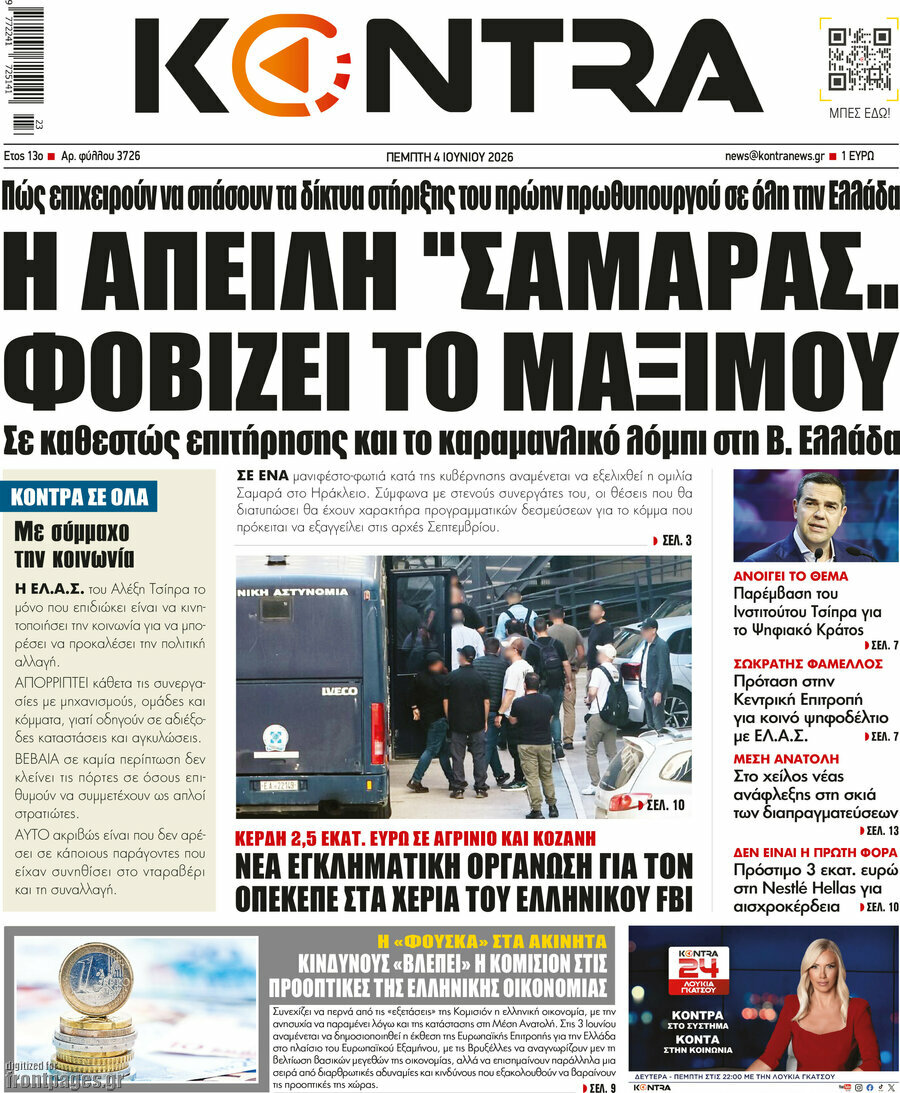
KONTRA NEWS: The “Samaras” threat terrifies the PM’s office
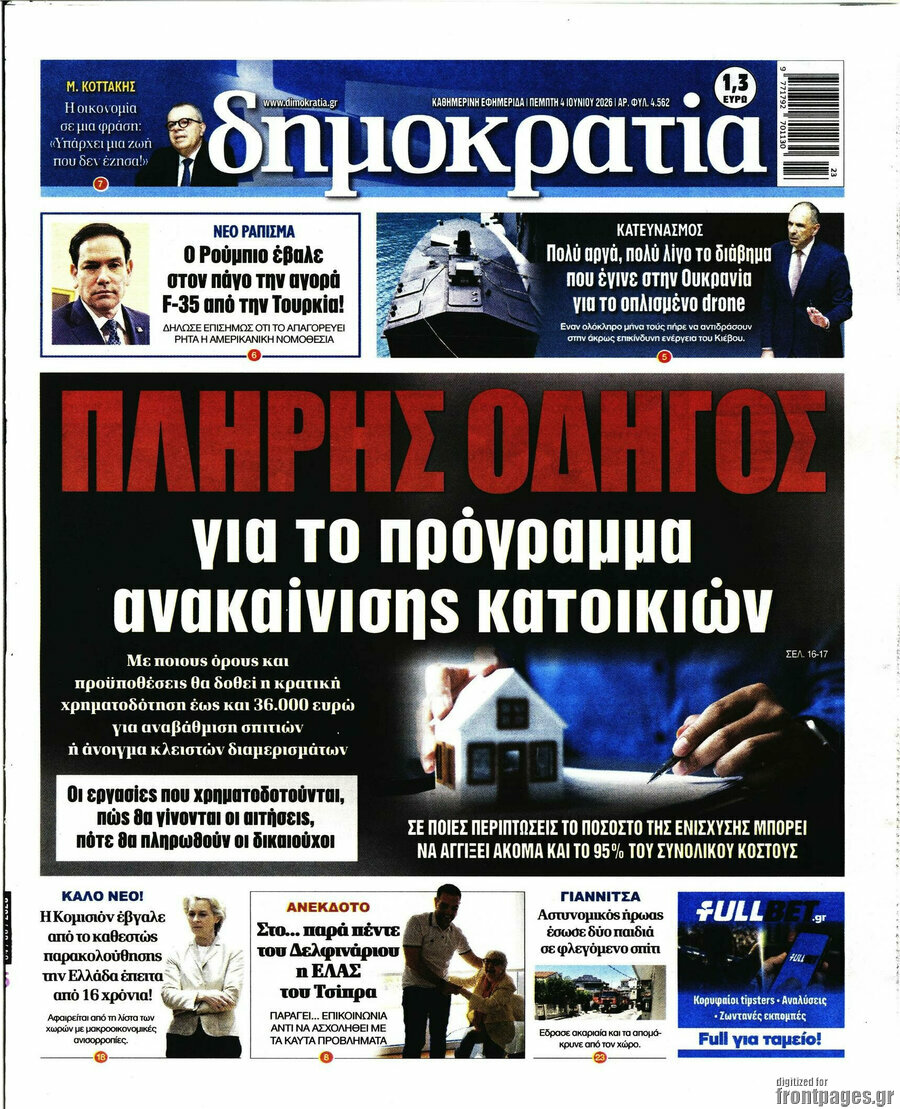
DIMOKRATIA: Full guide for the renovation program for households
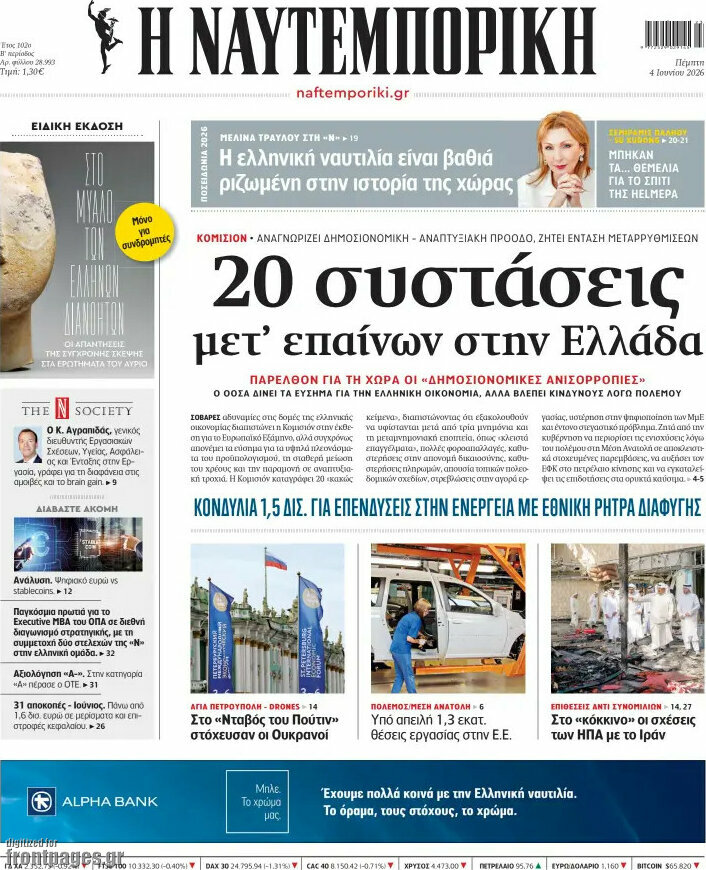
NAFTEMPORIKI:EU Commission: 20 recommendations with praise for Greece

DRIVING THE DAY
HERZ ÜBER KOPF: Few politicians have built as much influence around town as Manfred Weber. The European People’s Party chief is at the height of his powers, with immediate plans to expand his political dominion — but there are signs his heart might be pulling him back to Bavaria.
Bav-stalgia? Weber set off a fresh round of speculation about his future last week when he sent an open letter criticizing — albeit without naming — Bavarian Minister-President Markus Söder, a fellow member of the Christian Social Union. The message to roughly 800 senior party figures, accusing the party of a short-term, click rate-driven focus, set off a bomb in Bavaria’s CSU.
Warning shot: Weber’s attack on Söder — a rival since their days in the CSU’s youth wing — points to a bigger political motivation, seven party officials told Playbook. “Sending a five-page letter praising former CSU minister-presidents but not Markus Söder is a clear political signal,” one EPP official told Max Griera, who dug into the issue with Rasmus Buchsteiner and me.
But what exactly is Weber up to? Some in Brussels are wondering if Weber is eyeing Söder’s premiership. Being minister-president of Bavaria is a “dream” for all party members, as one EPP official put it, and rumors of Weber’s growing interest in Bavarian politics have circulated for a while. But insiders don’t believe Weber is actively preparing a bid for the premiership — at least, not now.
The other play: They think he wants that post to go to Bavarian Parliament President Ilse Aigner and that he’s instead lining up the CSU leadership (Söder currently holds both roles). That would allow Weber to increase his influence in German politics while remaining active in Brussels. His letter was an attempt to test the mood inside the CSU, four officials said.
Pushing the envelope: A bigger role in the CSU would create questions about Weber adding even more to his Brussels responsibilities. But as one EPP-linked EU official put it: “Many things about Weber raise questions. He’s been always operating at the limits of what’s possible.”
Weber’s web: The EPP leader remains deeply invested in Brussels, as his drive to broaden the center-right family continues. For example, Montenegro Prime Minister Milojko Spajić’s Europe Now Movement is expected to join the EPP at the party’s assembly in Vienna on June 30, EPP Vice President David McAllister confirmed to Max.
Magyar too: Hungary’s Péter Magyar and his Tisza party — already sitting with the EPP group in the European Parliament — have also begun the process of formally joining the party, according to two officials.
The real prize: Party insiders see Belgian Prime Minister Bart De Wever’s N-VA as the EPP’s next target. Adding the Belgian nationalists would bring the party’s prime minister tally in the European Council to 13.
No comment: A spokesperson for Weber declined to comment on his move against Söder, but Weber has insisted in German media that he’s seeking a debate about political substance, not personnel.
Takeaway: Weber is unlikely to leave Brussels any time soon. But after 21 years operating at a European level and two failed bids for the Commission presidency, he knows there may be little left to conquer — and might be increasingly tempted by opportunities closer to home.
BIG AND BREAKING
MAGYAR WELCOMES UKRAINE DEAL: Hungarian Prime Minister Péter Magyar late Wednesday announced Budapest had struck a deal with Kyiv on the rights of Hungarian minorities that would clear the way for the EU to open accession negotiations with Ukraine, Zoya Sheftalovich reports.
CHINESE FIRMS SANCTIONED: The EU’s diplomatic service is set to sanction four Chinese companies accused of supporting Russia’s war effort in Ukraine — a move likely to add to growing tensions between Brussels and Beijing. Playbook’s Nicholas Vinocur has the scoop.
NO DISCLOSURE: Czech ECR MEP Alexandr Vondra hasn’t disclosed his role as honorary chairman of a Czech think tank, even as he continues to work as shadow rapporteur on files affecting companies that fund the organization, a POLITICO investigation finds.
LONG GAME: The EU’s tech sovereignty package is geared toward boosting the companies on the continent so they can eventually challenge their U.S. rivals.
TARIFF CENTRAL: U.S. President Donald Trump is slowly unveiling his new tariff regime to replace the one knocked down by the Supreme Court earlier this year. Meanwhile, the European Commission hit back at plans to impose a new 10 percent tariff, which the U.S. justified by arguing Brussels had failed to ban the import of goods made with forced labor.
IT’S OFFICIAL: EEAS Secretary-General Belén Martínez Carbonell has been nominated as EU ambassador to Mexico, as Playbook previously reported. Other notable diplomatic appointments: Ursula von der Leyen’s former Green Deal adviser Peter Van Kemseke heads to Norway; and Dutch diplomat Caspar Veldkamp is off to Beijing.
ALLIES PLAN FOR PEACE: Germany, France and the U.K. are working on plans with Kyiv to engage Russia in negotiations to end the war, Bloomberg reports.
CALL TO KICK OUT RUSSIAN TOURISTS
TURNING THE SCREWS: Eleven European countries want Brussels to tighten access for Russian travelers to the Schengen Area ahead of the summer holidays, arguing Russians shouldn’t be sunning themselves on European beaches while Ukrainians are dying.
What they want: In a letter to EU foreign policy chief Kaja Kallas and Migration Commissioner Magnus Brunner ahead of today’s Justice and Home Affairs Council, ministers from the Baltics, Czech Republic, Denmark, Finland, the Netherlands, Poland and Sweden, plus non-EU Iceland and Norway, call on the Commission to tighten EU visa policy on Russia. They also back Estonia’s campaign to prevent Russian fighters from entering Schengen.
By the numbers: The ministers argue implementation of EU guidance is patchy, allowing Russians to go “visa shopping.” Russian visa applications were 8 percent higher in 2025 than 2024, according to the 2026 Schengen Barometer — and the number of visas issued increased even more. 623,451 Russians got a visa in 2025, versus 565,719 in 2024.France issued the most Schengen visas to Russians in 2025, followed by Italy and Spain.
Behind the push is a changed political landscape, according to one diplomat familiar with the discussions. With Viktor Orbán no longer acting as a spoiler, pro-Ukraine capitals see their chance to increase pressure on the Kremlin while Russia is struggling on the battlefield and economically.
What’s next: Two diplomats said the signatories would raise the letter on the JHA sidelines to gauge whether there’s enough support to move ahead. If so, the proposal could be fast-tracked before the summer. “If there is a positive feeling in the room, things could move quite quickly,” the diplomat said.
Some capitals are against it: “Russians, when they get to Europe, they get a sense of what Europe means. It’s not just about big boats, spending money etc. … We need to be a bit careful,” said a diplomat from a country not among the signatories. Another cautioned against reading too much into visa statistics, noting some countries have a broader diplomatic footprint and greater capacity to process applications, rather than more lenient visa rules.
Spain’s take: The Spanish foreign office said Madrid has supported all EU restrictive measures on Russia and strictly implements visa regs.
 |
20-SECOND PLAYBOOK PRIMER
With Hungary signaling it will drop its opposition to Ukraine’s bid for EU membership, Ukraine and Moldova will soon open the first negotiating “cluster.” But what are these clusters? Candidates to join the EU need to meet a set of political and economic conditions. There are 33 of these, split into six thematic groups known as clusters. The first cluster to be opened (and the last that will be closed) is called Fundamentals and covers the likes of the judiciary, public procurement and financial control.
TALK TO PLAYBOOK: WhatsApp us on +32 491 050629 and listen from 7 a.m. to hear if we give you a shoutout.
BRUSSELS ❤️ MELONI?
MELONI DIVIDEND: Giorgia Meloni’s role as a bridge between mainstream European leaders and the far right is paying dividends for Rome. The Commission yesterday allowed governments to exclude some green energy investments from EU fiscal calculations. The Italian prime minister had called for leeway in a letter to Commission chief Ursula von der Leyen.
Far-right whisperer: Meloni is increasingly seen as a peacemaker between Europe’s mainstream and far right — vital as France’s National Rally eyes next year’s presidential election. Per two diplomats and an EU official, Meloni could serve as a model for the party’s presumptive candidate Jordan Bardella by showing there’s more to be gained from working with Brussels than against it.
The concession will be a relief to heavily indebted Italy and comes at a sensitive moment for Meloni, who faces a battle to win reelection next year while the economy is slowing and energy costs are high.
Official response: The Commission says the measure was designed to accelerate the move away from imported fossil fuels and toward energy independence. An EU official dismissed the idea it was designed as a sweetener for Meloni.
It’s not over: Regardless, frugals like Sweden are furious, arguing the Commission’s decision undermines the credibility of the bloc’s fiscal framework, our colleague Gregorio Sorgi reports. Their frustration is set to spill over at next week’s Ecofin meeting, where several governments are expected to challenge the proposal.
7 MORE THINGS GETTING US TALKING
CUT USE: The Commission wants households to use less energy at peak times in preparation for an explosion of power demand from artificial intelligence data centers and electrification of the economy.
EXCLUSIVE — SOCIALISTS SET MID-TERM PRIORITIES: The Social Democrats in the European Parliament approved a list of six priorities, obtained by POLITICO, after a vote among its 136 MEPs. The list will be presented at the group’s “Red Gala” on June 9.
PRESIDENCY PRIORITIES: The incoming Irish presidency of the Council of the EU will keep the Council’s focus on simplifying EU policy, according to a draft policy program obtained by Sebastian Starcevic (for Pro subscribers).
TECH SOVEREIGNTY (IN MINIATURE): As of today, Qwant will replace Google as the default search engine on European Parliament computers. The French search engine pitches itself as a privacy-focused European alternative that does not track users or collect personal data.
JUSTICE SCOREBOARD DROPS: The European Commission today unveils its annual Justice Scoreboard, a key input into the Rule of Law Report due in July. This year’s edition is expected to show improved perceptions of judicial independence and gains in the efficiency of justice systems across the EU.
NO CHANGE TO PARLIAMENT’S TOBACCO RULES: Political groups have rejected proposals to tighten the European Parliament’s rules on meetings with tobacco lobbyists, according to our Morning Health colleagues (for subscribers).
FLAMINGO REVOLUTION: Growing protests in Albania against a proposed resort backed by Jared Kushner have adopted the flamingo as their symbol, with critics saying the development would encroach on the birds’ breeding grounds, Alice Taylor reports.