Former PM to announce new party, core team
Former prime minister Alexis Tsipras is set to present the name and founding declaration of his new party on Tuesday, calling for the unity of progressives and the Left, in a long-awaited move ahead of the general elections set for next year.
https://www.ekathimerini.com/politics/1304866/former-pm-to-announce-new-party-core-team
Androulakis: Three pillars of intervention to address the demographic challenge
PASOK leader Nikos Androulakis, speaking at the Demographics 2026 conference outlined his party’s three pillars for addressing the acute social issue of population decline:
-revitalising rural Greece;
-re-establishing the welfare state;
-interventions in urban centres.
Parliament approves renewed term for BoG Governor Stournaras
The reappointment of Yannis Stournaras as governor of the Bank of Greece (BoG) was approved by the Greek Parliament’s Committee on state-owned enterprises, banks, public utility enterprises and social security agencies on Monday.
https://www.amna.gr/en/article/995718/Parliament-approves-renewed-term-for-BoG-Governor-Stournaras
Video emerges of Marinakis-Dimitriadis stadium brawl
A video has emerged showing the altercation between newspaper publisher and sports club owner Vangelis Marinakis and former government official Grigoris Dimitriadis during Sunday’s EuroLeague basketball final in Athens.
https://www.ekathimerini.com/politics/1304804/video-emerges-of-marinakis-dimitriadis-stadium-brawl
ATHEX: Index jumps to a fresh 3-month high
The prospect of a peace deal between Washington and Tehran gave international market a major push higher, while oil rates nosedived. That predictably gave the Greek stock market a considerable boost, with banks leading the upward move and most of the market following, albeit with reduced turnover. The benchmark has moved to levels unseen in the last three months, since the outbreak of the war in the Middle East, showing that the market has now factored in an end to the conflict, and any episode in the opposite direction would entail a considerable decline.
https://www.ekathimerini.com/economy/1304823/athex-index-jumps-to-a-fresh-3-month-high

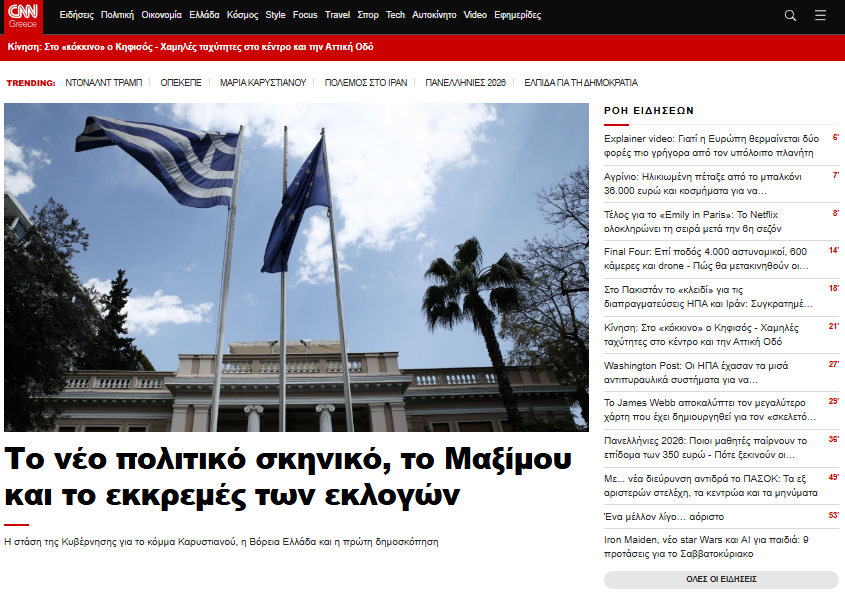

KATHIMERINI: The “map” of organized crime in Greece
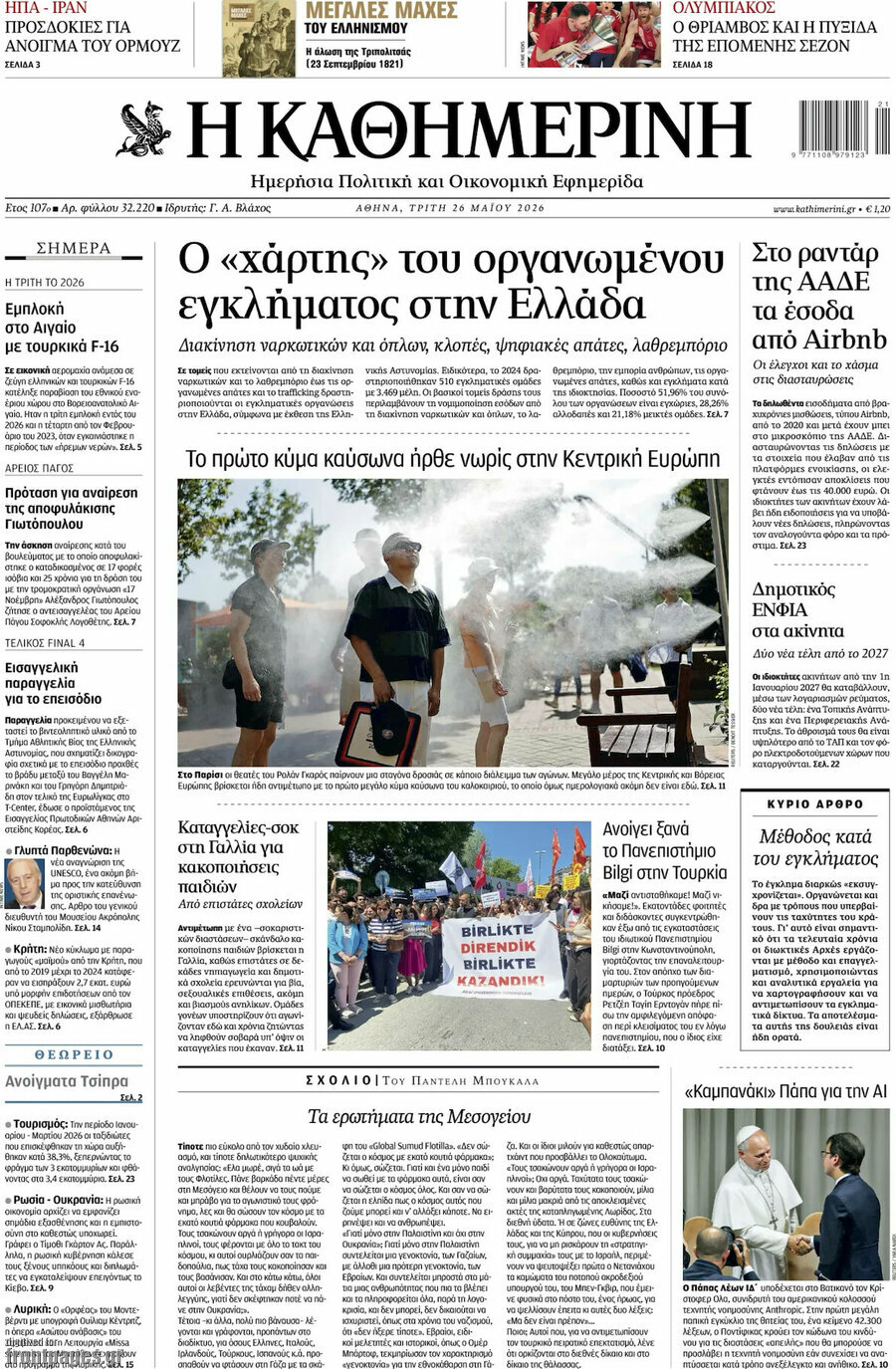
TA NEA: Controls and transparency are unknown words for the public sector
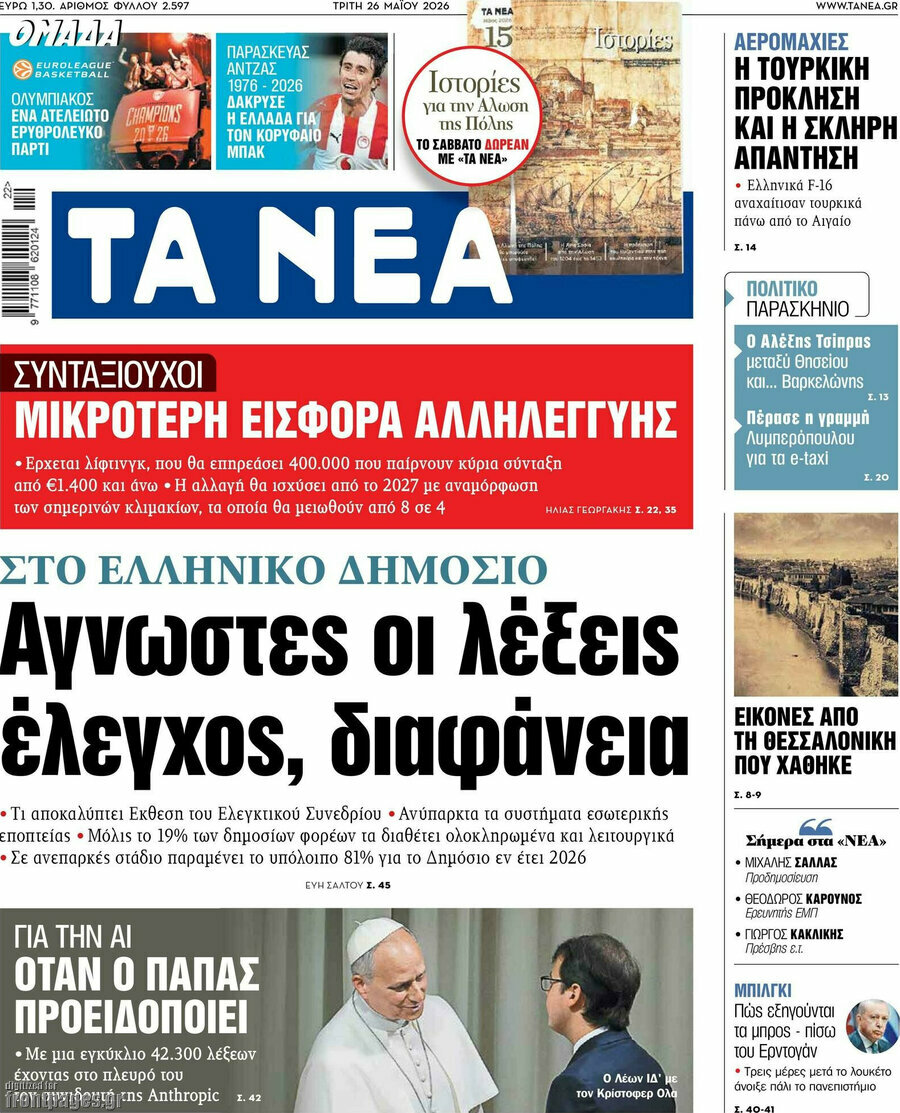
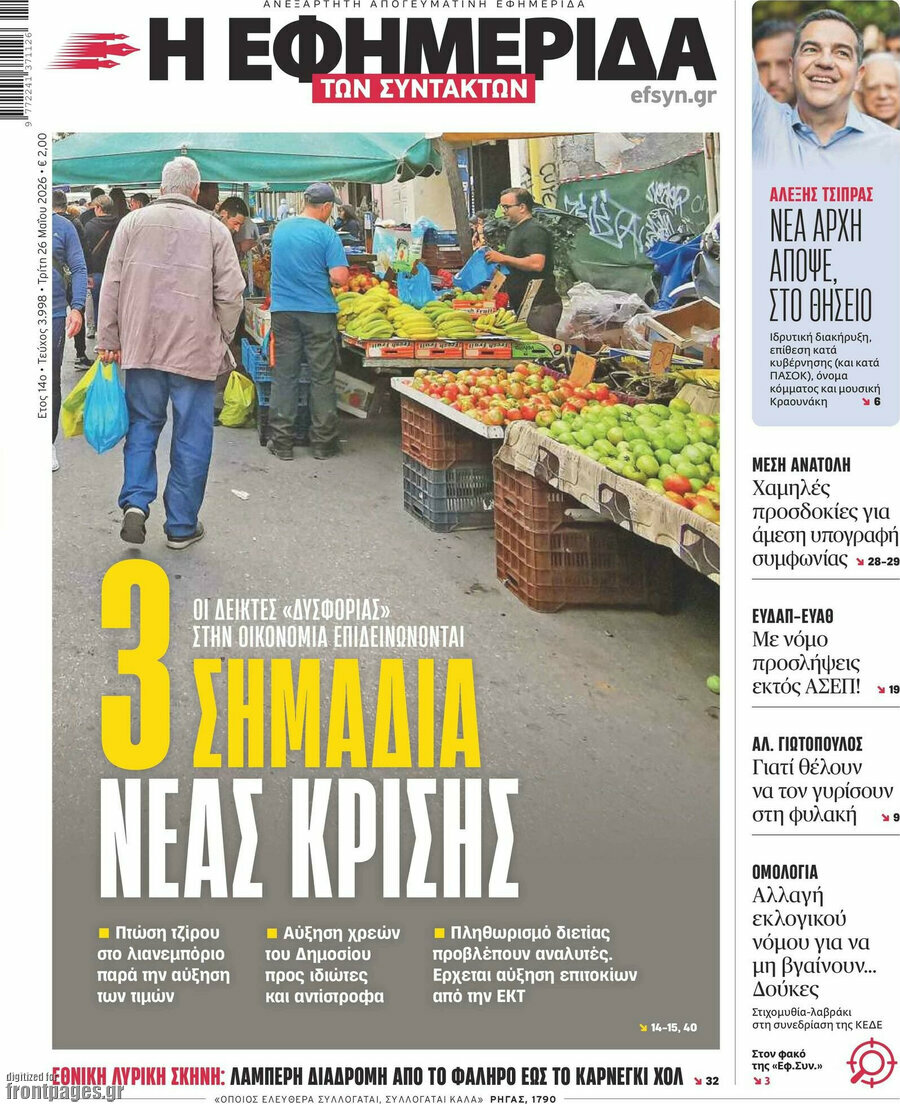
EFIMERIDA TON SYNTAKTON: 3 signs of a new crisis
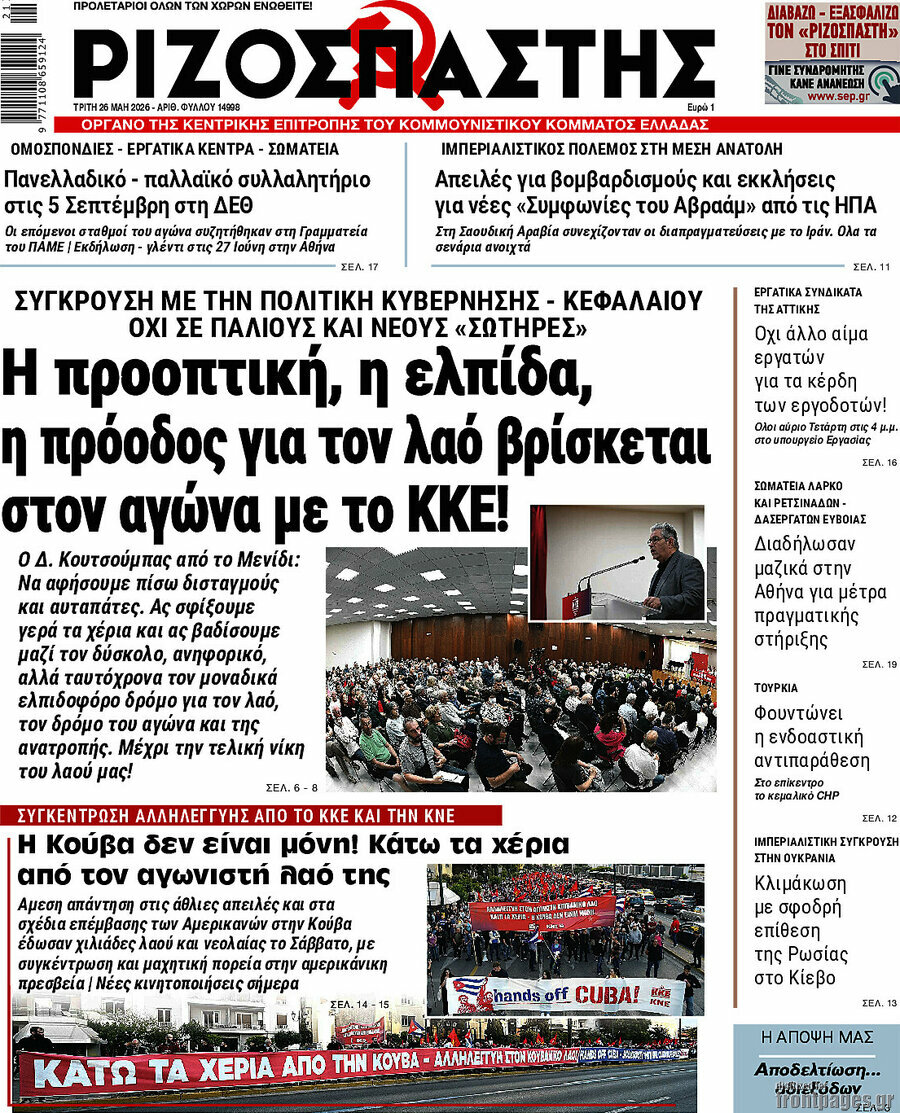
RIZOSPASTIS: The prospects, hope and progress of the people lie with the Greek Communist Party
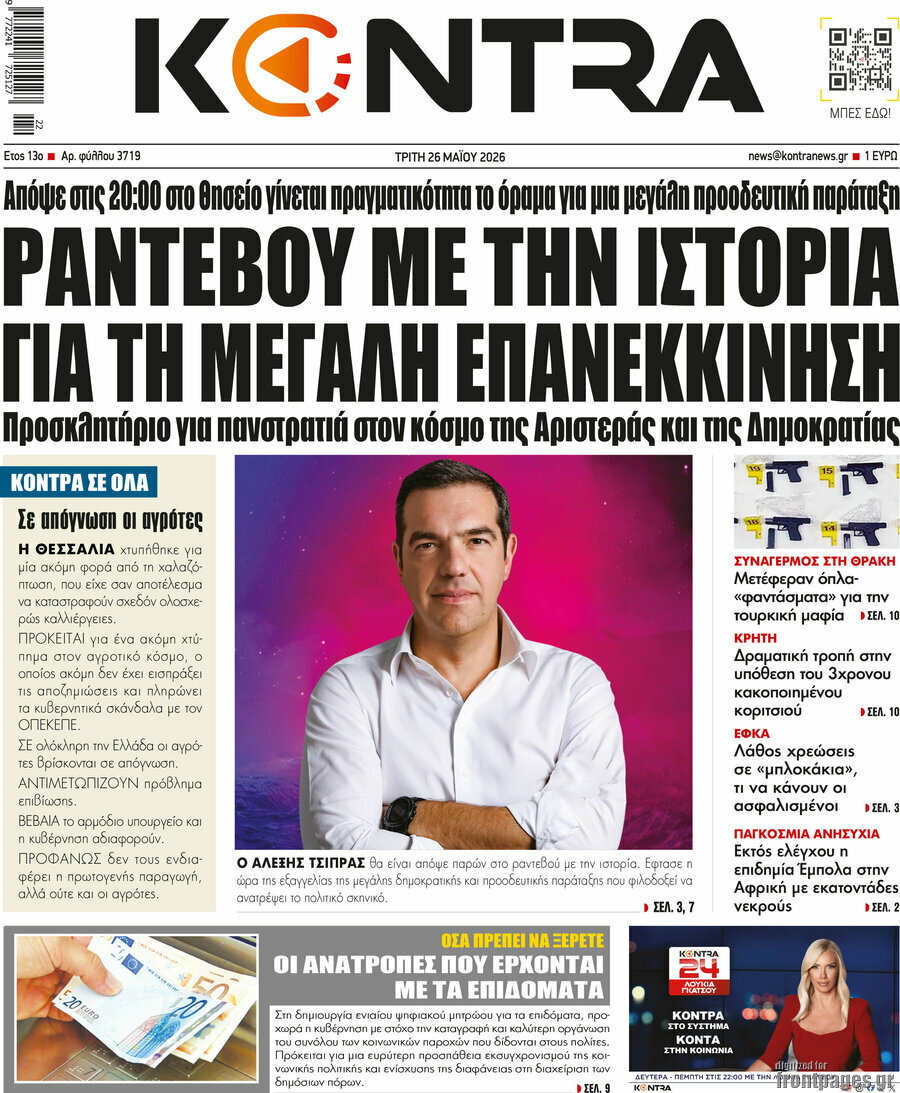
KONTRA NEWS: Rendezvous with history for a great restart
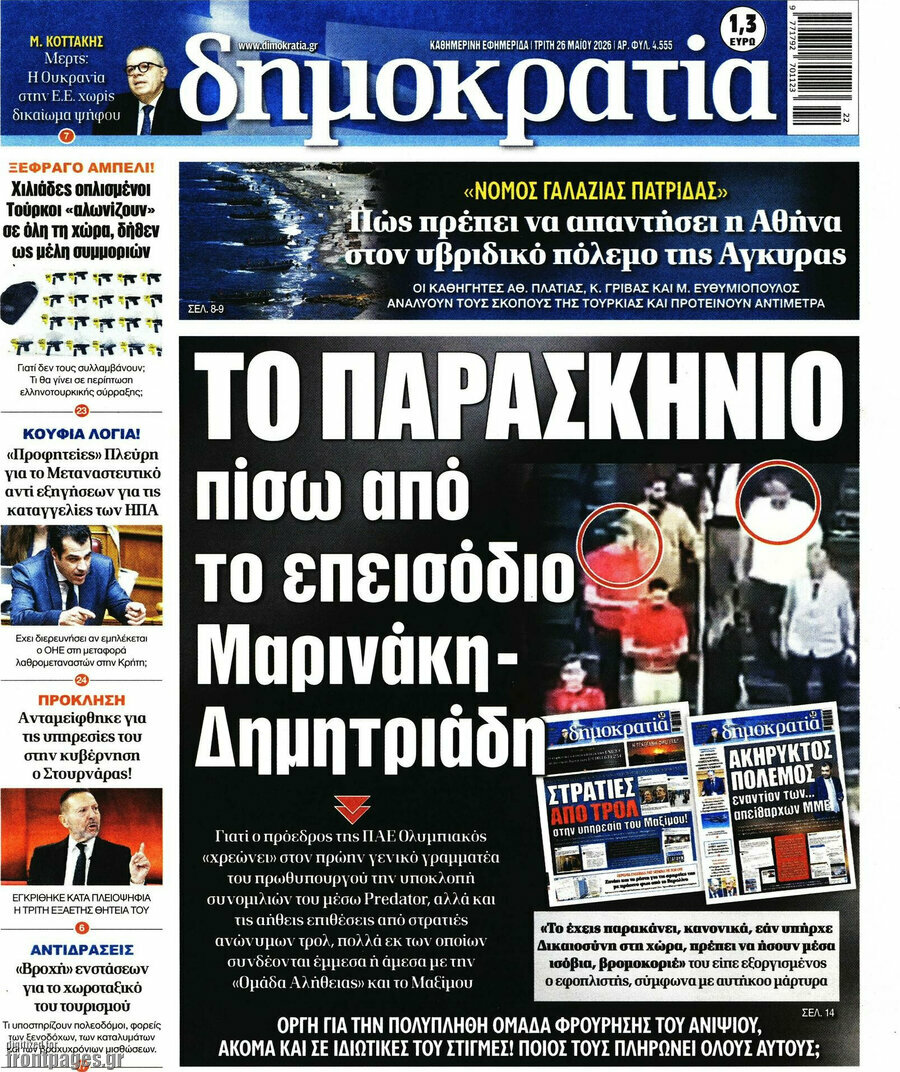
DIMOKRATIA: The backstage behind the heated incident between businessman Marinakis and the PM’s cousin and former associate Dimitriadis
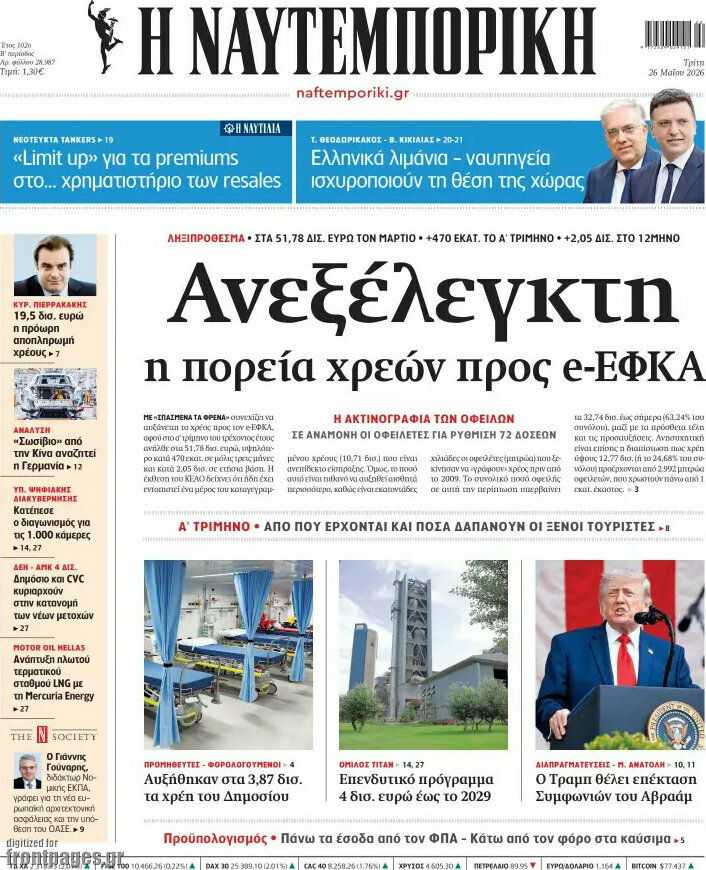
NAFTEMPORIKI: The course of debts owed to the unified social security fund e-EFKA is uncontrollable

DRIVING THE DAY
FRUGALS VS. “FRIENDS OF COHESION”: Wealthy EU countries are ramping up a campaign to shrink the size of a proposed €1.8 trillion long-term EU budget, gathering in Brussels today to align their positions ahead of high-stakes talks on the numbers.
Meanwhile, their opponents are hitting back. A group led by Romania called “Friends of Cohesion,” including more than a dozen countries, backed a statement Monday evening that calls for the EU to consider new “own resources” as well as joint borrowing to finance investments.
Countdown to a fight: The frugals’ breakfast meeting raises the stakes of upcoming talks on the budget, the Multiannual Financial Framework, especially given that France and Germany — Europe’s most populous countries — are expected to be present, Gabriel Gavin and Gregorio Sorgi report.
In the room: Ministers representing nine EU net contributors (countries that pay more into the budget than they receive) will try to align on how to convince the bloc that they won’t sign off on the deal unless their bills are reduced, said diplomats from four participating EU countries granted anonymity to discuss their plans.
Tell us how you really feel: “The volume needs to come down, substantially,” Swedish European Affairs Minister Jessica Rosencrantz told POLITICO ahead of the meeting. “There’s simply not any room for an increase of Sweden’s contribution, or any net contributor for that matter.”
Why now: EU governments will debate the MFF at a General Affairs Council today, laying out positions before Cyprus, which holds the EU’s rotating presidency, circulates a so-called NegoBox — a detailed breakdown of the proposed budget. That’s expected to circulate as early as June 10, two of the diplomats told Gabriel and Gregorio.
Cut till it hurts: The Netherlands will call on the EU to make “tough choices” in the new budget to make sure money is spent where it can “generate the greatest cross-border EU added value and impact.”
Why it’s a fight: The battle lines are now drawn between the “Friends of Cohesion” and the frugals, with tensions only due to rise in coming weeks as capitals crunch the numbers.
Then there’s the European Parliament, where lawmakers have threatened to delay the start of negotiations until 2027 unless the EU locks in spending for cohesion funds and to support farmers.
The bottom line: With the current MFF set to expire at the end of next year, European Council President António Costa told POLITICO last month that capitals have a “collective responsibility to reach an agreement by the end of the year,” arguing this was the only way to ensure a budget is up and running at the start of 2028.
BIG AND BREAKING
MIDDLE EAST LATEST: The U.S. military said last night it carried out “self-defense strikes” in southern Iran, including on missile launch sites and boats laying mines, even as peace negotiations between Washington and Tehran continued. POLITICO’s Jacob Wendler has the write-up.
BALTICS SEEK SHELTER: The Baltic countries are turning to Ukraine for expertise on bomb shelters.
DUTCH PUSH: The Netherlands is pushing ahead with plans to set up the first “return hubs” outside the EU.
BE CLEAR ON WATER USE: EU environment agency boss says tech companies must be transparent about the impact of AI data centers.
BRUSSELS TRUMPS NICOSIA: Influencer MEP Fidias Panayiotou picks the European Parliament over a return to Cyprus.
TECH PENALTY: The Commission is planning to hit Google’s parent company Alphabet with a fine in the “high hundreds of millions of euros” before the summer break for breaching the Digital Markets Act, Handelsblatt is reporting.
GIVE PEACE A CHANCE?
UKRAINE BACKERS DOUBT PEACE ENVOY PUSH: Top officials from countries close to Ukraine are pushing back against the idea of naming a European envoy for Russia-Ukraine peace talks, arguing that Vladimir Putin isn’t serious about a ceasefire and that naming an envoy could undermine efforts to pressure Russia via sanctions.
Harder than it looks: The calls to name a European to engage directly with Moscow have been growing louder as the United States steps back from its role as a Ukraine-Russia mediator. But EU countries are deeply divided over whether it’s a good idea.
Poland enters the chat: Polish Foreign Minister Radosław Sikorski told my colleague Zoya Sheftalovich at the GLOBSEC conference in Prague that Europe should be “careful” rushing to negotiate with Russia: “We don’t want to be seen by Ukraine as people who put pressure on them to make compromises.”
Baltic skepticism: The foreign ministers of Estonia and Lithuania both echoed that line over the weekend, warning of a potential “trap” from Putin to drag out talks and win concessions.
Why now: EU foreign ministers are due to discuss engaging directly with Russia at an informal gathering later this week, with chief EU diplomat Kaja Kallas also sounding skeptical about the idea.
And yet, more names: That hasn’t stopped advocates of direct talks from touting candidates. After Playbook mentioned former German Chancellor Angela Merkel, ex-ECB chief Mario Draghi and Finnish President Alexander Stubb as possibles, other names have surfaced. These include: António Costa, former Finnish President Sauli Niinistö and former European Commission President Jean-Claude Juncker.
Still available: Stubb reiterated his interest in the job over the weekend but said he would only step forward at the request of EU leaders and after a firm ceasefire was agreed.
The key thing: Europeans already bear the bulk of the financial burden for Ukraine’s war effort. Can they also act as mediators to end the war? Not for some countries.
EYES ON THE SKY: The head of Ukraine’s national security committee, Rustem Umerov, was in the Berlaymont for talks with von der Leyen’s head of cabinet Bjoern Seibert over defense industry cooperation on the eve of her trip to the Baltics, the Commission confirmed to Playbook.
20-SECOND PLAYBOOK PRIMER
Ukrainian President Volodymyr Zelenskyy rejected a German proposal to grant Ukraine associate membership in the EU (a category that doesn’t currently exist). But what would such an arrangement look like? German Chancellor Friedrich Merz suggested Ukrainian officials could take part in EU summits and ministerial meetings — but not vote in them. Ukraine could also have a non-voting associate European commissioner and non-voting representatives in the European Parliament.
TALK TO PLAYBOOK: On the Brussels Playbook Podcast, Zoya asked whether you think the EU’s budget should get bigger or smaller. WhatsApp us on +32 491 050629 and listen from 7 a.m. to hear if we give you a shoutout.
SECURING THE STRAIT
EU URGED TO GET INVOLVED: European countries should move quickly to help secure freedom of navigation in the Strait of Hormuz and not wait for a final U.S.-Iran ceasefire, a top UAE diplomatic official told POLITICO.
A group of European countries including the U.K. has pledged to help reopen the Strait, but only after a firm ceasefire between Iran and the U.S. Anwar Gargash, diplomatic adviser to the UAE president, urged European involvement to be “proactive, not post-conflict,” calling for concrete action before any final deal.
Brass tacks: Gargash said EU states should shift from “broad concepts to operational coordination” to allow ships safe passage. The strait has been largely cut off to commercial traffic for months, due to Iranian attack threats.
Carrot: “Europe needs to engage in collective maritime security and secure the free flow of energy and fertilizers from the strait, as it has a direct stake,” Gargash told POLITICO on the sidelines of the GLOBSEC conference in Prague. He added that there was potential for deeper cooperation with Europe on trade, technology and defense partnerships.
Not there yet: U.S. President Donald Trump signaled over the weekend that a deal with Tehran was nearly ready but warned negotiators early Monday not to “rush into” it. A major sticking point remains Iran’s nuclear ambitions, which may be handled in separate talks, according to U.S. media reports.
6 MORE THINGS GETTING US TALKING
BIENNALE BACK DOOR: How Russia’s return to the Venice Biennale reignited debate over Moscow’s place in Europe’s cultural institutions.
HIDDEN DATA: Why governments are storing citizens’ information outside their borders.
IDENTITY CRISIS: France’s far-right National Rally is offering contradictory messaging on the economy — much to its rivals’ delight.
SISTINE CHATBOT: The pope sets out an ambitious vision for regulating artificial intelligence.
SCOTTISH SCANDAL: Former Scottish National Party Chief Executive Peter Murrell, the ex-husband of former First Minister Nicola Sturgeon, has pleaded guilty to embezzling more than €464,000 from the party, Reuters reports.
FOOTBALL DIPLOMACY: Mexican President Claudia Sheinbaum said she has “no issue” with her country hosting Iran’s World Cup team, after FIFA confirmed its training base for the tournament had been moved from the U.S. to Tijuana.