
Androulakis critical of National Intelligence Service’s director during Parliamentary hearing over wiretappings, sources report
Main opposition PASOK-Movement for Change leader Nikos Androulakis accused the head of Greece’s National Intelligence Service (EYP) Themistoklis Demiris of “hypocrisy” and of damaging the country’s image and interests during a hearing before Parliament’s Special Permanent Committee on Institutions and Transparency, according to sources on Wednesday. Demiris had been summoned to a hearing before the Committee starting on Wednesday morning regarding the wiretapping scandal.
MPs, officials appearing before EU prosecutors in farm subsidy fraud probe
About 50 people are scheduled to begin appearing before investigators at the European Public Prosecutor’s Office in Athens on Thursday, as part of a widening investigation into suspect farm subsidies distributed in 2021 through the state payments agency OPEKEPE.
Greece condemns Israel over treatment of flotilla detainees
Greece’s Foreign Ministry on Wednesday condemned Israeli National Security Minister Itamar Ben-Gvir’s treatment of Greek citizens detained during the interception of the Global Sumud Flotilla, calling it “unacceptable and absolutely condemnable.”
Greece’s public debt falls to €400.5 bln in first quarter of 2026
Greece’s public debt declined to €400.5 billion at the end of the first quarter of 2026, compared to €406.5 billion at the end of 2025, according to figures released by the Public Debt Management Agency on Wednesday.
ATHEX: Buyers back in bourse driver’s seat
Stock selling dominated the start and finish of Wednesday’s session at the Euronext Athens bourse, but the action of buyers in between sufficed to revert the benchmark at Athinon Avenue to an upward course after three consecutive days of losses upon closing.
https://www.ekathimerini.com/economy/1304373/athex-buyers-back-in-bourse-drivers-seat



KATHIMERINI: They don’t even know who’s staying at the university dorms
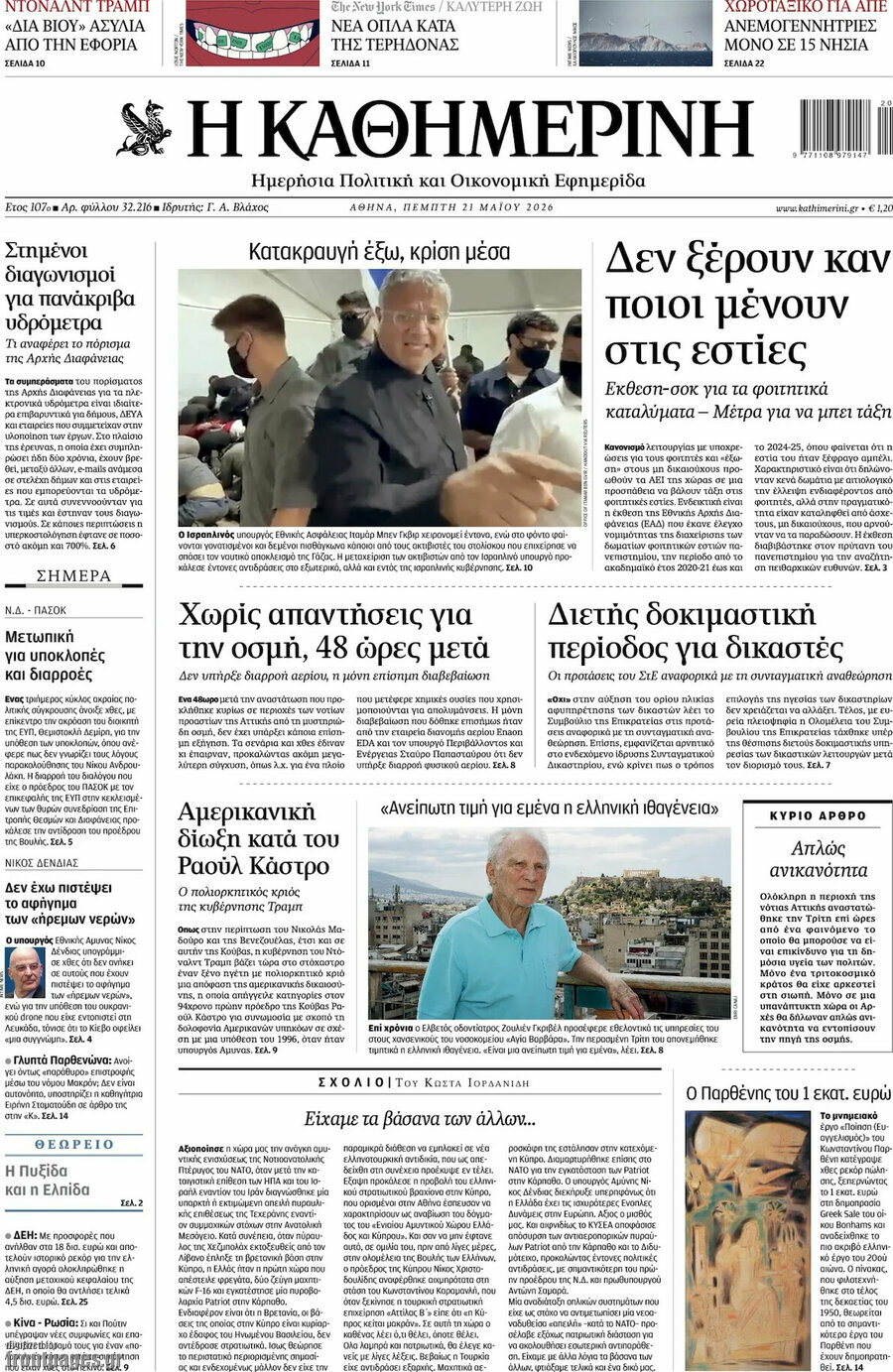
TA NEA: Foreign Affairs Minister in Albania on a special mission: Delineation of EEZ with Albania
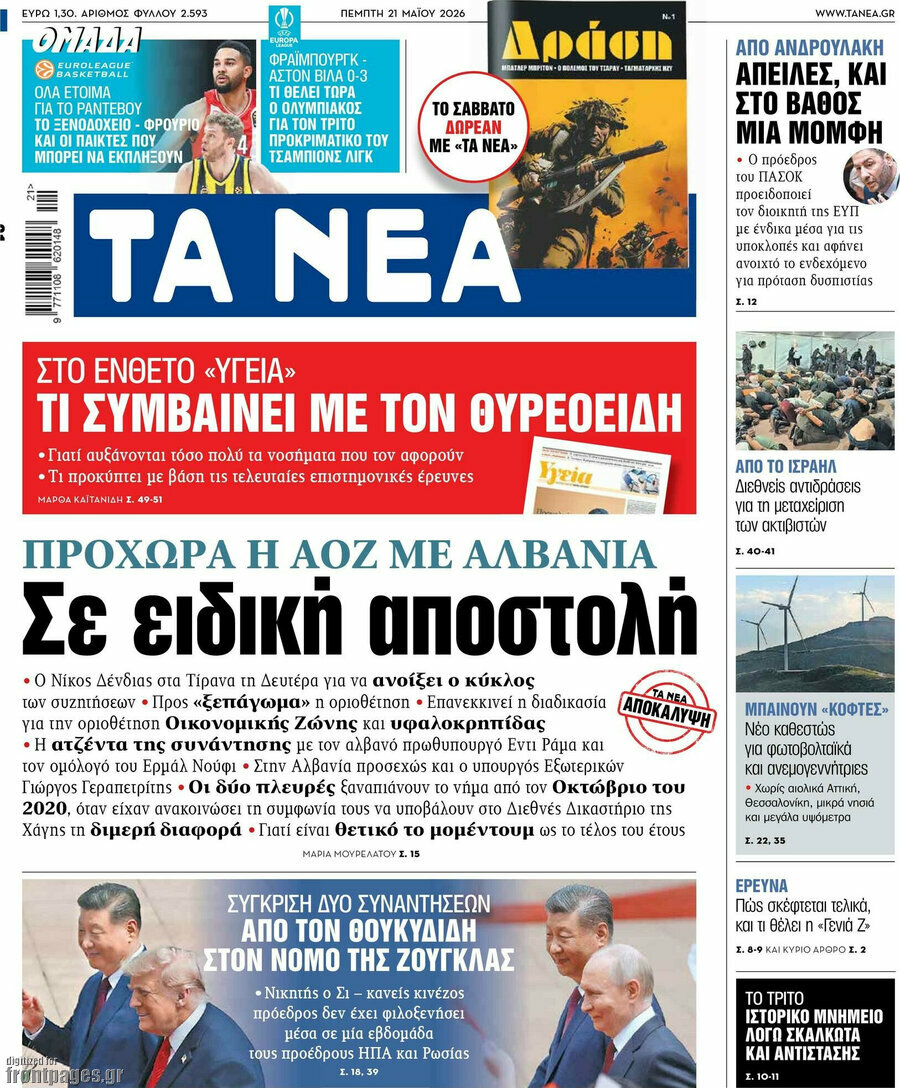
EFIMERIDA TON SYNTAKTON: Households are being auctioned through accelerated procedures
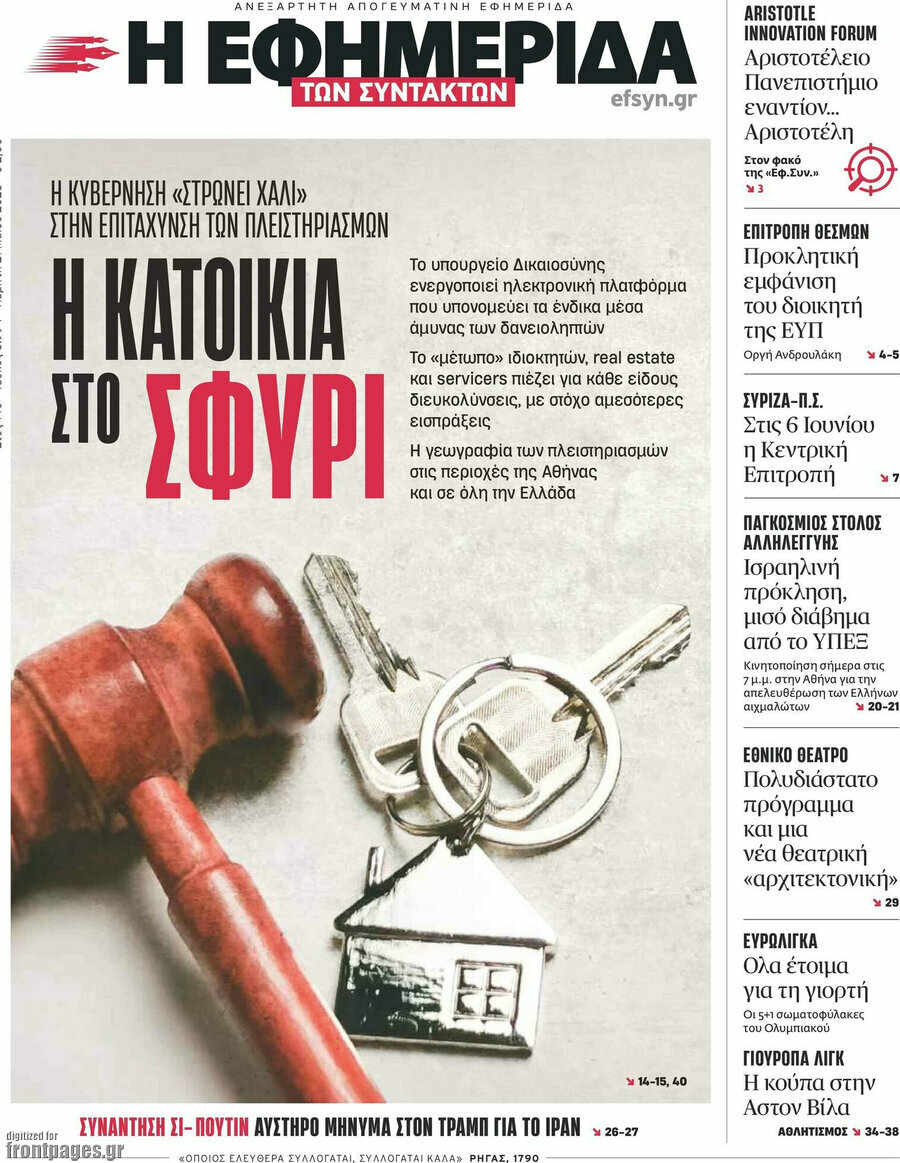
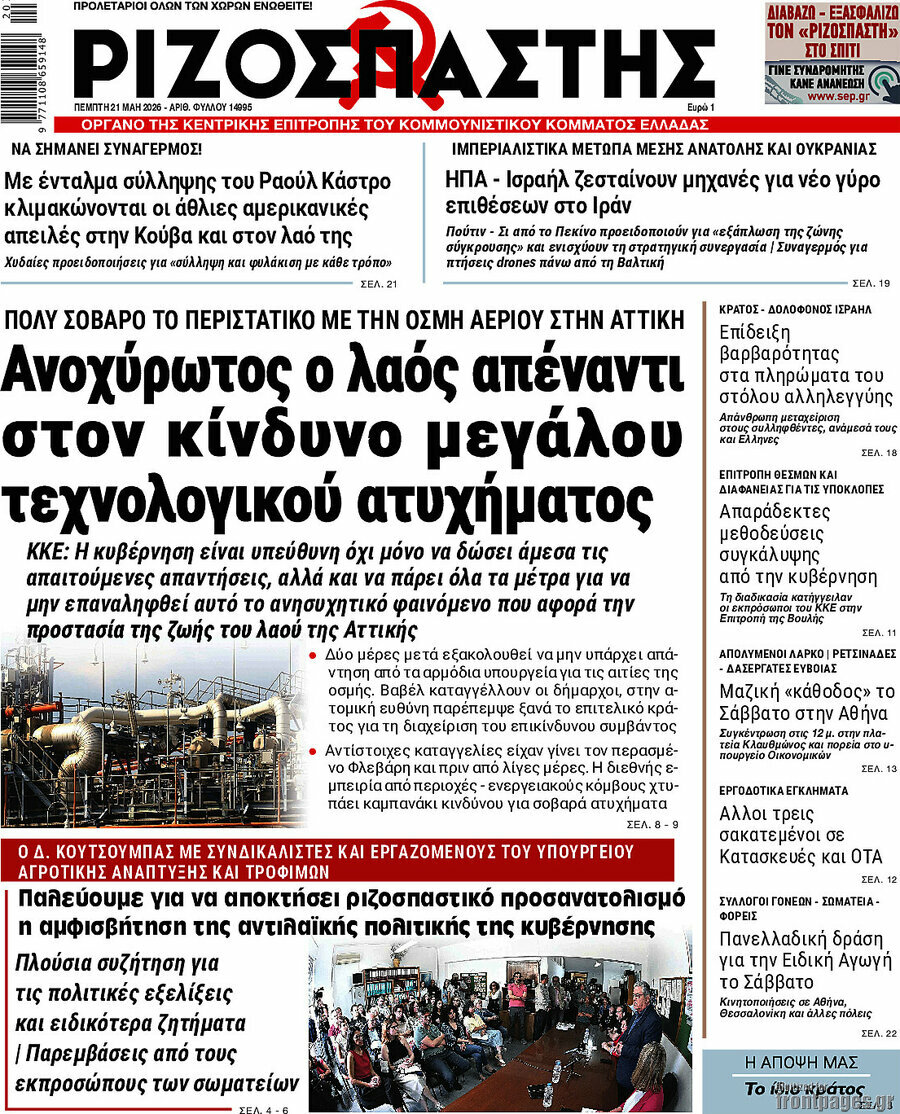
RIZOSPASTIS: The people are defenseless against the hazard of a large technological accident
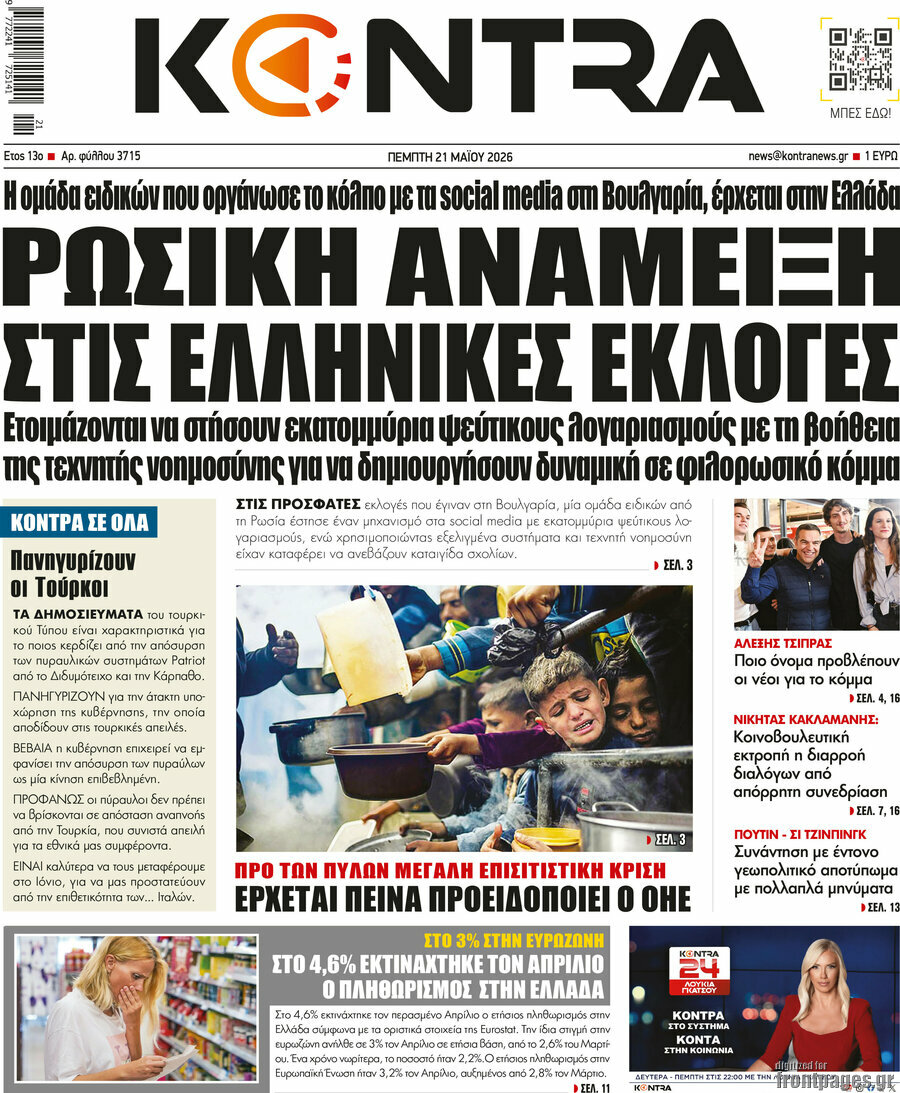
KONTRA NEWS: Russian involvement in the Greek elections
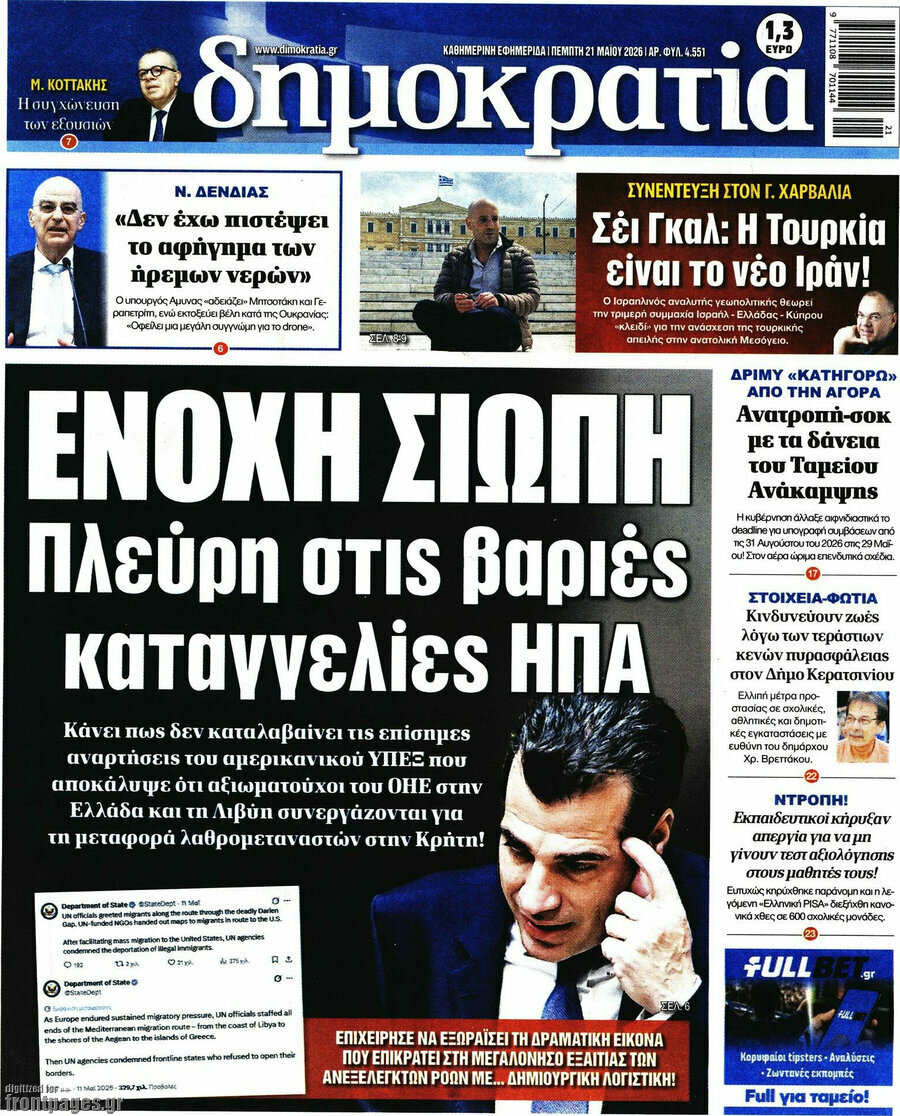
DIMOKRATIA: Guilty silence by Migration Minister Plevris regarding accusations from the USA
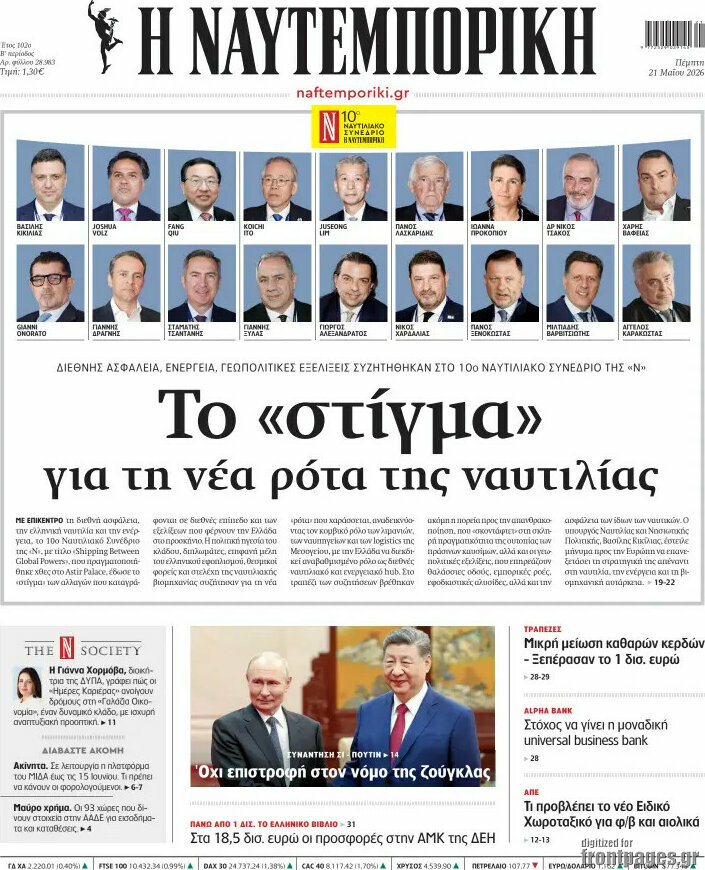
NAFTEMPORIKI: The map position for shipping’s new course

DRIVING THE DAY
THE PLOT THAT’S NOT: European Council President António Costa — the bloc’s most powerful Socialist — is on track to win reelection in six months, seven diplomats and two officials told Playbook. And the former Portuguese prime minister’s popularity with the capitals that appoint him could scupper European People’s Party chief Manfred Weber’s ambition to cement the center-right’s control over the EU institutions.
Power games are already underway ahead of the so-called midterm reshuffle, when the presidencies of the European Council and Parliament come up for renewal early next year. The jostling, which will define who steers the bloc at a time when it faces Russia’s war, U.S. trade pressure and economic challenges, is pitting Commission President Ursula von der Leyen’s coalition — which includes her EPP, the Socialists and the liberals — against itself.
Also up for reappointment is European Parliament President Roberta Metsola. The Maltese EPP politician is expected to seek a third term, despite convention dictating she hand over to a Socialist successor. Weber and Metsola’s allies have been warning center-left MEPs that any attempt to oust her would spark retaliation — including the EPP trying to boot out Costa in favor of its own candidate to maintain the balance of power.
Costa needs the green light from a majority of EU countries to secure another two and a half years at the helm of the Council. But more than a dozen governments told POLITICO that he has their backing and they expect him to be reappointed with little serious contest.
“We are quite happy,” said one envoy of Costa’s leadership. “He will make it,” said a second, praising his initiative to make EU leaders’ summits a single-day affair. Another EPP official said it would be “madness” to oust a “hardworking, respected and admired” Council president at a time of crisis. They said leaders, including those from the EPP, would be unlikely to “kill off” Costa. “Why make a leadership change unless something isn’t working? And Costa is working.” All were granted anonymity to discuss internal dynamics.
Let’s tread carefully: “Costa’s experience is an important asset for the governments in the Council. We can’t mix party politics with his function in this delicate moment for Europe,” Socialist lawmaker Brando Benifei told Playbook.
Not interested: Another blow toWeber’s plans is the fact the two most likely EPP candidates to challenge Costa have effectively ruled themselves out. Greek Prime Minister Kyriakos Mitsotakis and Croatian Prime Minister Andrej Plenković are both running for reelection back home.
Back to Parliament: Now the EPP will see what it can offer the Socialists to back Metsola, while the Socialists plan how to strong-arm the EPP into supporting a candidate of their own. The Socialists are yet to present a candidate.
SPEAKING OF WEBER: The EPP chief is having a tough week. My colleague Max Griera and I reported that his right-hand man, Tom Vandenkendelaere, is making a sudden exit to spend more time with his family. The veteran operative and former MEP leaves a major vacuum in Weber’s top team that they may struggle to fill.
BIG AND BREAKING
MERZ VS. THE CHINESE STEAMROLLER: The EU is betting that Berlin will have no choice but to finally drop its opposition to plans to squeeze trade with Beijing, amid public anger over industrial decline and economic stagnation.
FLOTILLA FALLOUT: Israeli PM Benjamin Netanyahu has sharply rebuked his National Security Minister Itamar Ben-Gvir for taunting activists who were detained while trying to breach the naval blockade of Gaza, the AP reports. Italian PM Giorgia Meloni demanded an apology for the treatment of Italian detainees, and Spanish PM Pedro Sánchez posted last night that he’ll push for Brussels to bar Ben-Gvir from entering the EU.
ALBANESE UNSANCTIONED: The U.S. has removed outspoken U.N. special rapporteur Francesca Albanese from its list of sanctioned individuals, according to the Treasury Department website — a week after a federal judge temporarily blocked the sanctions.
BALTIC CRISIS: Lithuanians were ordered to take shelter as stray drones continue to violate Baltic nations’ airspace as a consequence of Russia’s brutal war on Ukraine.
KALLAS OFFENDS COMMISSION
EXCLUSIVE — LATEST KALLAS-COMMISSION SPAT: The difficult relationship between the European Commission and EU foreign policy chief Kaja Kallas has taken a turn for the worse, with officials slapping her down for comments she made appearing to compare China’s trade practices to cancer.
On-record distancing from Kallas’ remarks: “This is not the position of the European Commission,” chief spokesperson Paula Pinho told Playbook.
Discontent: “You don’t say that as a diplomat,” said an official with knowledge of the response, granted anonymity to speak frankly about the icy nature of relations between Kallas and Ursula von der Leyen. “There are words you use to signal things but you don’t call countries a disease.”
Disgust: Five national governments complained to Brussels about Kallas’ remarks, the official said.
What Kallas said: Europe has “a very clear understanding of the diagnosis of the disease” when it comes to China, but does not have a remedy — suggesting Brussels could back “chemotherapy” and embrace painful measures to save its economy. It was at a conference in Estonia on Sunday.
A matter of protocol? While Kallas’ comments tally with the approach the EU is taking, with Brussels pushing forward bold new measures to tackle China’s market dominance, governments said the undiplomatic language is likely to provoke Beijing.
But Kallas’ allies show no signs of backing down: An EU official close to her told me that “everyone who watched the panel understood that [Kallas] spoke about the problem of EU-China trade imbalances, how they are destroying European production, and are causing job losses. She raises the alarm bells and the College [of Commissioners] debate soon will address the issue, because unfortunately our European response at this moment is insufficient — and this needs to change.”
20-SECOND PLAYBOOK PRIMER
Brussels is trying to agree a deal that would increase the number of failed asylum-seekers leaving the bloc. Many would end up inreturn hubs — detention facilities outside the EU, designed to hold people whose asylum applications have been refused or who have been ordered not to remain in the bloc for another reason. At the moment, people staying irregularly are usually allowed to remain until they are deported. EU countries need to sign an agreement with the country hosting the hubs, defining how people would be transferred there, plus the living conditions and lengths of stay.
TALK TO PLAYBOOK: On the Brussels Playbook Podcast, Zoya asked listeners in the Baltics and elsewhere to write in about their experiences with the recent drone activity. WhatsApp us on +32 491 050629 and listen from 7 a.m. to hear if we give you a shoutout.
MERZ PUSHES ON ENLARGEMENT
LARGER, FASTER: The EU is taking far too long to process membership bids from Ukraine and other hopefuls and urgently needs to pick up the pace, German Chancellor Friedrich Merz warns in a letter to top EU officials today, Nicholas Vinocur reports.
Clarion call: While Brussels reviews candidates’ applications, EU capitals must approve every step toward membership. Merz’s letter, addressed to the heads of the Commission, Council and Cyprus’ EU presidency, is really aimed at fellow leaders: Let’s get moving.
Look closer: Enlargement has slipped off the agenda at recent leaders’ summits and risks being overlooked again at the next European Council, said a senior German official granted anonymity to discuss the confidential diplomacy. A Western Balkans summit on June 5 should mark a “new dynamic,” the official said.
Ukraine is a special case: Merz says his proposal reflects Kyiv’s wartime circumstances and could help “facilitate the ongoing peace talks” with Russia.
EU perks galore: Merz floats an “associate member” status for Ukraine, giving Kyiv access to leaders’ summits, a non-voting Commission seat and non-voting MEPs. Western Balkan countries could get privileged single market access and observer status.
The bottom line: Berlin is taking up a leadership role on the highly charged topic, despite widespread fatigue and looming political, legal and technical hurdles.
MORE ON MERZ: Moscow is seizing its chance to exploit the chancellor’s plummeting popularity and boost his Russia-friendly rivals on the far right, James Angelos and Nette Nöstlinger report.
3 MORE THINGS GETTING US TALKING
SCOOP — WASHINGTON’S AI PUSH: The White House is preparing to issue an executive order as early as today asking tech companies to submit cutting-edge AI models for federal review, in a bid to tighten scrutiny and reduce the risks of catastrophic harm, my colleagues in D.C. report. Meanwhile, the Pentagon is launching a task force to speed up the adoption of the latest powerful AI tools in its cyber operations.
SPLITTING L’ATOMO: Giorgia Meloni wants to bring back Italy’s nuclear reactors, but she’s coming up against deep-seated public fears, Elena Giordano writes this morning.
PARIS PROBE: France has announced a probe into alleged evidence that an Israeli firm ran a disinformation campaign aimed at eroding support for local election candidates who were critical of the Israeli government.