
President Tassoulas in Evros: Greek-Turkish borders on land or sea are non-negotiable; Greece protects them absolutely
The President of the Hellenic Republic Constantine Tassoulas, visited Kipi in Evros, where he emphasised that “the Greek-Turkish borders, whether on land or at sea, are non-negotiable, and Greece protects them absolutely.”
A summer of tensions with Ankara?
The government is preparing for a likely tense summer with Turkey, if it proceeds with legislation codifying its territorial claims. Thus far, the intent to pursue the legislation had only been mentioned by leaks of unofficial consultation papers to Turkish media. On Thursday, Turkey’s Ministry of Defense officially confirmed the news in a statement saying that the draft law will define Turkey’s rights in maritime zones under its jurisdiction and will plug gaps in domestic legislation. The statement further says that the ministry had provided input through military, technical, academic and legal experts and noted that Turkish armed forces will protect Turkish rights with “unshakable determination.” Both Greek Foreign Minister George Gerapetritis and Defense Minister Nikos Dendias reacted to this statement.
https://www.ekathimerini.com/politics/foreign-policy/1303843/a-summer-of-tensions-with-ankara
Greece remains a top travel destination in 2026, according to new Travel Trends survey by Visa
Greece is holding fast to its position as one of the top travel destinations in 2026 according to the Travel Trends 2026 survey conducted by Visa, in collaboration with Ipsos and Payment Innovation Hub, among travelers who intend to visit Greece this year in the United States, United Kingdom, France and Germany.
Greece records OECD’s largest per capita income increase
Greece recorded the largest increase in real per capita household income, that is, income available for consumption or savings, among OECD countries in the fourth quarter of 2025, with a 3.3% rise compared with the previous quarter, according to data released on Wednesday by the Organization for Economic Cooperation and Development.
https://www.ekathimerini.com/economy/1303821/greece-records-oecds-largest-per-capita-income-increase
ATHEX: Banks and tech stocks boost index
Blue chips boosted the Greek stock market on Thursday, with banks and technology stocks securing significant gains, despite the decline in trading volume. This was in line with the historic highs that New York indexes S&P 500 and Nasdaq posted the previous day. However, there is no indication the local market will cease yo-yoing, as one day’s rise appears to be the next day’s drop, at least as long as the conflict persists in the Middle East.
https://www.ekathimerini.com/economy/1303832/athex-banks-and-tech-stocks-boost-index




KATHIMERINI: Athens expects a heated summer with Ankara
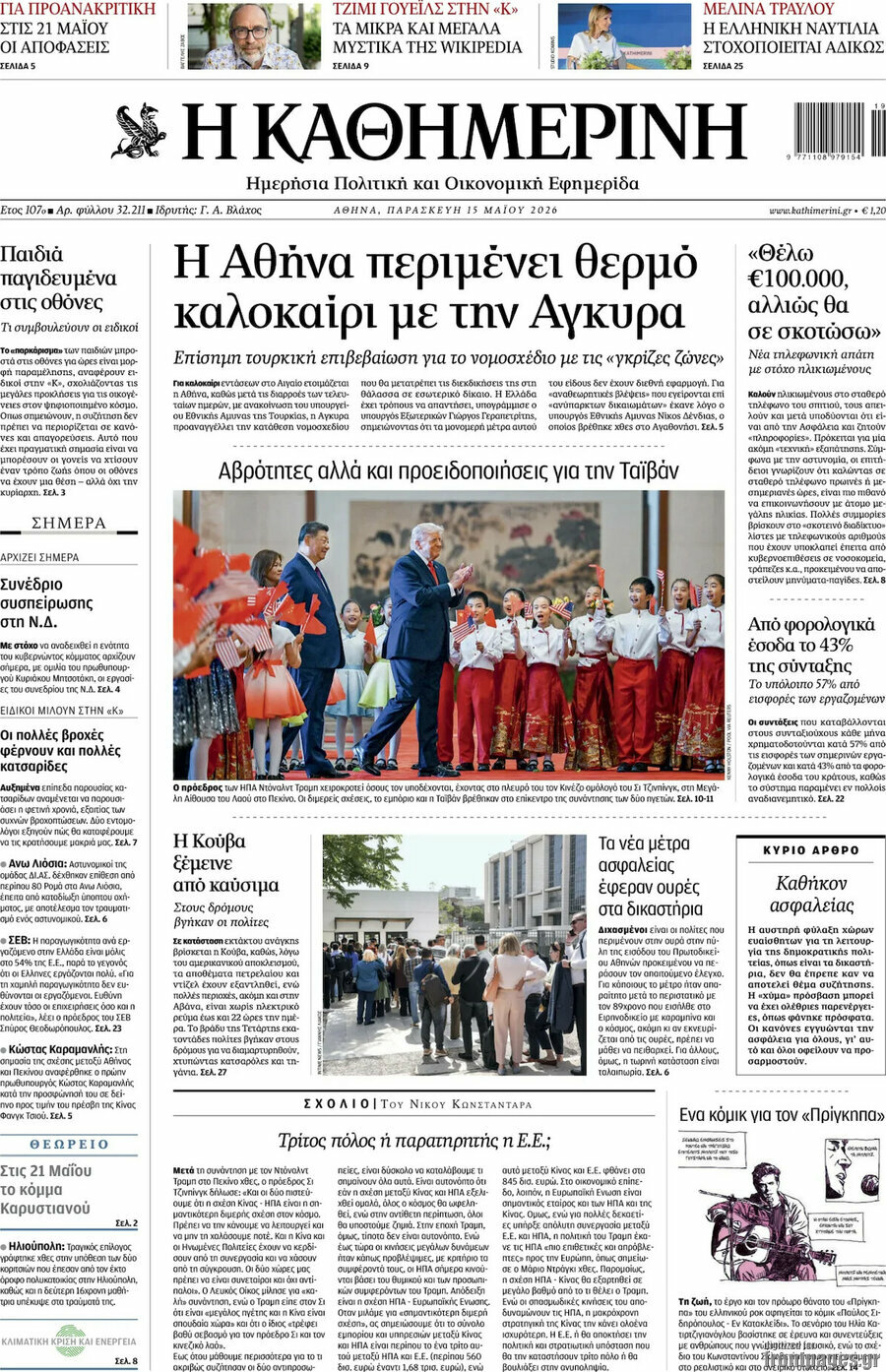
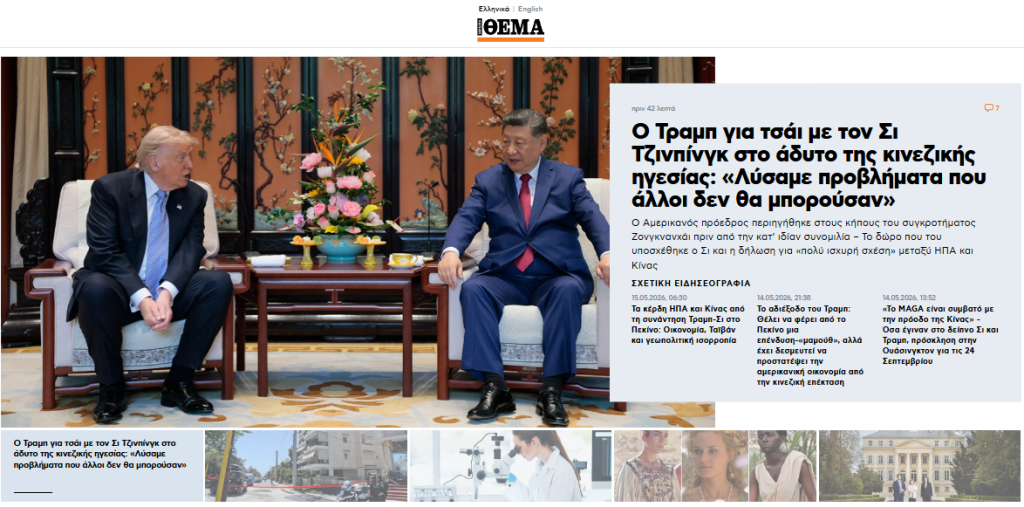
TA NEA: Thucydides, Trump and Xi
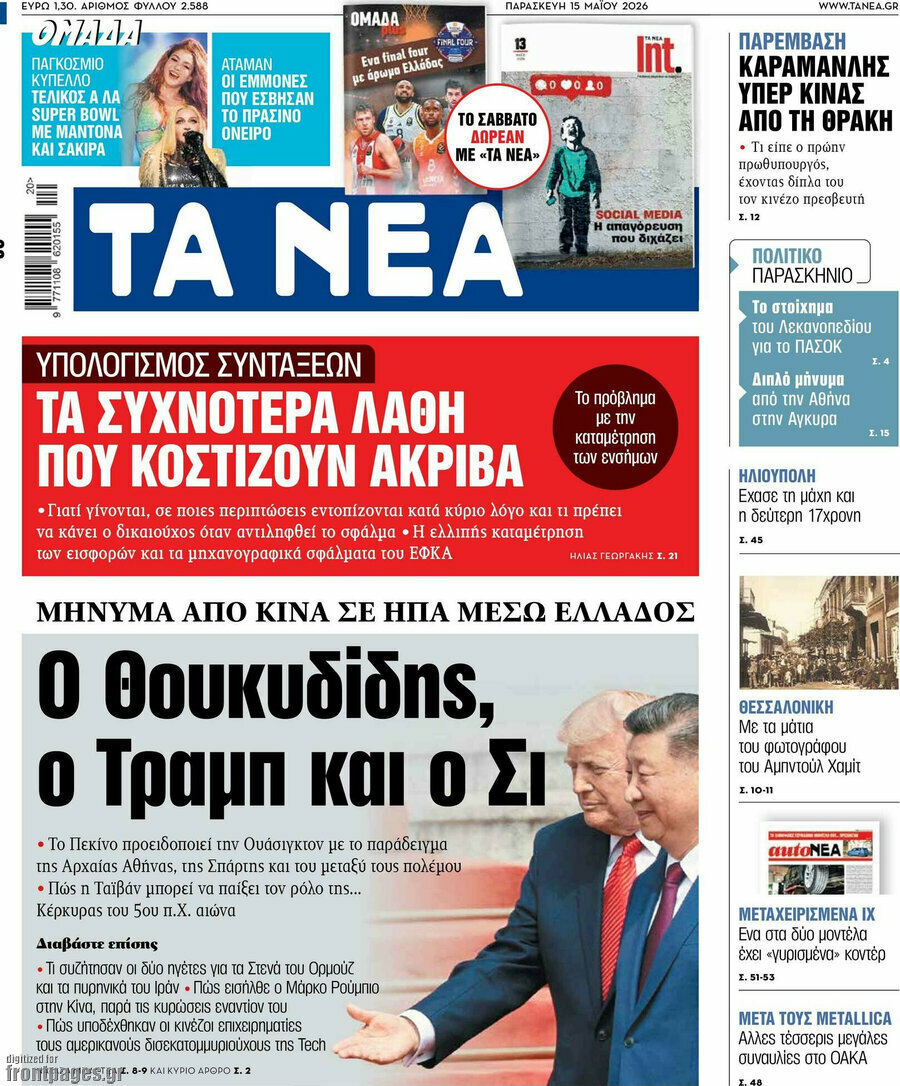
EFIMERIDA TON SYNTAKTON: The “caps” of university entry exams
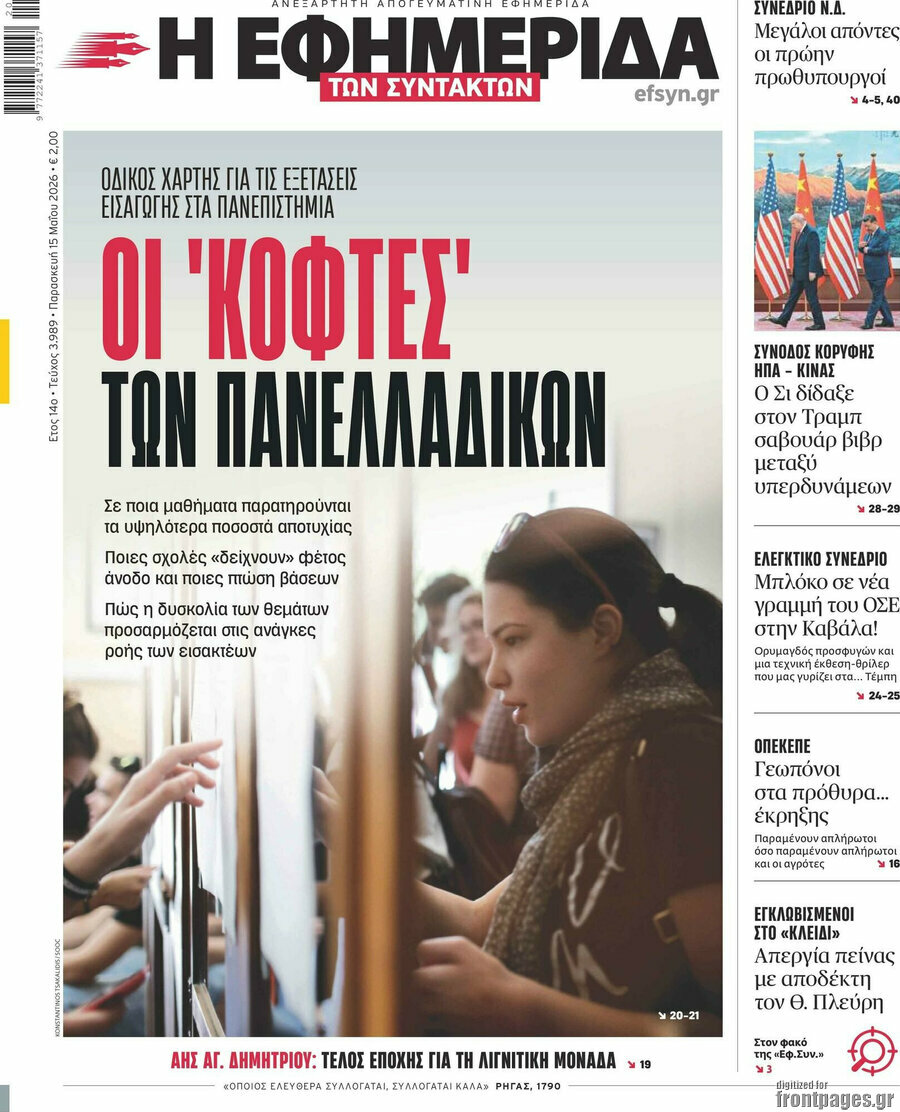
RIZOSPASTIS: Call for rallies against the imperialistic war and Greece’s involvement
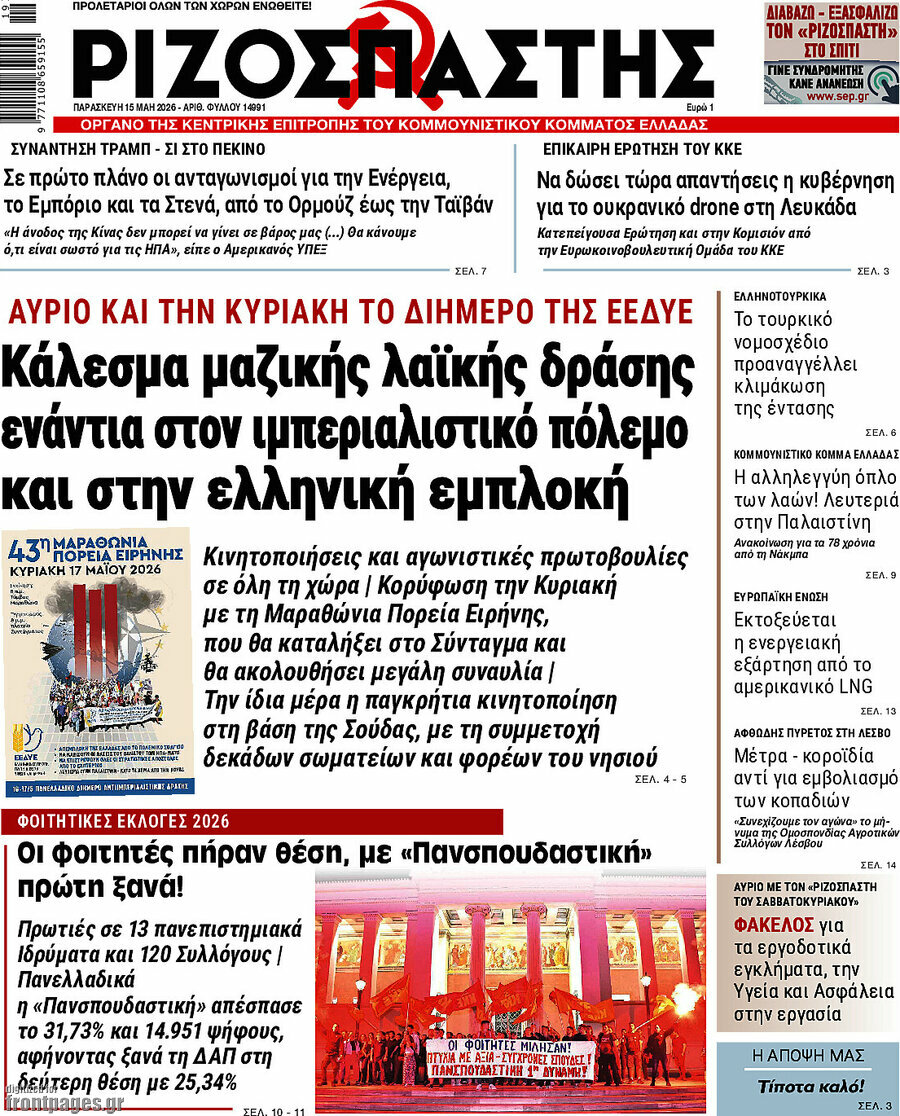
KONTRA NEWS: Androulakis is ethically compromised: You can’t be a party leader and also be involved in state procurement
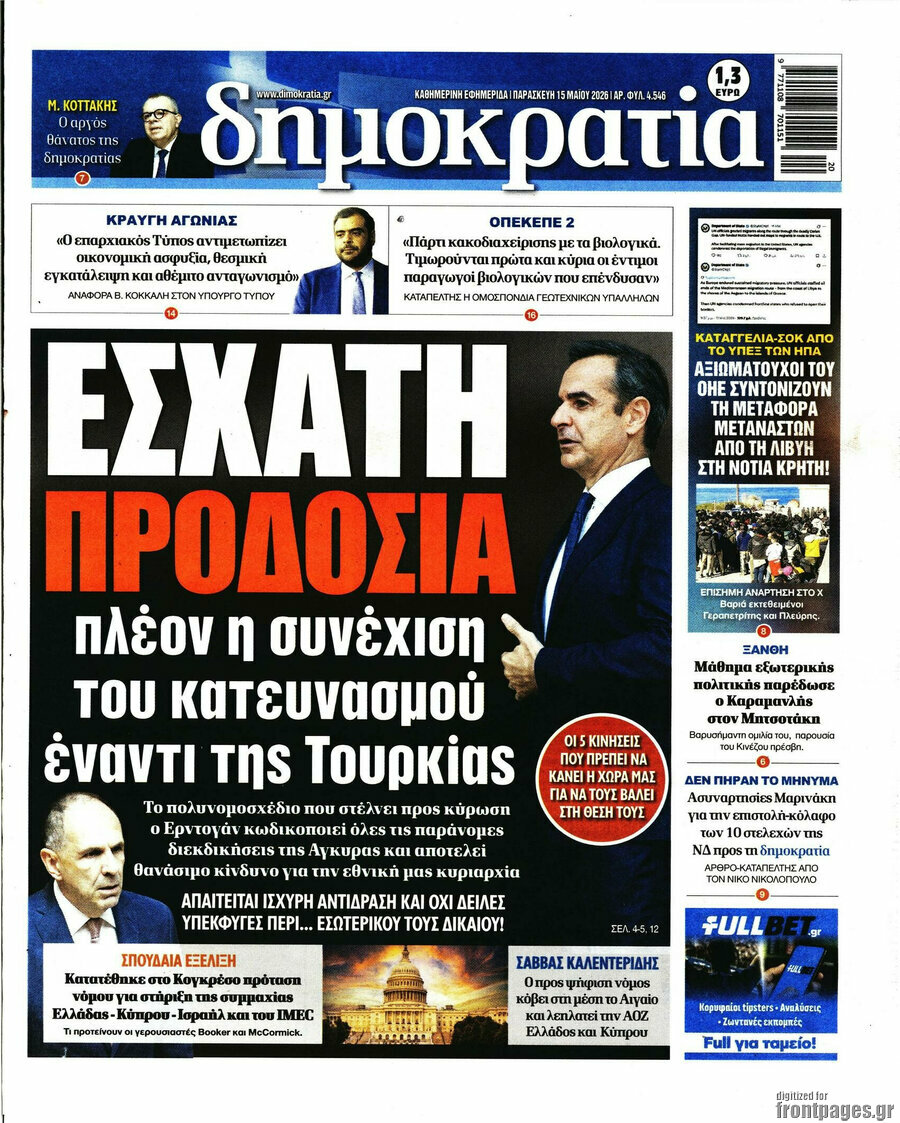
DIMOKRATIA: The continuation of the government’s appeasing policy towards Turkey equals treason
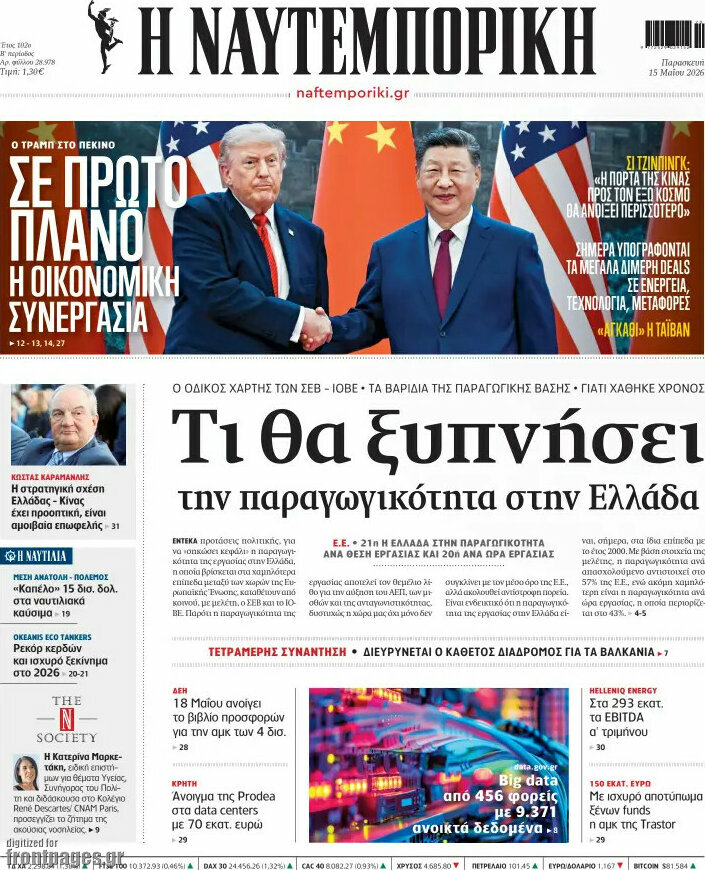
NAFTEMPORIKI: What will wake up Greece’s productivity

DRIVING THE DAY
ONE DG FADES, ANOTHER FLEXES? As Brussels buzzes about the possible demise of the European Commission’s historic regional policy department (more on that below), a much smaller DG attached to the president’s office is playing a broader operational role across the EU executive.
Meet DG IDEA: Formally, it is the Commission president’s in-house advisory service — a place for long-term thinking, strategic advice and, in the executive’s own words, “bold ideas.” Under Ursula von der Leyen, however, it appears to have become something more flexible: a small pool of officials close to the president who can be deployed across sensitive files.
Size doesn’t matter: IDEA is dwarfed by traditional powerhouses such as DG REGIO. It has around 25 staff and an administrative budget of just €265,000 for 2026, according to Commission records. But its proximity to the president gives it a different kind of weight.
The footprint: IDEA officials have appeared on files and missions far beyond classic long-term policy planning. When Mediterranean Commissioner Dubravka Šuica traveled to Washington for the launch of Donald Trump‘s Gaza Board of Peace, she was accompanied not by her chief of staff, but by IDEA official Toma Šutić. During work on the Industrial Accelerator Act, IDEA official Hauke Engel was assigned to support von der Leyen’s powerful chief of staff, Bjoern Seibert. More recently, two IDEA staffers — Maria Melchior and Jorge Fegert — were tapped to co-chair the Commission’s expert panel on protecting children online.
The bigger picture: The evolution of IDEA fits a broader pattern in von der Leyen’s Commission, where critics say decision-making has become increasingly centralized around the president, her cabinet and a tight circle of trusted advisers.
The official line: Commission spokesperson Balazs Ujvari told Playbook that DG IDEA is an advisory service with directorate general status, tasked with generating “bold ideas” and helping turn them “into concrete and bold actions.” He stressed that the Commission’s in-house think tank has “historically always” been attached to the president, with roots in the Jacques Delors-era Forward Studies Unit and Jean-Claude Juncker’s European Political Strategy Centre.
The shift: Internal records reviewed by POLITICO suggest that, under von der Leyen, IDEA now operates less like a classic think tank and more like a hybrid unit: part ideas shop, part presidential support structure and part reserve bench for trusted officials.
The internal view: “It’s kind of a special place,” said one former official who worked there. “On the one hand, it’s an extension of the president’s cabinet. On the other, it’s basically an internal think tank.”
And a bit of a mystery? Several Commission insiders POLITICO spoke to — granted anonymity to discuss internal matters — said they don’t fully understand what DG IDEA actually does. “Very strange — there are so many people there,” one official from another department said. A second was more direct: “I’m sure it was created with a purpose, but I don’t know what they do.”
The people: Its organization chart includes Philippe Lamberts, the former Greens leader who now heads IDEA, and his deputy Patricia Reilly, who also serves in von der Leyen’s cabinet. Other officials linked to the president’s team — including defense adviser Thomas Lunau and Irene Robles Ruiz, an aide to von der Leyen’s diplomatic adviser Simon Mordue — are also formally attached to the service.
Takeaway: IDEA is not large, and a presidential in-house think tank is not new. But its staffing patterns and recent deployments point to a service that now does more than generate ideas — and to a presidency able to project influence through small, trusted structures as well as traditional DGs.
BIG AND BREAKING
DISPATCH FROM BEIJING: Donald Trump and Xi Jinping were meeting at the Chinese Communist Party’s leadership compound for their final day of talks as Playbook prepared for publication. Trump said they “made some fantastic trade deals” and discussed ending the war in the Middle East, the Associated Press reports.
EXCLUSIVE — UKRAINE CASH DROP: Kyiv is on track to receive a fresh €9 billion payout from the EU loan program next month, with Brussels expected to rubber-stamp the terms as early as Monday.
BLINDSIDED: A last-minute decision by U.S. Defense Secretary Pete Hegseth to cancel the deployment of 4,000 American troops to Poland caught Pentagon staff and European allies by surprise — not for the first time.
UKRAINIAN DRONES TOPPLE LATVIAN PM: Evika Siliņa is resigning after coalition tensions exploded over two stray Ukrainian drones hitting Latvian oil facilities — bringing down her government in the process.
REGIO UNCERTAINTY
AFTERSHOCKS IN DG REGIO: The rumor mill around the possible restructuring (or even disappearance) of the Commission’s regional policy department, DG REGIO, has intensified since Playbook revealed the plan on Wednesday. Since then, the key players have already weighed in—publicly and privately.
“Unsettling to read”: Hours after our exclusive, DG REGIO chief Themis Christophidou sent an internal note to staff — which Playbook obtained. The email, titled “Addressing this morning’s media article,” aimed to tackle the issue “quickly and directly.” “I understand the article will be unsettling to read,” Christophidou wrote, seeking to reassure staff that their expertise remains “very much valued and needed.”
The real fear: For many officials — particularly contract agents — that’s the underlying question: will my job still exist? Much of the department’s expertise lies in managing and interpreting local and regional realities across Europe. A more investment-driven model would inevitably make that know-how less central.
Unusual admission: The note acknowledged leadership was “aware of the speculation circulating,” while stressing “no decision has been made” on the DG’s future. “You deserve to hear any significant news about your work and your futures from our institution — not from a news article,” it continues, in a candid acknowledgment of the communication vacuum surrounding the overhauling process.
Unsettling to hear (for me): After publication, I headed to a press conference with Commission Executive Vice President Raffaele Fitto expecting a denial. Surprisingly, he confirmed that a rethink of DG REGIO is underway, without ruling out the possibility that it could eventually disappear altogether. “Inside DG REGIO we are reflecting on the opportunity and possibility of creating a more efficient DG and identifying the right model,” Fitto said, sugarcoating it.
Anxiety spreading: “If this were true, it would mean the verdict had already been written before the trial even began,” Committee of the Regions President Kata Tüttő said. “Surely this could never happen in a democratic European Union.” Meanwhile, Parliament’s REGI Committee Chair Dragoş Benea declined to speculate, saying he would engage once formal proposals emerge.
20-SECOND PLAYBOOK PRIMER
What is Mythos and how worried should we be about it? It’s an AI model, developed by U.S. tech firm Anthropic, which has said Mythos outperformed most humans in finding and exploiting software glitches. Anthropic says it chose to shield the technology from wider use because it doesn’t want it to fall into the hands of hackers. European lawmakers and officials say they want to take a look at Mythos to judge the risks for themselves.
TALK TO PLAYBOOK: WhatsApp us on +32 491 050629 and listen from 7 a.m. to hear if we give you a shoutout.
EUROVISION PLAYLIST
DOUZE POINTS FROM EU LEADERS: It’s that time of year again … The Eurovision final takes place on Saturday. The contest has produced no shortage of political controversy — especially this year — but it’s also delivered plenty of great songs along the way. Which ones are EU leaders’ all-time favorites? We asked them.
The history book on the shelf: Ursula von der Leyen gave us three (yes, three) of her favorite Eurovision songs. “The most emblematic song has to be ‘Waterloo’ by ABBA in 1974,” the Commission president told Gabriel Gavin. “It’s more than just a Eurovision winner. It became part of European cultural heritage and launched one of the most iconic pop groups in history.”
Vous, qui cherchez l’étoile … The Eurovision song “that moves me the most is ‘Ne partez pas sans moi’ by Céline Dion, which won in 1988,” von der Leyen said. “What a voice, what emotion.”
Forever till the end of time … “From more recent entries, I think the energy in ‘Euphoria’ by Loreen in 2012 is unmatched,” von der Leyen added.
Em silêncio, amor … European Council President António Costa told Gabriel that his favorite ever Eurovision entry is Portugal’s 1974 song “E depois do adeus” by Paulo de Carvalho. While the tune failed to win the contest, it became the anthem for the country’s Carnation Revolution three weeks later.
Back to this year: POLITICO’s Ellen O’Regan is in Vienna for the Eurovision final, so stay with us for the news and inevitable political fallout.
4 MORE THINGS GETTING US TALKING
STARMER SHOWDOWN: The plot to oust British PM Keir Starmer is finally taking shape, with Greater Manchester Mayor Andy Burnham the frontrunner to replace him — if he can overcome one major obstacle.
BUNGA BUNGA STRIKES BACK: Giorgia Meloni’s justice ministry is being dragged into fresh turmoil as a Silvio Berlusconi-era scandal crawls back from the political graveyard.
MY WAR IS YOUR WAR: Former Trump national security adviser John Bolton argues in an exclusive interview that Iran is not just America’s fight, but Europe’s too.
THUS SPOKE DRAGHI: Receiving the International Charlemagne Prize yesterday, Mario Draghi delivered a bleak message to Europe in the Trump era: “We are truly alone together.”
BRUSSELS CORNER
WEATHER: High 12C, showers.
PALACE COUPS: The town might have emptied out for the long weekend but it will be business as usual next week — and our reviews of the top spots for a working lunch around the Schuman roundabout continue with an old, oft-forgotten classic. Gabriel Gavin writes in to recommend the brasserie at the Residence Palace, a convenient — if slightly forlorn — location for a quiet sit down.
Blast from the past: Just behind the Council off Rue de la Loi, this cavernous eatery on the ground floor of the conference center and office space feels a little like it is run by a catering company rather than as a restaurant. But that doesn’t stop top-tier officials from piling into the plastic chairs for a midday meal.
Over classics like croquettes, filet américain and fish and chips, you can get down to business or listen in to bubble-types discussing key files and skiing holidays. It’s a retro choice that survives on the prestige of its location, but still offers a decent lunch — and at just over €20 for a main, it’s not just the decor that’s reminiscent of a bygone era.