
Former president criticizes handling of wiretapping scandal
Recent developments in the wiretapping scandal have “dealt a crucial blow to the heart of the rule of law,” former Greek president Prokopis Pavlopoulos has said, in comments sharply critical of the government and the justice system. Speaking at an event in Athens organized by the Union of Greek Constitutional Scholars and the Administrative Chamber of Greece, Pavlopoulos said the “blow” stemmed both from the executive branch – “and to be precise, the government” – and, “unfortunately, from manipulations within the justice system itself.”
Mitsotakis defends ‘executive state’ model against ND critics
Prime Minister Kyriakos Mitsotakis used a cabinet meeting to defend Greece’s “executive state” model and push back against criticism from within his governing party, according to government officials and remarks cited on Wednesday.
Turkey outlines plans for pipeline in occupied northern Cyprus
Turkish Energy Minister Alparslan Bayraktar said plans are under way to develop a natural gas pipeline project in the Turkish-occupied northern Cyprus, while reiterating that Turkey continues its exploration activities in the Eastern Mediterranean.
Greece, Qatar agree to deepen cooperation as leaders discuss Middle East tensions
The war in Iran and broader developments in the Middle East were the focus of talks Wednesday between Greek Prime Minister Kyriakos Mitsotakis and Qatar’s Emir Sheikh Tamim bin Hamad Al Thani at the Maximos Mansion, the Greek government said.
ATHEX: Turnover at lowest level this year
Wednesday’s bourse session at Athinon Avenue confirmed that the local stock market has lost its momentum due to the war in the Middle East, and traders are not willing to take any risks now given the volatility of markets and the geopolitical uncertainty. Most indexes and stocks headed lower, and only mid-caps notched minor gains. The benchmark narrowly managed to sustain the 2,200-point level, while daily turnover dropped to its lowest point in 2026.
https://www.ekathimerini.com/economy/1302407/athex-turnover-at-lowest-level-this-year




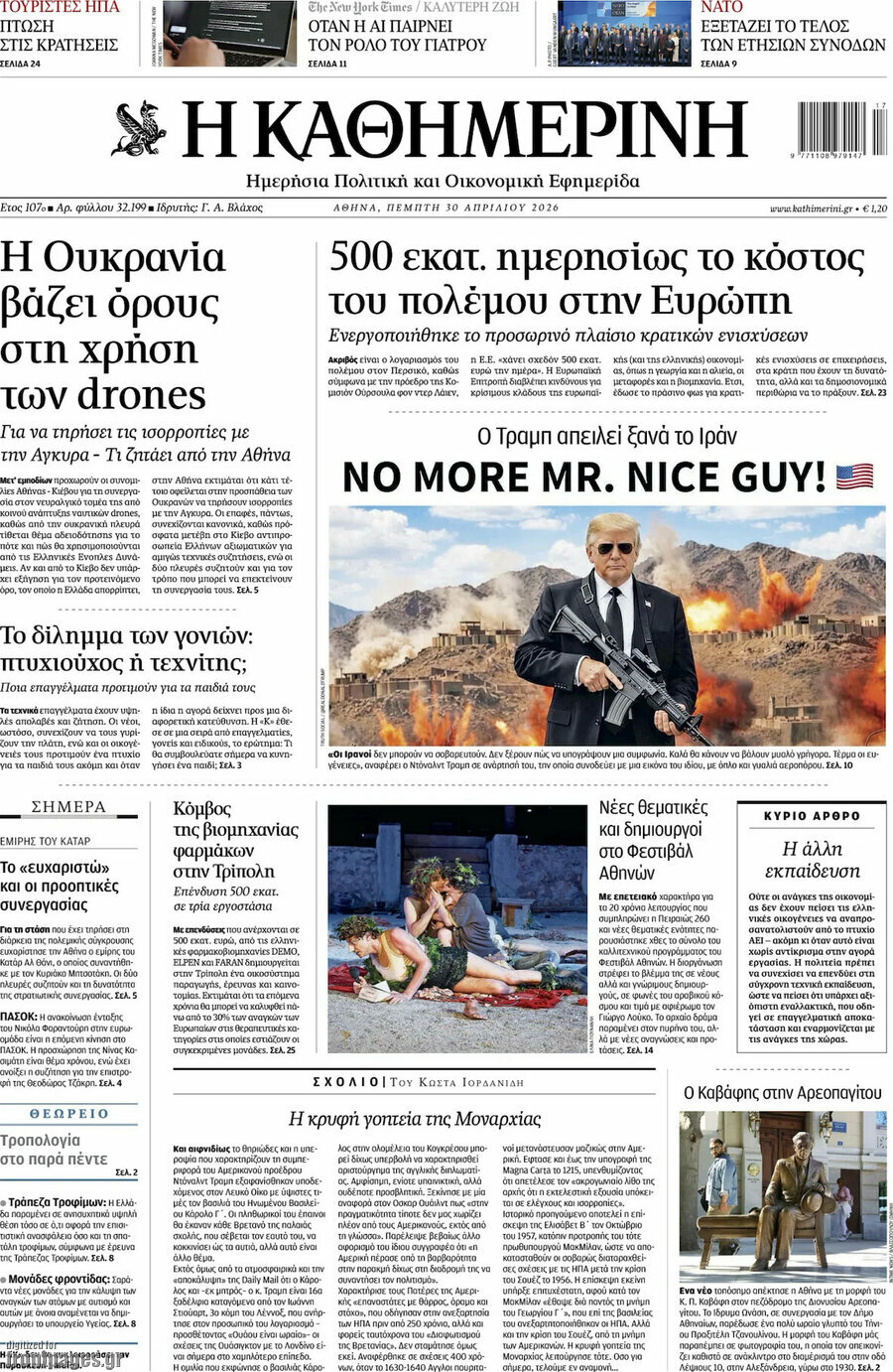
KATHIMERINI: The cost of the war for Europe amounts to 500 million daily
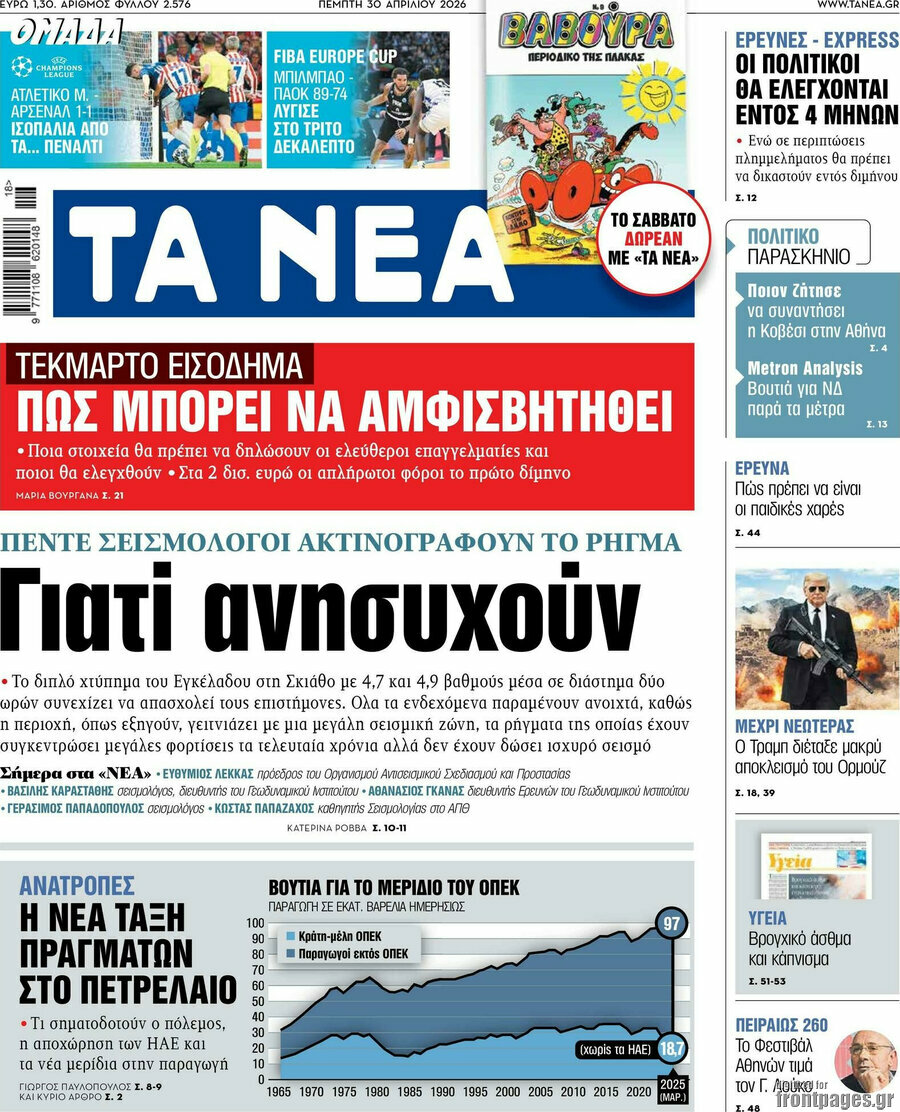
TA NEA: 5 seismologists worried
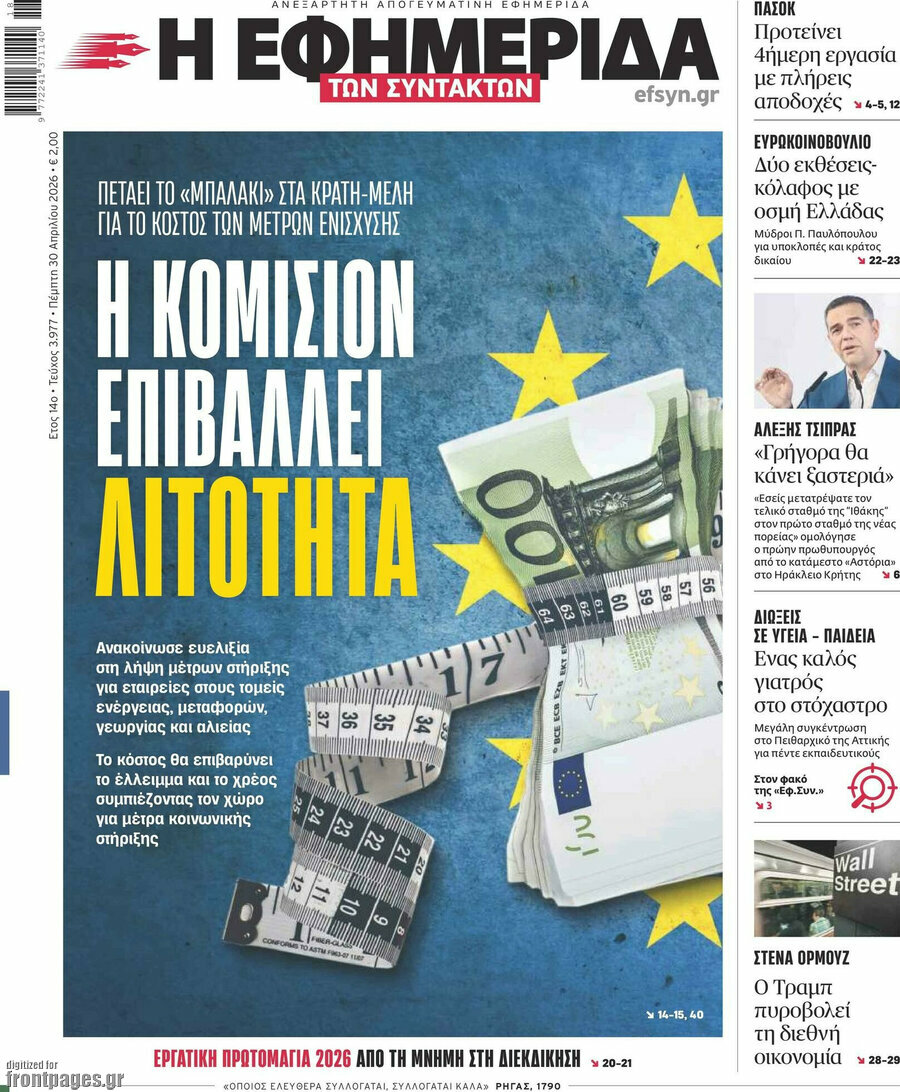
EFIMERIDA TON SYNTAKTON: EU Commission imposes austerity
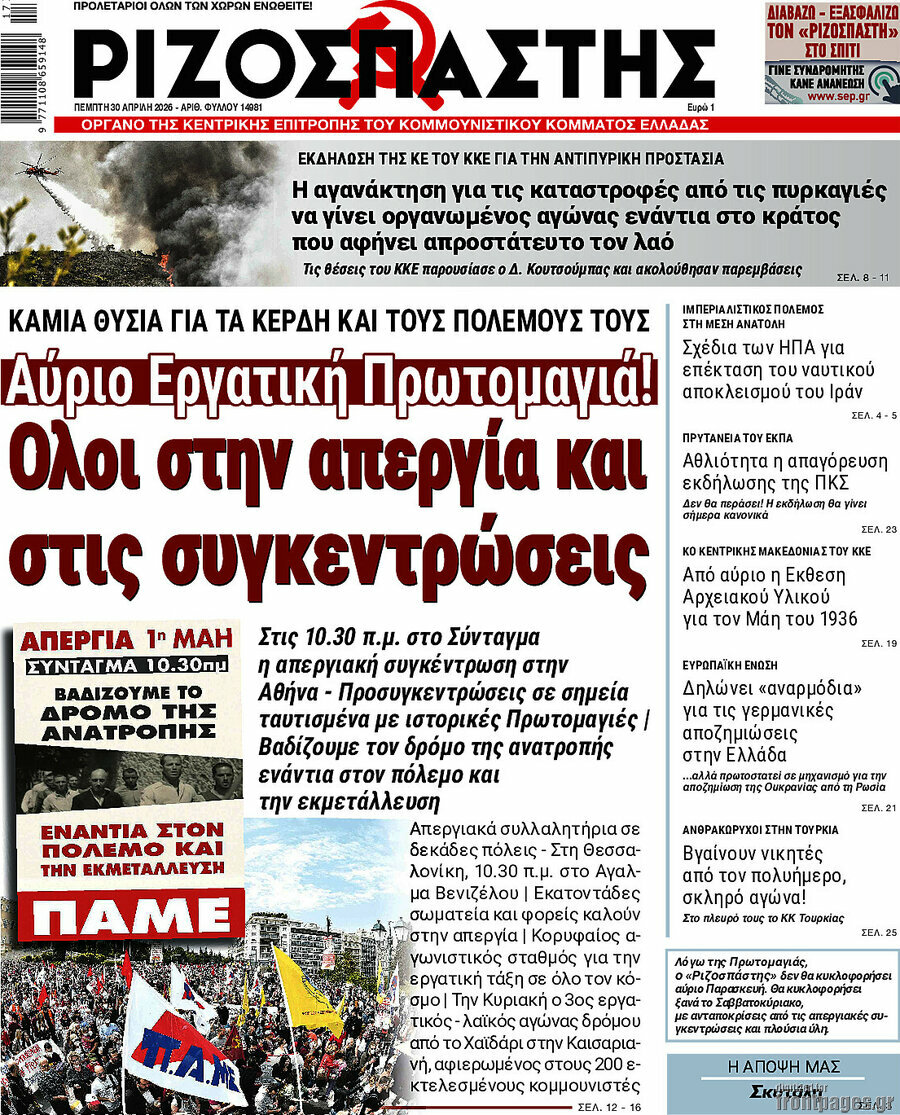
RIZOSPASTIS: Everybody join May 1st strike and rallies!
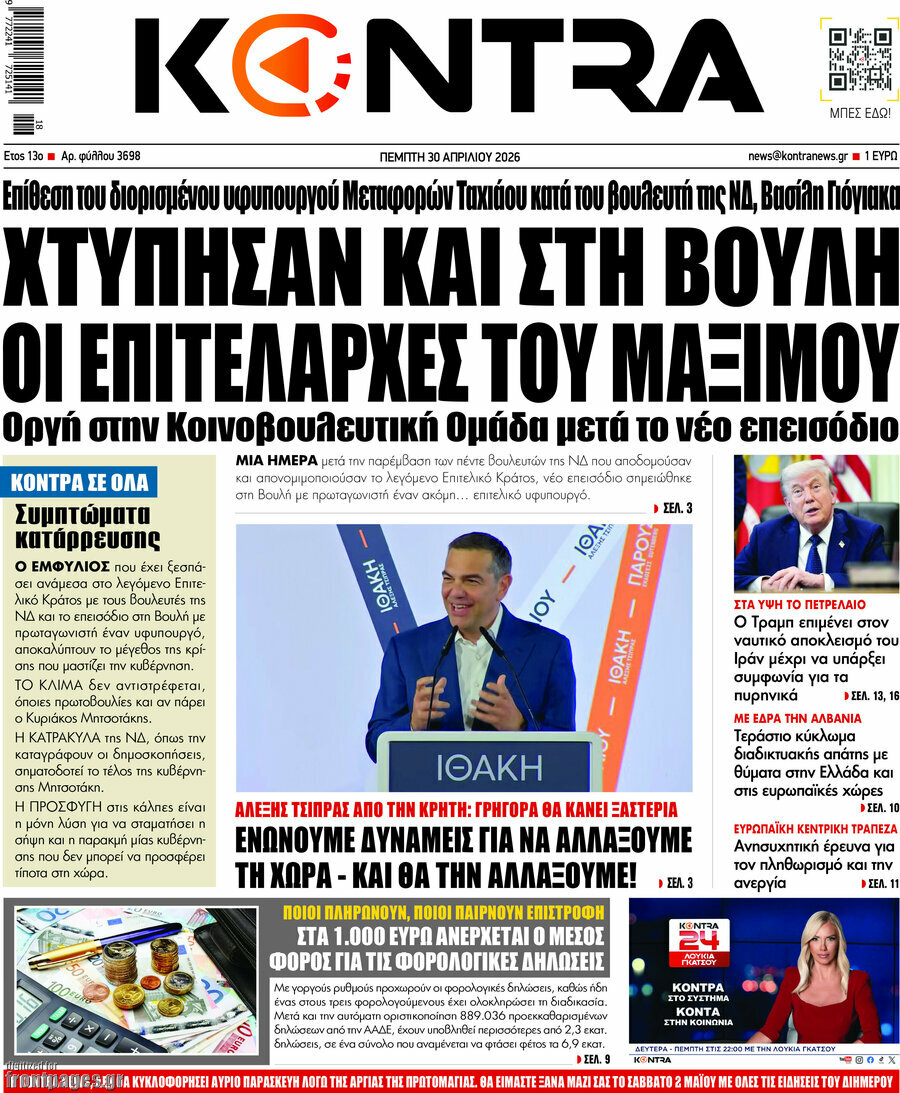
KONTRA NEWS: Maximos Mansion executives deal blow in parliament as well
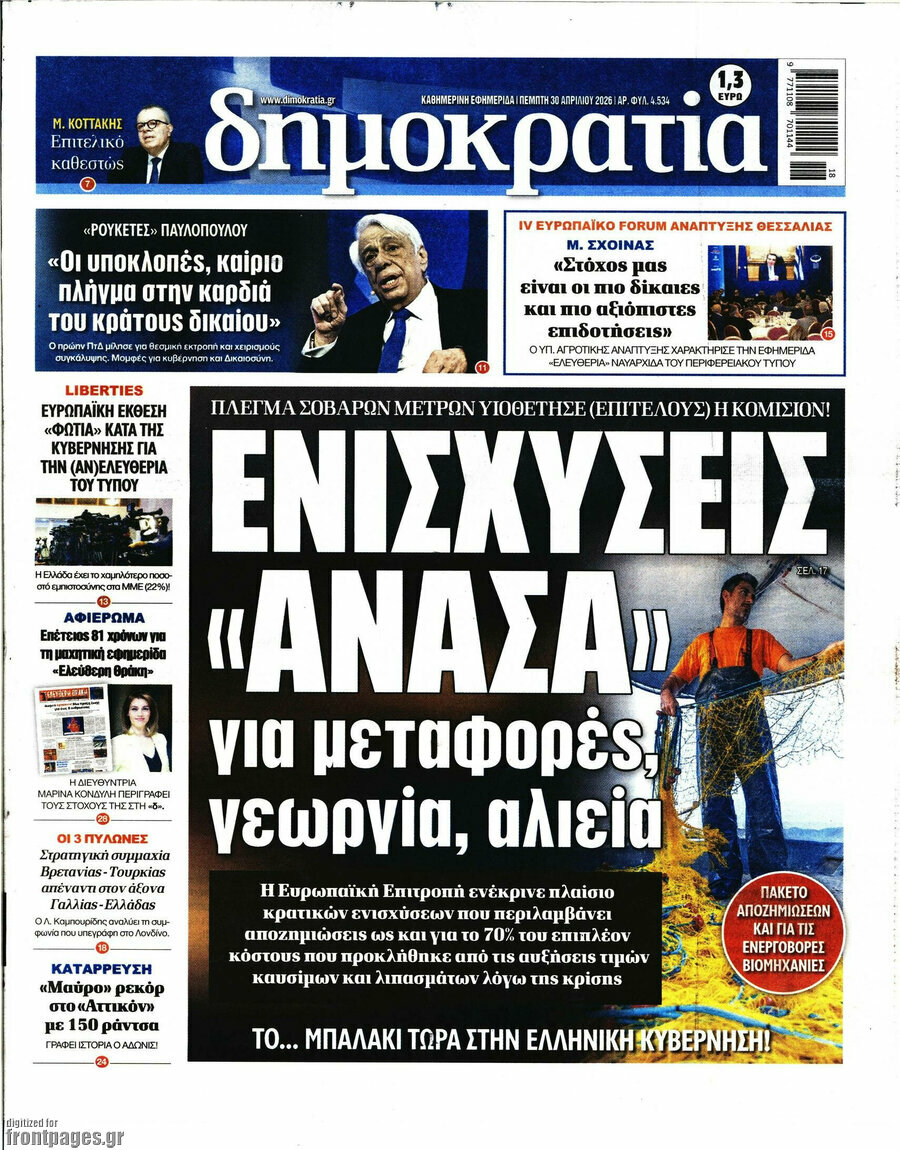
DIMOKRATIA: EU Commission: Lifesaving support for transport, agriculture and fishery
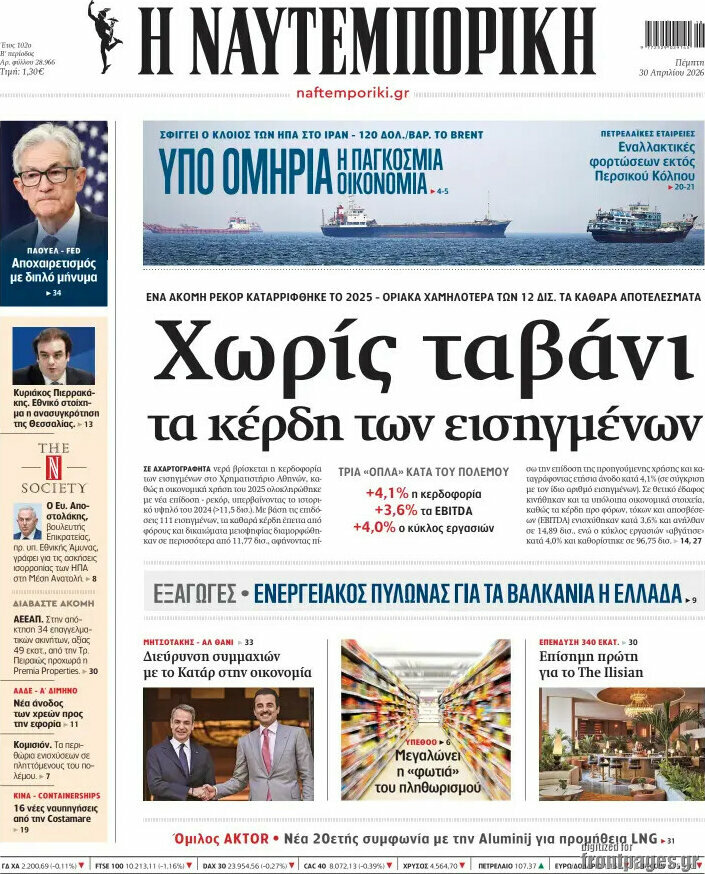
NAFTEMPORIKI: No ceiling for listed companies’ profits

DRIVING THE DAY
COSTA ON THE SPOT: A group of center-left European mayors descends on Brussels today with an uncomfortable message for one of their own.
Rome’s Roberto Gualtieri, Barcelona’s Jaume Collboni and Paris’ former mayor Anne Hidalgo will demand action on the continent’s housing crisis — and they want European Council President António Costa, the EU’s most prominent socialist, to step up. It’s a test of Costa’s progressive credentials on a core issue for the left.
Nearly 17 months in, Costa gets solid marks from EU leaders for his handling of the institutional side of the job. They seem to like him. He doesn’t step on their toes. They appreciate his push for shorter summits, where ambassadors draft and leaders discuss. But some in Costa’s own political family are less convinced that he’s using the position to advance their most pressing priorities.
Expectations were high: Costa is the first socialist to lead the European Council, and the first from his political family to hold one of the EU’s top jobs since David Sassoli. Yet many on the left remain underwhelmed. And with a reappointment process looming in less than a year, Costa can’t afford to disappoint the political family expected to back him again.
Two weeks ago, I was at the Global Progressive Mobilisation, a major rally in Barcelona, where frustration in the socialist camp was palpable. “I don’t know what happened, but that person is not Costa,” said one European socialist party official granted anonymity to speak freely.
That perception wasn’t helped by Costa’s last-minute withdrawal from the rally. Officially, he pulled out for “personal reasons,” though the fact that the event had taken on a distinct anti-Trump vibe may have felt like a political step too far for a president hesitant to stray from his institutional lane.
The recurring critique I heard there: Costa isn’t doing badly, but he’s not distinguishing himself either. Some pointed to his close alignment with Commission President Ursula von der Leyen — including joint messages on X — and warned that he’s in danger of being crowded out by a centrist narrative driven by the European People’s Party.
Costa will get a chance to show where he stands when he meets the Mayors for Housing Alliance this afternoon, with a press conference to follow at 3:15 p.m. Maria del Mar Jiménez Carreté, Barcelona’s EU affairs commissioner and a key architect of the alliance, told Playbook ahead of the meeting that the mayors want EU leaders to treat housing as a full-blown crisis.
Carreté believes that Costa, as a former Lisbon mayor, gets the scale of the problem. But cities want him to go further — to put housing firmly on national leaders’ agendas and push governments to give mayors more money and powers to tackle the crisis locally.
Momentum could build under Ireland’s upcoming presidency — housing is a live issue there, too — with early discussions underway on a possible leaders’ meeting later this year similar to the gathering on competitiveness at Alden Biesen in February, according to an EU official and a diplomat.
Also on the agenda: The mayors will meet with the Commission this morning before heading to Justus Lipsius to see Costa. Executive Vice President Teresa Ribera will host them alongside EVP Raffaele Fitto, with Housing Commissioner Dan Jørgensen dialing in from Paris. The mayors will hold a press conference with Ribera at 10 a.m.
What they’ll talk about: With the Affordable Housing Act in the works, the Commission is keen for the mayors’ input, especially on short-term rentals, according to an EU official. But it’ll be harder to win over the Commission on earmarking housing funds in the next long-term EU budget. Mayors want housing ring-fenced but the EU executive isn’t convinced. It argues that its long-term budget proposal already allows member countries to prioritize housing in national and regional plans.
INFRINGEMENT CHANGE OF TACK
ALL STICK, FORGET THE CARROT: The European Commission’s latest infringement package landed with a jolt on Wednesday. The executive referred 14 cases to the EU Court for non-compliance with EU law — that’s up from two in March and three in January. Was it a blip? Or has Brussels decided to bare its enforcement teeth?
No more Mr. Nice Guy: EU officials privately concede that sparing member countries from the Commission’s wrath hasn’t bought any goodwill — only louder complaints from the same governments about a dysfunctional single market. Since that Alden Biesen retreat, the executive’s internal line has hardened: It’s time to get serious again.
Fast and furious: Earlier this week in Strasbourg, the Commission unveiled a plan to overhaul how EU rules are approved, including a pledge to step up enforcement of the single market rulebook in key areas. Speaking to reporters (including POLITICO’s Marianne Gros), Economy Commissioner Valdis Dombrovskis made the direction clear: “Faster procedures, more automaticity and potentially higher penalties.”
The practical shift aims to accelerate the step to reasoned opinions and limit deadline extensions to exceptional cases — effectively bringing forward the “strikeout” moment of the court referral, when capitals feel real pressure. As Dombrovskis noted, the average duration of infringement cases up to 2025 was three years, with nearly one in five dragging on for more than five.
Flexibility on hold: In recent years, there’s been a noticeable tendency to go easy on some capitals — especially around sensitive electoral cycles. For example: Brussels’ decision to do a solid for energy companies breaking pollution limits. Those days may be over, with the Commission set to apply new zeal to its role as guardian of the treaties.
INTEREST RATES
WELCOME TO RATE DAY: European Central Bank President Christine Lagarde will step into the spotlight today to explain the bank’s latest rate decision, as policymakers grapple with the fallout from surging oil prices and the hit to confidence from the Iran war. A presser after the ECB Governing Council is expected at 2:45 p.m.
Between the lines: No move is expected — but Lagarde’s tone will matter, POLITICO’s Johanna Treeck reports from Frankfurt. Markets will parse every sentence for hints of a future rate hike that would squeeze the already-fragile eurozone economy.
Calm before the storm: Anything other than a hold today would be a genuine surprise. But investors are increasingly convinced that the ECB will have to raise interest rates — eventually — to tame prices. After a run of weak data this week, markets are pricing in a first hike in June, followed by two more before the end of the year.
MAGYAR IN BRUSSELS
IT’S A DATE: The one tangible outcome from this week’s Brussels visit by Péter Magyar was the incoming Hungarian PM’s promise to return on May 24–25 — following his swearing-in — to seal a “public political agreement.” Wednesday’s visit was “more like the meeting before the actual first date,” one EU official said.
A constructive vibe: Magyar described the talks with Costa as “useful and constructive” in a post on X, while his conversation with Commission President Ursula von der Leyen had been a “highly constructive meeting.” He was also keen to drive home the message that Brussels was not imposing conditions that are “contrary to Hungary’s national interests.”
It’s not just for your money: At stake is a significant chunk of Hungary’s recovery funds — including around €10 billion that could expire if Budapest fails to meet EU conditions by the end of August.
IN OTHER NEWS
EUROPE’S FUEL PROBLEM: With airlines grounding planes and officials urging citizens to cut back on their commutes, Europe’s effort to prevent shortages caused by the Iran war is running into an unexpected hitch: Nobody knows how much fuel the continent actually has. Ben Munster, Martina Sapio and Tommaso Lecca have the full story.
BREAKING BAD: The European People’s Party’s chief whip Jeroen Lenaers defied his own group Tuesday by voting against Parliament’s position on the EU budget. The Dutch MEP was keen to distance himself from the higher spending and taxes backed by the centrist majority. But in so doing the lawmaker broke the solidarity he’s supposed to enforce. Yet he’s unlikely to face punishment, with the EPP’s toughest penalties applying only to confidence votes. Lenaers declined to comment.
MONOPOLIES NEED LOVE TOO: Minutes from a College of Commissioners’ March 18 “orientation debate,” spotted by POLITICO’s Francesca Micheletti, revealed some members are asking whether monopolies deserve a better rap, given their potential to … drive innovation. The Commission is set to publish a draft of its long-awaited merger guidelines revision today.
LOCK IN YOUR VACATION: The European Personnel Selection Office has told thousands of hopefuls eyeing a career in the EU institutions that its long-awaited concours will kick off in autumn 2026. EPSO Director Olivier Salles told Playbook the early heads-up is so that candidates wanting to know “when they can go on holidays without risking missing the test — and how much time they have to prepare.”
FRIENDS WITH MEMBERSHIP BENEFITS: EU countries are sketching out a list of “pre-entry” benefits to offer to Ukraine, as pressure grows to give Kyiv short-term access to the bloc’s markets and financing schemes. The move comes as Brussels dials down expectations that Ukraine will become a full member overnight, as Gabriel Gavin and Nicholas Vinocur report.
ANTISEMITISM IN 2026: MEPs gathered in Strasbourg to discuss how to tackle antisemitism, as the number of incidents continues to rise. “In 2026 in Europe, Jews are being attacked, facing hatred and discrimination on the streets, on campuses, at work. Many no longer feel safe to express their identity in public,” European Defense Commissioner Andrius Kubilius told the plenary, on the same day two Jewish men were targeted in a London terror attack.
THEY’VE KILLED SPIDER-MAN: EU members have endorsed a revision of regulation 883 — the provisional agreement with the Parliament on the coordination of national social security systems. There’s a reason Italians are sniggering about a deal that has been 10 years in the making.