
Mitsotakis is challenged on two fronts
A year before the next national election is to take place, Prime Minister Kyriakos Mitsotakis faces not only the attacks of an opposition depicting his seven-year government as dangerously corrupt and authoritarian, but also attacks from his own MPs about his style of governance.
https://www.ekathimerini.com/politics/1302281/mitsotakis-is-challenged-on-two-fronts
Minister cites security gaps after rare Athens shootings, says country remains safe
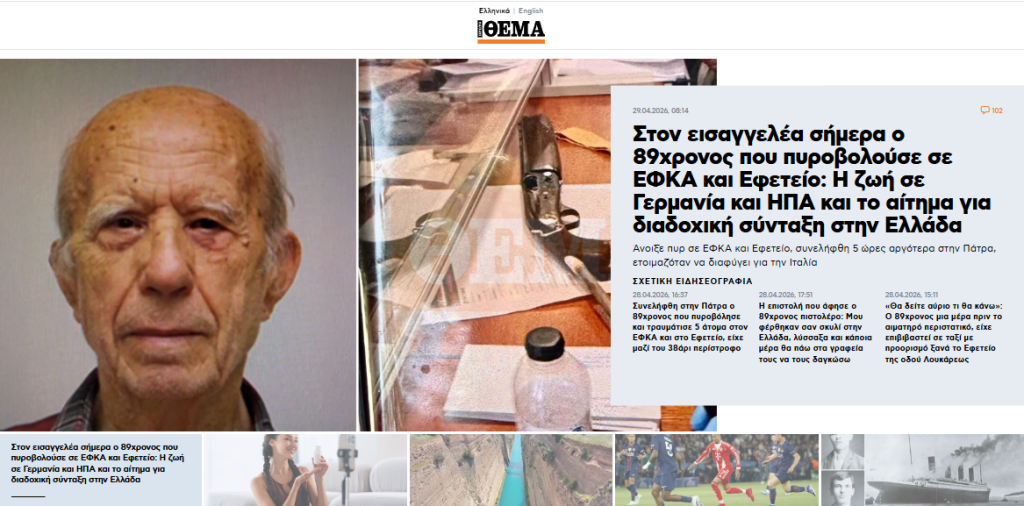
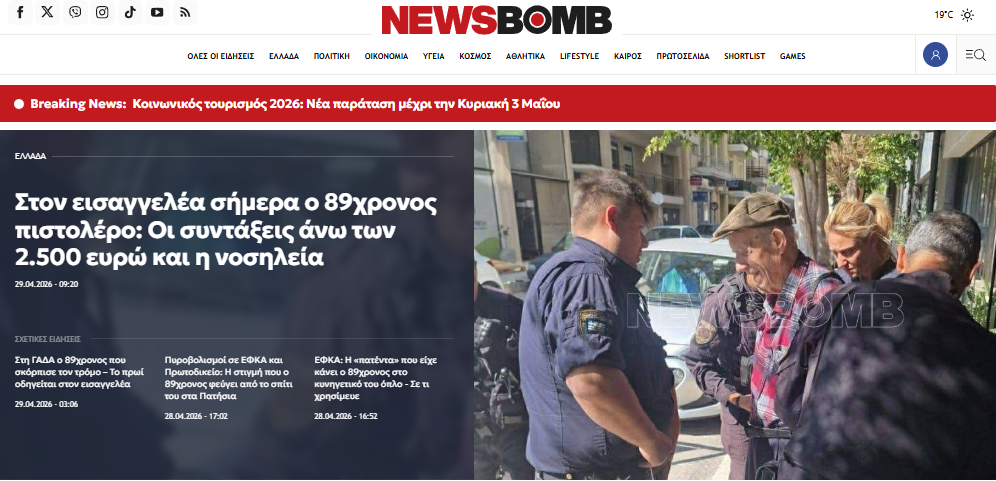
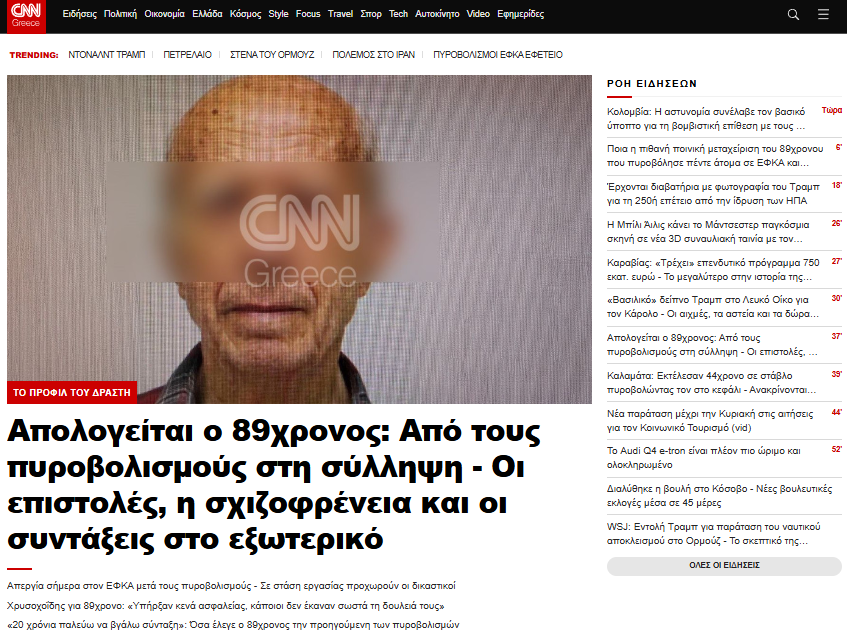
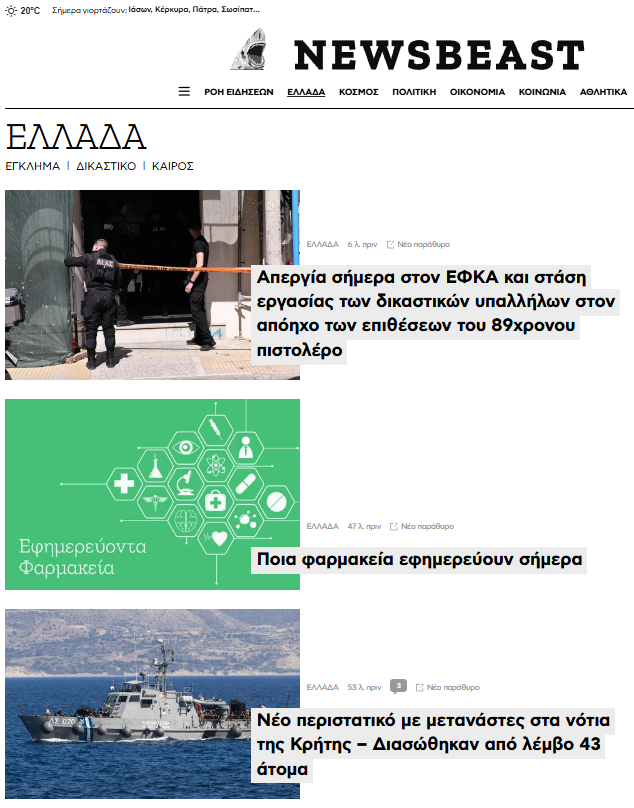
Greece’s citizen protection minister on Tuesday described a rare double shooting in central Athens as “dangerous and disturbing,” acknowledging security lapses while insisting the country remains broadly safe. Michalis Chrysochoidis said in a late-night television interview that “some people did not do their job properly” in connection with the incident, in which an 89-year-old man allegedly wounded five people in two attacks earlier in the day.
Pierrakakis and Kyranakis to Cabinet: State to waive legal remedies over compensation for Tempi rail crash victims’ families
Minister of National Economy and Finance Kyriakos Pierrakakis, along with Deputy Minister of Infrastructure and Transport Konstantinos Kyranakis, is set to propose at Wednesday’s Cabinet meeting a decision to designate the Tempi railway accident of 28 February 2023 as a “case of particular social significance.” Specifically, they will recommend that the State waive its right to legal action against compensation claims filed by the families of the victims of the Tempi train accident.
Stournaras: Greek economy’s outlook remains positive
The outlook for the Greek economy remains positive despite strong shocks and heightened uncertainty, according to Bank of Greece governor Yannis Stournaras, who spoke at the official dinner held οn Monday at the Economic and Financial Committee of the European Union in Athens.
https://www.amna.gr/en/article/988890/Stournaras-Greek-economys-outlook-remains-positive
ATHEX: S&P verdict aggravates sentiment
Tuesday’s bourse session at Euronext Athens – the local bourse’s new name – showed more caution by traders, as it was negative for the vast majority of stocks. Investors chose to withdraw from some of their recent positions, including mid-caps, and turnover remained on relatively low levels. This came as Standard & Poor’s revised its projection for Greek growth this year from 2.3% to just 1.7%, due to the war in the Middle East, although it stressed that the conflict “does not cancel the resilience of the economy.”
https://www.ekathimerini.com/economy/1302262/athex-sp-verdict-aggravates-sentiment



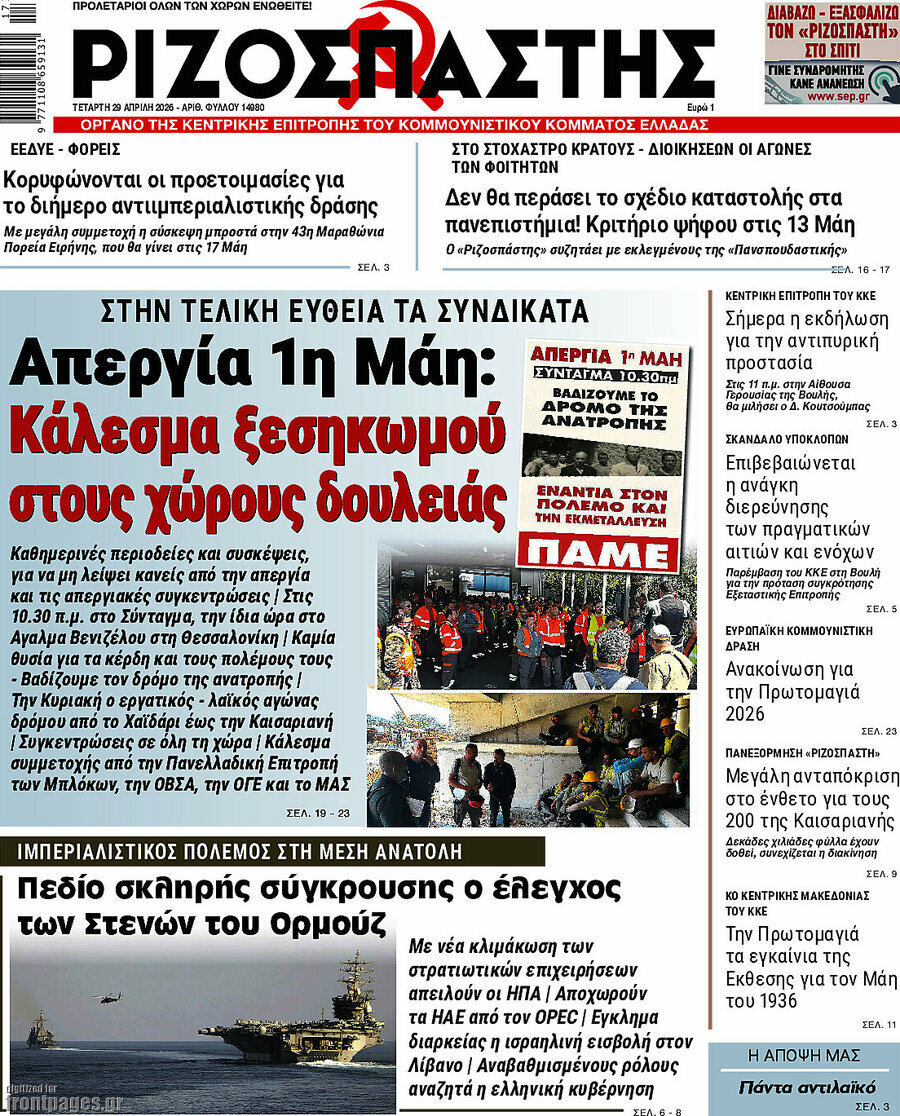
KATHIMERINI: Unfortified judicial halls
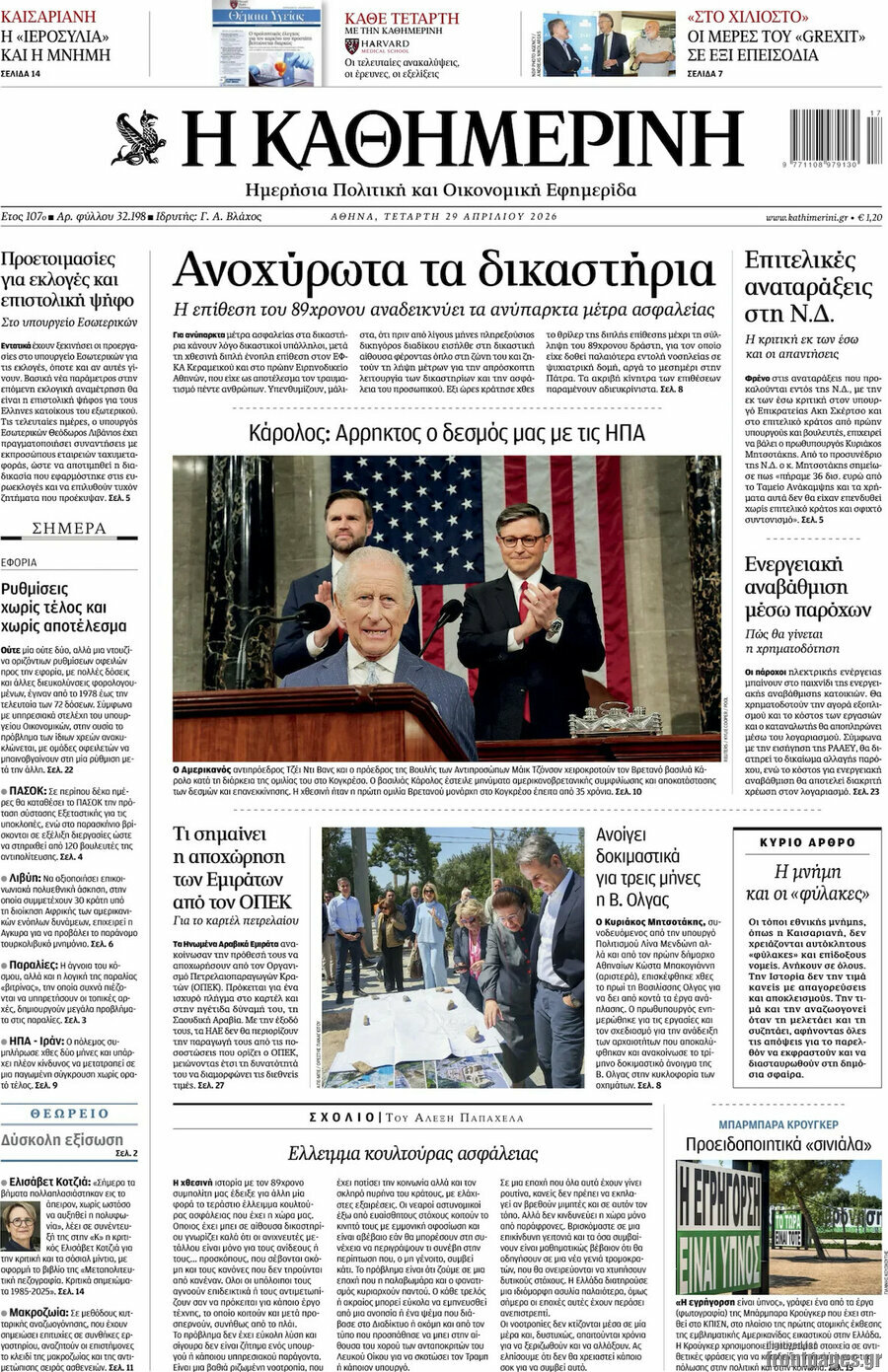
TA NEA: State Minister responds to complaining ruling party MPs with truce message
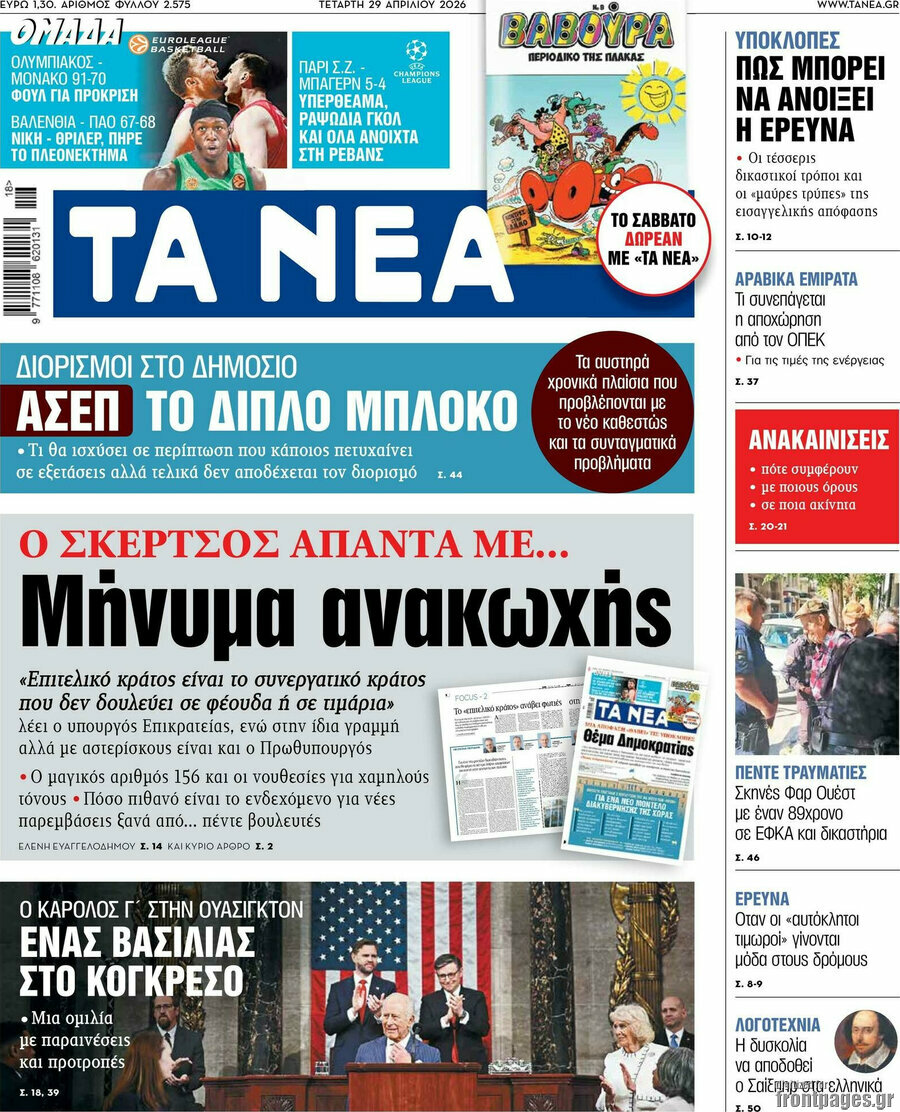
EFIMERIDA TON SYNTAKTON: Labor accidents have become a bloody everyday occurrence
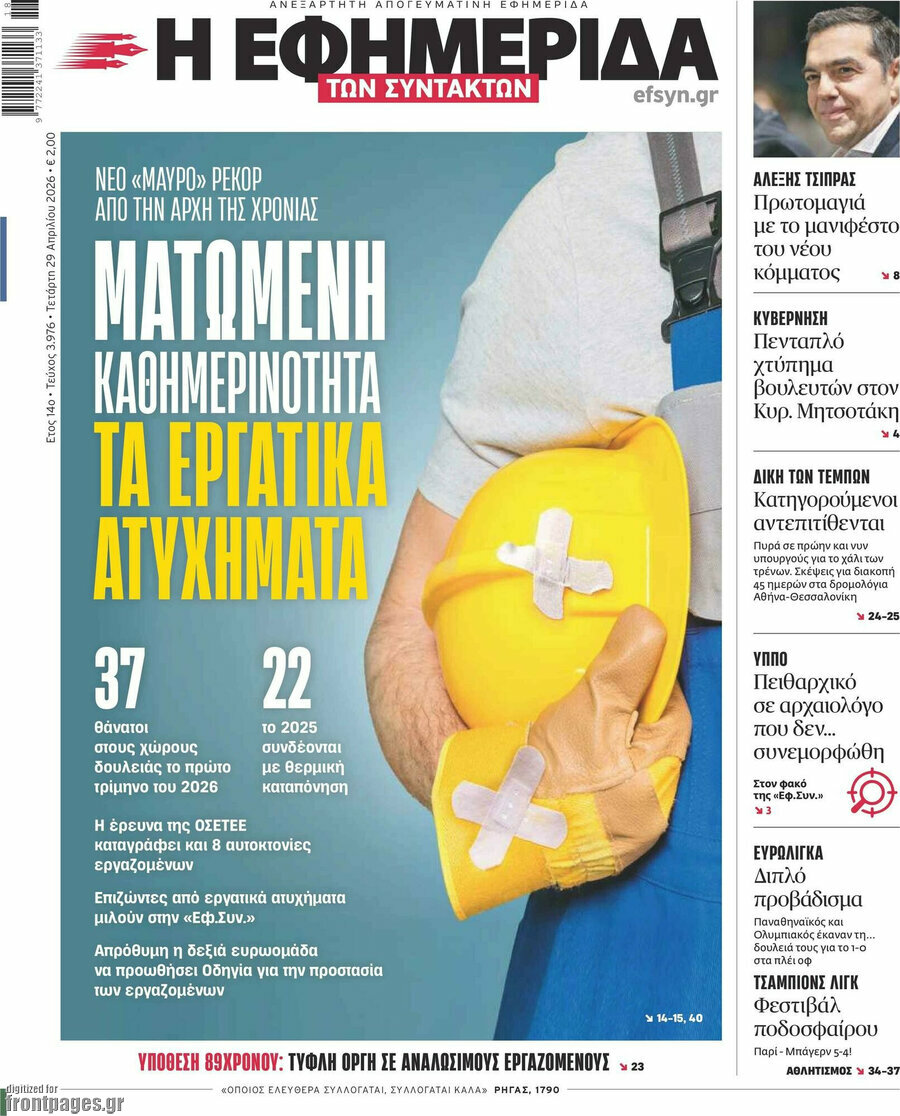
RIZOSPASTIS: May 1st strike: Call for upheaval in working spaces
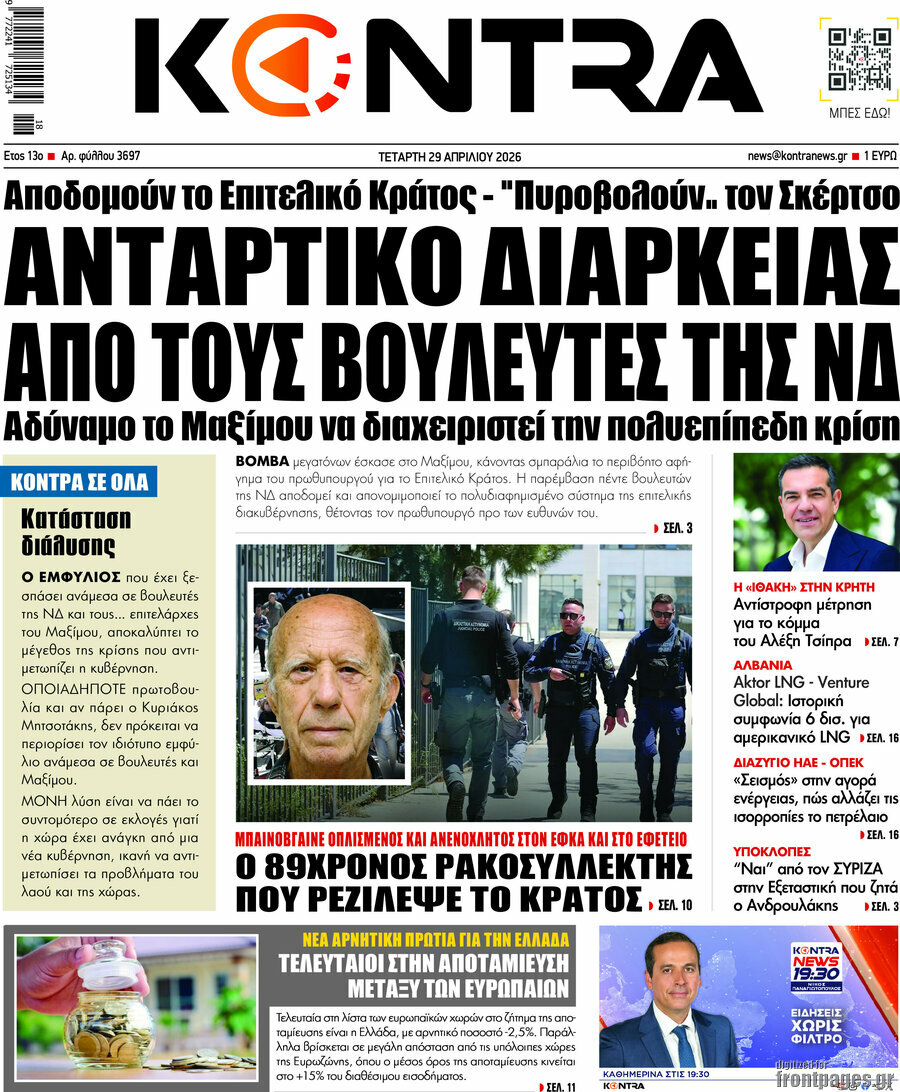
KONTRA NEWS: Ongoing guerilla war by New Democracy MPs
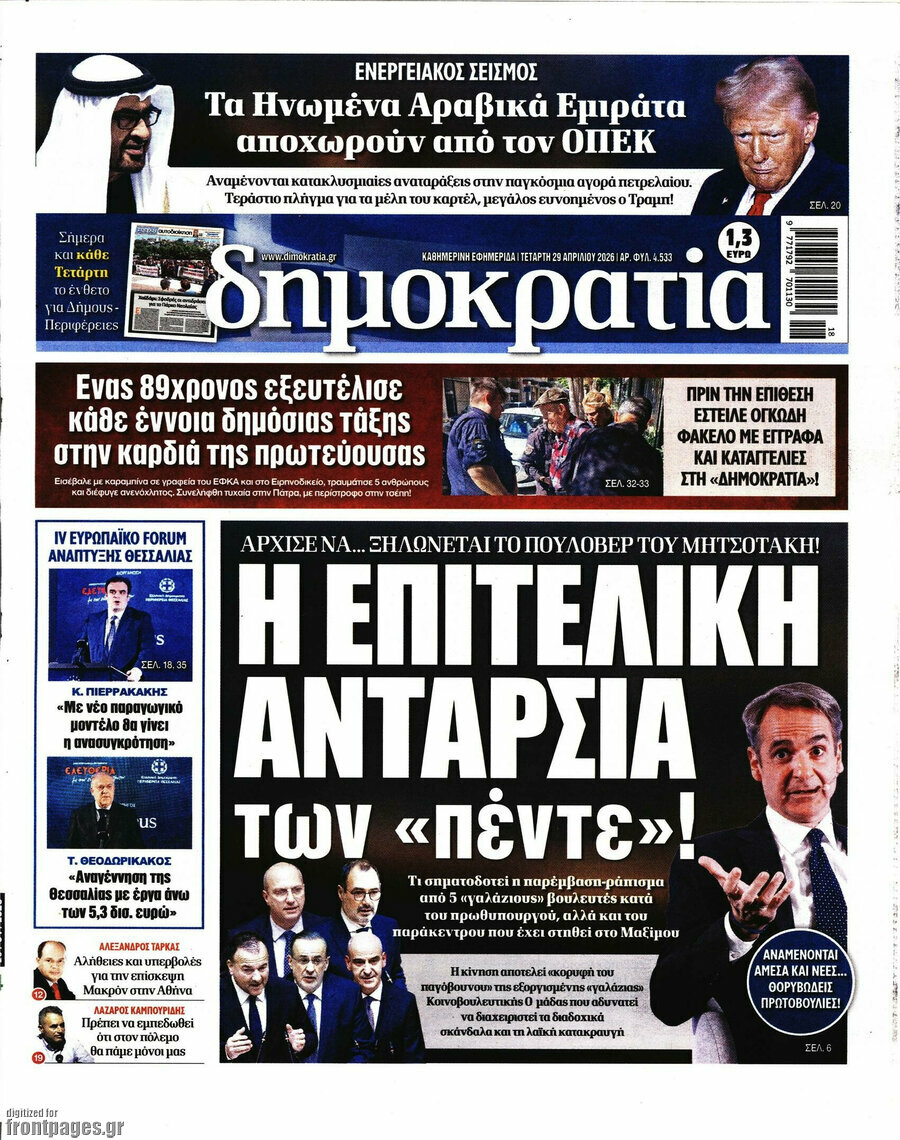
DIMOKRATIA: Mutiny by 5 ruling party MPs
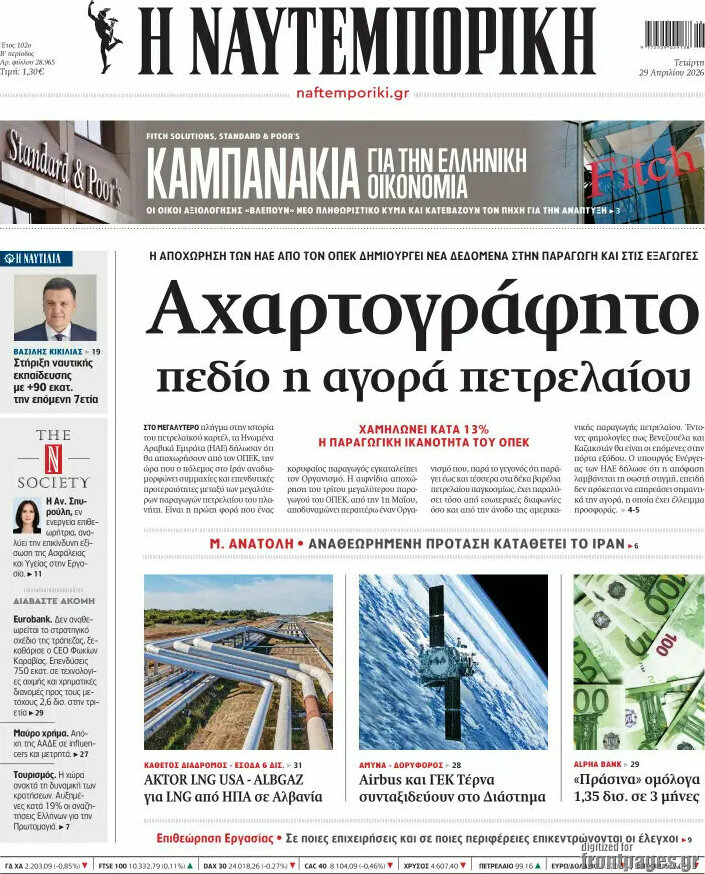
NAFTEMPORIKI: Oil market is an uncharted territory

DRIVING THE DAY
MAGYAR’S DEBUT: The days of Viktor Orbán throwing sand in the gears are over. Enter Péter Magyar, the rising star of European politics. Hungary’s incoming prime minister is heading to Brussels for high-level talks, where he’ll be received not as a problem to manage but as a partner-in-waiting.
VIP in the house: Commission President Ursula von der Leyen will receive Magyar this afternoon, in what one EU official described as a show of goodwill as the new Hungarian leader signals a break from Orbán’s disruptive policies. Magyar will have a sit-down with European Council President António Costa at 6 p.m.
Top of the to-do list? Unlocking roughly €10 billion in frozen EU funds — part of Hungary’s Covid recovery allocation. Budapest could lose the money permanently at the end of August if it fails to meet rule-of-law conditions tied to corruption, judicial independence and democratic standards.
Magyar is pushing for a broader reset … including relief from daily fines imposed over Hungary’s failure to follow asylum rules … securing loans under the EU’s SAFE program … and finding a pathway for Hungarian universities to rejoin Erasmus after being sidelined due to concerns about academic freedom.
The game plan: The future PM will move swiftly where possible, while deferring the trickier constitutional surgery. Passing new laws won’t be Magyar’s problem, with his Tisza party securing a two-thirds majority in parliament. Bedding down reforms carried out to the Commission’s satisfaction within a tight timeframe — that’s the challenge.
To meet the deadline, Tisza plans to hand the Commission a revised national recovery plan by the end of May, according to people familiar with preparations. Zoya Sheftalovich, Max Griera and Gregorio Sorgi have more details in their curtain-raiser.
Rerun or fresh IP? Some in Brussels (including Berlaymont types) are calling the meeting with the PM-elect unprecedented. Yet von der Leyen hosted Donald Tusk in October 2023, just 10 days after Poland’s election and before he formally took office. Like Magyar, Tusk promised to reverse his country’s democratic backsliding.
How did that work out? Brussels released funds to Poland in 2024 in response to reform pledges that later stalled. The EU may be more cautious this time.
FIRST, IN STRASBOURG: Von der Leyen heads into the Magyar meeting straight from the European Parliament, where she is laying out the EU line on the Middle East war and its spillover into energy and fertilizer markets.
No big reveals are on the cards … Expect a rehash of existing measures: emergency energy tools, looser state aid guidance and the “AccelerateEU” push for homegrown fuels. The real show is likely to be provided by feisty MEPs showing up with a grab bag of grievances.
COMMISSION MUSICAL CHAIRS
VON DER LEYEN TIGHTENS HER GRIP: There’s a clear winner in the first major reshuffle of the Commission’s top administrative jobs since Ursula von der Leyen took office — and it’s the boss herself.
Logjam cleared: The long-stalled overhaul of the Commission’s senior ranks is finally underway after the key bottleneck was cleared: Sabine Weyand’s position at DG TRADE. The workaround is a newly created role for her in the Secretariat-General as adviser on European strategic partnerships — a face-saving exit that unblocks other moves.
Don’t feel too sorry: Weyand struck an upbeat tone on X, saying she’s proud of what she achieved alongside Trade Commissioner Maroš Šefčovič. She’ll also be seconded to the European University Institute in Fiesole, allowing her to combine academia with her Commission role (and salary).
One former senior official joked to me that the EUI is “a cesspool of Italian intriguers and second-rate minds.” If that’s the worst of it, plenty in the Berlaymont might be tempted to volunteer.
Domino effect: The reshuffle is a “three-way musical chairs game,” as one Commission official put it. Weyand’s move clears the path for Ditte Juul Jørgensen to shift from running the Directorate General for Energy to heading DG TRADE, while Céline Gauer leaves her reform portfolio in the Secretariat-General to take over DG ENER.
Why it matters: Weyand had taken a more cautious line on parts of the EU-U.S. trade agenda than the Commission’s political leadership wanted — so, moving her sidelines a potential internal brake. Jørgensen is expected to be less openly critical. At the same time, von der Leyen is putting Gauer, a trusted loyalist, at the helm of DG ENER just as energy policy becomes politically explosive again.
Mapping the president’s influence: Of the Commission’s main departments and services, four report directly to von der Leyen: the Secretariat-General, Legal Service, DG COMM and DG IDEA. Another four are led by senior officials who previously held roles in her cabinet or are seen as part of her inner circle — Stéphanie Riso (DG BUDG), Kurt Vandenberghe (DG CLIMA), Eric Mamer (DG ENV) and Anthony Whelan (DG COMP).
Add in departments run by officials like Gauer and DG AGRI’s Elisabeth Werner — veterans of von der Leyen’s Secretariat-General — and about a third of the Commission’s policy-shaping departments are now in the hands of people seen as loyal to von der Leyen.
Energy is the real prize: With Gauer’s move, the key energy and climate departments — DG ENER, DG CLIMA and links to DG ENV — are now firmly in trusted hands for von der Leyen, at a moment when Brussels faces increasing pressure because of the war in the Middle East.
BUDGET BATTLE
LET’S GET IT STARTED: Feeling nostalgic about the €90 billion Ukraine loan saga? There’s a new funding fight to embrace. The clash over the EU’s next long-term budget is just getting started — and, with more than €2 trillion at stake, it won’t be pretty.
MEPs voted Tuesday for an ambitious negotiating position as EU leaders prepare to decide how much money to put on the table. The lawmakers’ €2 trillion gambit (it excludes Covid debt repayments) roughly amounts to a 10 percent budget increase. “Never underestimate this Parliament,” said the chamber’s President Roberta Metsola.
It’s a classic EU battle royale, with the “ambitious” camp on one side and the German-led frugals on the other, as POLITICO’s Gregorio Sorgi and Max Griera report. There’s one major flashpoint: new EU-level taxes — the so-called own resources.
A Cyprus twist: Four officials with knowledge of the discussions told Gregorio that at last week’s European Council in Cyprus, leaders asked Ursula von der Leyen to explore fresh revenue streams — from digital firms to online gambling and crypto. That would revive ideas long pushed by the Parliament, which bristles at having to rely on EU member countries.
Behind the scenes: EU ambassadors were briefed Monday that Costa personally asked von der Leyen to move forward with work on own resources.
COMMISSIONERS UNDER FIRE
HEALTH CHIEF FEELS THE HEAT: Olivér Várhelyi heads into a rough vote in the European Parliament today. MEPs are set to endorse a report accusing the health commissioner of “serious and prolonged management failures” during his time running the EU executive’s enlargement agenda from 2019 and 2024.
Staying put: On paper, the Hungarian Várhelyi’s proximity to Viktor Orbán — including past attendance at government meetings — should make him vulnerable as his country prepares to enter the Magyar era. But the incoming government in Budapest appears to have little appetite to coax Várhelyi out of his role in Brussels, even as the European Parliament’s report lands a blow.
Finger-pointing: The MEPs accuse Várhelyi of having provided “inaccurate information to Parliament in the context of the discharge procedure” during his time at DG NEAR, while behaving in a way that was “incompatible with the standards of accountability, reliability and sound administration required of a member of the Commission.” But the report falls short of calling for the commissioner’s resignation.
POISONED CHALICE: Questions have also hovered over Marta Kos, the enlargement commissioner, with her position looking shakier amid political shifts in Slovenia, her home country.
It’s personal: The government that appointed Kos appears to be on the back foot and the leader now edging closer to power, Janez Janša, is believed to harbor animosity toward Kos, according to two diplomats who spoke to Playbook.
But but but … while Kos faced tough questioning in the Parliament’s Foreign Affairs Committee last week, officials say pressure from the center-right group is now receding, and that Kos’ position is not in immediate danger.
PUTIN AT G20
PORTUGAL ANXIETY: An under-the-radar remark by Portuguese PM Luís Montenegro backing Donald Trump’s invitation to Vladimir Putin to the G20 in Miami is rippling through EU diplomatic circles. Speaking on the sidelines of last week’s European Council in Cyprus, Montenegro argued that dialogue with Russia is necessary to resolve ongoing conflicts.
Diplomatic backlash: The comment has unified diplomats across Europe, Jacopo Barigazzi reports. A Western European diplomat said Montenegro’s suggestion would risk “rewarding an aggressor who has not moved an inch toward peace,” reinforcing Moscow’s war effort while undermining Western credibility.
Portuguese officials pushed back, with one diplomat stressing that Montenegro’s words have to be taken in context: “The prime minister said this because of what he understood that was in the best interest of Ukraine.” The suggestion is that Putin’s presence will focus Washington’s drifting attention back on the war in Ukraine.
IN OTHER NEWS
TALKS ON AI LAW BREAK DOWN: Negotiations on a deal to delay the EU’s artificial intelligence rules collapsed overnight, my colleague Pieter Haeck reports — followed by a lot of finger-pointing. Representatives of the Parliament, the Cypriot presidency and the European Commission agreed to postpone the talks just before 2 p.m., according to three Parliament officials and two EU diplomats, with the main sticking point whether to give industrial AI lighter treatment — a demand from the European Parliament, backed by Germany. Talks are expected to resume, but with no date for that yet scheduled, the abandonment puts an already tight timeline to reach a deal under pressure. More here for Pro subscribers.
BALKAN BACKLASH: Internal Affairs Commissioner Magnus Brunner’s meeting with Serbian President Aleksandar Vučić in Belgrade today is drawing fire in Brussels. Some MEPs reckon the trip risks handing Vučić an easy propaganda win, Sebastian Starcevic reports.
BORDER RELIEF: Luxembourg’s Interior Minister Léon Gloden and his German counterpart Alexander Dobrindt signaled a softer approach to border checks, announcing there will be no fixed controls between the two countries. The checks will become more flexible, with the aim of cutting waiting times.
METSOLA WATCH: Snap elections in Malta — called this week by PM Robert Abela — have triggered the inevitable Brussels question: will Malta’s most famous politician, Roberta Metsola, make a move? Short answer: Don’t bet on it. While the Parliament president is said to be following developments closely, people around her insist she’s not interested in running.
DRESS-CODE OF CONDUCT: Czech EPP MEP Tomáš Zdechovský raised eyebrows in plenary after showing up in a branded T-shirt from a well-known fashion label, sparking chatter about whether it amounted to free advertising.
Dignity, always dignity: According to Parliament’s press service, there’s no formal dress code, as long as members respect the “general principle of conduct,” including the institution’s “dignity and reputation.” But in practice, enforcement falls to Metsola. And as her spokesperson put it: “No one’s going to tell you what T-shirt you’re going to wear.”