
Parliament set for heated rule-of-law debate amid surveillance row
A polarized debate over the rule of law is expected Thursday, as lawmakers meet amid allegations of surveillance and a growing political dispute over a senior government appointment.
Close aide to PM in hospital after collapsing during gov’t meeting
A close aide to Prime Minister Kyriakos Mitsotakis was rushed to hospital after collapsing during a government conference early Wednesday. Deputy Minister to the Prime Minister Giorgos Mylonakis, 52, was reportedly diagnosed with a brain aneurysm and intubated in intensive care.
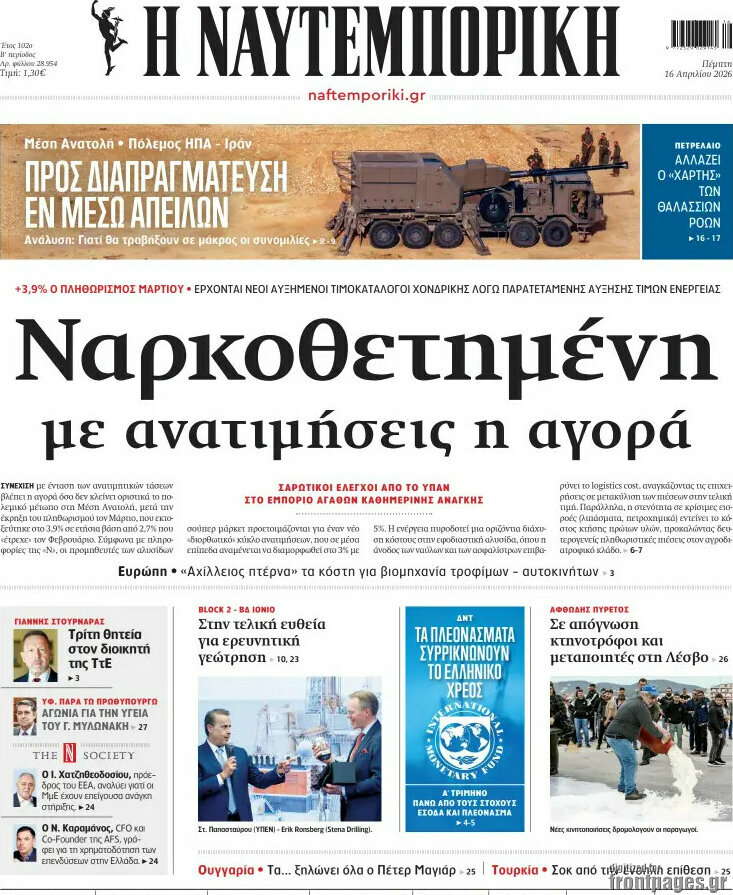
Mitsotakis proposes Stournaras stays at central bank helm for third term
Prime Minister Kyriakos Mitsotakis will propose the renewal of Yannis Stournaras’ mandate as Governor of the Bank of Greece, the government announced on Wednesday.
Estimated natural gas deposits in the Ionian Sea amount to 270 billion cubic meters, Energean CEO says
If the strong indications that there is natural gas at the Asopos 1 site are borne out and also permit commercial exploitation, this will lead to a leap in economic growth and geopolitical power for Greece, Environment and Energy Minister Stavros Papastavrou emphasised on Wednesday, at the signing of the Drilling Contract for Block 2 (Northwest Ionian), between the ExxonMobil – Energean – HELLENiQ Energy consortium and Stena Drilling (the company that owns the floating drilling rig to be used in the area).
ATHEX: Mid-caps keep benchmark on arising course
Even without the help of the banks index, but with the crucial backing of mid-caps, the benchmark of the Greek stock market continued its ascent on Wednesday in what was a far quieter session than the previous ones at Athinon Avenue. Traders’ eyes remain glued to geopolitical developments, which will not only determine the course of market mood for investments, but also the price of everyday commodities in the run-up to the summer – and which in Greece’s case affects both of its main industries: Shipping and tourism.
https://www.ekathimerini.com/economy/1301023/athex-mid-caps-keep-benchmark-on-arising-course




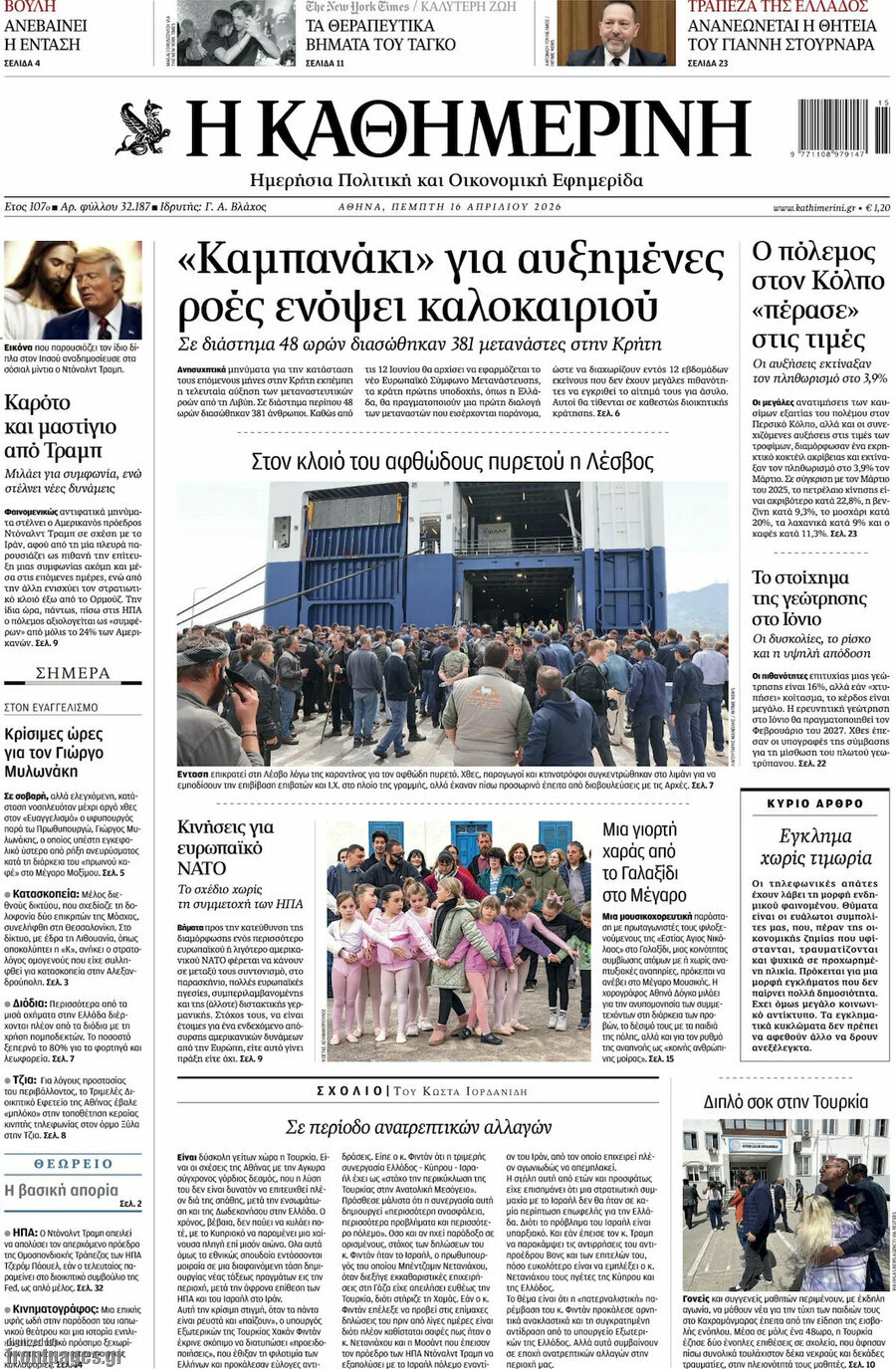
KATHIMERINI: “Alert” for increased migrant waves in view of the summer
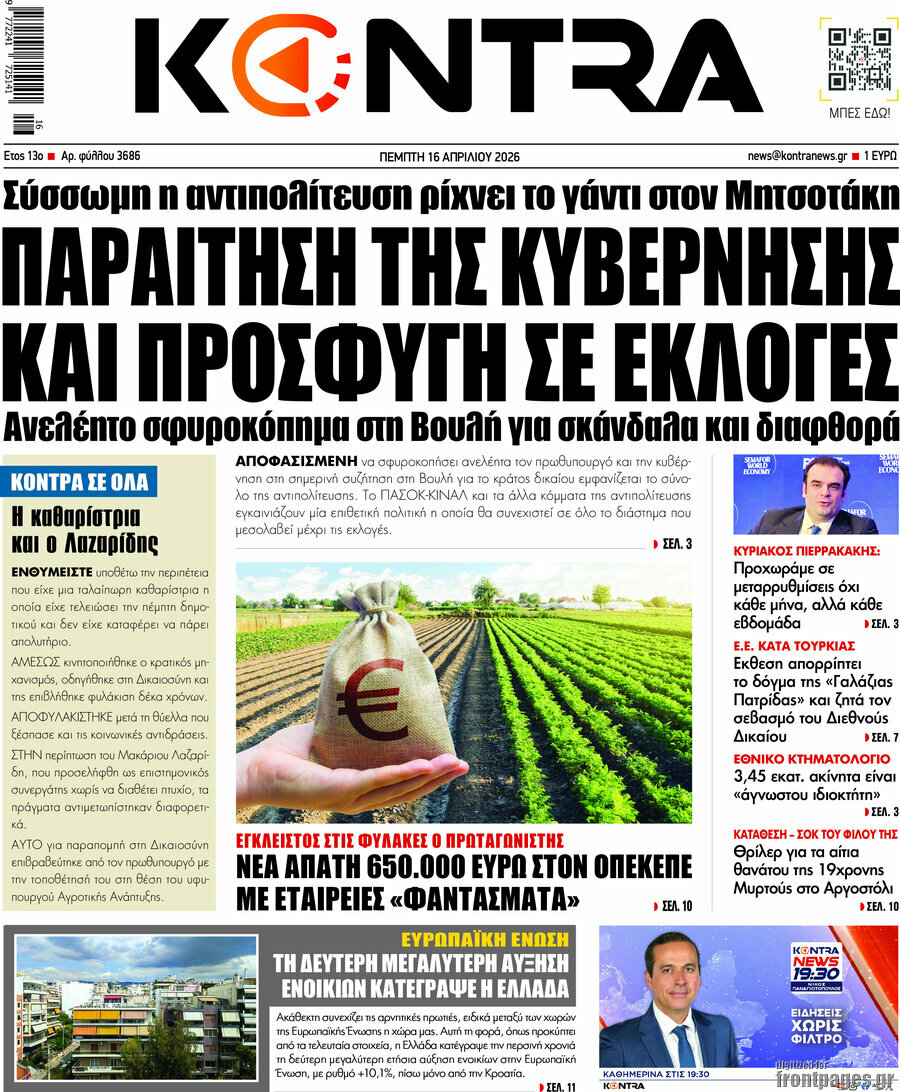
TA NEA: The expectations regarding the first nat gas drilling in the Ionian Sea
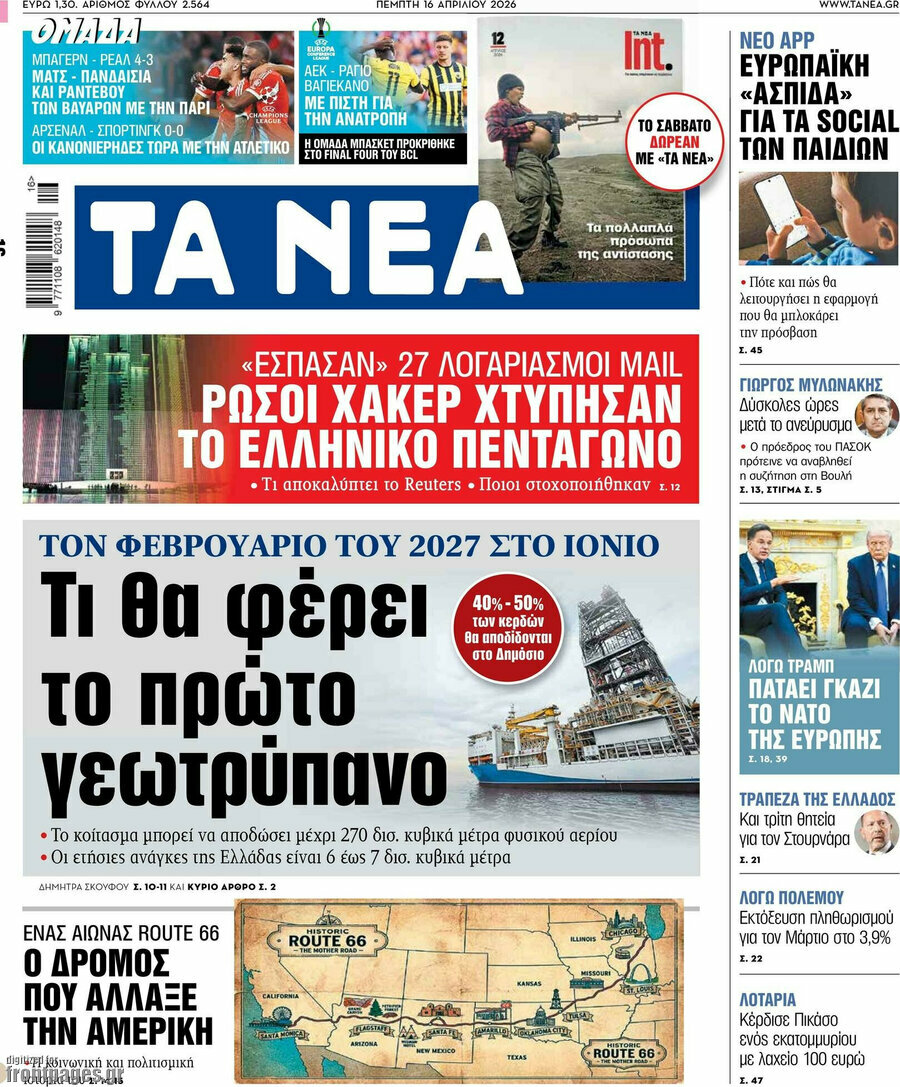
EFIMERIDA TON SYNTAKTON: Maximos Mansion’s “Nixon” stands with his back against the wall
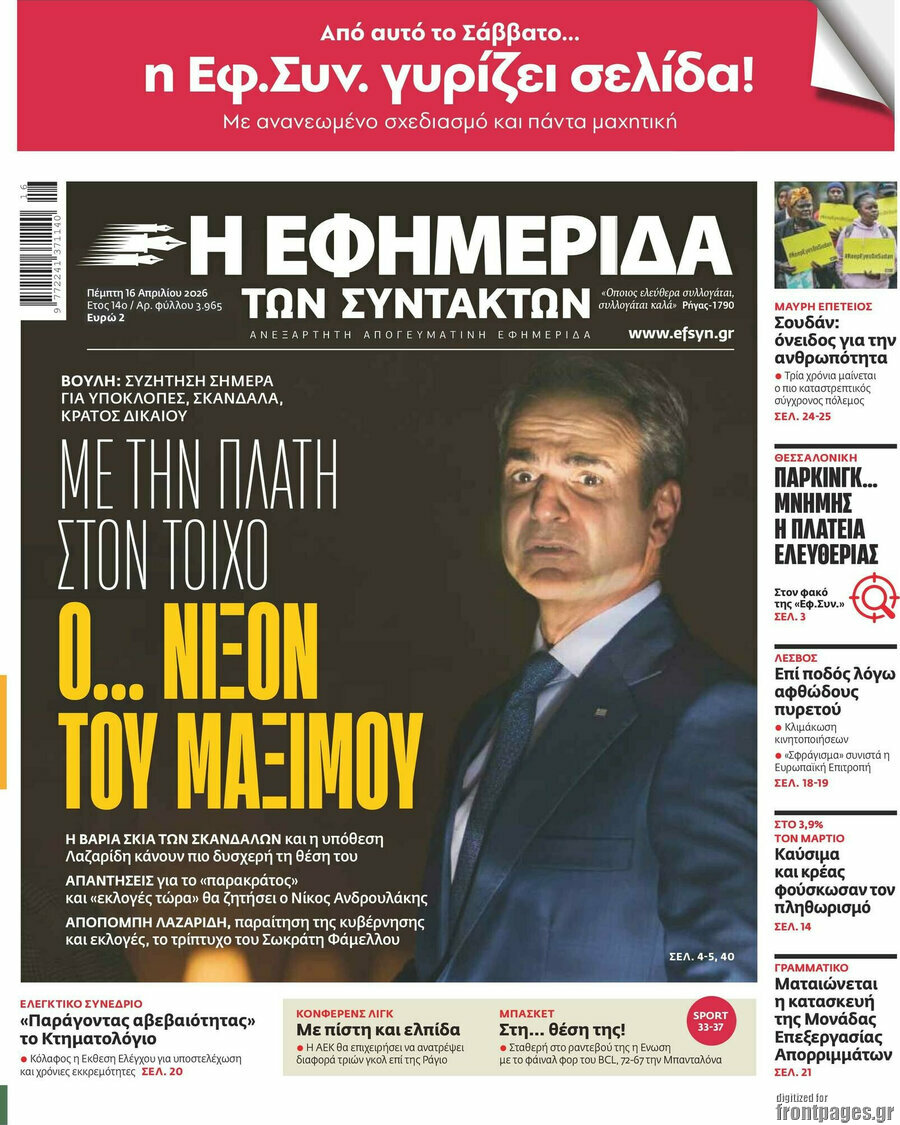
RIZOSPASTIS: Price hikes due to the war and the “tax-heist” by the state pillage simple folks’ income
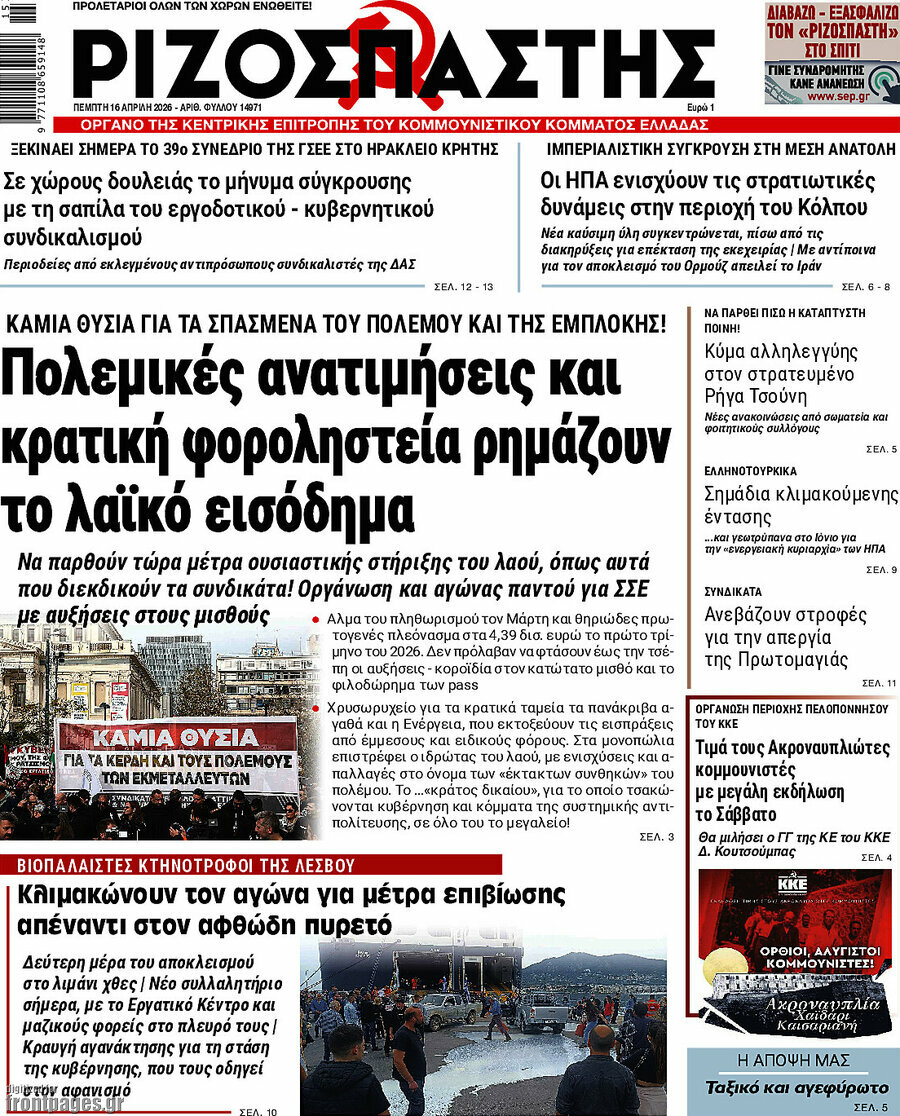
KONTRA NEWS: All opposition parties demand the government’s resignation and snap elections
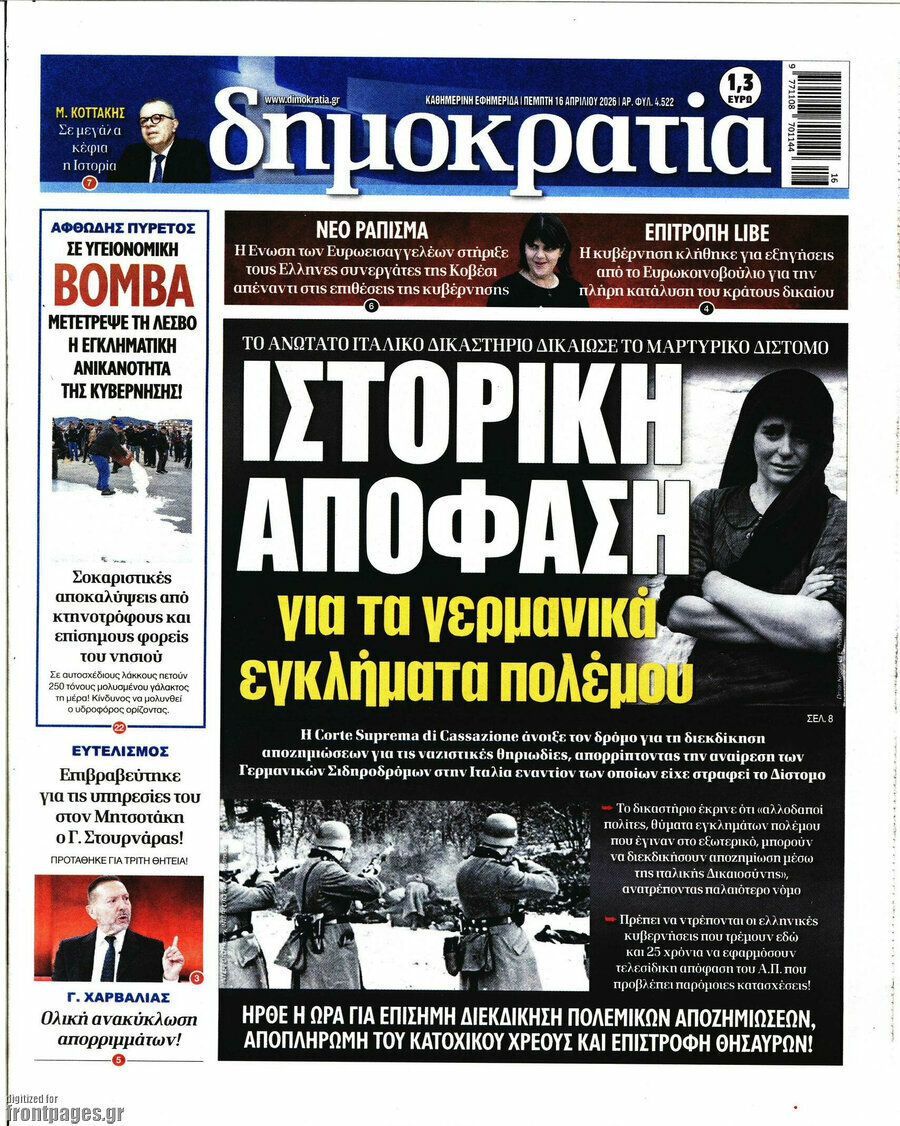
DIMOKRATIA: Historic decision regarding German war crimes
NAFTEMPORIKI: Price hikes set up a minefield in the market

DRIVING THE DAY
RESET MODE: Commission services are spending today preparing for tomorrow’s first contact with Hungary’s prime minister-in-waiting Péter Magyar — not yet sworn in, but already treated in Brussels as the man in charge.
That was fast: The meeting lands just five days after Magyar ended Viktor Orbán’s 16-year rule and well before his government formally takes office — Orbán will remain in caretaker mode until at least May 5. But Brussels isn’t waiting.
De facto legitimacy: A Commission delegation will meet officials from Magyar’s Tisza party, who have no doubt been buoyed by the size of the landslide victory. The prospect of a parliamentary super-majority suggests sweeping reforms and a rapid unwinding of Orbán’s controversial legacy are on the cards.
Who’ll be in the room: The Commission is keeping the guest list under wraps. Two key players are definite no-shows: Rule of Law Commissioner Michael McGrath and Budget Commissioner Piotr Serafin, who are both abroad (California and Asia, respectively). Even so, expect a sizable, senior-level presence: multiple Commission services have skin in the game.
What’s at stake: Above all, money — tens of billions in frozen EU funds — and a broader political reset with a country long cast as the bloc’s problem child under Orbán, most recently over his veto of a €90 billion Ukraine loan that Hungary won’t even be contributing to.
The ticking clock: The most urgent piece is roughly €10 billion in recovery funds, set to expire at the end of August. But workarounds are on the table:Hungary could try to buy time via technical fixes, as POLITICO’s Gregorio Sorgi reports. Budapest could channel funds through a national promotional bank or blend them with cohesion money. In practice this would mean using recovery money to finish projects already financed through regional funds.
All smooth? Not quite: Orbán’s exit has eased tensions, but Magyar isn’t reading as a purely a figure of reassurance. He has already signaled his combative streak, pledging to suspend what he called a “false news service” on state TV and publicly urging President Tamás Sulyok to resign as part of a post-Orbán reset.
Orbán snubs goodbye party: While Brussels heads to Budapest, Budapest won’t show up in Cyprus. As POLITICO’s Seb Starcevic scooped yesterday, Orbán will skip next week’s informal European Council. Under Council rules, he’ll be represented by another leader — likely Slovak Prime Minister Robert Fico, his ally.
Missing the perks: Departing leaders used to receive a scale model of the Europa building as a farewell gift. Not anymore. “Now it’s a framed photo of European Council members, signed by the President,” one official said. Memo to António Costa: Don’t try that when visiting the White House.
That sounds cheap, I said, asking whether at least the frame was valuable. “It’s a symbolic gift,” came the reply. Orbán will also miss the Council’s traditional highlight reel — a pity, given that as the bloc’s longest-serving leader, his greatest hits would have made for quite the montage.
COMMISSION RESHUFFLE
MUSICAL CHAIRS ON HOLD: Many expected the appointment of Commission President Ursula von der Leyen loyalist Anthony Whelan to DG COMP to set off the long-awaited reshuffle of top Commission jobs. Well, it hasn’t — and it probably won’t anytime soon. That’s according to talks with well-placed officials, who spoke to Francesca Micheletti, Gregorio Sorgi, Mathieu Pollet, Jacopo Barigazzi and me over the past days.
Why nothing moves: The reason is quite simple, actually: no vacancy, no cascade. Whelan’s promotion doesn’t free up space — he moves from deputy director-general for state aid to director-general in the same service, without triggering a downstream opening. And with no first domino, there can be no domino effect.
The real bottleneck: That said, the top first-domino candidate is widely seen as Sabine Weyand, now the influential boss of DG TRADE. She’s a victim of her own success: the Commission’s top brass wants her to stay until at least 2027, according to two EU officials, in case fresh negotiations with the U.S. become necessary.
Isn’t it ironic, don’t you think? There’s some lingering irritation over Weyand’s blunt comments in Alpbach, in which she downplayed the EU-U.S. deal outcome as a politically constrained compromise rather than a real negotiation. But that hasn’t weakened her position. As one of the two officials put it, there’s irony in being stuck because of the deal she disliked the most. “Out of all deals, this one … ”
Blocked ambitions: Weyand’s staying put freezes the next layer. Ditte Juul Jørgensen, the Commission’s director-general for energy, is widely seen as the natural successor at DG TRADE. One former senior official puts the odds of her eventually moving to TRADE at “95 percent” — but only once Weyand moves.
In the meantime, smaller pieces are moving around the mosaic. DG TRADE’s Deputy Director-General Maria Martin-Prat heads to Geneva on May 1 as EU ambassador to the World Trade Organization, with Joanna Szychowska expected to step up, Playbook has learned.
Ditto SG: The same logic applies at the very top. A vacancy at secretary-general level — a powerful post, once held by Berlaymonster himself, Martin Selmayr — would unlock movement across the system. Names like Céline Gauer circulate. Declan Costello is already lined up to move into the Recovery and Resilience Task Force, which Gauer leads, from DG ECFIN. But inertia remains.
Hotel California factor: Current Secretary-General Ilze Juhansone remains firmly in place, seen by many EU officials surveyed as an extension of the president’s cabinet and a guarantor of control. As one official put it: “It’s harder to leave the president’s cabinet than to get into it …”
Waiting games … The freeze extends across departments. Covid-19 vaccine negotiator Sandra Gallina is expected to retire soon leaving DG SANTE without a boss — though the timing remains unclear. There doesn’t seem to be movement in DG MENA either, after the controversial farewell of Stefano Sannino, with an acting director expected to stay there for more time.
… and trench warfare: At DG CONNECT, Director-General Roberto Viola runs one of the Commission’s biggest and most sensitive services (hence his already extended mandate). He is said to be keen to stay on, even as an internal tussle brews between his deputies Renate Nikolay and Despina Spanou over succession.
Call me: All those named were offered a right of reply. The Commission’s spokesperson service declined to comment. Viola, via a spokesperson, said “no comment.”
IRAN AND THE EU
GULF EYES EU AS MEDIATOR ON IRAN: The EU should step up as a diplomatic broker in the Iran war, Gulf Cooperation Council Secretary-General Jasem Mohamed Al Budaiwi told POLITICO’s Jacopo Barigazzi ahead of talks today with Commission President Ursula von der Leyen.
Why Brussels: “We will support any initiative that is fair and square to the region and the international community,” the top Gulf official said. The EU may well be sitting on the sidelines for now — insisting this is not its war. But it played a role in the past. From the 2015 Iran nuclear deal onwards, Brussels has shown it can convene and close. The EU is “a reliable partner for us and for all over the world, capable of helping reach a deal in this conflict or others,” he said.
Russia reality check: Yet expectation in Brussels that Gulf capitals might edge closer to the EU line on Moscow looks misplaced. Despite deepening ties with Ukraine, the six GCC countries — Bahrain, Kuwait, Oman, Qatar, Saudi Arabia and the UAE — are not recalibrating. Trade with Russia has surged more than sevenfold since 2021.
GCC keeps its options open: Al Budaiwi is clear that relations with Washington, Brussels, Beijing and Moscow all matter. “We are getting aligned with our own interests,” he said — suggesting this isn’t about having a partnership with a single bloc.
Sanctions? UN or nothing. EU diplomats often complain that GCC countries haven’t fully aligned with western sanctions on Russia. Here too, no change in tone: “We view sanctions through the United Nations and the Security Council,” Al Budaiwi said (those are bodies where Russia holds a seat and veto power). He also dismissed claims that Gulf states facilitate sanctions’ circumvention. “This is not true. We are countries that respect and implement international law.”
Paging Kallas: The GCC is equally unmoved by criticism from EU foreign policy chief Kaja Kallas, who recently argued that Gulf support for Ukraine has been insufficient and that the relationship “cannot be a one-way street.” “The relationship with the EU is a two-way street in every aspect,” Al Budaiwi replied. GCC countries, he argued, have played a significant role: Saudi Arabia hosted early peace talks; the UAE facilitated multiple prisoner exchanges; and all GCC members have provided humanitarian and development support. “The GCC–Ukraine relationship is huge.”
IRANIAN OPPOSITION TESTS BRUSSELS: Opponents of Tehran’s regime took the stage in the European Parliament on Wednesday, using a foreign affairs committee hearing to push a shared goal: toppling the regime, as Ferdinand Knapp writes in to report.
Who showed up? Mustafa Hijiri and Abdullah Mohtadi, leaders of two Kurdish parties; Nobel Peace Prize laureate Shirin Ebadi; Saeed Bashirtash, who backs Reza Pahlavi; and journalist Sanaz Behzadi.
Unity among Iranian opposition: Hijiri said Iranians are ready to do “whatever it takes” to bring down the regime. Bashirtash agreed. “The Iranian nation will accept nothing less than the collapse of this regime,” he said. Ebadi said U.S. and Israel’s war on Iran has caused less casualties than the violent crackdown on protestors by Tehran in the beginning of 2026.
Fault lines in the European Parliament: Support from MEPs was neither universal nor uncomplicated. ECR lawmaker Sebastian Tynkkynen criticized the panel’s balance, arguing Pahlavi’s support base was underrepresented (committee chair David McAllister said Pahlavi had been invited but declined, opting instead for meetings in Rome). On the left, Marc Botenga rejected the premise altogether, framing the war as resource-driven and calling on the EU to condemn the U.S. and Israel, as it did Russia.
Pressure Brussels moment: Ebadi used the hearing to press the EU to move beyond rhetoric. “Why don’t you recall European ambassadors? Why don’t you expel Iranian ambassadors?” she asked. However, Iranian-born Belgian MP Darya Safai, who attended as a guest, told POLITICO: “It’s a very important sign that Europe wants to know more about Iran and its future.”
U.K.-EU FORUM
THE OG RESET: Hungary may be dominating the “reset” narrative in Brussels right now, but the U.K. could reasonably claim ownership of the term. Today’s annual U.K.-EU Forum in Brussels is the latest checkpoint on how that reset (™) is actually progressing.
Who’s in the room: U.K. Europe Minister Nick Thomas-Symonds is expected to offer an update on the state of play in negotiations. His counterpart in the talks, EU trade chief Maroš Šefčovič, will deliver one of the keynotes, alongside European Parliament President Roberta Metsola, who opens the event.
Metsola at center stage: Fresh from a high-profile visit to the U.K., Metsola is increasingly positioning herself as a political bridge in the post-Brexit relationship. The Parliament president has been stressing the need to move beyond the emotional hangover of the withdrawal. Indeed, the event’s organizers told Playbook that, when approached, Metsola signed on almost immediately.
Show some respect: She’s expected to urge the U.K. not to look for an off-the-shelf model, as it’s not about choosing between being “Swiss” or “Norwegian.” Rather, the country should pursue a uniquely British model. “The U.K. is not just another third country — it is a former member and should be treated as such.”
What’s being worked on: The agenda reflects a relationship still under construction — from defense and security to growth and public opinion. Parallel technical work is continuing — for example, agri-food standards, one of the more sensitive files. Negotiators are apparently aiming for progress on that one by mid-2027. Former EU Commissioner Julian King is also on the speaker list.
Something to celebrate: One concrete step forward: The U.K. will rejoin the EU’s Erasmus+ program from Jan. 1, 2027, under a deal signed in Brussels Wednesday. London says around 100,000 people could benefit in the first year.
Fun fact: The family of Erasmus alumni includes former Commission Vice-President Jyrki Katainen, who spent a year at the University of Leicester in the 1990s and is now back in Brussels as EU special adviser on Arctic relations, as reported by Playbook.
KIDS’ CORNER
WON’T SOMEONE THINK OF THE CHILDREN? Europe’s top political tier is tackling minors and social media on two fronts today, while quietly competing for ownership of the file.
Opposing initiatives: On one side there’s a call of European national leaders convened by Emmanuel Macron; on the other, an expert panel hosted by von der Leyen herself (although the commission president will straddle both formats, while Tech EVP Henna Virkkunen will attend neither, my colleague Eliza Gkritsi found out).
The subtext: Who leads? The Commission insisted Wednesday its age-verification solution is “technically ready,” with deployment within weeks. The timing of this announcement — coming just after Macron launched his initiative — didn’t go unnoticed, as we hinted on yesterday’s Playbook. A Commission senior official didn’t deny that it was Macron’s call that spurred the announcement of the verification wallet on Wednesday.
Von der Leyen’s crash course: It will be the second meeting of the Commission’s expert panel, although this time there’ll be a more policy-focused lineup. Von der Leyen is expected to join in the afternoon before dialing into Macron’s 5 p.m. leaders’ call, with fresh input and a Commission line.
Macron’s digital posse: The French president has enlisted a solid group of leaders: Cyprus President Nikos Christodoulides, Czech PM Andrej Babiš, German Chancellor Friedrich Merz, Greek PM Kyriakos Mitsotakis, Italian PM Giorgia Meloni, Irish Taoiseach Micheál Martin, Spanish PM Pedro Sánchez and Slovenian PM Robert Golob — plus a layer of digital ministers.
MEANWHILE… CSAM! The Commission is pushing to break the deadlock on child sexual-abuse material (CSAM) rules — a file that, as Sam Clark writes in to report, has been caught up for years by one word: detection.
Why it matters now: The two-hour political negotiation will be the first to directly confront the impasse presented by the scanning of online messaging services (that’s the checking of messages, images, links or files for child sexual-abuse material). Detection has become a privacy flashpoint.
Moral duty: Speaking at an event in the European Parliament on Wednesday night, Home Affairs Commissioner Magnus Brunner framed it in moral terms: the EU’s duty to victims to “conclude these negotiations swiftly.” The aim is for a deal by the end of June, with two more rounds of talks penciled in.
VIDEO GAMES CHIP IN: It’s not just kids’ play anymore. Today, Parliament debates a European Citizens’ Initiative titled “Stop Destroying Videogames,” which targets publishers that render games unplayable once they are no longer supported by the company.
It’s all in the timing: As MEPs debate lifecycle rights, Commissioner McGrath is in California meeting Electronic Arts CEO Andrew Wilson, whose company produces titles such as FIFA (Series) and The Sims.
OFF WHATSAPP: Sam Clark reports that national governments in the EU are pushing to get WhatsApp out of their officials’ system by rolling out in-house messaging services. It’s an effort to stop staff from using popular encrypted apps and switch to local alternatives the countries can control.
OTHER NEWS
EU-NATO ‘TURF WAR’ OVER REARMAMENT: The Financial Times reports that the EU and NATO are at odds over how to manage an extra $1 trillion a year rearmament drive sparked by Donald Trump’s threats to European security. The newspaper quotes officials describing the clash as a “turf war.”
ICE VS. FRANCE: Paris is pressing the U.S. Department of Homeland Security to release an 86-year-old French widow of a military veteran from immigration custody after she was detained earlier this month. U.S. Immigration and Customs Enforcement agents detained Marie-Therese Ross in Alabama on April 1 after she overstayed her 90-day visa, Associated Press reports.
BULGARIAN ELECTIONS: Bulgaria’s former president and air force chief Rumen Radev is on course to win a general election Sunday, with promises to combat the all-pervasive deep states that he accuses of undermining the EU’s poorest country. Boryana Dzhambazova has the story.