
Greek shield over Saudi refineries
The interception on Thursday of two ballistic missiles near the Saudi Red Sea port of Yanbu has highlighted the growing dangers in a region shaped by ongoing missile exchanges among American, Israeli and Iranian forces. The missiles were brought down by a Greek-operated Patriot air defense system stationed in western Saudi Arabia, where the Greek Force in Saudi Arabia (ELDYSA) has been deployed since November 2021.
https://www.ekathimerini.com/politics/foreign-policy/1298630/greek-shield-over-saudi-refineries
PM warns of migration crisis risk
Beyond the other issues on the agenda – the war in the Middle East and the resulting energy crisis – Prime Minister Kyriakos Mitsotakis on Thursday raised another concern as he arrived at the European Council summit in Brussels: the risk of a new migration crisis. Mitsotakis said the conflict must not lead to a refugee crisis “like that of 2015,” calling on European partners to send a clear message about protecting the bloc’s external borders, which he noted are also Greece’s borders.
https://www.ekathimerini.com/politics/foreign-policy/1298632/pm-warns-of-migration-crisis-risk
‘Block 2’ offshore concession enters second exploration phase
The Hellenic Hydrocarbons and Energy Resources Management Company (HEREMA) announced that the Energean – ExxonMobil – HELLENiQ ENERGY Joint Venture, co-lessees of the offshore concession Block 2 in the northwestern Ionian Sea, has officially submitted notice for the continuation of exploration operations in the area. This development marks the beginning of the second exploration phase for the concession, which also includes the drilling of an exploration wella key milestone for Greece’s efforts to accelerate its upstream sector.
https://www.amna.gr/en/article/979248/Block-2-offshore-concession-enters-second-exploration-phase
Greece requests €5.3 billion Social Climate Fund package
Government spokesperson Pavlos Marinakis said Thursday Greece has submitted a request for €5.3 billion in Social Climate Fund resources, for projects supporting vulnerable households and businesses. The plan, he told a press briefing, includes investments in energy upgrades for buildings, social housing, and public and private transport.
https://www.ekathimerini.com/politics/1298587/__trashed-3
ATHEX: Mini sell-off as energy rates soar
As the conflict in the Middle East escalates into tit-for-tat strikes on energy infrastructure, the global market suffers and the Greek bourse predictably incurs losses that on Thursday accelerated considerably. Athinon Avenue experienced what would amount to a mini sell-off, with stocks in all sectors heading south and turnover increasing to the highest level of the last five sessions, as traders were eager to pull their funds from the market.
https://www.ekathimerini.com/economy/1298648/athex-mini-sell-off-as-energy-rates-soar


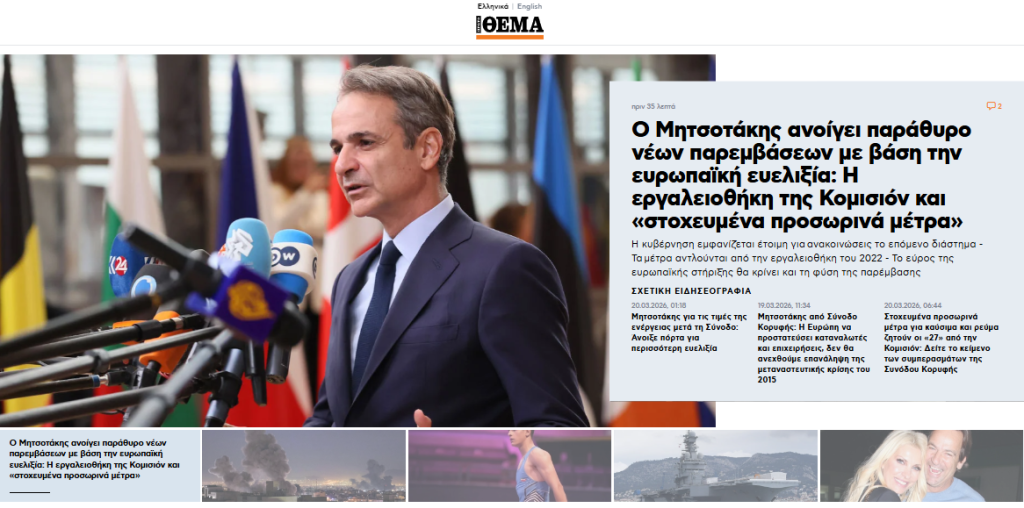
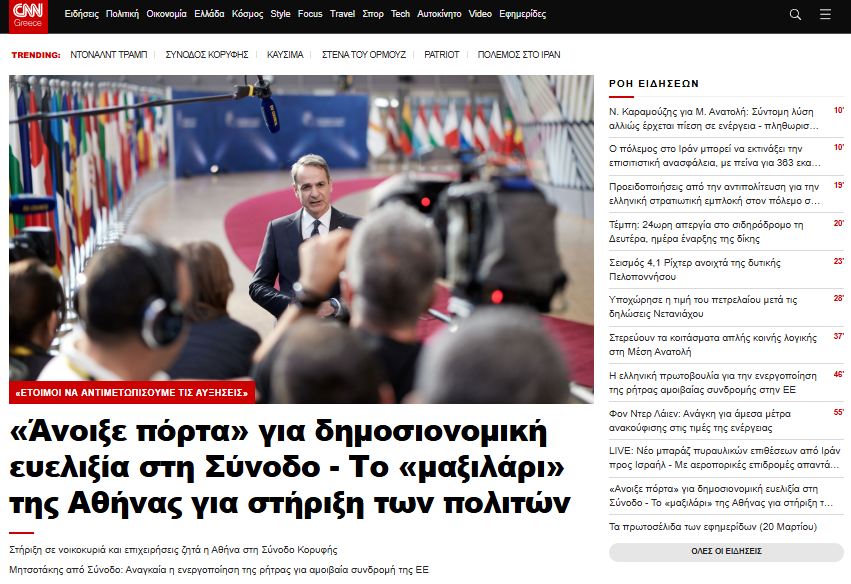


KATHIMERINI: Nightmare scenario regarding energy and refugees
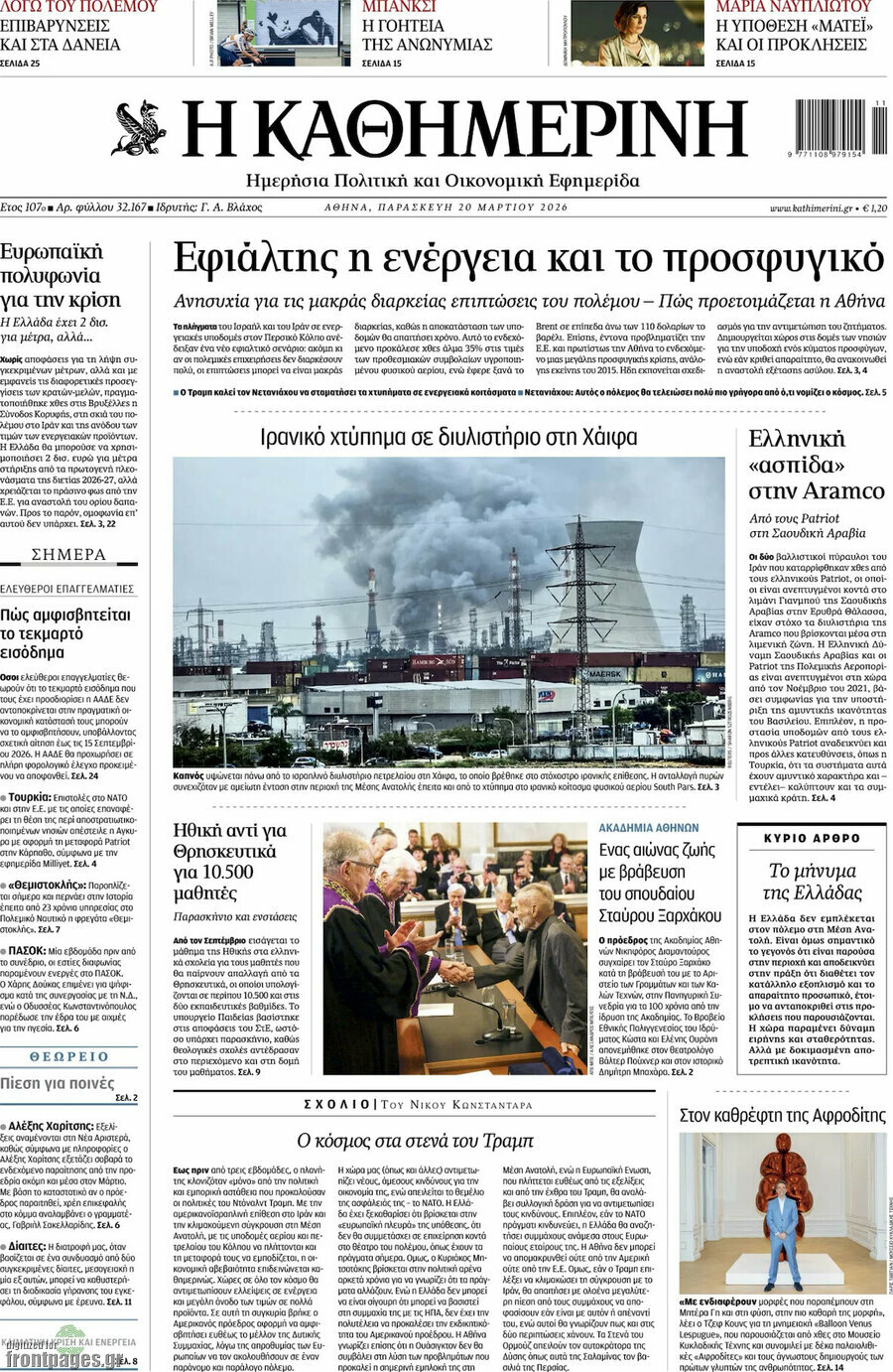
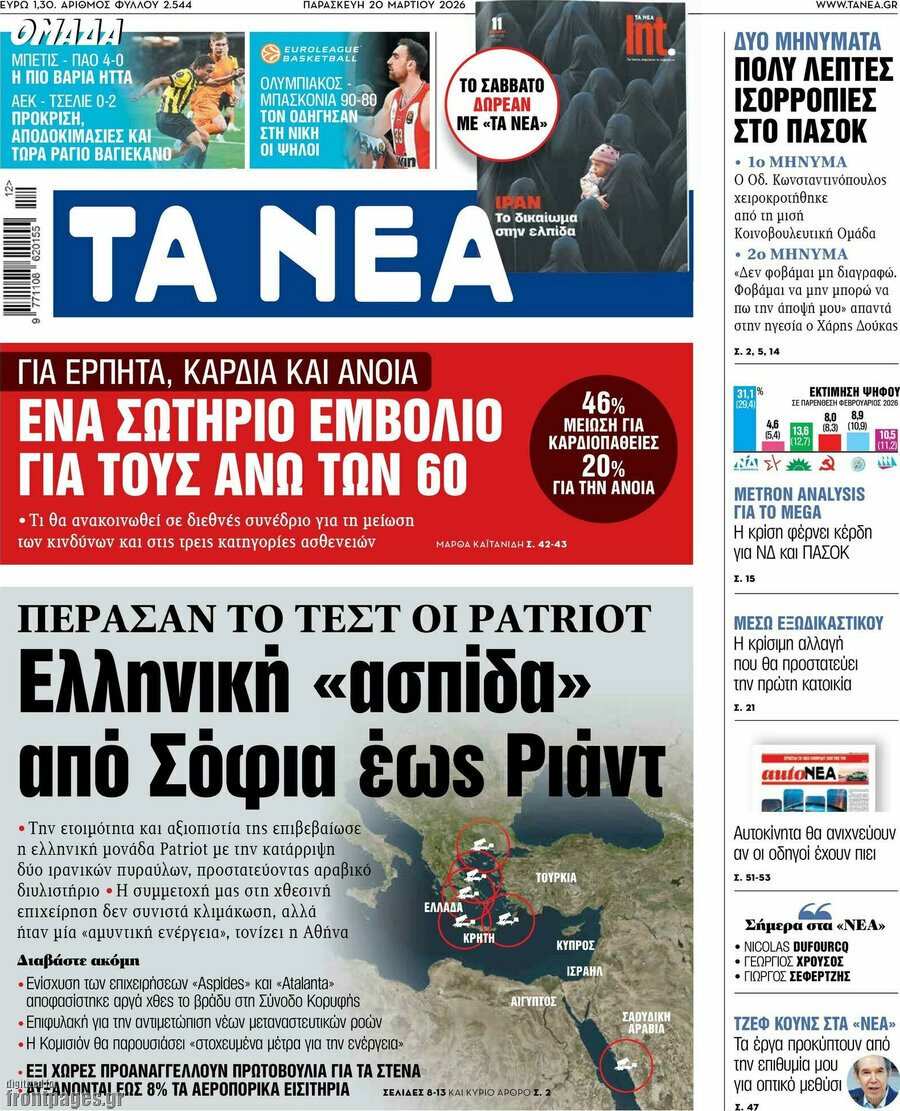
TA NEA: Greek “shield” from Sofia to Riyadh
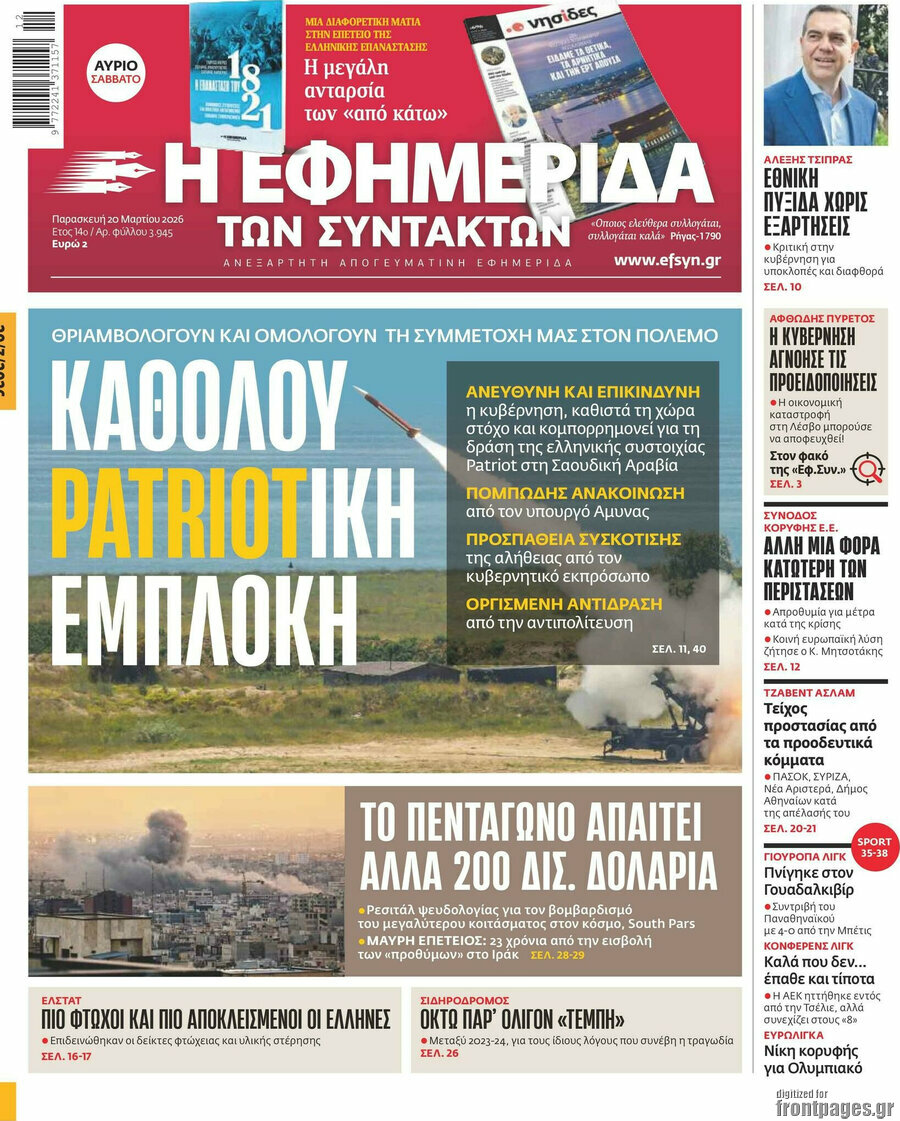
EFIMERIDA TON SYNTAKTON: No “patriotic” involvement in the war
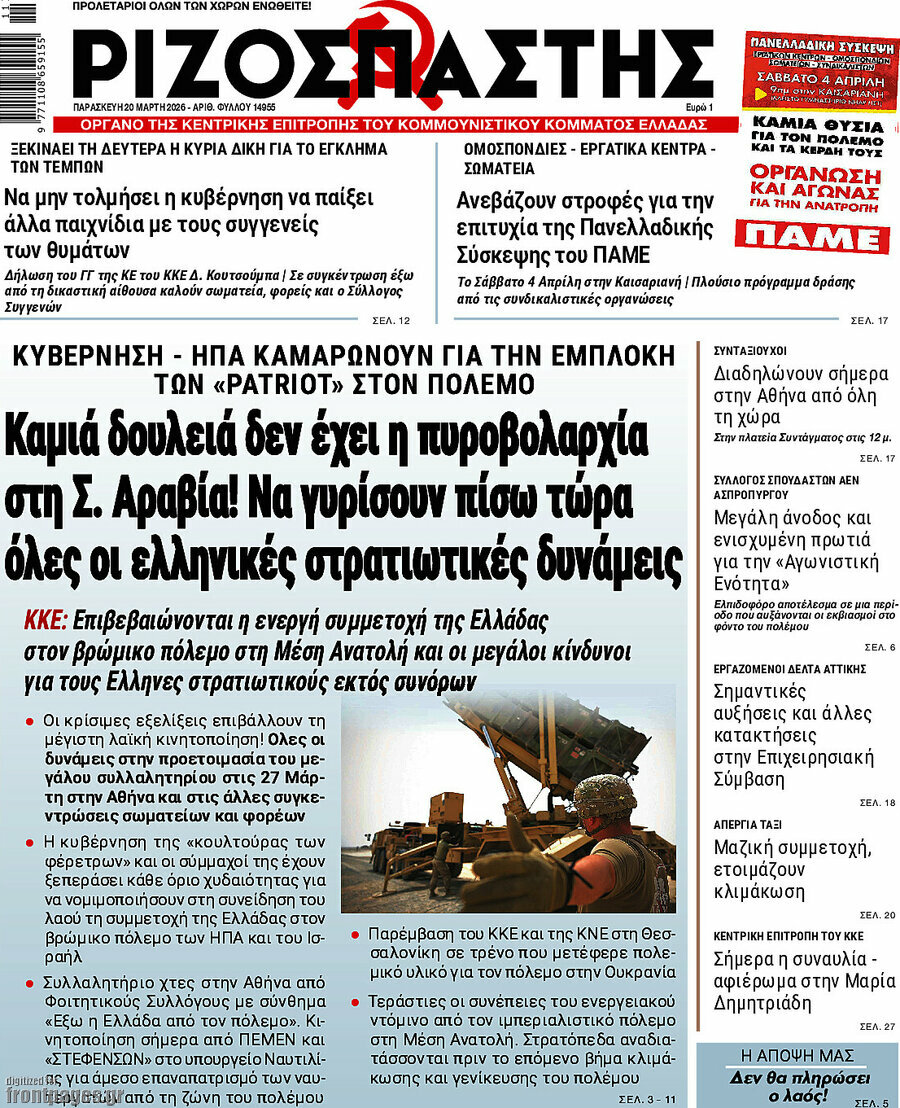
RIZOSPASTIS: Artillery battery has no place in Saudi Arabia! All Greek armed forces must return now
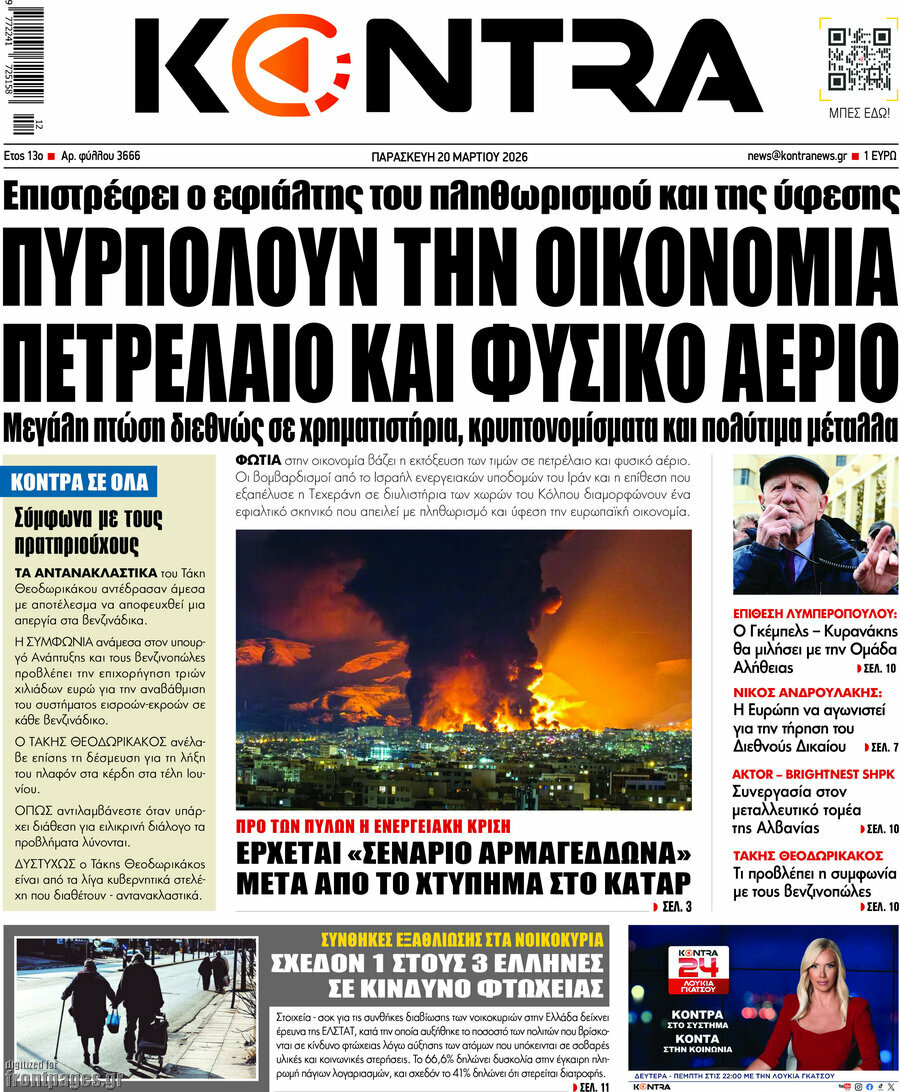
KONTRA NEWS: Oil and natural gas set the economy on fire
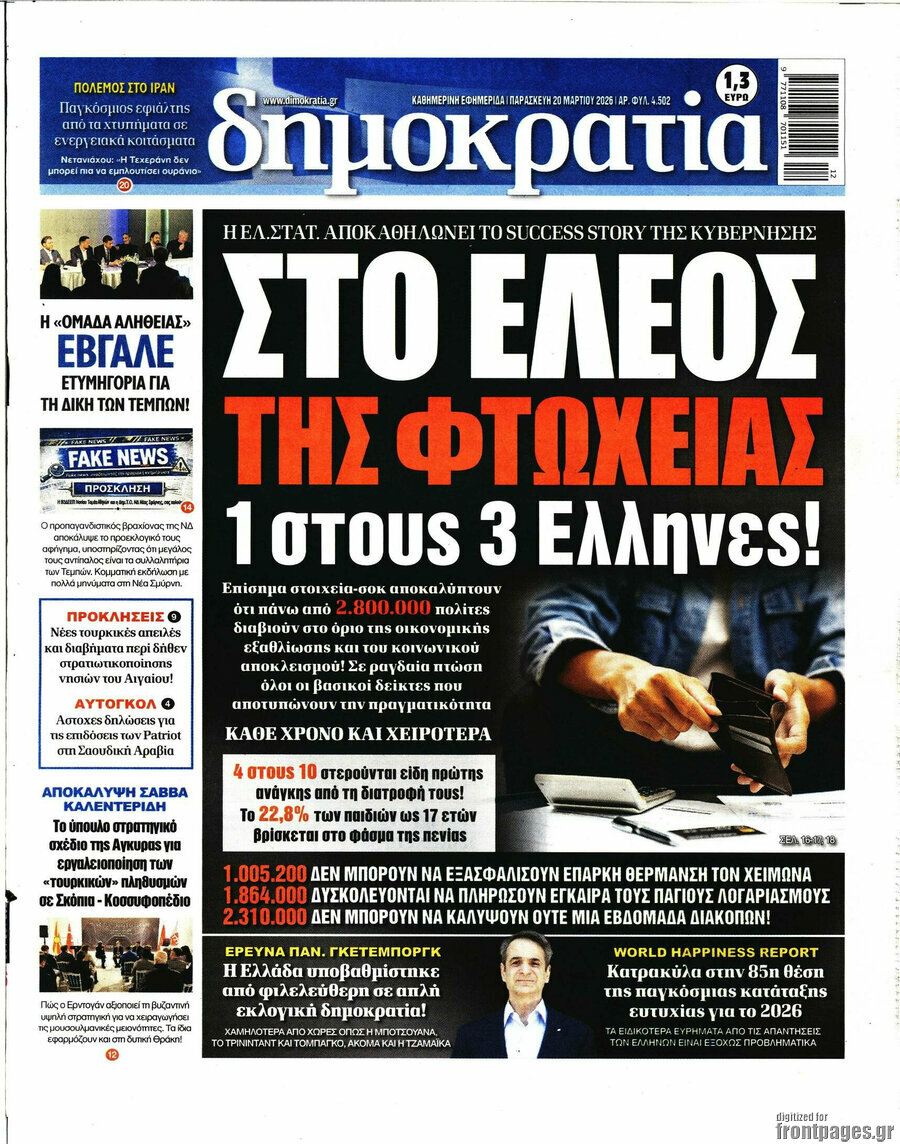
DIMOKRATIA: 1 in 3 Greeks at the mercy of poverty
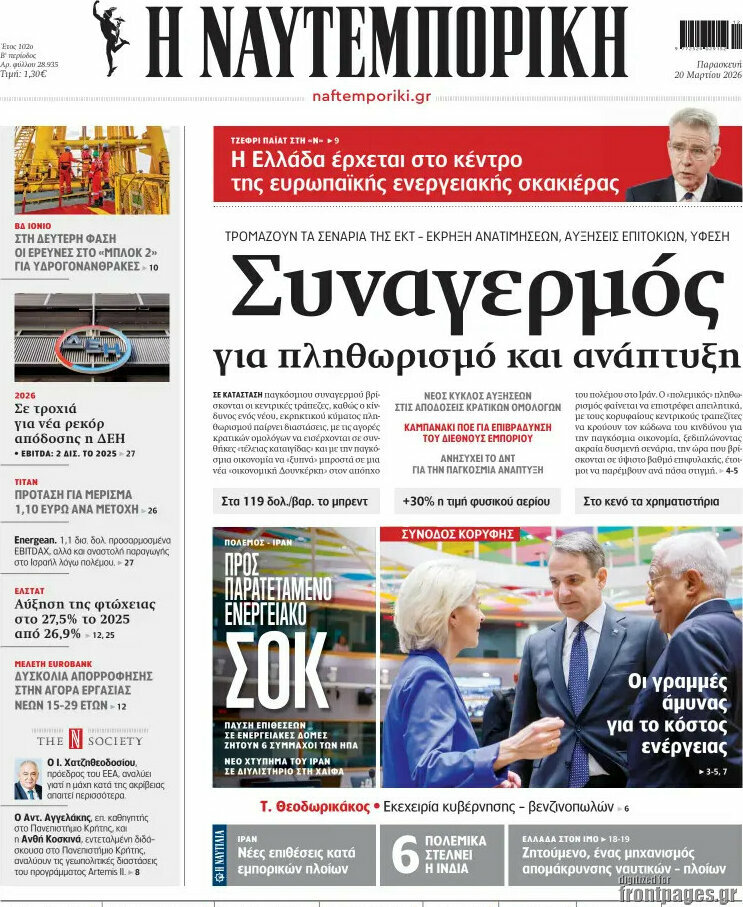
NAFTEMPORIKI: Alert regarding inflation and growth

DRIVING THE DAY
TO THE VIKTOR, THE SPOILS: Hungarian Prime Minister Viktor Orbán left Brussels this morning in high spirits, having secured — in his mind at least — a major victory over the European Union by blocking the €90 billion Ukraine loan after what one diplomat called an “unprecedented” row at the European Council summit.
Orbán drew fire from European Council President António Costa, who usually prides himself on maintaining friendly relations with even the trickiest presidents and prime ministers. Costa, speaking at a press conference last last night, accused the Hungarian leader of “blackmail.” Privately, diplomats said, the confrontation was even more intense.
So much for the peace offering: Orbán refused to back down despite the EU offering financial and technical support to Ukraine to restore the flow of Russian oil via the Druzhba pipeline to Hungary and Slovakia, and dispatching a mission to assess the damage. Orbán had accused Kyiv of slow-walking repairs and insisted he’d block the much-needed loan until oil supplies were restored.
Orbán’s motive? Five diplomats and officials, granted anonymity to speak frankly, said it was clear the standoff over the €90 billion loan was designed to appeal to the Hungarian leader’s core voters at home ahead of a pivotal April 12 election, and that any attempt to force him to back down would only play into his domestic political narrative.
Playbook asked Orbán if he thought his actions would impress Hungarian voters: “I stand for their interests,” he insisted. “So what I have done today is to crush the oil blockade, which were imposed on us by [Volodymyr] Zelenskyy. So I defended the interest of the country.”
That was echoed by Orbán’s EU Minister Janos Boka, who told Playbook Budapest hadn’t planned on creating the row. “It was Zelenskyy who decided to politicize the issue of the Druzhba pipeline not us. It was him who threatened the Hungarian prime minister and not the other way around.”
Italian Prime Minister Giorgia Meloni tried to play good cop in a bid to get a deal, telling leaders she understood her Hungarian counterpart’s reasons for going back on his word and blocking the loan. Most leaders, though, were in no mood to be sympathetic.
Despite their exasperation, they were wary of playing into Orbán’s hands politically: “Normally you can do a deal with Orbán— but these are not normal times,” said one diplomat. “Countries have had enough, but nobody wants to push further at the moment and get dragged into the Hungarian election.” A second said leaders understandably showed their displeasure, “but they didn’t go over or anything beyond that in order to avoid that becoming campaign material.”
Call the lawyers? A third diplomat said that, while complicated legal workarounds could be explored — including voting on some proposals by qualified majority or challenging Budapest under the treaties — “why would you do that before the election?”
The EU’s plan for now … is to wait until after next month’s election to see if Orbán loses, and then assess its options. The loan to Ukraine could be handled administratively without reconvening leaders if Hungary drops its opposition, whether under a reelected Orbán or a new government. Belgium’s Prime Minister Bart De Wever told reporters after the summit that fellow leaders were annoyed by Hungary’s positioning but not panicking, and that the situation will change after the election. “In my view it’s a matter of time,” De Wever said.
“We will deliver one way or the other,” Commission President Ursula von der Leyen insisted.
Will Orbán’s gambit pay off? His Fidesz party is polling at 39 percent, trailing arch-rival Péter Magyar’s Tisza on 48 percent, according to our Poll of Polls, but he’s not conceding anything yet. “Certainly,” Orbán said with a smile when Playbook asked if he can win.
SUMMIT SPEED READS:
— EU leaders find themselves incapable of action despite wars so close to home
— How ‘unacceptable’ Orbán defeated the EU again — but maybe for the final time
— Von der Leyen promises ETS tweaks in ‘days’
— 15 things we learned at the EU leaders’ summit
MIDDLE EAST
IRAN ENERGY CRISIS: While European leaders made little headway in Brussels on a collective response to the crisis in the Middle East, Israel and Iran continued the tit-for-tat attacks on infrastructure that have sent energy markets into a spin and the U.S. stepped up a military campaign to reopen the Strait of Hormuz.
There were some signs of hope overnight: Oil prices retreated after European countries and Japan said they’d contribute to efforts to unblock the strait, the U.S. said it was looking at measures to boost oil supply and Israeli Prime Minister Benjamin Netanyahu said the war will end “a lot faster than people think.” Netanyahu told a press conference that Iran’s capacity to enrich uranium and make ballistic missiles has now been destroyed.
Bibi chastened? Netanyahu also said Israel will hold off on further strikes against Iran’s South Pars gas field at the request of Donald Trump. Trump told reporters in the Oval Office that he’d admonished the Israeli PM for the attack Wednesday that sparked a furious response from Tehran and sent the war into a dangerous new phase. “I told him, ‘Don’t do that,’ and he won’t do that,” the U.S. president said — a rare split between the two leaders that shows how jittery Washington is about containing the energy crisis.
Empty tank: But analysts are warning that a worst-case scenario for gas markets is now looming after Iran’s relatiatory attack against the world’s biggest liquefied natural gas plant. Qatar said Thursday it would be unable to fulfill deliveries to Italy and Belgium following strikes on its production facilities in the Persian Gulf. QatarEnergy’s CEO said the attacks knocked out about a sixth of Qatar’s LNG export capacity and that repairs would take three to five years.
Also: Saudi Arabian oil officials are projecting that oil could rise to $180 a barrel if the disruptions continue beyond next month, the WSJ reports.
And there’s more: Already roiled by Trump’s tariffs, global trade now faces a further slowdown as a result of the Middle East conflict, the World Trade Organization projected Thursday. If the current standoff continues, goods trade will grow 1.9 percent in 2026, down from 4.6 percent in 2025, it forecast.
One outcome from the talks in Brussels: French President Emmanuel Macron said France is looking at using the United Nations as a route to unblock the Strait of Hormuz. Macron said he raised the prospect with U.N. Secretary-General António Guterres of getting a “U.N. framework” to reopen the vital shipping route, and intends to sound out members of the Security Council about the proposal. “We have begun an exploratory process, and we will see in the coming days if it has a chance of succeeding,” Macron said in response to a question from POLITICO.
Bad Romance: Meanwhile, the EU’s top diplomat Kaja Kallas used her time in front of leaders yesterday to caution against getting sucked in to the Middle East conflict. “Starting war is like a love affair — it’s easy to get in and difficult to get out,” she said, according to two diplomats who spoke to Playbook, as the discussion turned to whether to send warships to the Strait of Hormuz.
U.N. warning: Meanwhile, U.N. Secretary-General Guterres — who had lunch with leaders at the European Council on Thursday — sat down with POLITICO as part of the visit to Brussels, warning that there are “reasonable grounds” to believe both sides could have committed war crimes as part of the conflict between Iran and the U.S.-Israeli coalition. You can listen to the full interview on our EU Confidential podcast here.
SINGLE MARKET
ONE EUROPE, MANY MARKETS: While attention is on global conflicts, EU countries have quietly moved to strengthen the single market at home, creating new obligations to break down barriers. The Commission set out a road map on how to relax the flow of goods and workers at a dinner in Brussels Wednesday with single-market “sherpas” — point-people put forward by member countries to deal with the issue.
The bloc is now tied to a series of deadlines, signed off by leaders last night, to tackle questions like a new regime for business rules to mutual recognition of professional qualifications. As one diplomat pointed out, Council conclusions are “gospel” for the Commission and give them momentum for serious reforms.
Expect more of this: German Chancellor Friedrich Merz even went as far as to propose “we should always begin” the European Council conclusions with competitiveness, a move he said received unanimous approval.
VOTE CORNER
SPEAKING OF MELONI: The right-wing Italian prime minister appears to have the world at her feet: rock solid support at home and the respect of her peers in Europe. But Giorgia Meloni’s winning streak will come to an end this weekend if voters reject a contentious referendum proposal she has championed to create separate career paths for prosecutors and judges.
REMEMBERING UMBERTO BOSSI: The father of the Italian party the League died Thursday, aged 84. The far-right party he founded — now led by Matteo Salvini and part of Meloni’s governing coalition — was once a more centrist secessionist movement fighting for the independence of Italy’s richest northern regions from southern Italy, with particular disdain reserved for what he dubbed “thieving Rome.” Bossi remained an icon for the party: “He changed my life,” Salvini said.
OTHER SIDE OF THE RIVIERA: Meanwhile, in the French coastal city of Nice, a projected win for the country’s far right — after a campaign that featured an antisemitic incident where a pig’s head was tied to the gates at the incumbent’s home — shows how anti-immigration forces could take control of the levers of power.
About that vote: Hundreds of thousands of French voters will cast their ballots in local races on Sunday for the second weekend in a row, a critical acid test ahead of next year’s presidential election.Giorgio Leali and Victor Goury-Laffont in Paris have the definitive guide on what to watch out for.
One to watch: Former French Prime Minister Edouard Philippe is being earmarked as the candidate most likely to beat the far right and replace Emmanuel Macron as president. According to polling shared exclusively with POLITICO, he’s on track to survive a must-win vote in Le Havre.
WHO’D HAVE FJORD IT? Norway could one day follow Iceland in hosting a referendum on EU membership, opposition leader Ine Eriksen Søreide told Nick Vinocur.
AND FINALLY: Slovenians are also heading to the polls Sunday to settle what appears to be a close battle between PM Robert Golob and pro-MAGA former premier Janez Janša. This piece by my colleagues Ali Walker, Sebastian Starcevic and Antoaneta Roussi on how the campaign has been clouded by allegations of interference by an Israeli private intelligence firm is well worth your time.
IN OTHER NEWS
INVASION PREPARATIONS: Danish soldiers who flew to Greenland in January were prepared to blow up airport runways over fears the U.S. could invade the Arctic territory, Denmark’s public broadcaster DR reported. Blood supplies were also brought in to treat the wounded in the event of fighting, according to a BBC write-up.
TRUMP TOLD YA: Senior members of Donald Trump’s transition team repeatedly tried to intervene to block former EU Trade Commissioner Peter Mandelson’s doomed appointment as U.K. ambassador to Washington, my colleagues Esther Webber and Daniel Lippman report.
UKRAINE TALKS ON HOLD: The three-way peace talks involving Russia, Ukraine and the U.S. are on a “situational pause” after the start of the Iran war, the Kremlin said Thursday. But Volodymyr Zelenskyy said on X last night that Ukraine is keen to resume discussions and is expecting a meeting on Saturday.