Greek warships deploy off Cyprus in show of support amid regional tensions
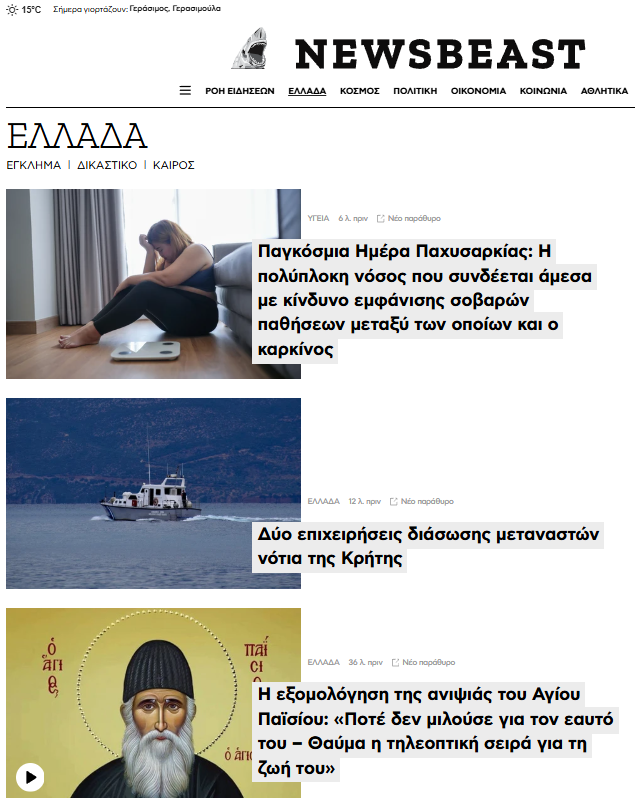
Two Greek warships arrived off Cyprus early Wednesday, completing what Athens described as a defensive deployment aimed at shielding the island from a potential Iranian strike and underscoring Greece’s solidarity with Nicosia.
PM Mitsotakis meets with PASOK leader Androulakis
Prime Minister Kyriakos Mitsotakis on Tuesday met in his office in Parliament with main opposition PASOK-KINAL leader Nikos Androulakis, in order to brief him, at his request, on developments in Iran and the wider Middle East region. The meeting took place at a particularly critical moment for international and regional stability, against the backdrop of rapid developments in Iran and the Middle East.
https://www.amna.gr/en/article/974614/PM-Mitsotakis-meets-with-PASOK-leader-Androulakis
Papastavrou: We confirmed that Greece has a sufficient supply; energy security is national security
The assessment of the crisis in the Middle East and its impact on the Greek energy market, was discussed at a broad meeting held on Tuesday evening at the Ministry of Energy, chaired by the Minister of Environment and Energy Stavros Papastavrou, and Deputy Minister Nikos Tsafos, with representatives of supervised bodies and oil, natural gas, and electricity companies.
Appeals court reaffirms Golden Dawn as criminal organization
An appeals court on Wednesday unanimously upheld a landmark ruling that the neo-Nazi party Golden Dawn operated as a criminal organization, reaffirming a 2020 trial court decision.
ATHEX: Year’s gains go up in gunsmoke
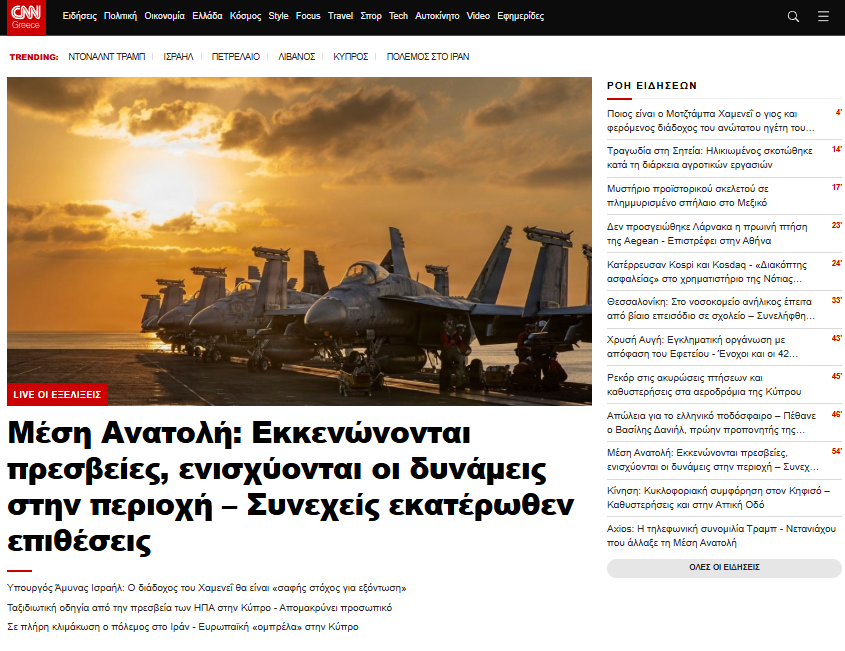
Developments in the Middle East have meant that all of the Greek bourse gains in the first couple of months of the year have vanished and the momentum of local stocks from the 2025 financial reports has been completely obliterated. On Tuesday the main index at Athinon Avenue accelerated its drop, and has now declined about 10% in the last three sessions, losing all its 2026 gains and then another 2.18%.
https://www.ekathimerini.com/economy/1296921/athex-years-gains-go-up-in-gunsmoke

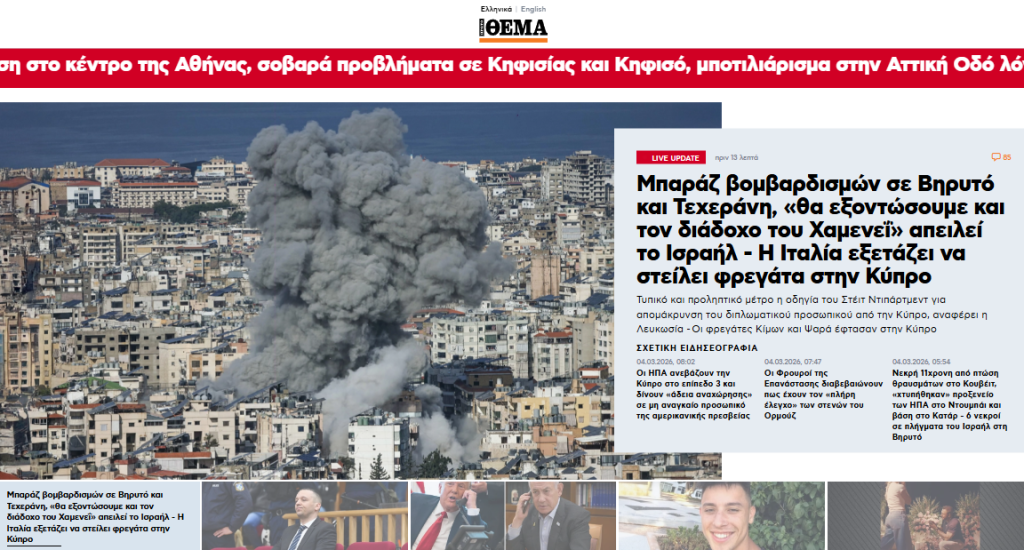

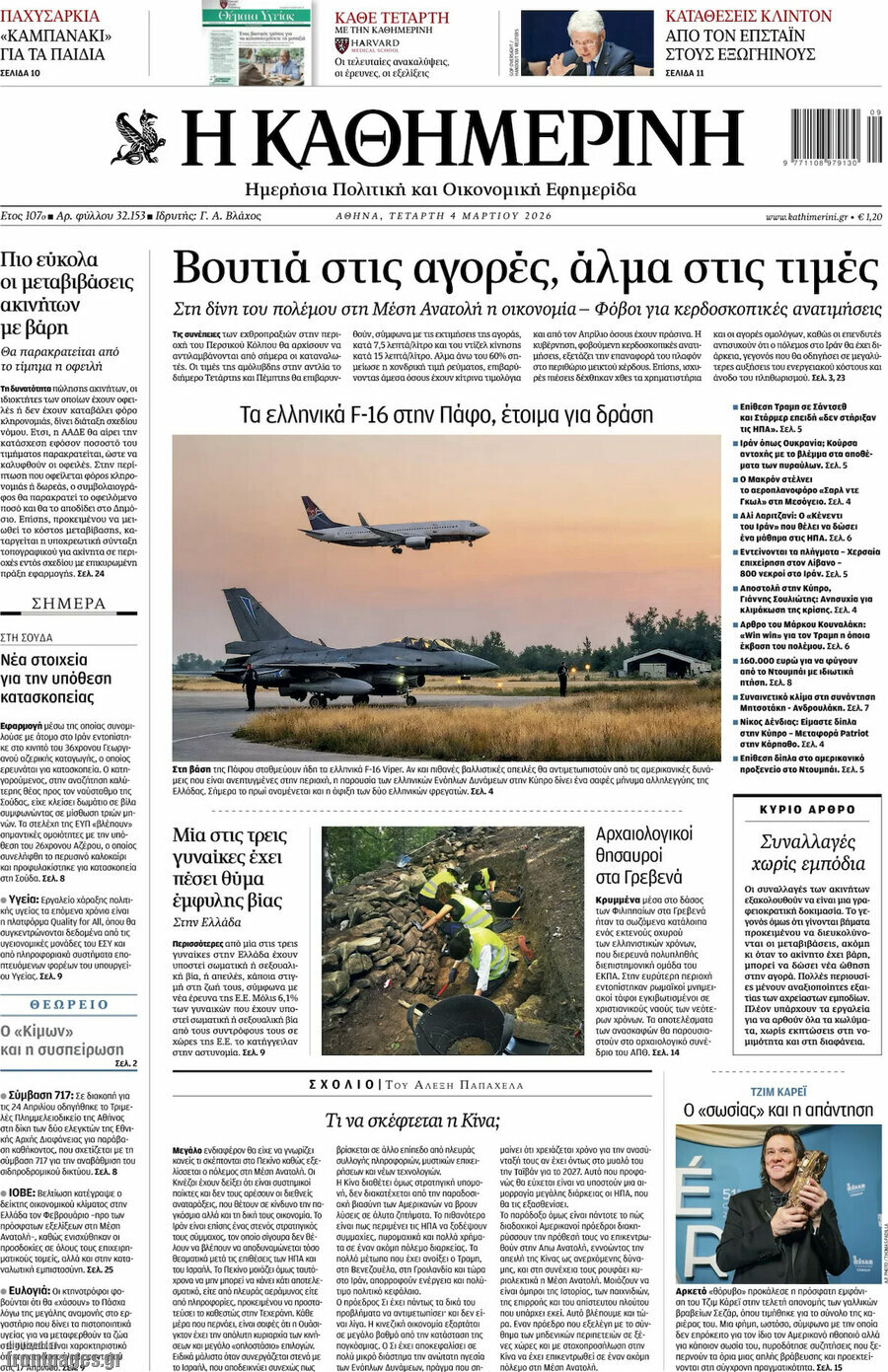
KATHIMERINI: Markets plunge, prices spike
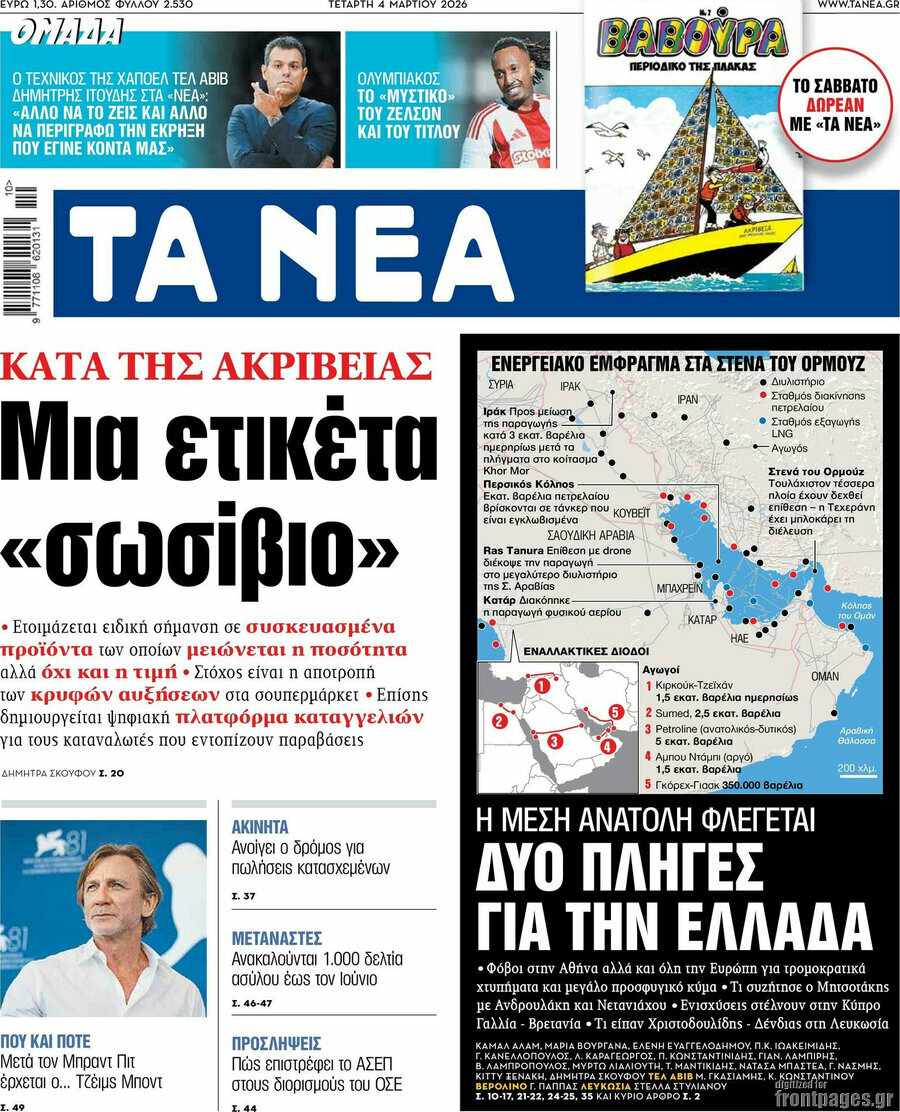
TA NEA: A label to act as a “lifejacket” against price hikes
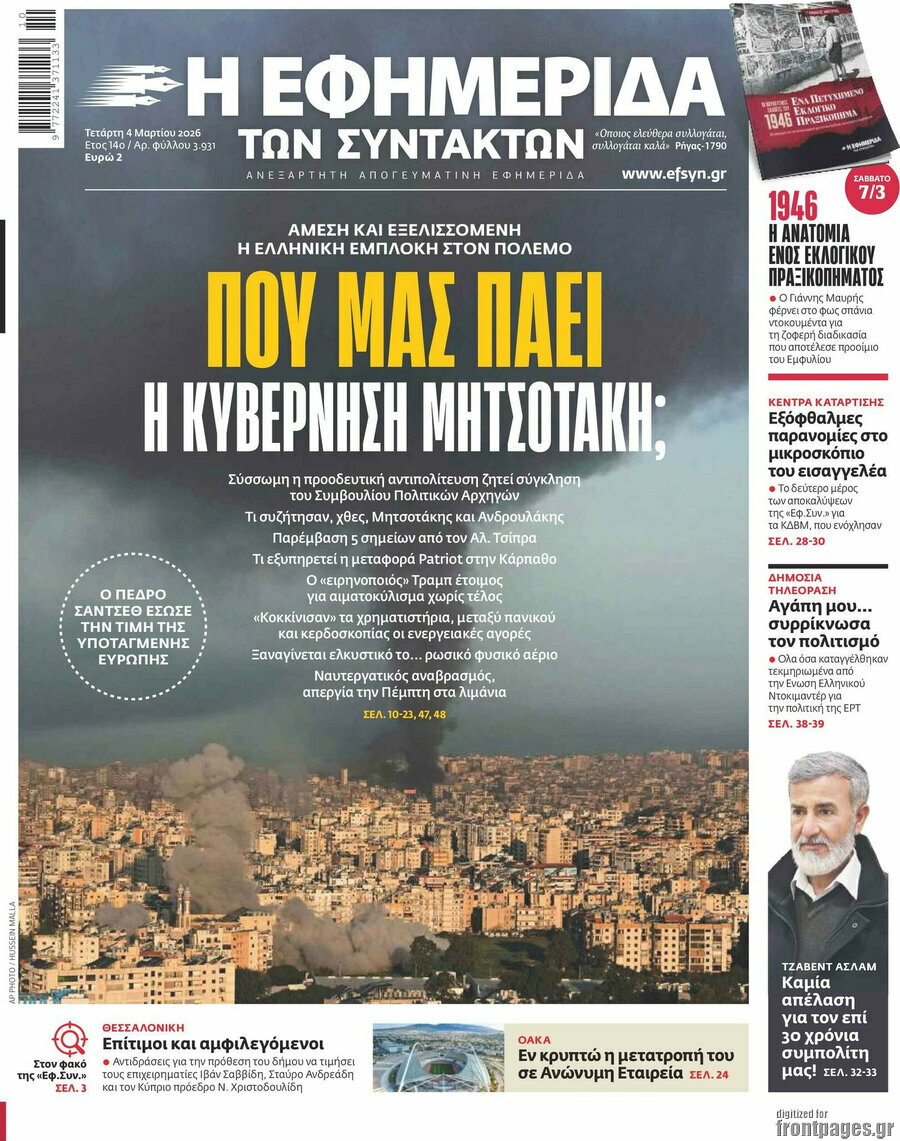
EFIMERIDA TON SYNTAKTON: Where is the Mitsotakis government leading us?
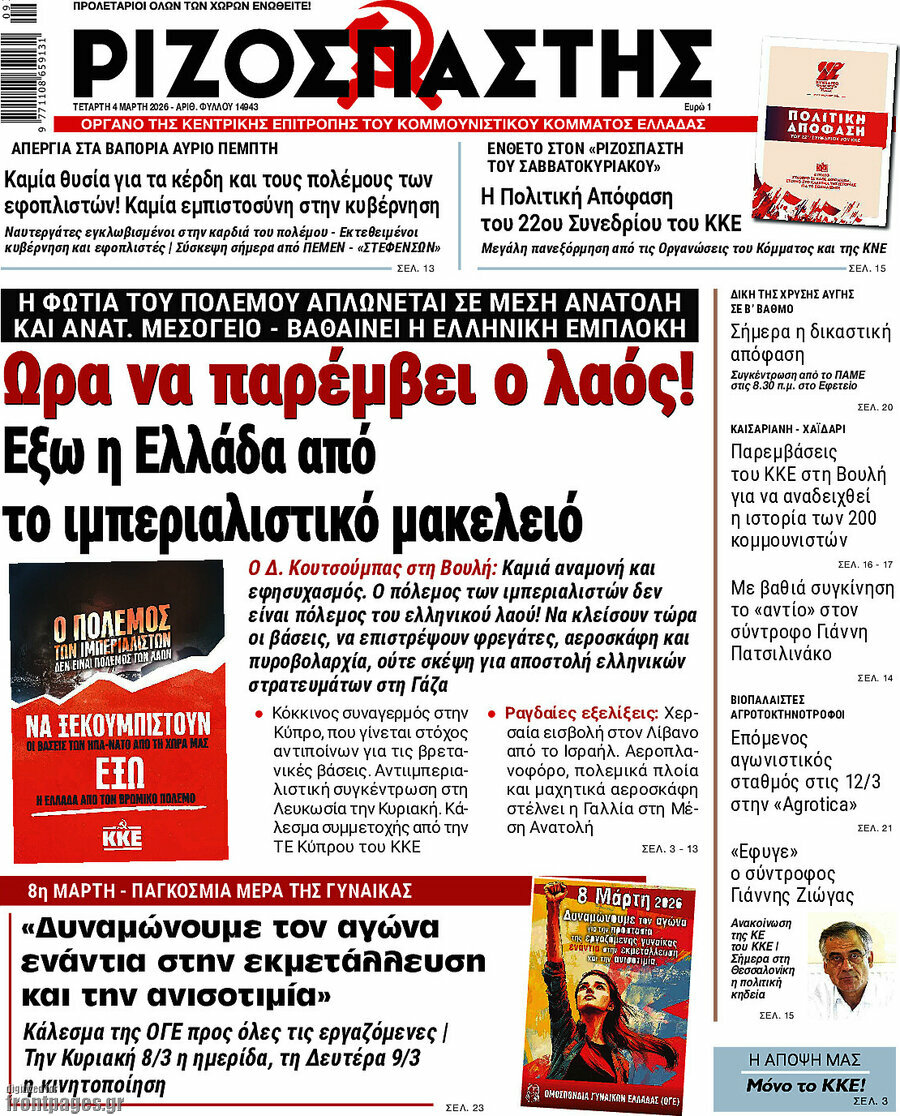
RIZOSPASTIS: Time for the people to intervene so that Greece stays out of the imperialistic massacre
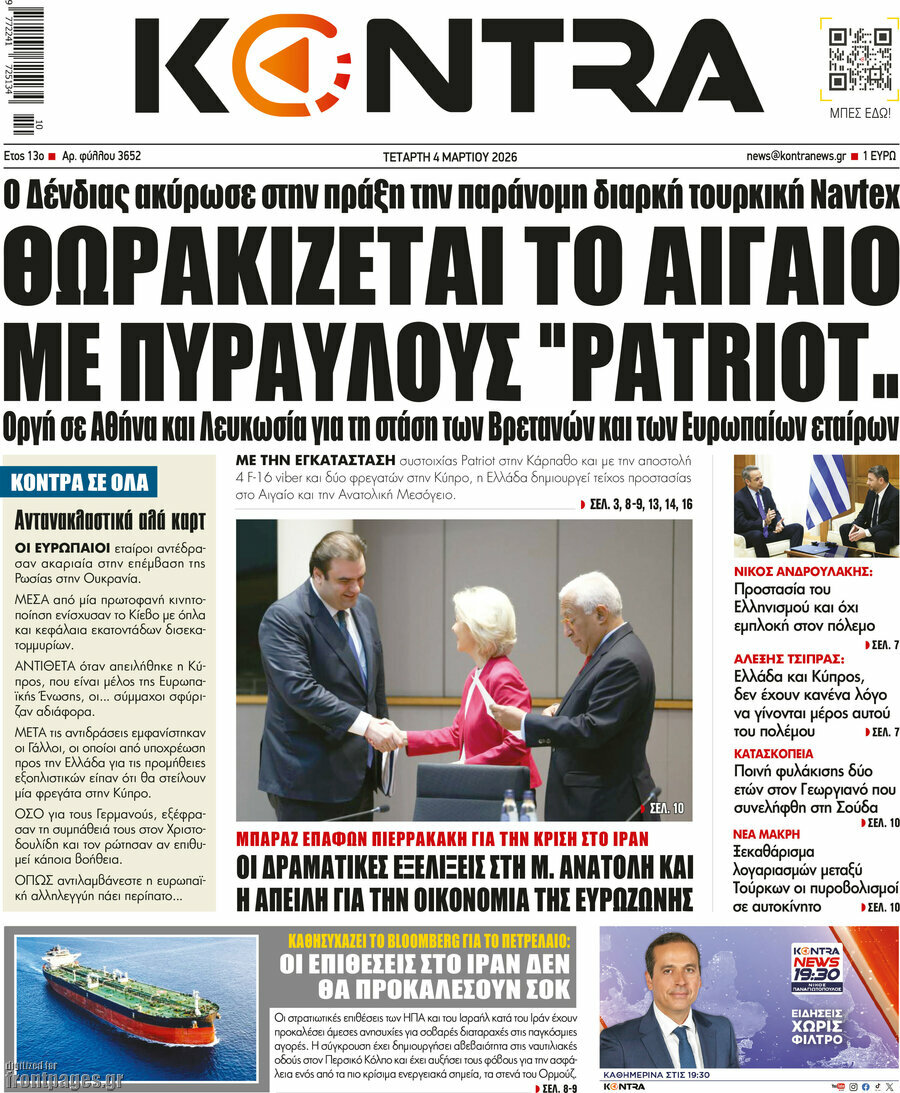
KONTRA NEWS: The Aegean Sea is fortified with Patriot missiles
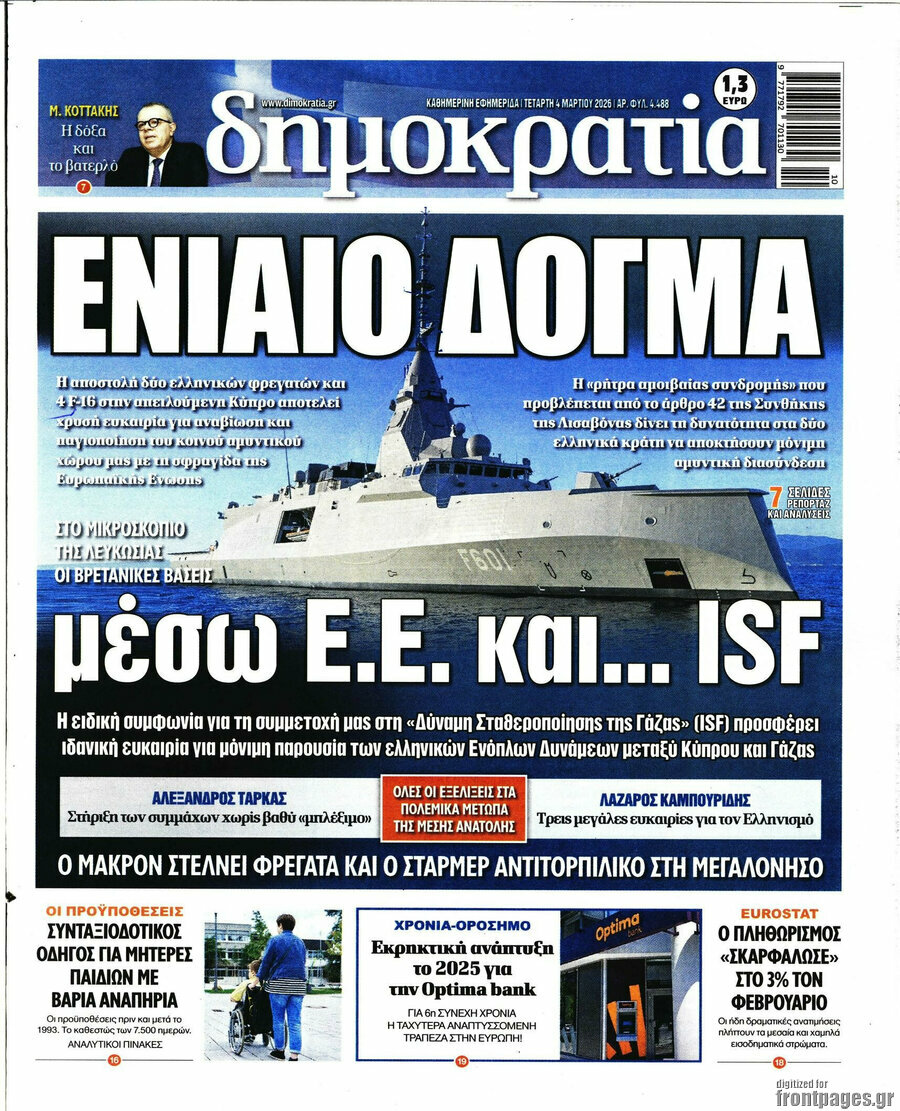
DIMOKRATIA: Joint defense dogma via EU and… ISF
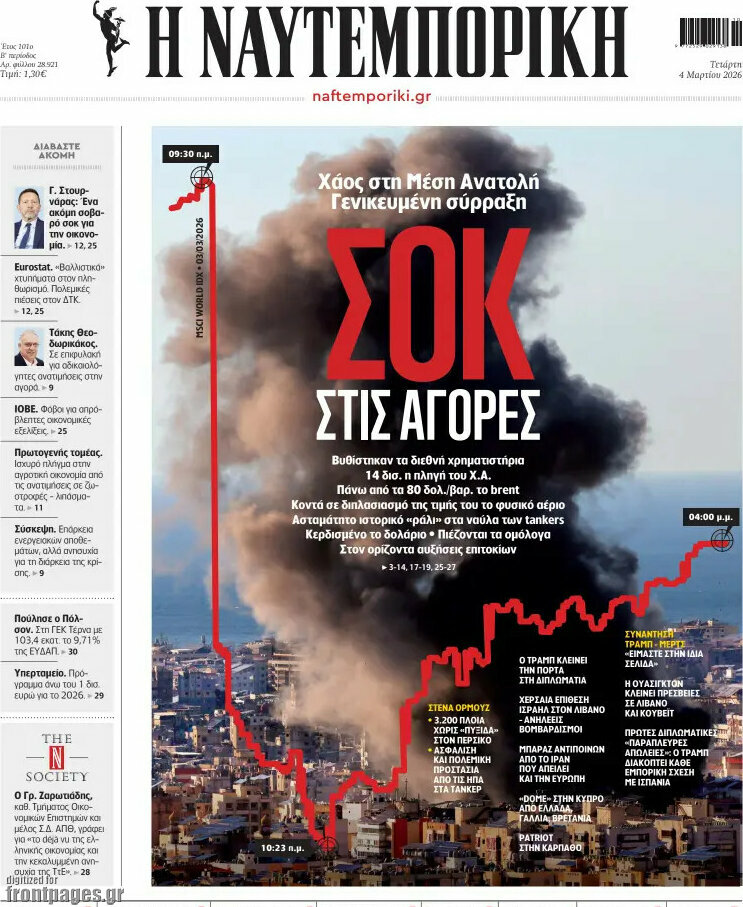
NAFTEMPORIKI: Shock for the markets

DRIVING THE DAY
IT’S MADE IN EUROPE DAY: Not many expected this to land today, but after weeks of internal wrangling — and moments when it looked close to collapsing — the European Commission is set to unveil the Industrial Accelerator Act (IAA), its attempt to put European industrial policy back in the driver’s seat.
What’s in the pipeline: Commission Executive Vice President Stéphane Séjourné will hold a press conference after the weekly College of Commissioners meeting where he’ll unveil a more interventionist policy agenda aimed at slowing Europe’s industrial decline and keeping pace with China in advanced manufacturing and clean tech.
In simpler terms: European governments will be nudged to spend more of their taxpayers’ money on green products made in the EU, boosting demand for domestic industries.
Made in Europe, making headaches: The plan’s most controversial element is the so-called Made in Europe clause — essentially channeling public procurement money toward EU-based companies, including quotas for materials such as aluminum, concrete and mortar, as well as components used in electric vehicles.
Expect pushback from: 1. Member countries that have previously bristled at the idea — Germany foremost among them. Many who’ve seen the final version say it appears to only sidestep the concerns raised by Berlin … 2. third countries that have complained or asked to be included in the “Europe” count, including Switzerland and the U.K. … and 3. parts of industry, particularly the automotive sector. France’s Renault is already warning of a “guillotine effect” (the French do love a guillotine metaphor).
It was a struggle to get here: By our count, the proposal has been delayed at least three times since the beginning of the year and debated in three special preparatory sessions stretching from Sunday into Tuesday. One Commission official told me there were 44 edits to the text on Monday alone.
Lights, camera … It’s not quite screenplay-worthy drama, but yesterday’s technical briefing for reporters was filmed for a documentary about how policy gets made in the Brussels bubble, according to colleagues who were there.
Why the marathon drafting? “The time spent drafting this text reflects the scale of the change it introduces,” Séjourné told me and Aude van den Hove ahead of the presentation. The EU’s industry chief argued that the months spent ironing out differences inside the Commission should make negotiations with EU capitals and lawmakers somewhat smoother.
Late … and rushed: But my colleagues Jordyn Dahl, Aude, Zia Weise and Francesca Micheletti report that by trying to salvage the credibility of a core plank of Commission President Ursula von der Leyen’s Clean Industrial Deal, the executive risks having the legislation torn apart during consultations with the Council of the EU and European lawmakers.
One thing we’ll be watching … is the open question of what constitutes a “trusted partner.” Recent drafts appear to move toward an opt-out rather than an opt-in system, which would give the executive greater flexibility over which non-EU countries qualify — and avoid having to negotiate agreements country by country.
When the proposal comes out, the real fight begins. EU capitals will have to forge a common position, bridging the divide between Germany’s caution and France’s enthusiasm for industrial activism. As Séjourné put it to us: “The accelerator is more than just a change in operating method; it represents a change in doctrine.” And doctrine shifts rarely go down quietly.
ALSO TODAY — MARITIME STRATEGY SETS SAIL: The Commission will also unveil its long-awaited EU Industrial Maritime Strategy and Ports Strategy — Brussels’ plan to revive Europe’s struggling shipbuilding sector — after another internal tug of war, Martina Sapio writes in. One source of friction: DG TRADE pushed back against draft language suggesting a review of import duties on certain ships, warning it could undermine trade and forcing renegotiations that stretched until the week before publication.
MIDDLE EAST CRISIS
FRIENDLY FIRE? Europe’s Iran headache is getting worse. As tensions escalate in the Middle East, EU capitals are being squeezed both by Tehran’s threats and pressure from Washington.
Unfriendly Madrid: U.S. President Donald Trump blasted Spain from the Oval Office yesterday for refusing to allow the U.S. to use the jointly operated Morón de la Frontera and Rota airbases to launch attacks on Iran. Trump slammed Spain’s position as “terrible” and “unfriendly,” warning: “We’re going to cut off all trade with Spain.”
Trade ban or … embargo? The U.S. Supreme Court recently curtailed the administration’s ability to impose sweeping tariffs, but Trump suggested he could instead reach for trade embargoes — and hinted Spain might be first in line. “I could tomorrow — or today, even better — stop everything having to do with Spain,” he said.
Madrid shrugs: Spain brushed off the threat Tuesday, with one government source saying it has “the necessary resources to mitigate potential impacts, support affected sectors and diversify supply chains.” If Washington wants to alter its trade relationship with Spain, they added, it must respect “the autonomy of private companies, international law and the bilateral agreements between the European Union and the United States.”
The spat with the White House has reinforced Spanish Prime Minister Pedro Sánchez’s role as one of the bloc’s most outspoken anti-Trump voices, my colleague Aitor Hernández-Morales writes.
Not helpful, Merz: Trump’s jibe at Spain came during a press conference alongside German Chancellor Friedrich Merz, who offered little cover for Madrid. Instead, Merz echoed criticism of Spain’s refusal to back Trump’s demand that NATO allies spend 5 percent of GDP on defense — a stance that last year prompted Trump to suggest Spain could be “thrown out” of the alliance and face punitive tariffs. “We are trying to convince Spain to catch up with the 3 percent or 3.5 percent we agreed in NATO,” Merz said.
Third Gulf War looming? Iran warned European countries Tuesday that joining U.S. and Israeli attacks on its territory would mean entering the war.
Are we at war already? Not according to Cyprus. The military buildup around the island is “necessary,” but the country itself is not part of the conflict, government spokesman Konstantinos Letymbiotis said. Israeli Ambassador to Brussels Avi Nir-Feldklein told my colleague Gabriel Gavin that Europe is already at war with Iran — whether it likes it or not.
Macron moves: French President Emmanuel Macron said Tuesday he has ordered the aircraft carrier Charles de Gaulle to deploy to the Mediterranean. France’s credibility is at stake, he said, and Paris must honor its defense commitments to partners such as Qatar and the United Arab Emirates.
Breaking overnight: an Air France plane arrived at Roissy-Charles de Gaulle Airport from Oman carrying the first French citizens to be repatriated from the region, Le Monde reports.
Schrödinger’s Coreper: Meanwhile, Brussels remains largely stuck in analysis mode. An Integrated Political Crisis Response meeting convened Tuesday by the Cypriot EU presidency initially looked like a kind of super-Coreper, bringing together the Commission, the EU’s diplomatic service and the European Council. But in reality, as one EU official put it, it turned into something closer to a “Schrödinger’s Coreper,” with participants unsure of what, if anything, it would produce.
The outcome was predictably inconclusive. According to a readout from an EU official, delegations discussed potential risks to EU citizens in the region, energy and transport disruptions, economic fallout including supply-chain shocks and internal security concerns. Officials also received an update on the consular situation.
TECH WORRIES FROM IRAN: Commission Executive Vice President Henna Virkkunen told POLITICO’s Mathieu Pollet the EU’s immediate priority is the safety of its citizens in the Middle East — but she also warned of heightened cyber threats, particularly targeting Europe’s critical infrastructure. Defending against cyberattacks is “something we have to do all the time,” Virkkunen said, “but in this very risky situation in the Middle East we have to be extra alert.”
UKRAINE LOAN
THERE’S ALSO THE HUNGARY DILEMMA: The rapid escalation of conflict in the Middle East has partly distracted Brussels from another delicate file that remains urgent but unresolved: the €90 billion loan package for Ukraine, currently blocked by Hungary.
Where we left it: The Commission said last week it was exploring options to circumvent Budapest’s veto, but it has yet to present a concrete proposal. I asked Commission spokesperson Paula Pinho yesterday whether there’s anything on the table, and she told me: “They may not be visible, but we are working on options to precisely unblock the €90 billion loan.”
The timing matters: Ukraine is expected to run short of funds by the end of March, and EU leaders have pledged to cover Kyiv’s financial needs for the next two years. “We are very much aware that the clock is ticking,” Pinho added.
Dear Ursula: Hungarian Prime Minister Viktor Orbán had until now mostly addressed European Council President António Costa in relation to the dispute over the loan, but he sent a message to Commission President von der Leyen Tuesday, according to a post on X. Commission officials said at yesterday’s midday press briefing that Orbán’s letter hadn’t yet arrived, but an EU official later told Playbook it reached Brussels in the evening.
In case it wasn’t clear: Orbán’s core complaint remains the halt in the flow of Russian oil through the Soviet-era Druzhba pipeline, which Budapest believes Kyiv has deliberately shut off. In his letter to von der Leyen, Orbán again proposed sending a fact-finding mission to investigate the damage to the pipeline and urged the Commission to support the idea.
Diplos doubling down: “It is absolutely necessary to relaunch the Druzhba for Hungary,” a Hungarian official told POLITICO, adding that they would accept whatever the fact-finding mission concluded. It could be a way to unblock the Ukraine loan, the diplomat suggested, though they warned that any attempts to bypass Budapest’s position “would be seen as an escalation.”
Stalemate persists: “We’re all very aware Orbán is in full election mode,” an EU official told Playbook, referring to Hungary’s parliamentary election on April 12. Negotiations are ongoing, the official said, but the situation remains stuck. “We’re just not there yet.”
Even a call didn’t help: Von der Leyen spoke with Zelenskyy on Tuesday evening (the Ukrainian president also called Costa, according to another EU official). A Commission spokesperson confirmed that the pipeline issue came up in the conversation but provided no further details.
NEW DUTCH PM
JETTEN MAKES HIS BRUSSELS DEBUT: The Netherlands’ new prime minister, Rob Jetten, was in Brussels Tuesday for his first foreign trip — an early sign of his ambition to bring his country closer to the EU. The Dutch leader did the full EU circuit, meeting Ursula von der Leyen, António Costa, Parliament President Roberta Metsola, NATO Secretary-General Mark Rutte and Belgian Prime Minister Bart De Wever.
Iran everywhere: Unsurprisingly, the Middle East dominated the agenda. Iran came up in “every conversation,” Jetten said at a presser attended by POLITICO’s Sonja Rijnen. The focus was on the safety of Europeans in the region and the potential economic spillover. The war is already affecting “energy prices, the economy and how Europe can prepare for this,” he warned.
Diplomatic tightrope: Jetten acknowledged there were questions about the legality of the U.S.-Israeli airstrikes — “International law is always tricky in situations like this,” he said — but stressed that Iran has long destabilized the region. He said the Netherlands understands the action the U.S. and Israel has taken but pointed out that it’s not actively contributing to the military operation.
Learning from a veteran: Jetten’s meeting with former Dutch PM Rutte provided a lighter moment when the NATO chief offered a tip for surviving the first weeks in office: “Occasionally get some sleep.”
Orbán in the WhatsApps: Jetten revealed he’d also exchanged messages with Hungarian PM Orbán after being sworn in. “It is obvious that we are not on the same page on a number of files,” Jetten said. “But that is also the beauty of the European Union.” He added: “My own sexuality is something he’s going to have to deal with.” (Jetten is the Netherlands’ first openly gay prime minister.)
Something Orbán won’t love: The new Dutch government wants less unanimity in EU decision-making, Jetten said — a position that would weaken the veto power Hungary and others often rely on.
Working with Brussels: Von der Leyen said she has “high expectations” for the new Dutch government. Jetten signaled a transactional relationship ahead: “She knows what she’s getting with me. On some files I’ll help her a lot — and on others I’ll ask something in return.”
Migration stays a priority: Officials in the European Parliament said Jetten made a “very good and positive” impression, focusing on competitiveness, security and climate. Migration remains high on his agenda too: he confirmed he will continue the informal pre-summit “migration breakfasts” his predecessor Dick Schoof shared with Italian Prime Minister Giorgia Meloni and Danish Prime Minister Mette Frederiksen.
IN OTHER NEWS
PROVOCATIVE ART: An exhibition of satirical artwork inside the European Parliament has sparked backlash from the right. The display, organized by centrist German MEP Marie-Agnes Strack-Zimmermann, features works from Düsseldorf’s carnival — including a depiction of Donald Trump engaged in a sexual act with the Statue of Liberty.
Street-carnival worthy: The right-wing European Conservatives and Reformists group condemned the display, with Co-Chair Nicola Procaccini calling it “disrespectful to the American people.” Strack-Zimmermann told Playbook the backlash demonstrates the exhibition’s relevance, adding that “precisely where art provokes, we must defend it.”
TIME FOR AN EU-TURKEY RESET? Enlargement Commissioner Marta Kos says it’s time to put the EU’s relationship with Turkey on a new footing after “years of frosty relations.” The commissioner, who is in Berlin today for talks with Chancellor Friedrich Merz’s European affairs adviser Michael Clauss, told my Berlin Playbook colleague Hans von der Burchard that “migration management is not possible without Turkey” and that the Iran war could trigger new flows of refugees to Europe. She also said Ankara is central to Brussels’ hopes of creating alternative trade links between Europe and Asia.
BIG PHIL ENTERS THE FAO RACE: A new contender has entered the race to become the EU’s single candidate for the top job at the Food and Agriculture Organization: former Agriculture and Trade Commissioner Phil Hogan. My colleague Ketrin Jochecová has the story on Hogan’s Dublin-backed candidacy.