Paris, Athens deepening naval alliance
Defense Minister Nikos Dendias will host his French counterpart, Catherine Vautrin, on Thursday, aboard the newly delivered frigate Kimon, underscoring the growing defense partnership between Athens and Paris.
https://www.ekathimerini.com/politics/foreign-policy/1293558/paris-athens-deepening-naval-alliance
PASOK leader: Gov’t responsible for undermining people’s trust in institutions, political system
The government is responsible for undermining institutions, PASOK-Movement for Change (KINAL) leader Nikos Androulakis said in Parliament on Wednesday, adding he will request a parliamentary discussion ex agenda.
Proposed migration law to crack down hard on illegal entry to Greece
Tough draft legislation the center-right government has brought for debate in Parliament will allow no opportunity for migrants who entered the country illegally to acquire legal status, Greece’s migration minister said. Plevris said that while provisions will be made for migrant workers to be invited to Greece for specific projects, “from now on the only way in for somebody to work will be the legal one.”
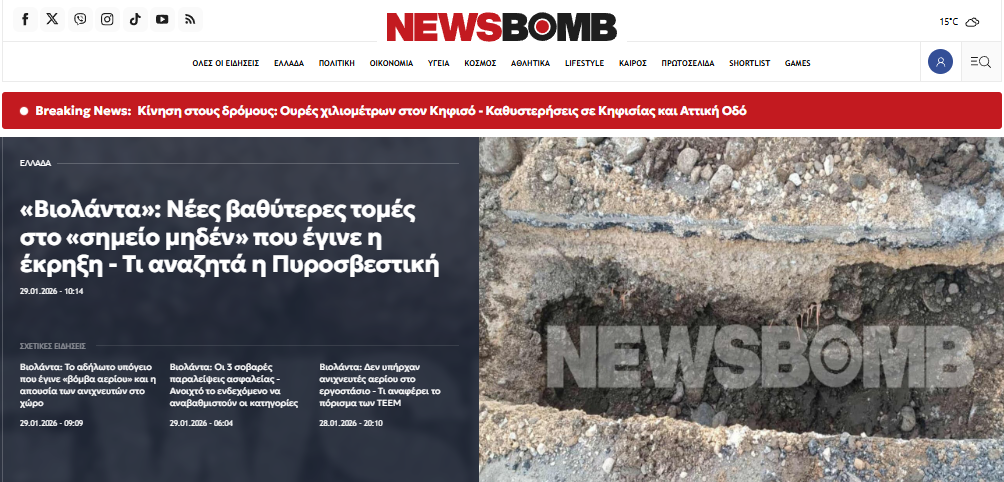
Long-term propane leak from underground pipe to blame for explosion at Violanta factory, investigators report; three released after testifying
A months-long propane gas leak led to the explosion that caused the death of five workers at the ‘Violanta’ biscuit factory in Trikala on Monday, the chief of the National Coordination Operations & Crisis Management Center (ESKEDIK) said in a briefing on Wednesday.
ATHEX: Index hits level unseen since 2009
The Greek stock market is going from strength to strength and from record to record. On Wednesday, its benchmark climbed to highs unseen since late 2009, while turnover was the highest of the last three weeks. Buying interest partly shifted away from bank stocks and into some other blue chips, diversifying the forces of price growth compared to Tuesday. The expectation for an earlier entry of the local bourse in the club of advanced markets has accelerated the arrival of foreign funds and investors, observers note.
https://www.ekathimerini.com/economy/1293669/athex-index-hits-level-unseen-since-2009

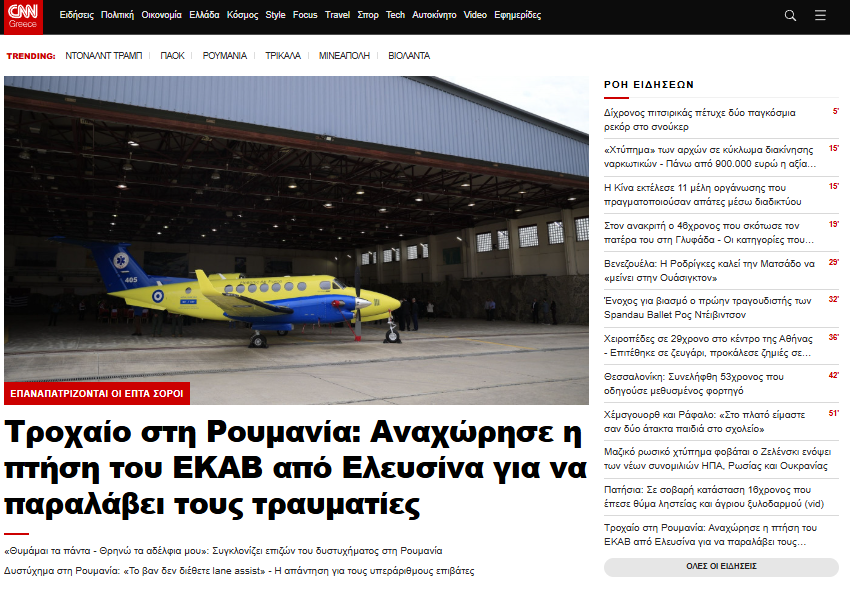
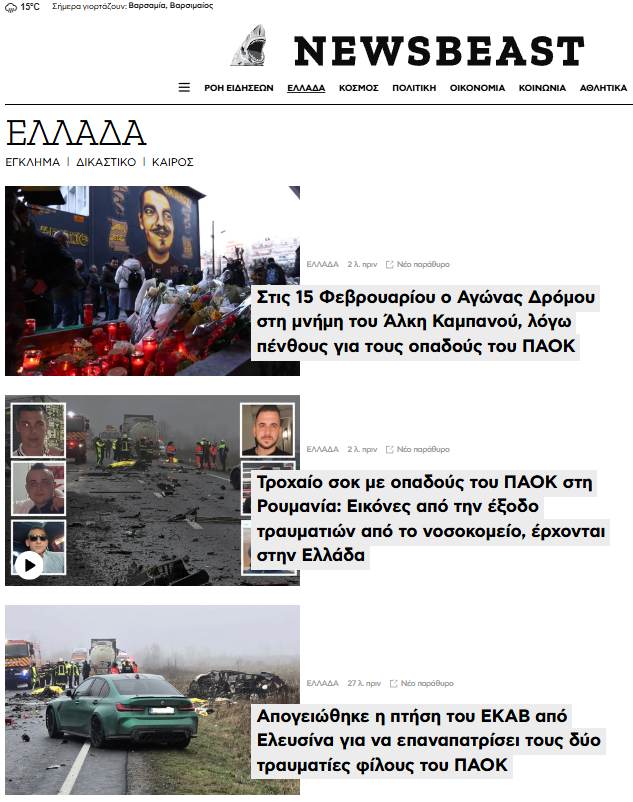

KATHIMERINI: French Minister of the Armed Forces, Catherine Vautrin: Defense agreement with Greece is a priority
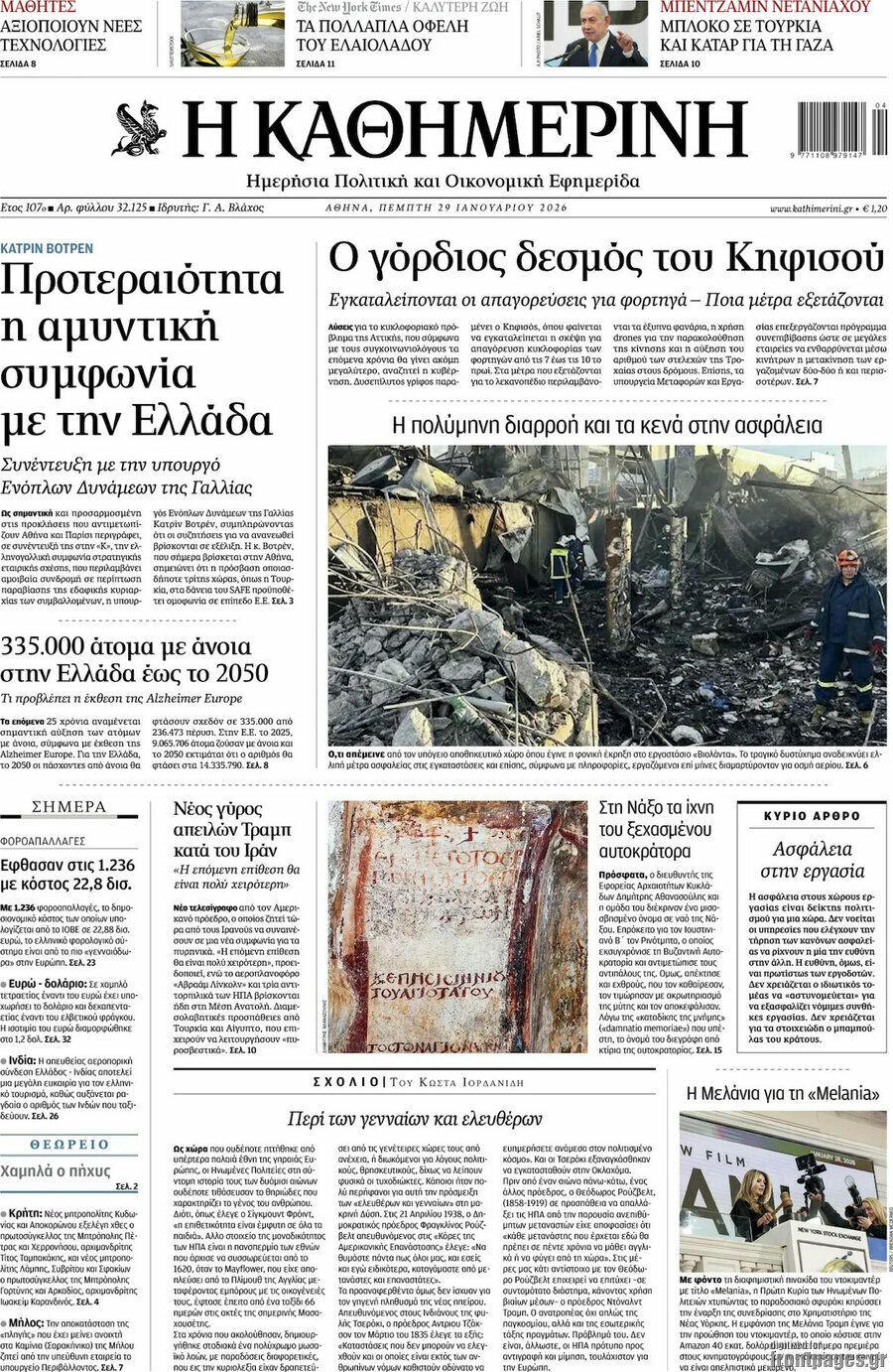
TA NEA: Constitution review to begin very soon
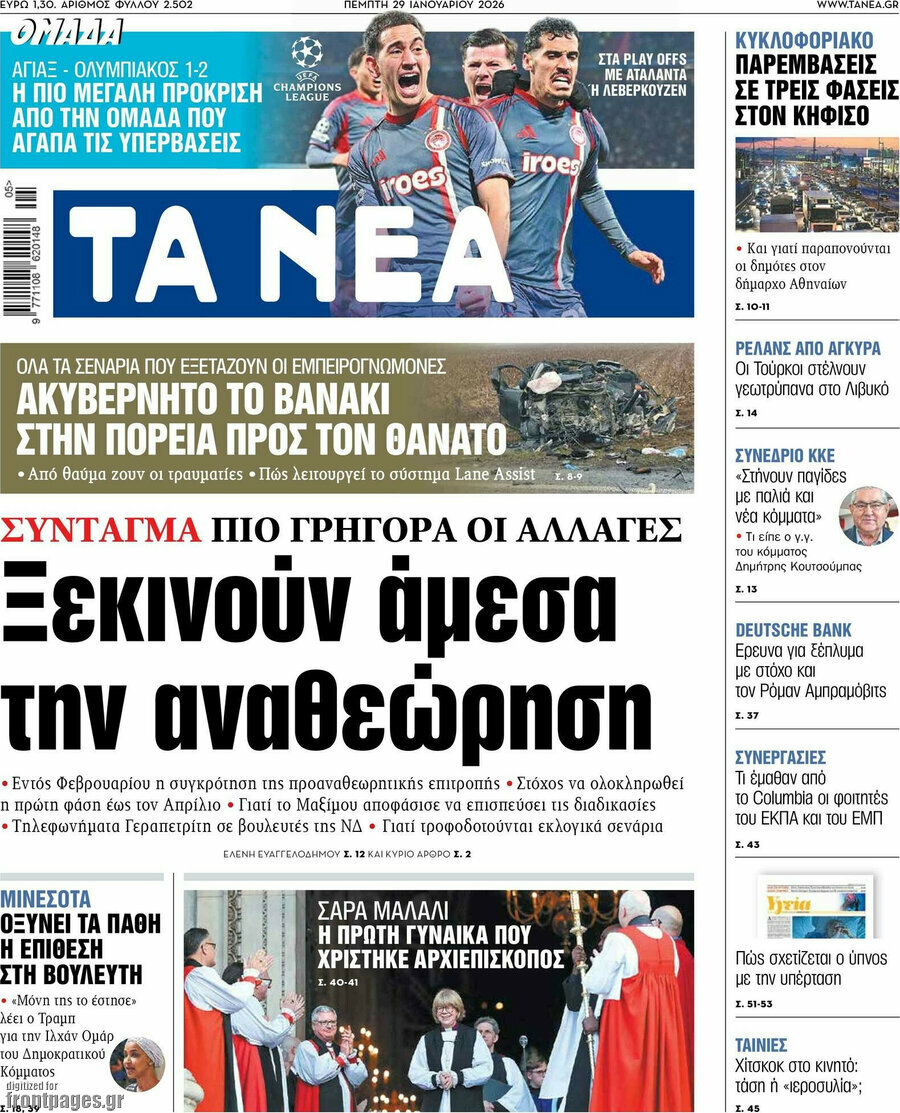
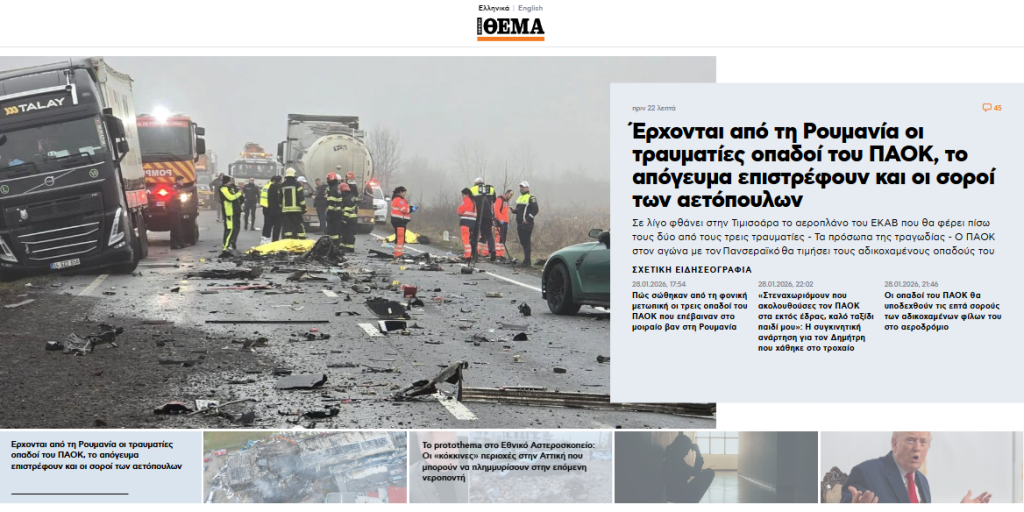
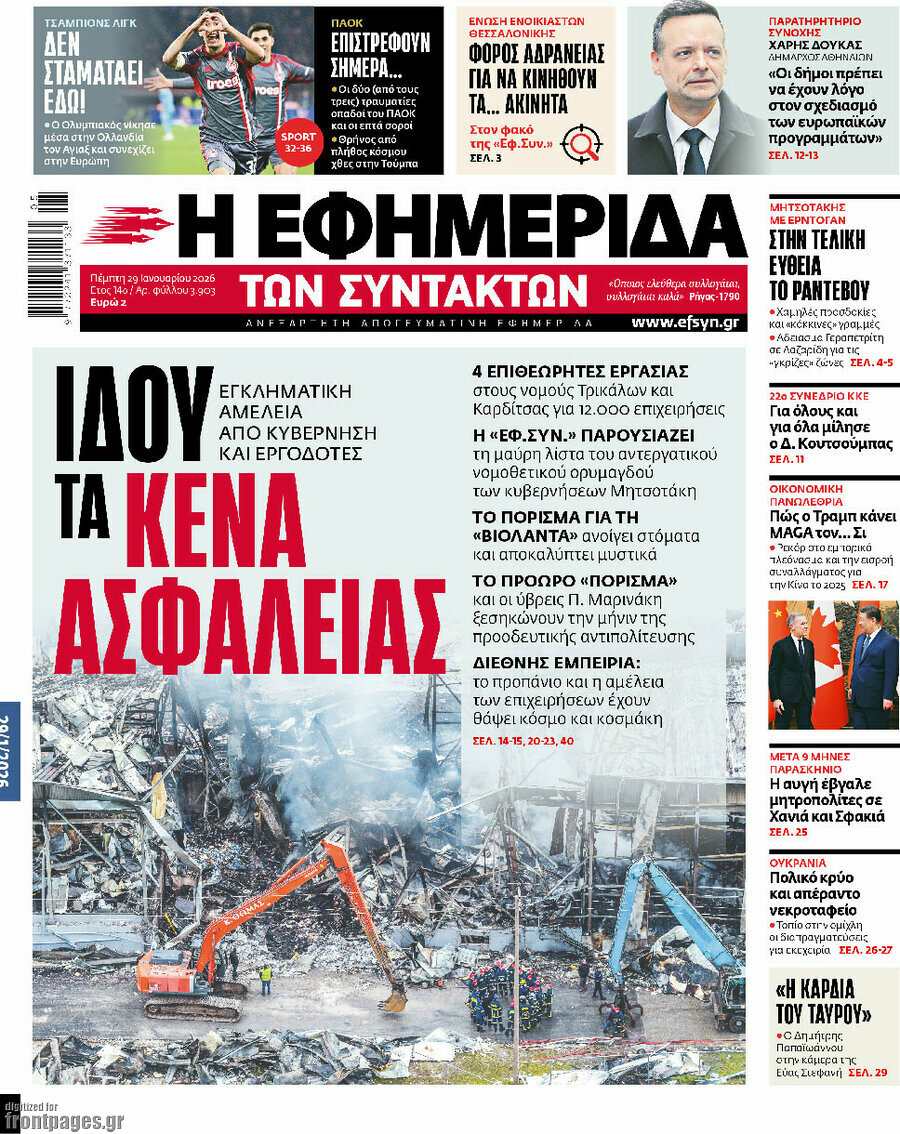
EFIMERIDA TON SYNTAKTON: Security gaps regarding workers’ safety exposed
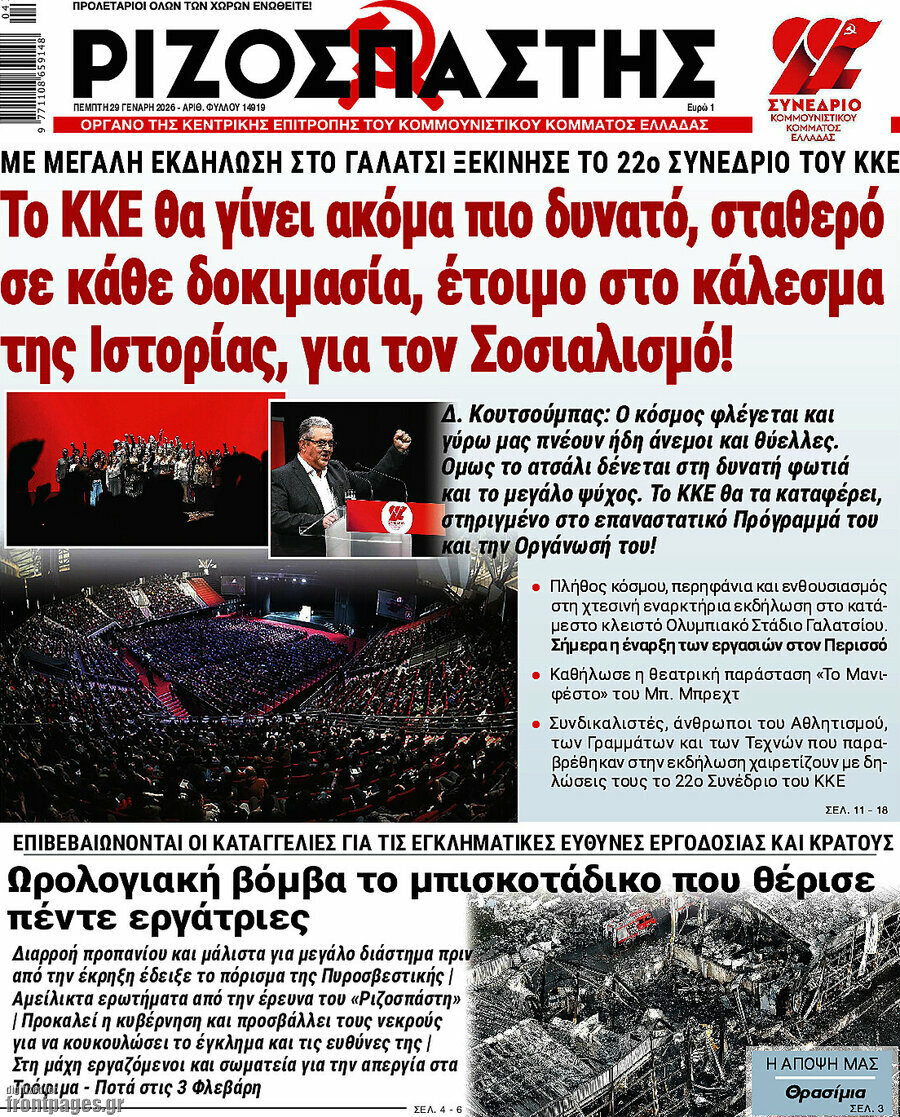
RIZOSPASTIS: The Greek Communist Party will grow stronger and more stable and will be ready to heed history’s call for socialism
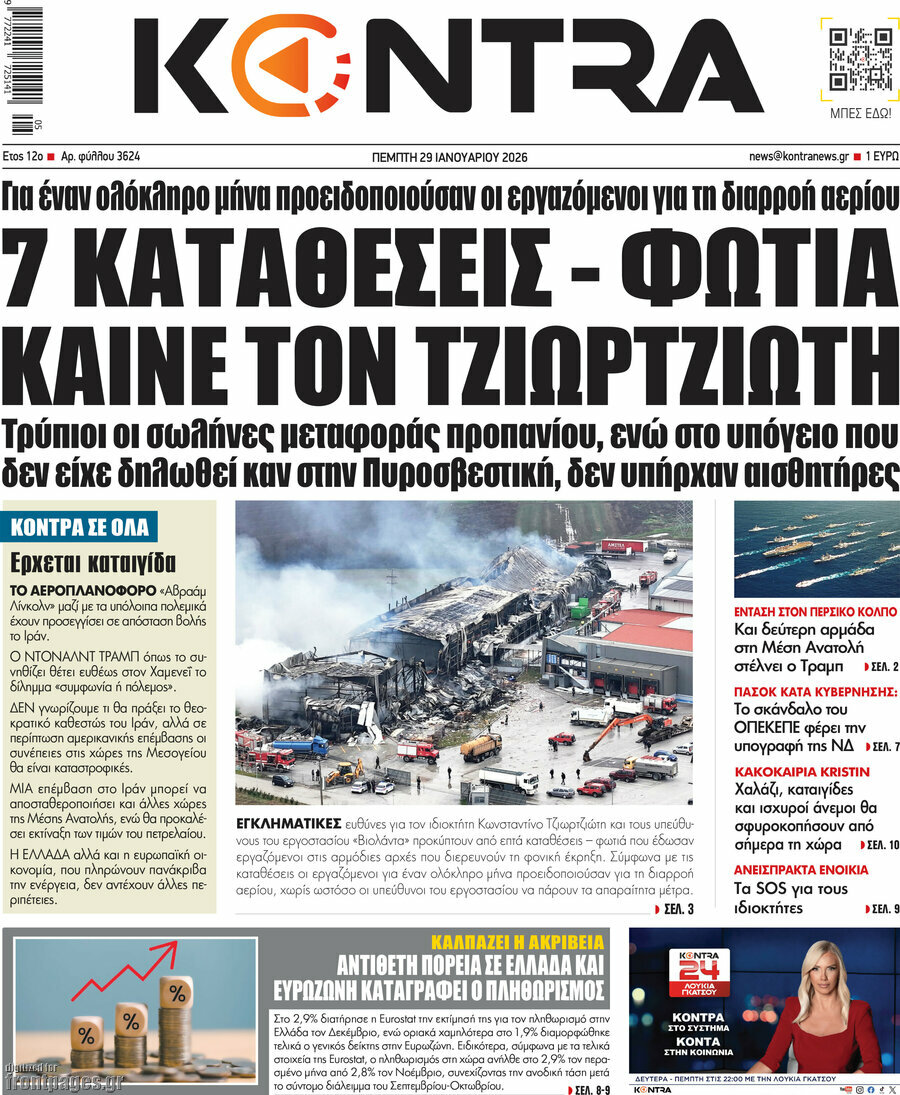
KONTRA NEWS: Seven “hot” testimonies incriminate “Violanta” biscuit factory owner Tzortziotis
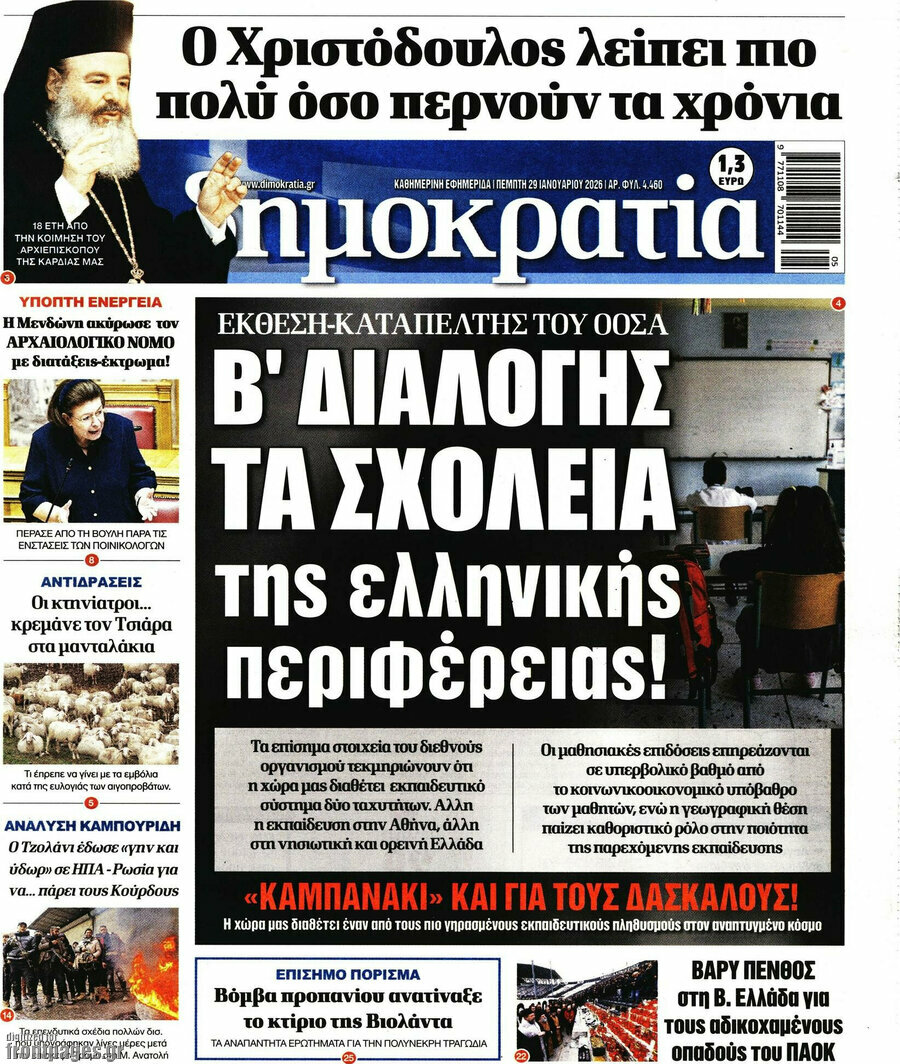
DIMOKRATIA: Regional areas have second-gear schools
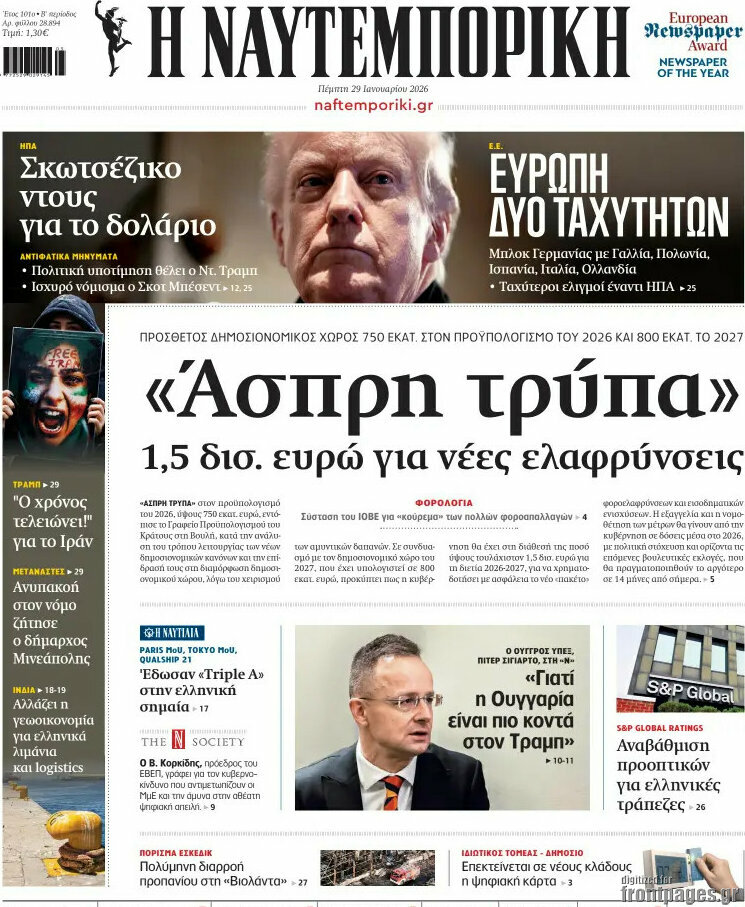
NAFTEMPORIKI: “White hole” of 1,5 billion euro paves the way for new alleviations

DRIVING THE DAY
WHAT’S ALL THE FAC ABOUT? European Union foreign ministers meet in Brussels today for a packed Foreign Affairs Council, with a major potential breakthrough on Iran in reach — along with a push to stop former Russian soldiers who have fought in Ukraine from entering the bloc.
The foreign ministers will focus on three live areas: Ukraine, including the latest readouts on peace talks … the Middle East, with Iran, Gaza and Syria all in play … and the African Great Lakes, following the renewed offensive in the Democratic Republic of the Congo by the M23 paramilitary group.
Beyond stock-taking: Across the board, today’s agenda shows an EU trying to move beyond mid-game crisis management and toward something closer to strategic endgame planning on several long-running files.
Revolutionary breakthrough: As Playbook reported yesterday, EU members appear close to an agreement on listing Iran’s Islamic Revolutionary Guard Corps (IRGC) as a terrorist organization, after France dropped its opposition to the move. All the background you need is in this story by Gabriel Gavin, Zoya Sheftalovich and Tim Ross.
If agreed, the IRGC listing would amount to a remarkable and, until recently, unlikely shift. It still requires unanimity, but the mood in town suggests no member country is expected to block consensus.
What would change: The IRGC listing would trigger asset freezes and travel bans, placing the group alongside al Qaeda and Islamic State — effectively shutting down Tehran’s last remaining channel with the EU.
Send the message: Ahead of the FAC, Dutch Foreign Minister David van Weel told POLITICO’s Tim Ross it was time for Europe to send a “strong signal” after the regime’s crackdown on peaceful protests. Listing members of the Pasdaran, as the IRGC is informally known, as terrorists “has been something that’s been on my wish list for quite some time,” van Weel said.
“I do think that the regime has crossed another line now — and a big line — with these atrocities we have seen happening during the protests. So, hopefully, we will see some movement there,” the foreign minister said.
Washington context: The talks come as U.S. President Donald Trump steps up pressure on Iran with fresh military posturing in the region, raising the prospect of EU coordination with Washington. A POLITICO poll shows around half of Trump voters are in favor of a military intervention in Iran — the highest level of support for any foreign target.
RUSSIAN VETERANS: Also on the table at FAC is a new push led by Estonia to ensure that former Russian soldiers who fought in Ukraine are barred from entering the EU. The fear is that an eventual peace deal could lead to thousands of hardened ex-fighters, many with criminal backgrounds, crossing the border.
Big numbers: “[After] four years of fighting, we are talking about even a million or so people — certainly hundreds of thousands — who are right now still fighting,” a senior Estonian diplomat told my fellow Playbookers Nick Vinocur and Gabriel Gavin. “These are big numbers. But what happens when they want to come to the Schengen [Area]?”
Crime wave: Violent offenses in Russia are skyrocketing, Tallinn warns, with demobilized soldiers — some released after serving in prison battalions — returning from the front lines. “One way to mitigate the risk is to put as many of these individuals that are proven to have been fighting in the war against Ukraine [onto] the Schengen blacklist,” the diplomat said.
The problem is that existing systems to identify and ban individuals are too slow and too dependent on individual EU countries, the diplomat said.
Reality check: While EU countries are “morally” on board with Estonia’s push, according to one EU diplomat, implementing the ban would be difficult for many of them. Estonia has the legal ability to impose a blanket ban while other countries would need to list the fighters individually and compile the evidence underpinning the decision.
MIGRATION VISION
WAIT, WHAT DAY IS IT? Only five College meetings have taken place on a Thursday during Ursula von der Leyen’s tenure as Commission president (I confirmed this with a little help from a friendly Berlaymont archivist, after I put the call out in a previous edition). Today’s meeting is even more unusual: an early start (9 a.m.) and just one item on the agenda.
A vision for migration: The Commission will approve two strategies: one on asylum and migration management, the other on visas. There’s no legislation involved, but rather an attempt to consolidate the Commission’s vision for migration policy, which is notably firmer today than it was five or even 10 years ago.
Migration strategy, decoded: Playbook has seen the outlines and can confirm the strategy rests on five pillars: migration diplomacy (comprehensive partnerships with third countries) … strong EU borders (an issue for Frontex as well as ETIAS and the Entry/Exit System) … the implementation of the migration pact (coming into force this summer) … returns (read: deportations) … and talent mobility (luring migrants the EU wants).
The shift: “Openness requires order; it must be Europe that decides who has the right to build a life here,” Commission Executive Vice President Henna Virkkunen told Playbook ahead of the strategies’ adoption.
What’s new/what isn’t: Expect plenty of back-slapping over the drop in the number of arrivals, but few genuinely new initiatives. This is about setting direction, not launching legislation, with much of the heavy lifting either already done or under negotiation. The political message, however, is clear: firmness without veering into Trump territory, with repeated nods to European values and protections for those in need.
Put it on visa: As Playbook reported earlier this week, the visa strategy openly recasts the granting of visas as a central foreign-policy lever — a trend already visible in the tightening of rules for Russians. “Our visa policy is a powerful tool — and it must serve our interests,” Migration Commissioner Magnus Brunner told Playbook. “Visa-free travel to the EU is a privilege. It comes with clear responsibilities that this strategy sets out.”
In practice: Third countries will be assessed against new objective criteria, including low visa-refusal rates and high return rates. Where obligations are not met, visa-free travel could be suspended. “For countries whose citizens require visas, we will strengthen our leverage by linking visa conditions more closely to cooperation on readmission, border protection, security and the fight against illegal migration,” Brunner said.
DEMOCRACY SHIELD
DISINFORMATION PROTECTION: The Commission’s long-gestating plan to insulate the EU from foreign interference and disinformation — the not-so-creatively named Democracy Shield — is finally showing a pulse, with key milestones scheduled for today. MEPs kick things off at 9 a.m. with the presentation of recommendations from Parliament’s special committee, our tech reporter Eliza Gkritsi writes in to say.
Should Big Tech pay? As we scooped last week, Parliament’s key demands — drafted by Swedish center-right MEP Tomas Tobé — include a call for the Commission to assess whether major tech platforms could be made to contribute financially to the EU’s fight against foreign information manipulation.
Refresher: Teed up by Ursula von der Leyen at the 2024 Copenhagen Democracy Summit, the initiative is Brussels’ answer to hybrid threats and coordinated information campaigns targeting European democracies. The proposal eventually landed last November, following repeated delays and sustained criticism — especially from Parliament — over its lack of ambition and perceived deference to U.S. thinking.
The weak spots: MEPs are zeroing in on the proposal’s flagship enforcement tool: the planned Centre for Democratic Resilience. Tobé’s report is blunt: The center “lacks sufficient operational detail, clear budgetary allocations, a specific governance structure, a concrete mandate and a timeline.” Is that all?
Still wide open: Initially requested by the Parliament as an independent agency, the center has been downgraded in the Commission’s proposal to a voluntary coordination hub. Most tellingly, the EU executive has yet to say who would actually run it.
That silence has fueled an internal turf war over control of the center, pitting DG COMM — seen as close to, and effectively under the sway of, the Commission president — against other parts of the executive.
First test: The representatives of member countries are also in Brussels today for the center’s first “high-level technical meeting,” aimed at resolving some of the open questions. “These discussions are an opportunity to define the center’s mission, scope and practical functioning,” Democracy Commissioner Michael McGrath said in written comments to Playbook.
Outside the (empty) box: Attendance at the meeting may offer some clues as to which department is winning the turf war. Officials from DG JUST and DG COMM will be in the room, according to two EU officials. DG CONNECT, notably, won’t be present and appears to be out of the race altogether. Frustration is mounting: “We’re at the point where it no longer matters who’s in charge — it’s an empty box,” a parliamentary official told Playbook.
Mark your calendars: Today’s talks are meant to pave the way for a ministerial meeting on Feb. 24, when McGrath says he expects to formally launch the center with member countries.
Dialing it in: McGrath is sending his comments from Colombia, after stops in Brazil earlier this week, where democratic resilience — including election integrity and countering foreign interference and disinformation — is high on the agenda of his meetings.
HELLO, MR. PRESIDENT OF EUROPE
ONE CHAIR TO RULE THEM ALL: European People’s Party (EPP) boss Manfred Weber thinks the EU has an obvious problem: too many presidents! His fix: fuse the roles of Commission president and European Council president, so the EU can speak with one voice on the world stage.
What about treaties? No need to reopen them, Weber argued at a business event in Brussels on Wednesday. Just appoint the same person to both jobs.
Not so fast: “The Treaties do not allow, in their current form, for the same person to occupy the positions of president of the European Council and president of the European Commission,” a Council official told Playbook.
Commission view: Unknown. Paula Pinho, spokesperson for the EU institution that is the guardian of the treaties, opted not to comment.
“It’s not a new proposal, really — he’s been saying this for ages,” a sharp-witted EU official noted, prompting the obvious question of whether Weber floated the idea already back when he was running as the EPP’s Spitzenkandidat in 2019.
Is he … applying? “I don’t want to answer,” Weber said when asked by POLITICO whether he would consider a future “EU president” role.
Maybe a candidate? Danish Prime Minister Mette Frederiksen, riding a political surge at home — helped, in no small part, by Donald Trump. Fun fact: I once asked a diplomat whether Frederiksen might have wanted António Costa’s job as European Council president. The joking answer was: Maybe she wants von der Leyen’s instead. So — why not both?
Remember Sofagate? The European Council presidency is a relatively recent invention, created by the 2009 Treaty of Lisbon to bring continuity to leaders’ summits previously run on a rotating basis — much like today’s rotating presidencies for ministerials. It has worked (mostly) but also entrenched overlap with the Commission presidency, especially on external representation.
PARLIAMENT CORNER
SOCIALISTS EYE GAMBLING LEVY: The Socialists and Democrats (S&D) grouping in the European Parliament is preparing an amendment to a report on “own resources” — revenue streams that fund the EU — for the bloc’s next long-term budget. The socialists are pushing for a new EU revenue stream based on a harmonized levy on online-gambling and betting services, POLITICO’s Max Griera reports.
The pitch: The idea is to kill several birds with one tax: strengthen the EU’s revenue base, curb illegal and black-market gambling and reduce regulatory fragmentation across the single market’s digital services.
A safe bet: Victor Negrescu, the socialist lawmaker behind the push, argues the idea sidesteps the usual political landmines around EU taxation. “It does not tax citizens directly, it targets a genuinely cross-border digital activity and it addresses problems that member states already recognize they cannot solve alone,” he told POLITICO.
Learning from past failures: Unlike previous own-resources proposals that stalled over fiscal sovereignty concerns, Negrescu says this levy builds on an existing market reality and offers clear added value: a fair contribution from online operators, tougher action against the black market and fresh funding for shared EU priorities.
Industry not hostile: Some in the sector — which generated more than €130 billion in net turnover in 2022 and employs around 370,000 people across the EU — are on board. Dan Ghita, president of the Romanian betting association Rombet, told POLITICO’s Mari Eccles he would back a levy — provided the money funds an EU-level body able to share information on black-market operators.
Teeth matter: Such a body could have a “very big impact” on illegal gambling, Ghita argued, if it were empowered to act against rogue companies — collecting taxes and identifying the people behind them.
CIAO, DECARO: Wednesday was Antonio Decaro’s last day as chair of the Parliament’s Environment Committee (ENVI). The Italian socialist will return to Italy as the president of the Apulia region, after having won the elections last year.
Adriatic coast … Brussels … what a choice! Since MEPs are not allowed to also hold political positions nationally, the lawmaker had until Feb. 7 to decide whether to take on his new role or continue in his parliamentary role. One Parliament official described him as “very transparent from the start,” adding that “everyone knew that if he was elected, he would go back to Italy.”
Avanti un altro: The new ENVI chair must still be an Italian socialist, to respect the power-grabbing political agreement struck between the different groups of the European Parliament after the 2024 European elections, when the S&D secured the top ENVI job.
Top names: Pierfrancesco Maran, currently a member of the Internal Market Committee, is the frontrunner, two Parliament officials told my colleagues Max Griera and Marianne Gros. Trailing behind are Dario Nardella, an MEP on the Agriculture Committee, and Annalisa Corrado, the other Partito Democratico MEP currently on ENVI. The former is seen more favorably by the center-right EPP; the latter decidedly less so, a socialist parliament official told Playbook.
TRUMP-PROOFING THE EU-U.S. DEAL: The European Parliament’s three largest political groups are discussing new safeguards against the unpredictability of Donald Trump — including scenarios in which he might again rattle the Greenland cage — in an effort to break the deadlock over approving the EU-U.S. trade deal. That’s according to two lawmakers and three officials familiar with the talks who spoke with Max Griera.
THE EU’S BIG SIX
EUROPE’S NEWEST CLUB? A newly-convened group of the EU’s richest nations kicked off its first meeting Wednesday, with finance ministers of Germany, France, Spain, Italy, the Netherlands and Poland dialing into a call on how to rev up the continent’s sluggish economy.
Enter the Big Six: The format, dubbed the “Big Six,” was set up after Trump-linked market shocks and amid slow overall growth. It is also being eyed as a vehicle to revive an old Brussels classic: a two-speed Europe.
What was on the agenda? “We were discussing the need to improve the competitiveness of EU,” Polish Finance Minister Andrzej Domański told Playbook’s Gabriel Gavin. “We were discussing defense … the Savings and Investment Union, the single market also, to some extent.” Whether the format leads to specific pressure on the Commission from like-minded capitals remains to be seen.
An invite to the exclusive group is a big win for Warsaw. According to Domański, inclusion in the format is just the latest in a string of moves — including attending the G20 — that shows Poland’s growth means it is becoming a major force to be reckoned with alongside the traditional powerhouses of France, Germany and Italy.
On the right path: “Many countries, they may not say it loudly, but they are thinking ‘they do something right in Poland,” he went on.
IN OTHER NEWS
AMMUNITION FOR UKRAINE: The Czech-led ammunition initiative for Ukraine is moving ahead, Czech Foreign Minister Petr Macinka told a small group of reporters, including POLITICO’s Jacopo Barigazzi.
“The munitions initiative keeps running” despite Prague’s budget constraints, Macinka said, meaning the Czech Republic “is not able to put any money into it.” The lack of Czech financial participation is not a problem, he insisted: “Ninety-nine percent of the story is running the ammunition initiative. One percent is the contribution.”
CHANGE AT PSC: Delphine Pronk, the current chair of the Political and Security Committee, the Council body made of ambassadors dealing with defense and security, has been appointed as the managing director for Americas for the EU diplomatic body, the External Action Service. (Pronk is also the wife of Dutch EU ambassador Pieter Jan Kleiweg de Zwaan, if you keep track of Brussels’ power couples.)
Denmark steps in (it’s not what you think): Pronk is replaced by Lene Mandel Vensild, the current PSC ambassador who also worked as head of global division in the Danish prime minister’s office. It’s a big step, as until recently Denmark had an opt-out on defense. The appointment has been in the pipeline for a while and is not related to Greenland, officials say.