
Fire at biscuit factory in Trikala; five workers dead
A fifth woman was found dead by firefighters at the facilities of the biscuit factory in Trikala where a large fire broke out early on Monday.
https://www.amna.gr/en/article/965739/Fire-at-biscuit-factory-in-Trikala-five-workers-dead
Government outlines bill for new three-seat diaspora constituency, postal vote
Government officials on Monday presented details of draft legislation that would allow Greeks living abroad to vote by mail in forthcoming national elections, choosing three members of the diaspora to represent them in Greece’s parliament. Prime Minister Kyriakos Mitsotakis said the proposed voting law reform, if it secures the special enhanced majority required for parliamentary approval, would come into effect during the next national elections, scheduled for 2027.
First Greece-Turkey remarks from activist Karystianou, entering politics
Activist Maria Karystianou, who is launching a new political party, made her first public comment on Greek-Turkish relations, calling on Prime Minister Kyriakos Mitsotakis to inform the Greek people about his upcoming meeting agenda with Turkish President Recep Tayyip Erdogan.
Primary budget surplus of €8.1 billion in 2025
According to the data available for the execution of the state budget on a modified cash basis, the balance for the January-December 2025 period presented a surplus of €100 million, against the revised target of a deficit of €2.58 billion, which has been incorporated for the same period of 2025 in the 2026 budget introductory report, and a surplus of €369 million for the same period of 2024. The State Budget Primary Balance on a modified cash basis amounted to a surplus of €8.09 billion, against the primary surplus target of €5.32 billion and the primary surplus of €8.7 billion performed at the same period of the previous year.
https://www.ekathimerini.com/economy/1293440/primary-budget-surplus-of-e8-1-billion-in-2025
ATHEX: Blue chips universally boost index
Athinon Avenue resumed activities for the new week with another 16-year high for its benchmark, as the majority of stocks moved up thanks to a variety of sectors that attracted buyers. The growth in prices was not restricted to banks, as several other blue chips closed the day on historic highs, and the day’s turnover grew larger. However there are some conservative observers who point at the rise in the price of gold to warn of a shift away from securities.
https://www.ekathimerini.com/economy/1293461/athex-blue-chips-universally-boost-index


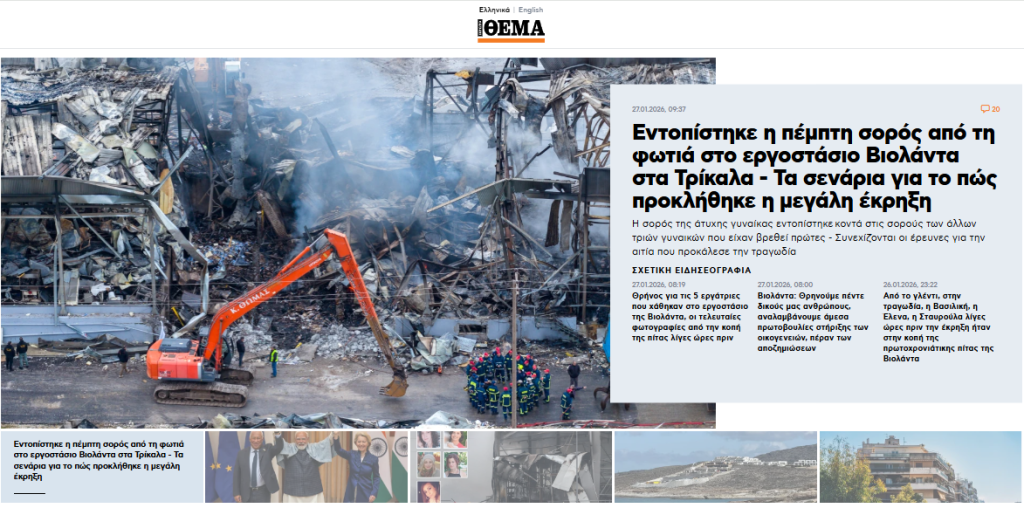
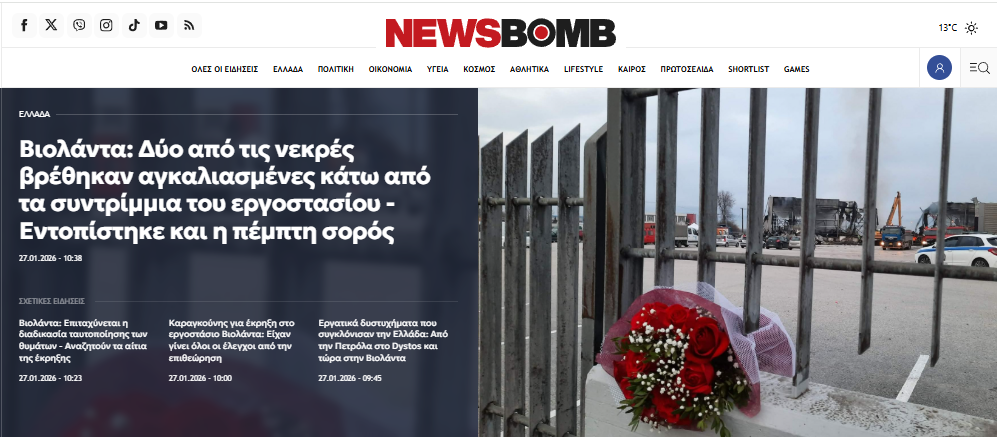
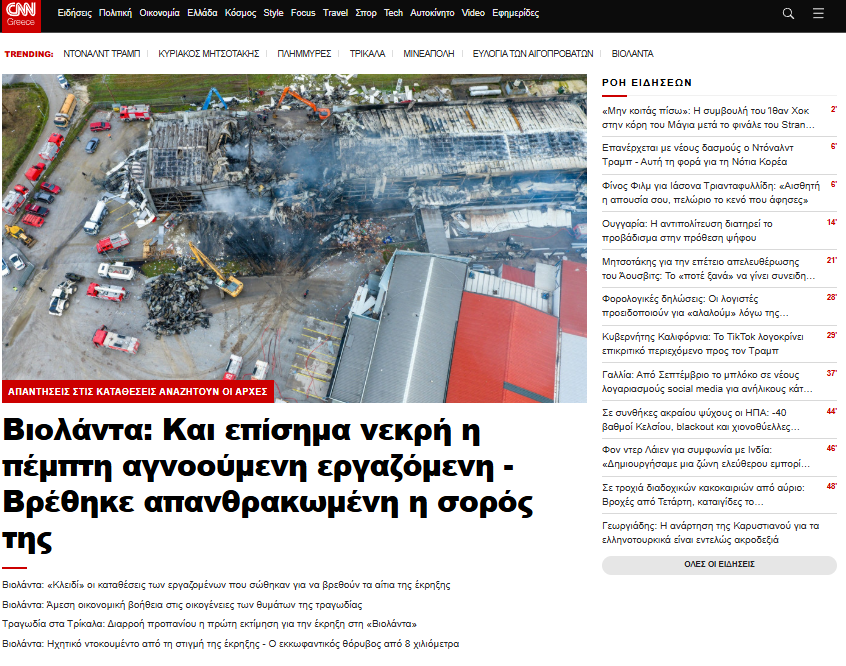
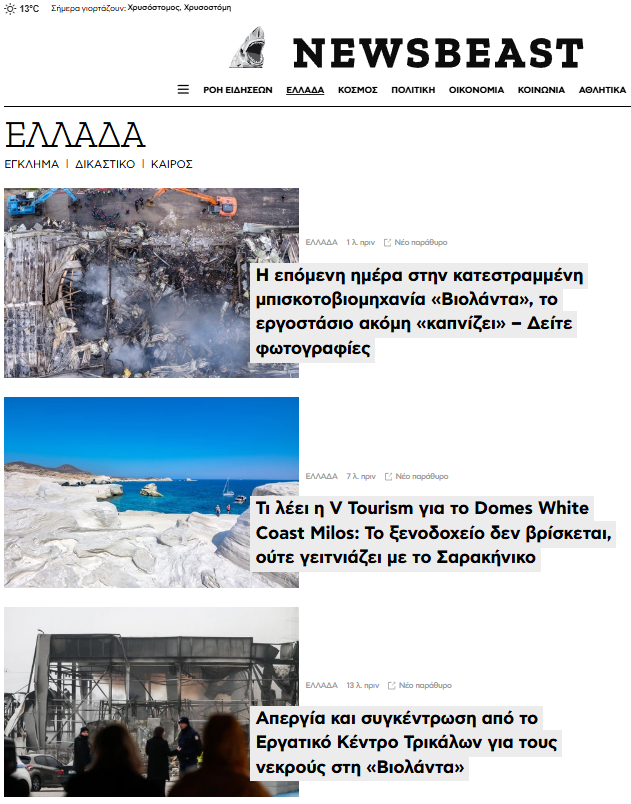

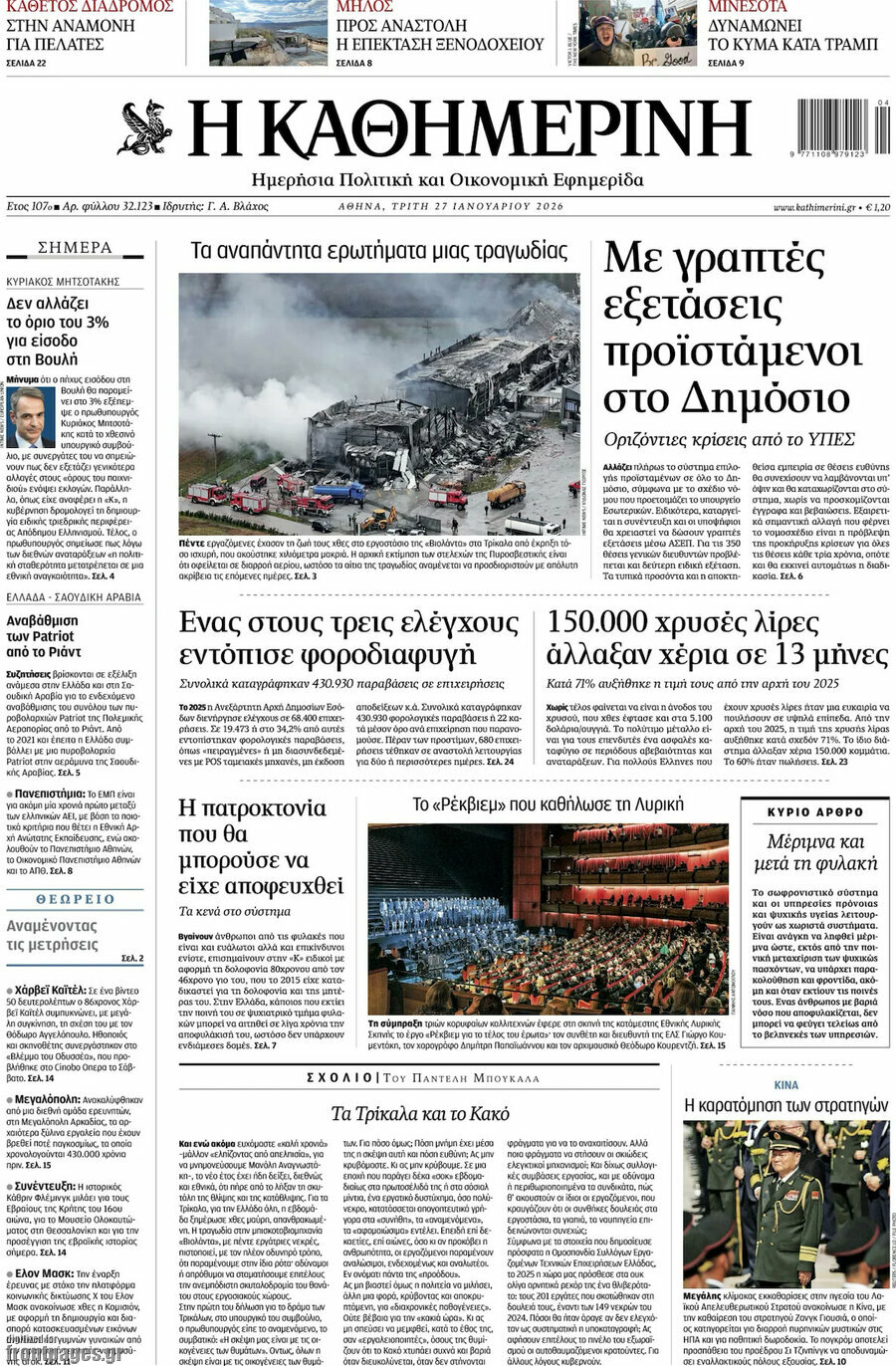
KATHIMERINI: Written exams for civil service managers
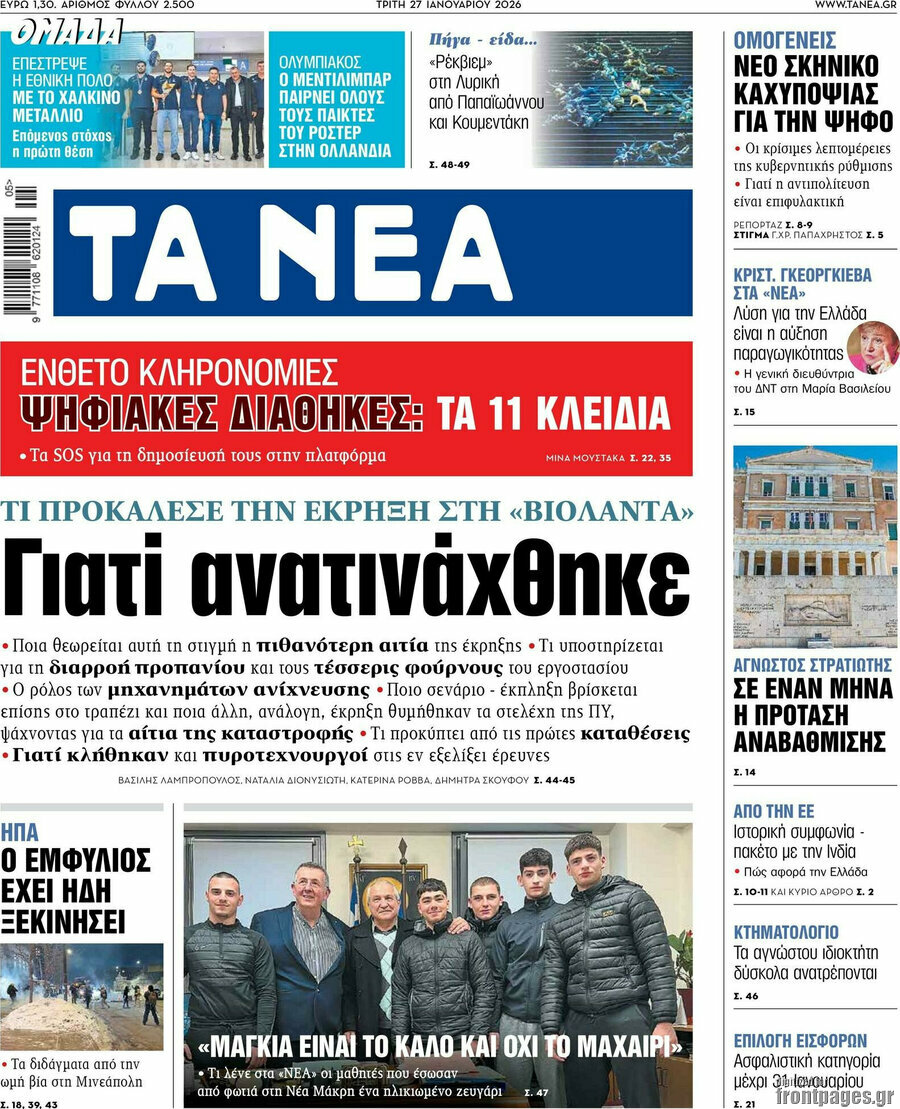
TA NEA: What caused the explosion at Violanta factory
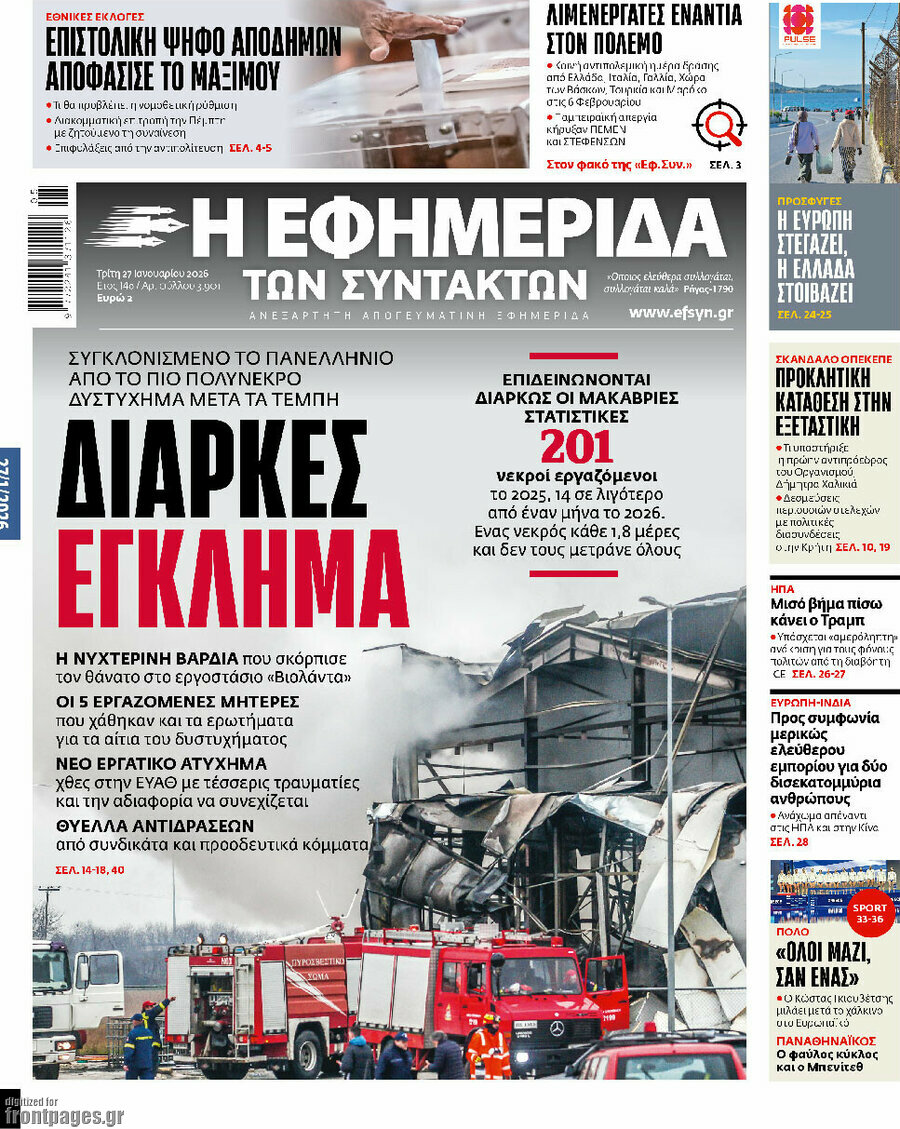
EFIMERIDA TON SYNTAKTON: Deadly explosion at biscuit factory: Ongoing crime
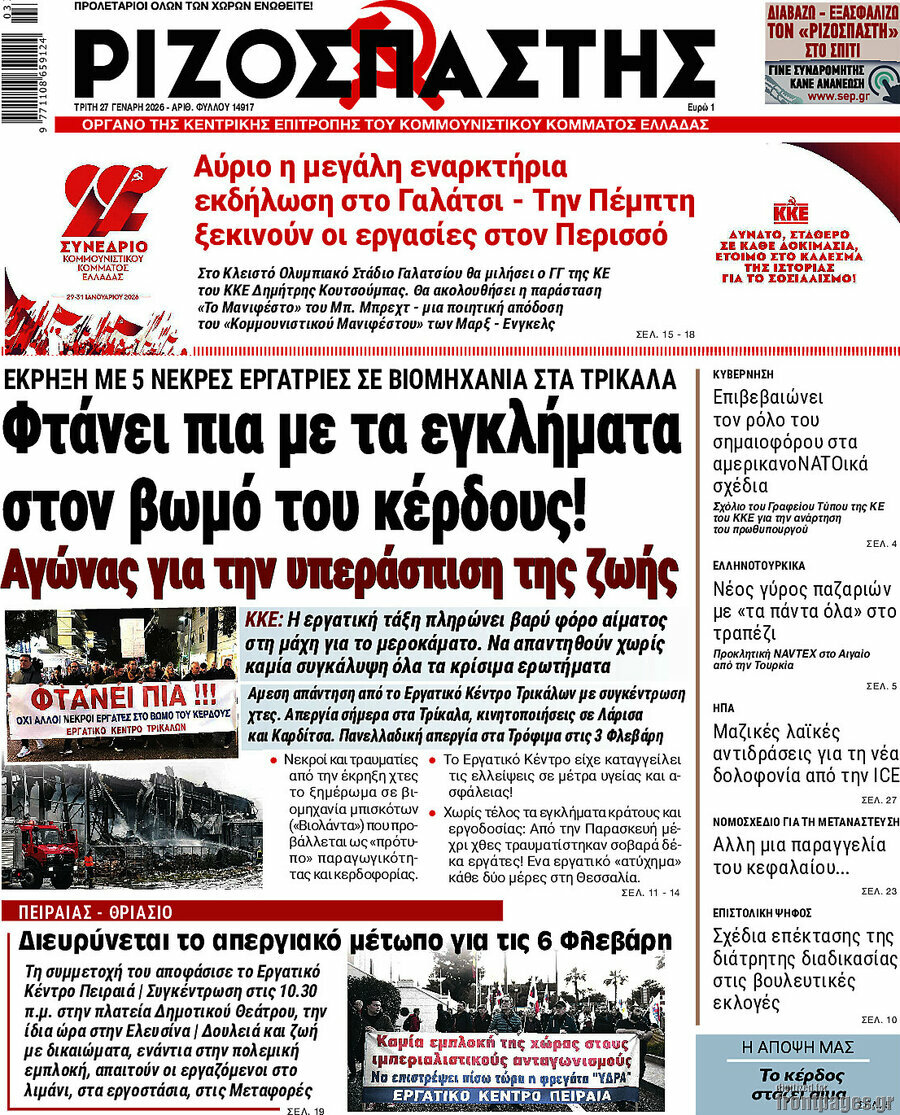
RIZOSPASTIS: Explosion at Violanta biscuit factory leaves 5 dead: Enough with crimes at the “altar” of profit
KONTRA NEWS: Deadly day-wage for 5 at “Violanta” factory
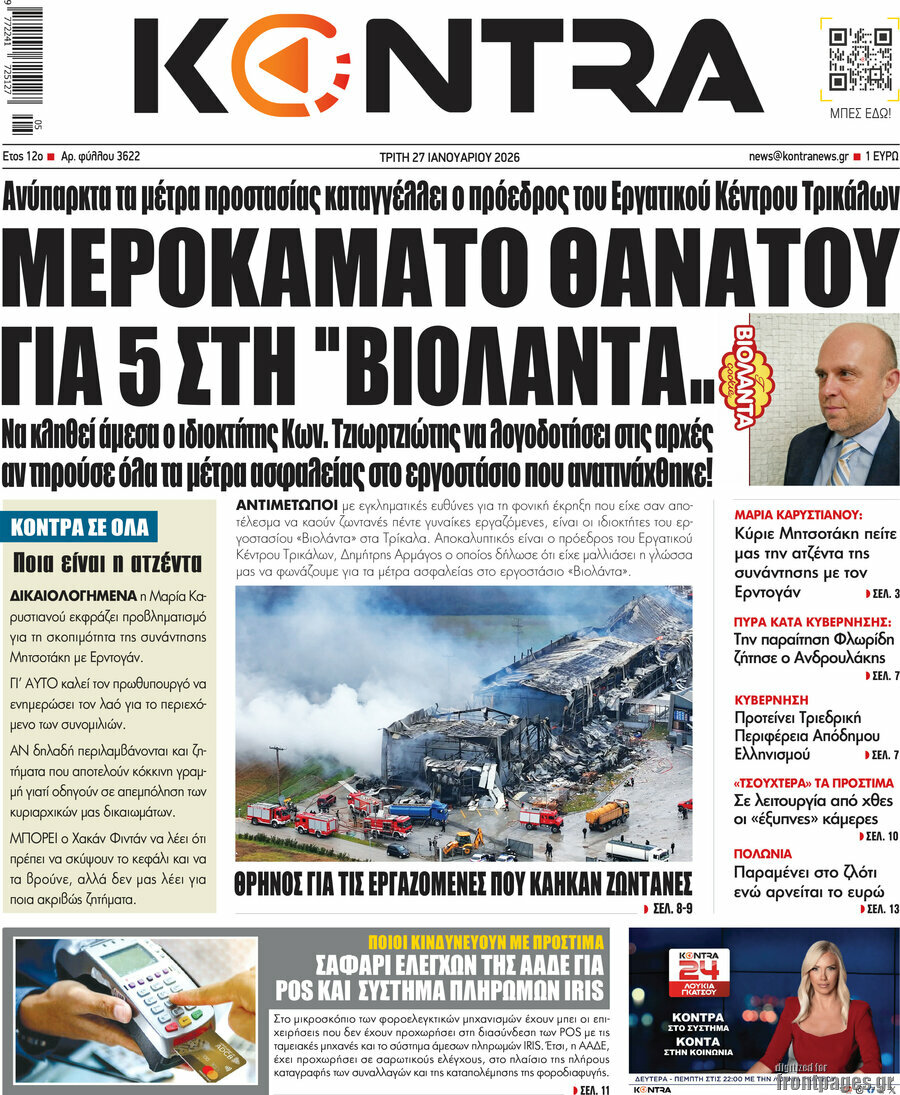
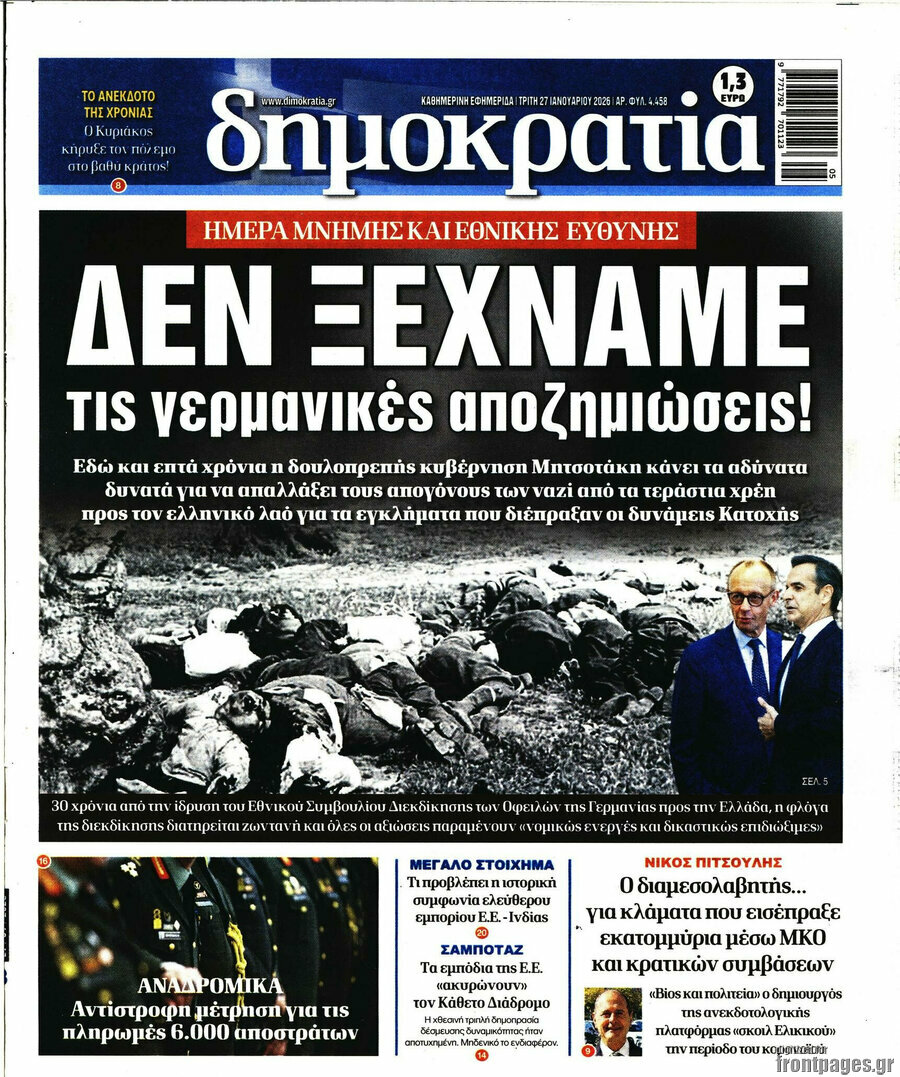
DIMOKRATIA: We will not forget about German war reparations
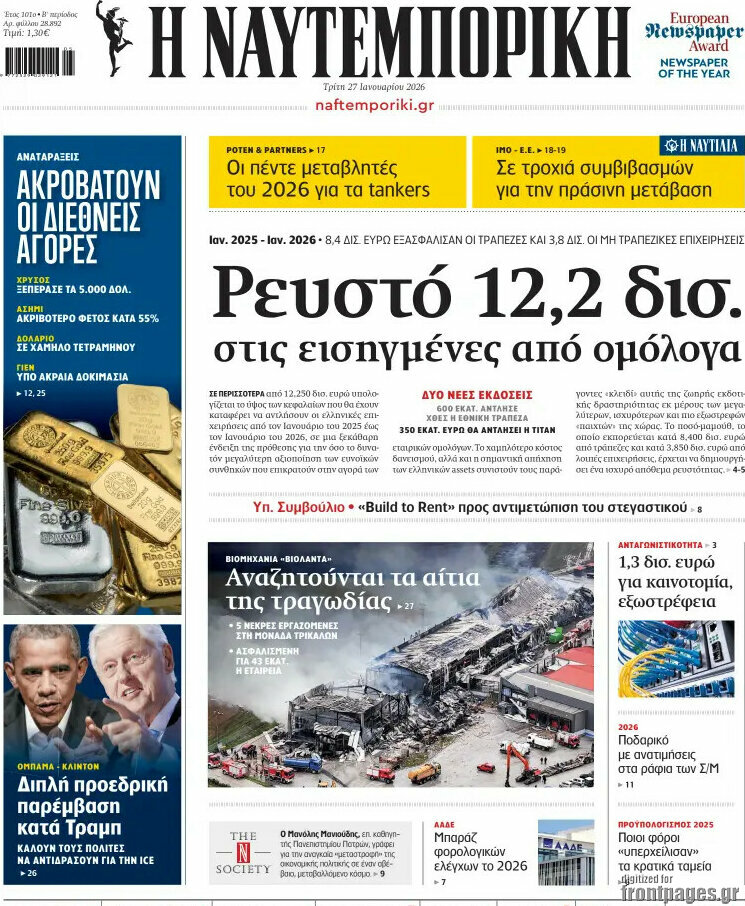
NAFTEMPORIKI: Listed companies enjoy 12,2 billion-euro liquidity from bonds

DRIVING THE DAY
ART OF THE DEAL: The future of a mammoth trade deal with Washington is up in the air after the European Parliament’s top trade lawmakers failed to agree on ratifying the EU-U.S. pact. The clock is ticking for MEPs to sign off on the agreement, even amid the bloc’s fraying relationship with Washington.
If lawmakers allow their lingering resentment over Donald Trump’s NATO-testing play for Greenland to get in the way of the deal, the EU won’t be able to drop its tariffs to 0 percent, as agreed with the U.S. president. That could set the stage for more transatlantic conflict and potentially spark a 15 percent tariff retaliation for EU goods.
The cautionary tale comes overnight from South Korea, where the legislature hasn’t signed off on the country’s trade deal with the U.S. That prompted Trump to threaten on social media to raise duties on South Korean cars and car parts, lumber and pharmaceuticals “and all other Reciprocal TARIFFS” from 15 percent to 25 percent.
The European Parliament froze ratification of the EU-U.S. agreement, signed by Trump and European Commission President Ursula von der Leyen in July, after the American president threatened tariffs on European allies who pushed back against the White House’s stance on Greenland. But EU leaders at last week’s European Council insisted the deal should be passed after Trump walked back his threats to seize the self-ruling Danish territory.
Greenland demands: Among the recalcitrants in Parliament are the center-left Socialists and Democrats (S&D), who told my colleague Max Griera that more information is needed on what has been agreed with the U.S. on Greenland before moving ahead. The centrist Renew Europe and the European Greens are also withholding their support.
Coalition of the unwilling: Von der Leyen’s center-right European People’s Party (EPP) wants Parliament to swiftly green-light the agreement. However, other members of the Commission president’s fragile governing coalition were still holding out at Monday’s meeting of lead negotiators.
Tick tock: Negotiators will now have to meet again on Feb. 4 to decide on the next steps, ahead of a potential vote in committee on Feb. 23 or Feb. 24.
Right-wing majority: Of course, the EPP could rely on the right-wing European Conservatives and Reformists (ECR) and the far-right Patriots for Europe and Europe of Sovereign Nations to unblock the trade agreement at the Feb. 4 meeting, according to one lawmaker familiar with the discussions. That’s because the right-wing groups are keen to maintain a good relationship with Washington.
Željana Zovko, the EPP’s lead negotiator on the file, told Playbook the issue would reveal whether politicians have the “maturity” to rise to the moment. “So far I just see playing games,” she said, adding that “our transatlantic relations and trade should not be a hostage of the games played.”
Inter-institutional bust-up: Diplomats and officials have expressed concern the parliament’s delay could cause problems with the Trump administration, which has already accused lawmakers of political posturing. “The implementation of the Joint Statement is unilateral on both sides,” said one envoy. “The U.S. administration and EU have promised to do [that] as quickly as possible — and stay in close contact throughout the process.”
Why go there? Another diplomat put it more frankly: “Why would [the European Parliament] delay this? It takes a couple of phone calls from the [national] leaders and then they will fall in line.” National governments will start to apply pressure on their parliamentary delegations before long, fearing an irate Trump may reverse the agreed tariff reduction, the diplomat said.
Not walking the walk: One Commission official suggested lawmakers want to have it both ways. First, MEPs say the EU needs to improve its trade links, then they “slam the brakes on both the U.S. trade deal and Mercosur,” the official said, referring to Parliament’s decision to send an otherwise signed-off deal with South America to a legal review, where agreements go to die.
THE OTHER TRADE DEAL
EU GOES EAST: EU and Indian leaders will shake hands on their landmark trade agreement this morning. “Official-level negotiations are being concluded and both sides are all set to announce the successful conclusion of FTA talks on Jan. 27,” Indian Commerce Secretary Rajesh Agrawal told POLITICO.
After the ceremonial get-together, the two sides will dot the i’s and cross the t’s on the pacts that boost trade and defense cooperation. India is expected to significantly reduce tariffs on cars and machinery under the trade deal, as well agricultural goods such as wine and spirits.
Win-win: “This would be a very good story for our agriculture sector. I believe we are aiming to start a completely new chapter in the field of cooperation in the automotive sector, in machinery,” EU trade chief Maroš Šefčovič told Camille Gijs.
“We approached this partnership from a completely new angle where we are aiming to open the sectors which, because of a very high tariff bill, have been closed until today,” Šefčovič added. Keep an eye out for more developments during the day.
REGULATION STATION
X-RATED: The EU has again courted confrontation with Elon Musk, after hitting his Grok AI service with a new probe under the Digital Services Act (DSA) over its generation of sexual imagery of women and minors. But while the last DSA fine against his X social media platform prompted a furious barrage of messages, this time Musk has kept his own counsel and hasn’t responded to a request for comment.
From the Berlaymont: “It is simple — we will not hand over consent and child protection to tech companies to violate and monetise,” von der Leyen said in a statement shared with Playbook. “In Europe, we will not tolerate unthinkable behaviour, such as digital undressing of women and children.”
Ask the bot: Grok, meanwhile, seemed upbeat when consulted on the decision by Playbook earlier Monday. Yes, the investigation “seems fair for several reasons,” the chatbot said when we asked it for a view as an experiment. “It’s a reasonable use of the DSA to address real risks.” However, the bot warned, the outcome could “highlight debates over innovation vs. regulation, potentially widening EU-U.S. divides.”
EFFICIENCY PUSHBACK: Italy and Germany called for slashing red tape, loosening merger controls and introducing an “emergency brake” on new legislation in a joint discussion paper obtained by POLITICO Pro. But not everyone is happy.
Aim higher: Former German State Secretary for the Economy Sven Giegold blasted the document for its “lack of ambition.” Giegold, who belongs to Germany’s Greens, told Nick Vinocur: “Where is the real investment agenda? Where is the real industrial strategic response? This is falling back to a nitty-gritty response.”
Blind spots: While the paper calls for extensive deregulation, it does not mention the Capital Markets Union or other reforms proposed in the Draghi Report or Enrico Letta’s recommendations. That’s because European leaders would need to sell such changes to their electorates and, potentially, pay a political price. German Chancellor Friedrich Merz and Italian Prime Minister Giorgia Meloni “don’t want to do that,” Giegold said.
“I’m deeply concerned that we are going to get killed economically,” he added. “In none of the largest technological sectors is Europe leading. Where is the response to that?”
STRATEGIC AUTONOMY
GAS COERCION: The drive by the Cypriot presidency of the Council of the EU to slash the bloc’s overreliance on imported fossil fuels should consider the U.S. as well as Russia, a new report from British think tank Chatham House concludes.
The analysis, seen exclusively by Playbook and published this morning, warns that increased dependence on American gas to replace Russian supplies has left industries exposed to high bills and price shocks.
With friends like these … “The actions of the current US administration to date, its ‘energy dominance’ agenda and serious trade — and even territorial — tensions with the EU all raise the possibility of the EU’s dependency on American gas being coercively leveraged to extract concessions in other aspects of the transatlantic relationship,” the report warns.
Shocking developments: Chris Aylett, one of the Chatham House researchers behind the paper, told Playbook that Washington is not “extremely reliable” as a supplier and the EU is coming to a recognition that “it’s in a bit of a bind” given its exposure to Trump’s whims. The think tank says boosting renewable power and supporting electricity-grid expansions — recommended by the Draghi Report — can reduce that risk.
NOT ALL ON BOARD: The warning comes after Hungary and Slovakia vowed on Monday to bring a legal case against the EU’s efforts to end imports of Russian gas.
RULE OF LAW
HUNGARY AND ARTICLE 7: Sweden is leading a renewed push to get Article 7 back on the table against Hungary, as Budapest continues to act as the spoiler for decision-making in the European Council, Zoya Sheftalovich writes in to report.
Sweden’s EU Affairs Minister Jessica Rosencrantz held several bilats on the sidelines of Monday’s General Affairs Council seeking to build momentum for the move, an EU diplomat said.
Reminder: Article 7, deployed when a country is considered at risk of breaching the bloc’s core values, is the most serious political sanction the EU can impose because it suspends the member’s right to vote on European Council decisions. Use of the sanction requires a unanimous vote among all other EU members.
The strategy: Sweden, which has been engaged in a war of words with Hungary over the past few months, doesn’t actually want to push the button on Article 7 just yet. It’s wary that doing so could play into the hands of Prime Minister Viktor Orbán ahead of the April election. Plus, Budapest is likely to be protected by Slovakia’s Robert Fico and Czechia’s Andrej Babiš if it comes to a vote. But the idea is to gauge support for using the tool if Orbán is reelected and continues to obstruct EU decision-making.
IN OTHER NEWS
UKRAINE LATEST: The Trump administration has told Ukraine that American security guarantees will depend on Kyiv agreeing to a peace deal that would require it to cede the Donbas to Russia, the FT reports this morning.
VISA SCOOP: The European Commission is set to unveil its new visa strategy on Thursday. Playbook got an advance peek at the bloc-wide guidelines, which are designed to bolster the EU’s competitiveness while tightening security.
Third-country crackdown: The roadmap proposes a new category of targeted, restrictive visa measures as a “tool” against hostile third countries, alongside the tougher monitoring of visa-free regimes. It also calls for changes to the EU’s visa code to make it more flexible and faster when triggering penalties against third countries with deteriorating security environments.
Visas for the economy: The Commission will also suggest exploring multi-entry visas with validity periods longer than five years, in a bid to spur economic growth. To attract talent and ease the burden on consulates, Brussels plans to allocate extra funding to prioritize high-value applicants, as well as creating a visa support office within Frontex to assist with training and document verification.
GUTTING THE GREEN: How can airlines roll back the EU’s ambitions to cut emissions? Carmakers might just have the answer on how to water down climate-friendly laws, industry is hoping, according to this report by Tommaso Lecca.
TOUGH CITY: A wave of crime is disrupting commercial operations in Marseille — and now threatens to shape the city’s mayoral elections, Victor Goury-Laffont reports.