
‘Code Red’ declared in five Greek regions expecting snow and heavy rain on Wednesday, Thursday
The Risk Assessment Committee met on Tuesday in the presence of the Climate Crisis and Civil Protection Minister Giannis Kefalogiannis, ahead of severe weather conditions expected on Wednesday and Thursday, with heavy rain and thunderstorms, locally severe snowfall, and gale-force winds in some areas.
Mitsotakis calls for ‘logic and dialogue’ in EU-US relations
Prime Minister Kyriakos Mitsotakis has called for “logic and dialogue” to prevail in relations between the European Union and the United States, warning that such an approach is necessary to “avoid the worst” amid growing international tensions. Mitsotakis made the remarks during his weekly meeting with President Konstantinos Tassoulas. Referring to Greece’s position on the international stage, he stressed that while the country maintains strategic relations with the United States, it is also firmly anchored within the European Union.
Highways open to traffic after most farmers rule to end protests
Farmers have removed tractors and other vehicles from most highways and key border crossings after more than 50 days, as protesters appeared convinced that they could not prise further concessions out of the government.
Greece will cooperate with Israel on anti-drone systems, cybersecurity, Dendias says
Greece will cooperate with Israel on anti-drone systems and cybersecurity, Defense Minister Nikos Dendias has said, after meeting his Israeli counterpart, Israel Katz, in Athens.
ATHEX: Stocks drop on global uncertainty
Escalating tension among allies within NATO on Greenland finally took its toll on Greek stocks on Tuesday, with the benchmark suffering considerable losses as banks yielded a large part of the gains earned over the six previous sessions. Uncertainty dominates eurozone markets and Athinon Avenue is no safe haven anymore. Local stocks will regain their rising momentum from the first sign of stabilization on geopolitical level, observers say.
https://www.ekathimerini.com/economy/1292912/athex-stocks-drop-on-global-uncertainty


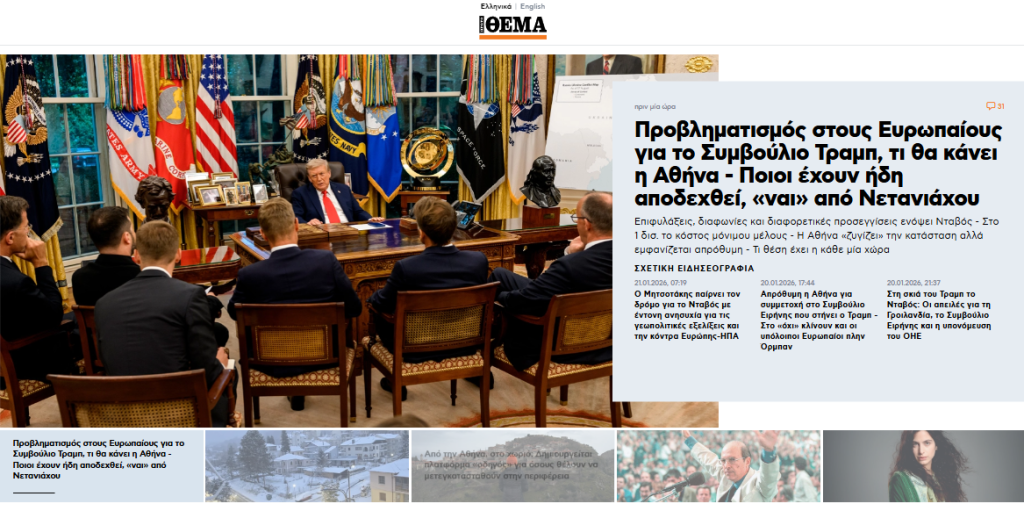
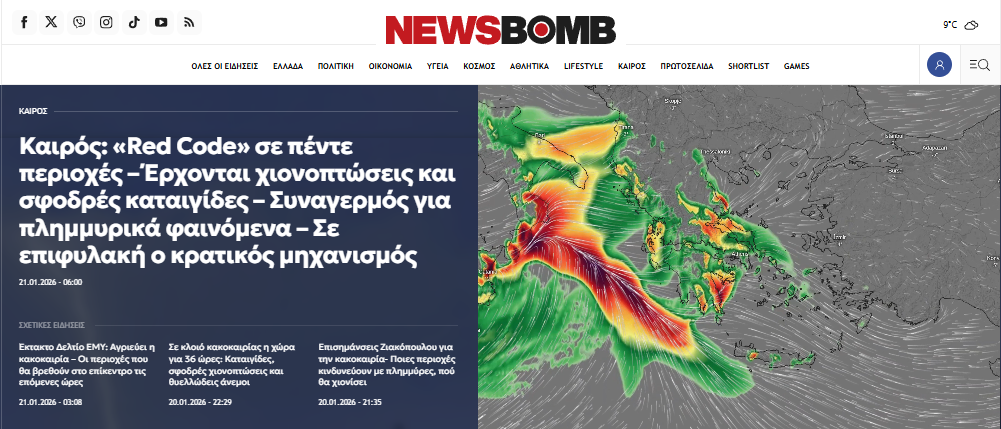
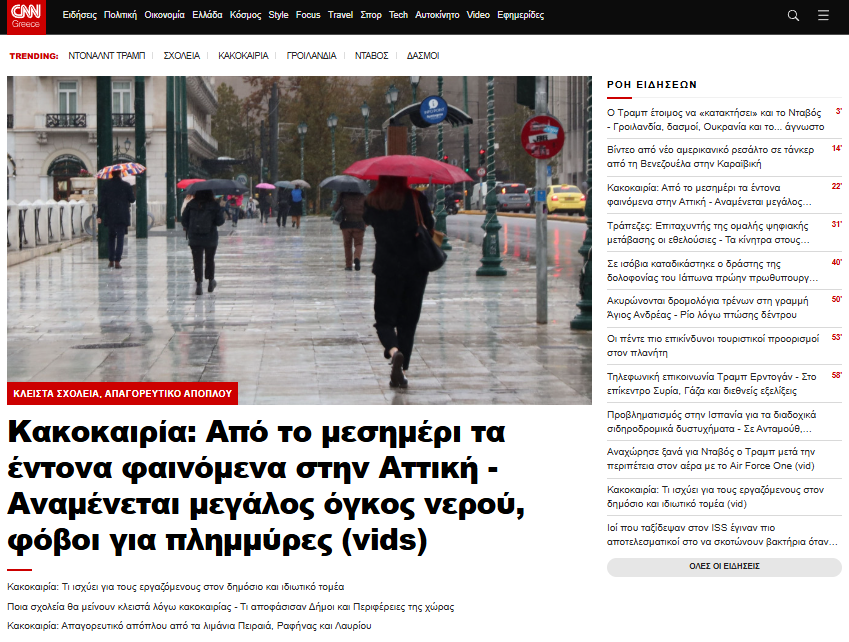
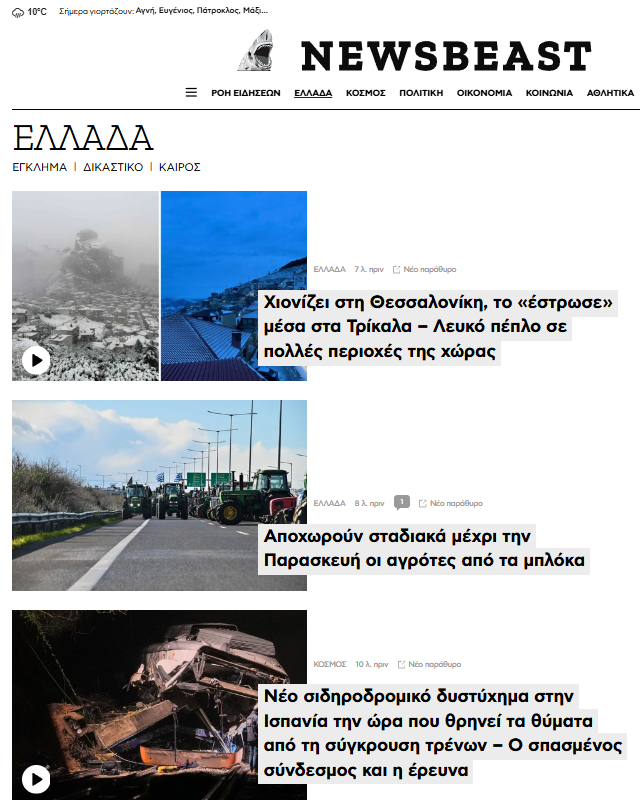

KATHIMERINI: Entry in public universities via IB
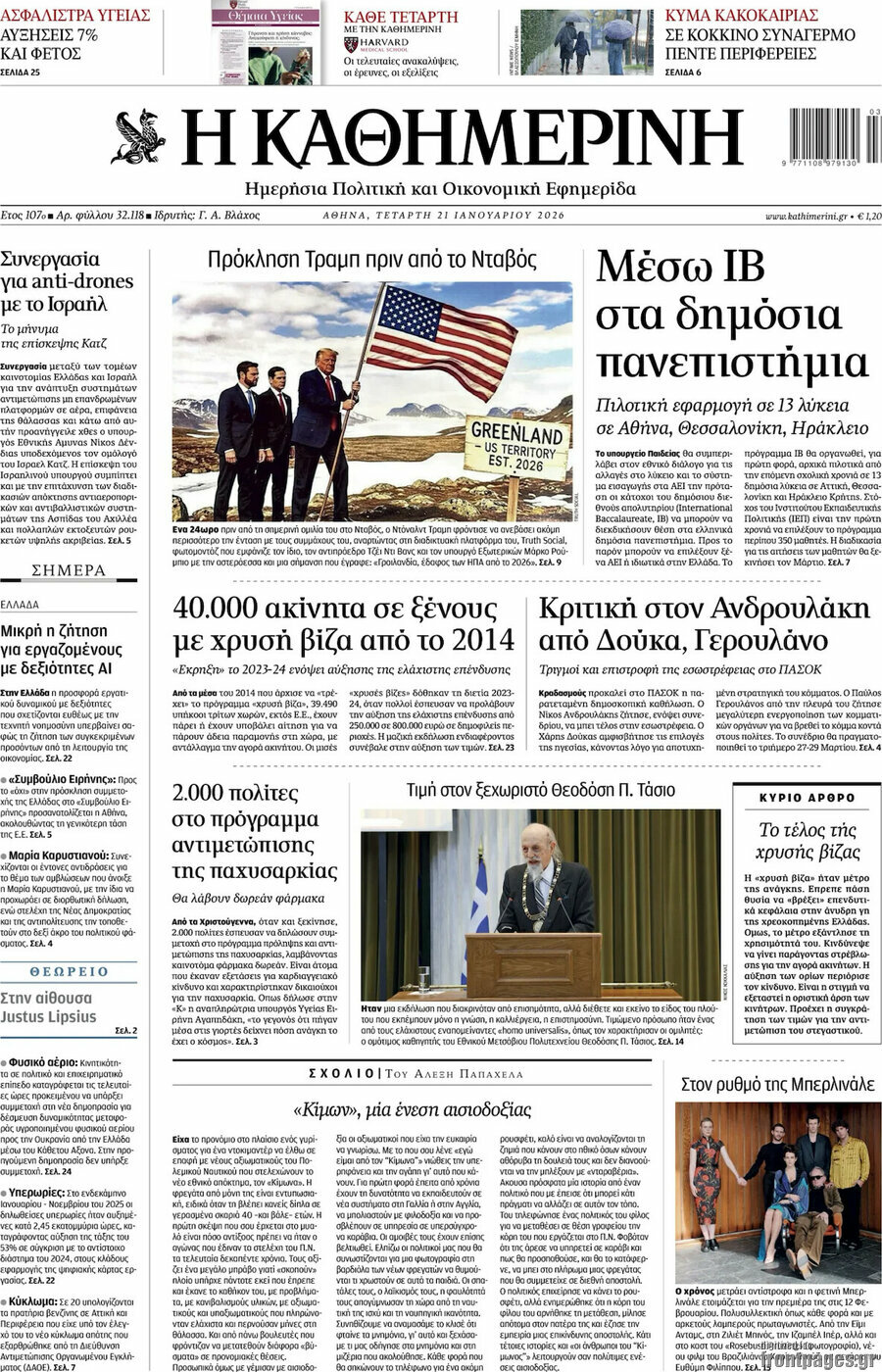
TA NEA: Kifissos avenue in Athens: No trucks will be allowed in the morning hours
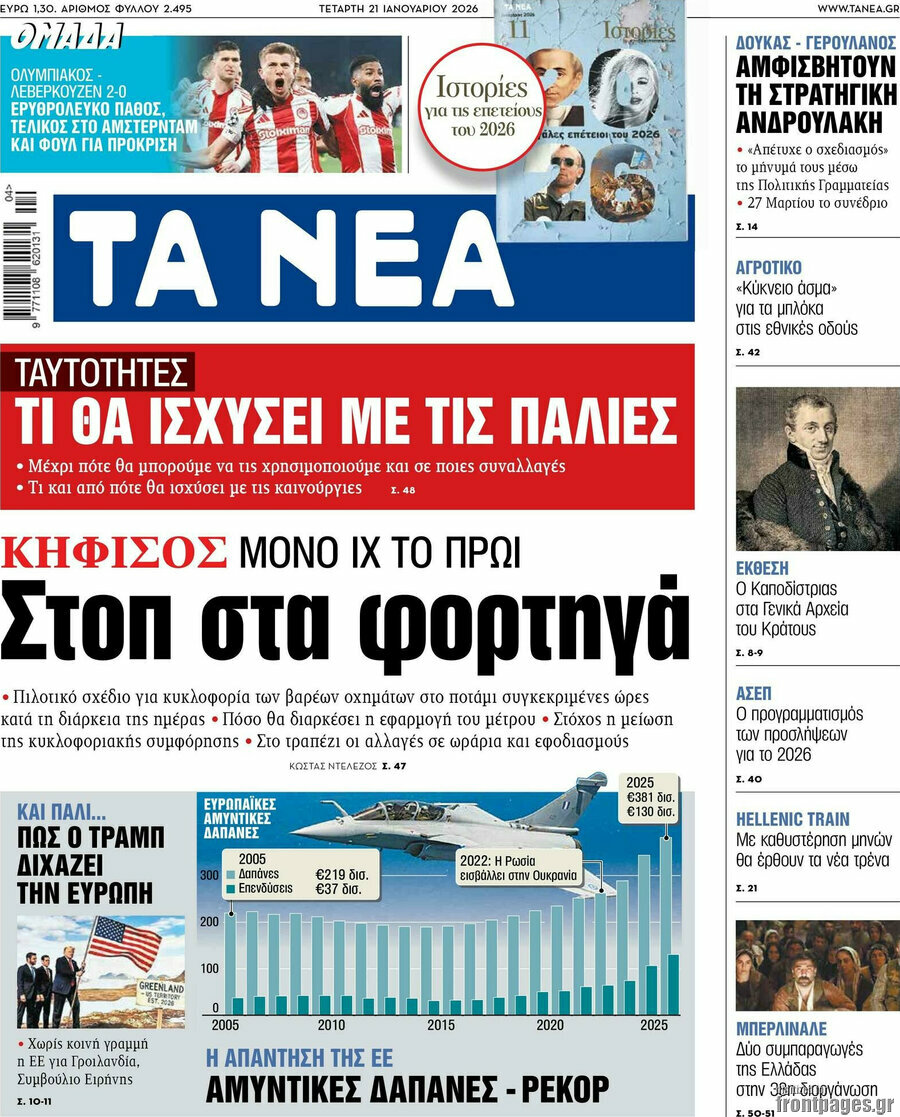
EFIMERIDA TON SYNTAKTON: A planet without rules
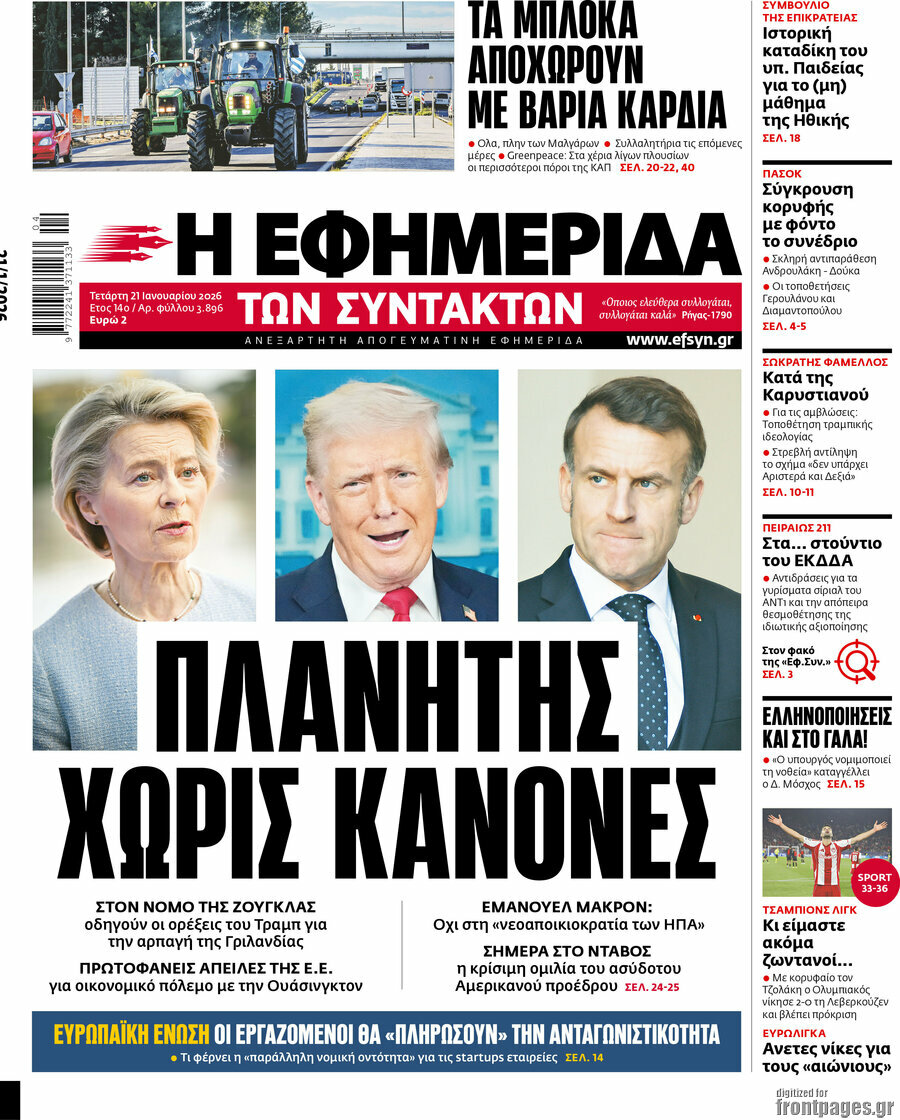
RIZOSPASTIS: Fatal rail-crash in Spain: Another crime on the rails of profit and privatization
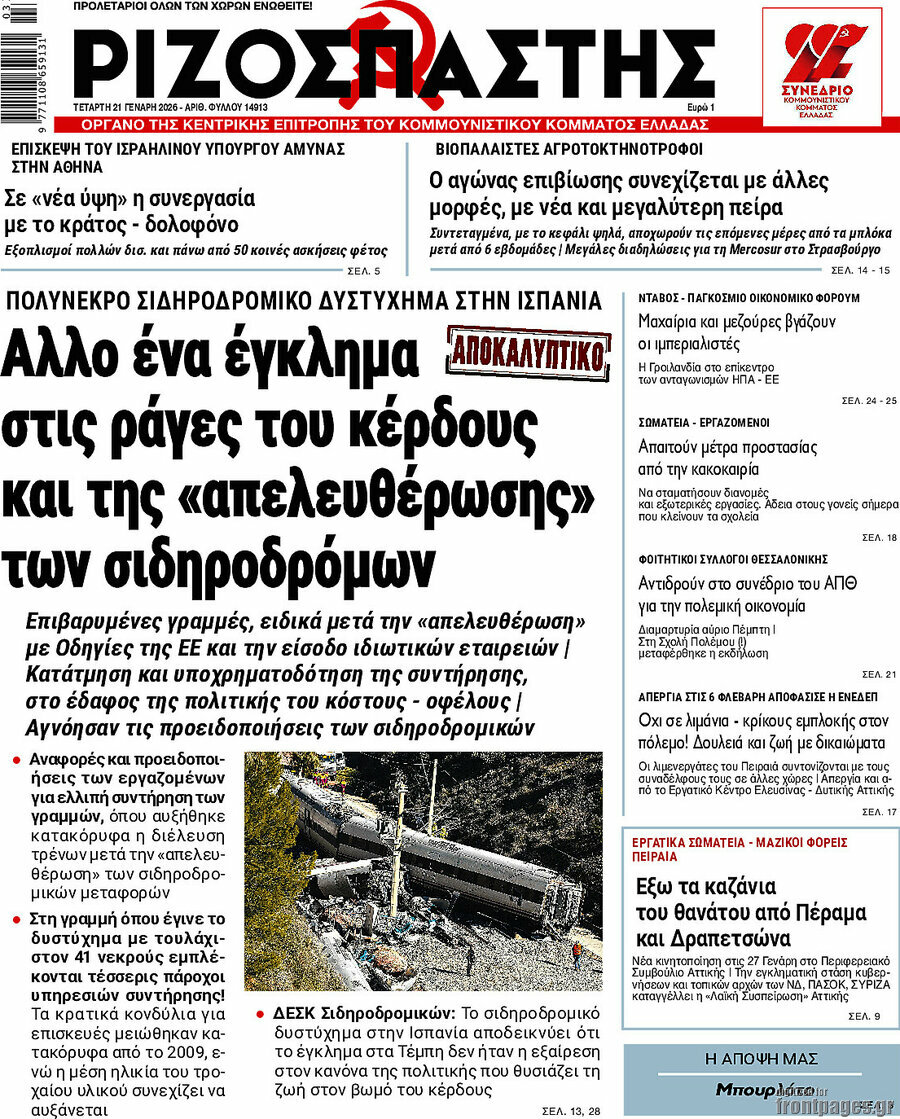
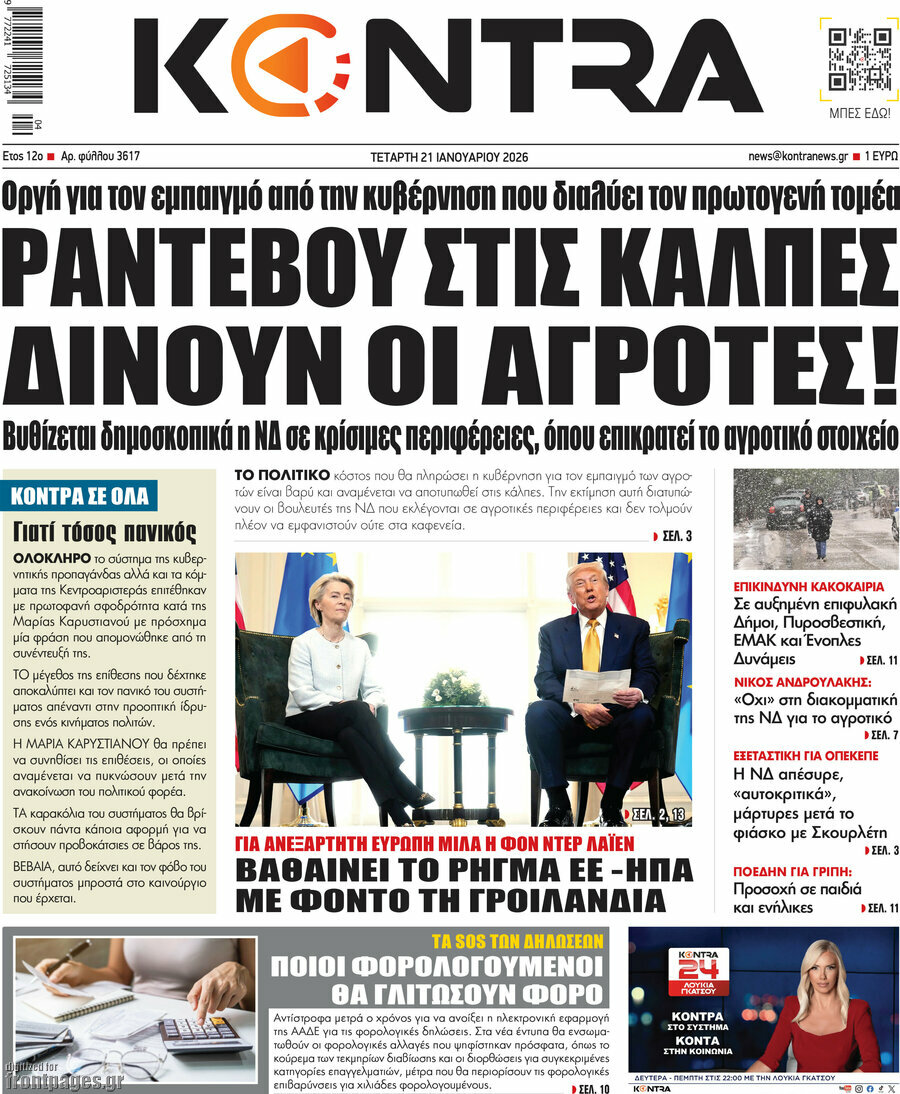
KONTRA NEWS: Farmers set appointment at the next ballots!
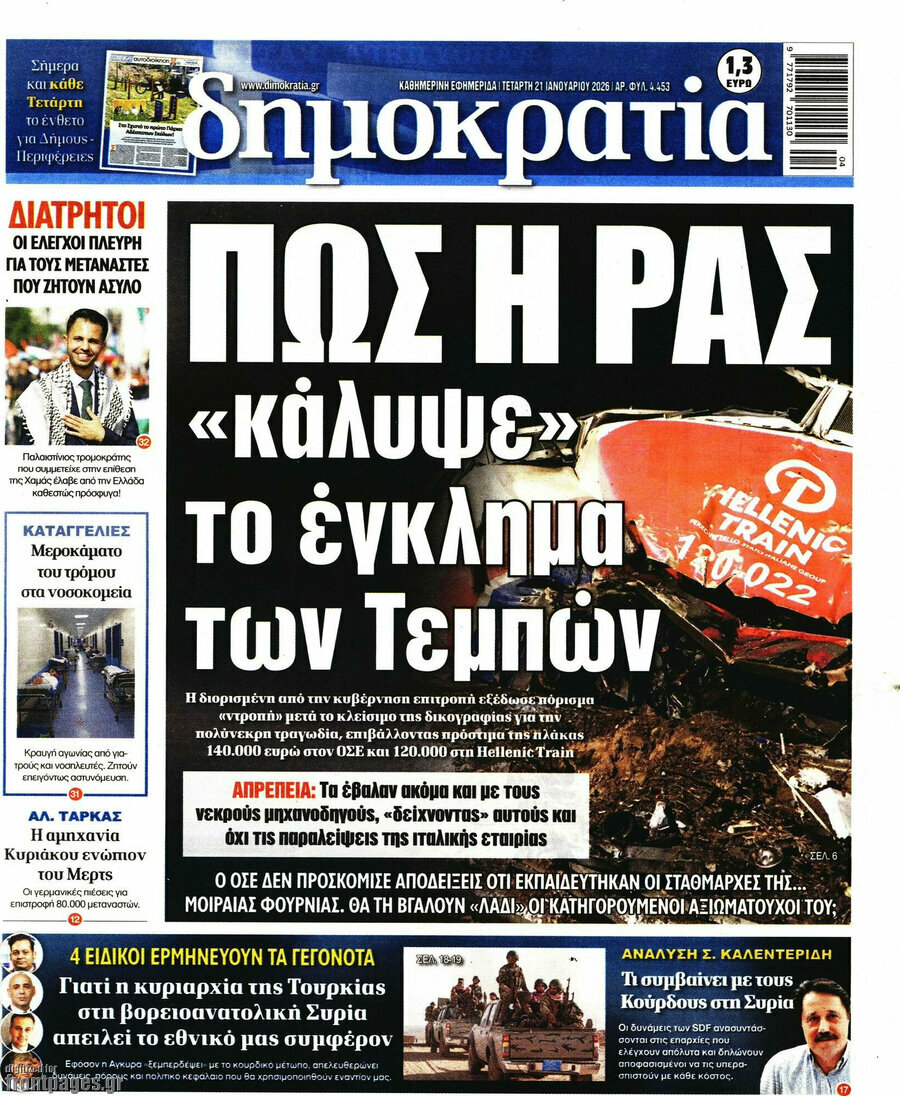
DIMOKRATIA: How the Regulatory Authority for Railways (RAS) “covered up” the Tempe railway crash crime
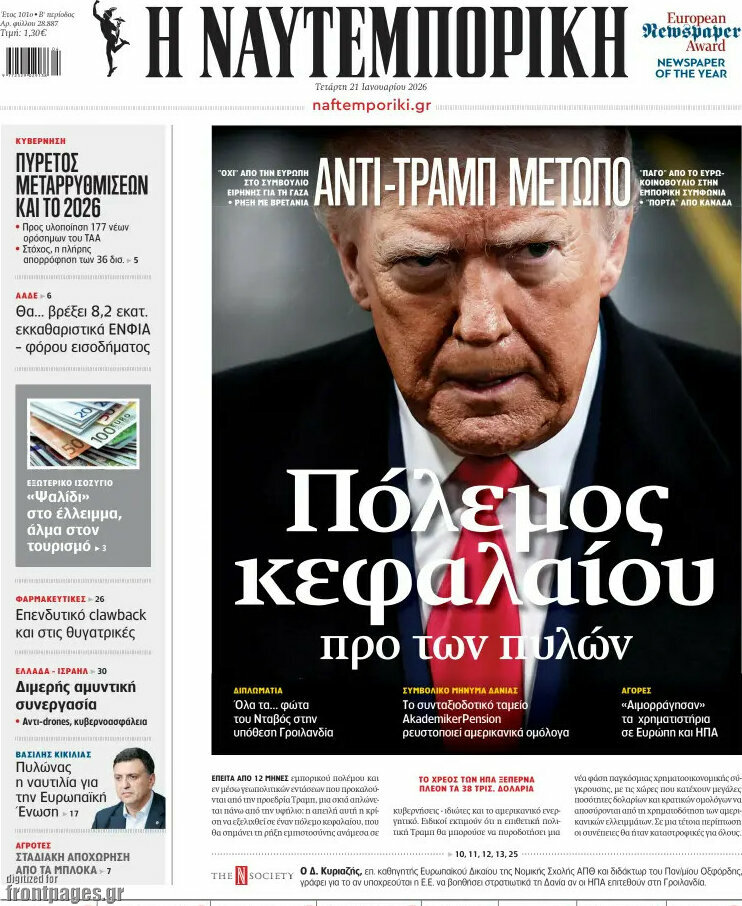
NAFTEMPORIKI: Capital war ante portas

DRIVING THE DAY
LET’S SEE WHAT HAPPENS IN DAVOS: It’s a line that has become the default answer from officials and diplomats to almost any question this week — pointing to how much is riding on the World Economic Forum. Donald Trump’s address from the resort town of the rich and famous will set the tone — and posture — of the EU’s response.
Don’t miss the moment: Trump’s speech — his first appearance at the forum since 2020 — is scheduled for 2:30 p.m. and is expected to run until around 3:15 p.m., assuming problems with his flight don’t result in too much of a delay.
Brace for the usual mix of confident bravado and direct callouts, heavy on superlatives (“tremendous,” “incredible” — you know what to expect!) and declarations that only he can fix things.
FAFO in Davos: Even before he takes the stage, Trump is dominating the agenda. Tuesday’s barrage of Truth Social posts — including fresh tariff threats on French wine — has already shifted the mood in Davos. The modus operandi appears to be: provoke first and see how Europe responds later.
Keeping it simple: At a Tuesday evening White House press conference marking a year back in office, Trump was asked how far he would go to acquire the self-ruling Danish territory. “You’ll find out,” he said. On whether military force was an option, he pointed instead to tariffs, calling them “the strongest” and “least complicated” tool available.
Not reassured: Greenlandic Prime Minister Jens-Frederik Nielsen said Tuesday that the possibility of the U.S. taking his country by force cannot be ruled out. “We have to be prepared,” he told reporters. “That’s the responsible thing to do — even if we don’t expect it.”
Highly anticipated — by Trump: The U.S. president expects to be “very happily awaited” in Switzerland. He also claimed to have “a lot of meetings” on Greenland lined up. But meetings with whom, exactly? Lips remain sealed — although Playbook is happy to brainstorm with a few educated guesses.
On standby: Ursula von der Leyen left Davos and has been in Strasbourg since Tuesday afternoon and is scheduled to address the European Parliament at 9 a.m. Still, according to her entourage, she could be back in Davos by late lunch. No small feat given the nearly four-and-a-half hour, 320-to-380-kilometer drive. But what’s a long car trek for the sake of Greenland and the security of the EU?
Others circling: German Chancellor Friedrich Merz, who’s also in Davos, said he hopes to meet Trump on Wednesday. Emmanuel Macron, meanwhile, left Davos on Tuesday without securing a tête-à-tête — despite having invited Trump to Paris later this week in a text Trump leaked on social media (POLITICO’s Clea Caulcutt has parsed every line of the texto).
Hands off the bazooka: Markets dipped following Trump’s renewed tariff threats against Europe, with U.S. stocks sliding to their lowest levels in week; and in Davos, U.S. Cabinet officials moved to cool nerves, with Treasury Secretary Scott Bessent urging to “sit back, take a deep breath and let things play out.”
Ukraine sidelined: As Croatian Prime Minister Andrej Plenković put it, the Greenland gambit has eclipsed nearly everything else — including discussions on Ukraine. That’s a notable shift, given that Davos was meant to help secure Trump’s personal backing for security guarantees in a post-war Ukraine, as POLITICO’s Jamie Dettmer reports from the Alpine talkfest. The FT reports this morning that an $800 billion prosperity plan set to be agreed between Ukraine, Europe and the U.S. at the summit has been put on hold because of the wrangling over Greenland and Trump’s Gaza peace board.
ON THE GROUND: Kathryn Carlson reports that in panel events, meeting rooms and parties around the resort, participants have mixed views on what to expect from Trump’s speech. Either he’ll TACO and avoid bombshells (maybe by focusing on domestic issues), or there will be fireworks.
Hot takes: Former White House communications director Anthony Scaramucci gave Kathryn his Trump forecast at a crypto-drinks reception. “He’s a contrarian … If you think he’s going to browbeat you, then he’s gonna be nice to you,” was the take of The Mooch.
The art of the deal: “I would suspect by today’s speech he’ll have something in place that he’ll say is a success for America — maybe some extra bases, maybe some deeded land that the Danish government will give him under the aegis of national security,” Scaramucci said.
EUROPEAN COUNCIL PREPPING
READY TO FIRE BACK? Trump may be sticking to a familiar script but the EU’s response has evolved over the past days. Initial disorientation is giving way to something closer to resolve — and a growing willingness, at least in theory, to consider retaliation.
EU’s not for flinching: Ursula von der Leyen said in her Davos address Tuesday that the bloc’s response will be “unflinching, united and proportional.” Belgian Prime Minister Bart De Wever went further, warning that Europe must get stronger or risk becoming U.S. “slaves.”
The real question: Trump’s address will be decisive in determining whether EU leaders ask the Commission to prepare its most powerful trade weapon — the Anti-Coercion Instrument — for potential use at an emergency summit later this week.
A shift in Berlin: Germany, long wary of open confrontation with Washington, is now backing calls to at least explore deploying the controversial instrument, according to five EU diplomats familiar with the discussions. Details in POLITICO’s exclusive story.
Chekhov’s bazooka: France and Germany appear to agree on putting the instrument on the table, though not necessarily activating it, one diplomat told Playbook. Another diplomat said Berlin is caught between solidarity with Paris and a continued desire to keep dialogue with Washington alive.
Rome resistance: Italy remains unconvinced. Two diplomats say the country is arguing that dialogue should come first, without signaling escalation (which is what the Franco-German push might look like).
Best market in the world: Conservative MEP Nicola Procaccini, a prominent member of Giorgia Meloni’s party, told POLITICO’s Max Griera that triggering the instrument would be a “mistake,” arguing the EU lacks the deterrent power of the U.S. “The American market is the best in the world,” he said. “There’s no alternative.”
Back where we started: As one diplomat put it, “the instinct is to negotiate — but even with a lot of goodwill, if in Davos …” The suggestion being that if Trump touches down ready to unleash, the EU may have no choice to hit back. Once again, everything hinges on what happens today.
Evidence #1: EU ambassadors meeting this morning will deal with anything but the looming standoff with Washington — from the EU-India trade deal to how to cover Ukraine’s financing needs over the next two years. A dedicated discussion to prepare Thursday’s extraordinary EU summit (and Trump’s threats) is scheduled for the very same day — notably, after the president’s Davos speech.
Evidence #2: And a meeting between European Council President António Costa and European Parliament President Roberta Metsola to discuss the special EU summit is set for 3:15 p.m. — that’s right when Trump is expected to finish speaking.
THE GIFT THAT KEEPS ON GIVING
EU-MERCOSUR MOMENT(S) OF TRUTH: Undecided lawmakers in the European Parliament will make or break a deal to create the world’s largest free trade area, according to a POLITICO analysis of voting intentions.
Long time coming: The Mercosur trade agreement, 25 years in the making, covers 700 million people, and Brussels considers it a key strategic tool for the EU to strengthen trade ties with South America as the EU’s relations with both the United States and China deteriorate.
Final hurdle: But the mega-deal must still win the approval of the European Parliament before it can enter into force. POLITICO reporters reached out to party groups and individual lawmakers and ascertained the voting intentions of 673 of the Parliament’s 719 MEPs. The findings put the deal at risk of running aground.
Swing vote: At least 301 of those lawmakers are expected to oppose the Mercosur deal if and when it lands in the Parliament, while 319 MEPs would support it. It’s a tally that undecided and undeclared lawmakers could easily swing.
Our data guru Hanne Cokelaere crunched the numbers from the poll by POLITICO’s all-star reporting team:
 |
A critical test: The European Parliament won’t be voting on the Mercosur deal itself anytime soon — potentially, not until May. But lawmakers will decide today whether to send the text to the EU’s Court of Justice for legal review. That move would effectively push a final decision back by up to two years, which critics argue would kill the deal in practice.
Knife-edge vote: Lawmakers and diplomats describe today’s decision as extremely tight. Referring the text to the court would freeze parliamentary approval for an estimated 18 to 24 months — a delay some see as tantamount to rejection, Max Griera writes in to report.
Down to the wire: As of Tuesday evening, two senior trade lawmakers said the margin could be as slim as five or six votes either way. Other parliamentary officials and diplomats put the gap closer to 15 votes against a judicial review. By late Tuesday night, rumors were circulating that the referral could pass by just two votes.
The Commission’s fallback: If Parliament opts for a court referral, one option under discussion is the provisional application of the deal while judges deliberate. That would strain interinstitutional relations — particularly given the Commission’s recent pledge not to do so, under a non-binding agreement governing relations with Parliament.
Still, pro-Mercosur officials on both sides are quietly floating a provisional application as a way forward. “If there is a delay of two or four years, I think it is important to move forward with the agreement as soon as possible,” said EPP chief trade lawmaker Jörgen Warborn on Tuesday, while stressing it was “too early” to discuss provisional application ahead of today’s vote.
Commission cautious: The Commission is keeping its options open. “To be clear: No decision has been taken on the provisional application of the Mercosur agreement,” Deputy Chief Spokesperson Olof Gill told POLITICO’s Camille Gijs. He added that “the treaty does allow for this possibility.”
Guns in the cellar: Bernd Lange, chair of the Parliament’s International Trade Committee, warned the Commission should seek Parliament’s consent before any provisional application if the deal is referred to the court. “Without a vote of the Parliament, I would take my guns out of the cellar — this is against democracy,” he said.
ODDLY UNITED FOR FARMERS: While parliamentary groups deal with internal disputes over the Mercosur deal, a group of MEPs volunteered to speak to angry farmers protesting outside the Parliament in Strasbourg on Tuesday. Huddled on a small stage, MEPs from the Greens stood alongside those from the European Conservatives and Reformists and Patriots for Europe to passionately blast the agreement, my colleague Lucia Mackenzie reports.
Punching up: “Von der Leyen go home” was a popular chant and slogan on posters. But barring a few flares and fireworks, the protest was an overall more civilized affair than the Brussels version — possibly related to the heavy presence of riot police around the entire protest perimeter. Around lunchtime, tarte flambée was being passed around the ranks.
But don’t be fooled: The affable vibe doesn’t make the farmers any less influential when it comes to trade matters and they aren’t ready to throw in the towel. “If necessary, we will protest again … We can never give up,” Belgian dairy farmer Sandy Vanparys told Lucia.
THE OTHER STRASBOURG
FREEZING THE U.S. TRADE DEAL: Mercosur may divide Parliament, but on freezing the U.S. trade deal there is a clear majority. The European People’s Party (EPP), the Socialists and Democrats (S&D), Renew and Greens are aligned on delaying — indefinitely — a vote on lowering tariffs for American goods, following the transatlantic row over Greenland.
Senior trade negotiators from the main political groups meet today to formally endorse the decision.
NEW RULES FOR REBELS: The center-right EPP approved stricter internal discipline rules on Tuesday evening, targeting lawmakers who break the party line in censure motions. The move follows repeated rebellions by EPP MEPs, who backed attempts to unseat Commission President Ursula von der Leyen — three times in the past seven months. Another censure vote is scheduled for Thursday.
Do as we say, or else: According to the new rules seen by POLITICO, rebellious lawmakers — or those who skip votes without justification — could face a six-month ban on speaking in debates or leading legislative files, resolutions or other non-binding texts. The reform “matches long-standing demands” from top lawmakers “to reward those investing more in assembling the general political line of the Group,” EPP chief whip Jeroen Lenaers said.
WHAT’S IN A NAME: Von der Leyen used her Davos speech on Tuesday to promote a long-anticipated EU-wide corporate law aimed at startups (the so-called 28th regime). While she largely recycled earlier promises — notably, company creation within 48 hours, fully online and valid across all 27 countries — she surprised some by embracing a new label for the policy.
“We call it EU Inc,” von der Leyen said, borrowing the name popularized by campaigners behind a European citizens’ initiative.
Campaigners celebrate: “TOTAL EU-INC VICTORY!!! WE MEMED THIS INTO REALITY,” posted Marvin Baumann, one of the initiative’s backers, following the speech.
EU … what? Not everyone is convinced. For the Parliament’s rapporteur on the 28-regime file, German S&D lawmaker René Repasi, the U.S.-style abbreviation raises eyebrows as it is a distinctly American legal concept, he said. “Maybe it’s not the right way to call this one in the current geopolitical context.”
When in doubt, try Latin: Repasi’s counter-proposal? Societas Europaea Unificata — S.EU. Less Silicon Valley, more Roman Empire. “We’re going back to the roots of our continent’s languages,” he said, politely suggesting Brussels doesn’t need to borrow its corporate identity from Delaware.
FIDIAS HITS BACK: EU lawmaker and YouTube influencer Fidias Panayiotou will address allegations that he is being investigated by the European Public Prosecutor’s Office for embezzlement, the lawmaker said in a statement to POLITICO.
IN OTHER NEWS
DIGITAL NETWORKS ACT LANDS TODAY: It’s a big day for the companies running the continent’s digital communications. After years of industry lobbying, the EU’s tech chief Henna Virkkunen will this morning unveil the Digital Networks Act, a long-promised plan designed to make it easier for operators to upgrade Europe’s critical networks. Mathieu Pollet scooped the proposal last week.
“BLACK DAY” FOR WILDERS: Seven MPs quit Dutch far-right firebrand Geert Wilders’ Party for Freedom, meaning it is no longer the largest opposition grouping in the Netherlands.
U.S. NATO CUTS: The Pentagon is planning to eliminate about 200 positions in key NATO command centers, including the Allied Special Operations Forces Command in Brussels, Reuters reports.