
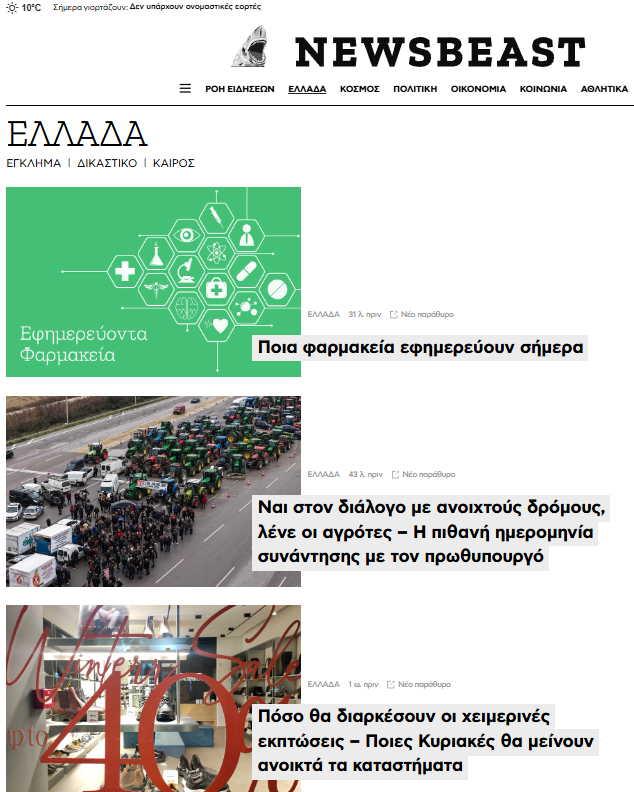
Farmers approve of National Roadblock Committee mtg with premier, at Karditsa meeting
Farmers agreed to a meeting between Prime Minister Kyriakos Mitsotakis and an extended farmers’ committee, during a meeting of the Panhellenic Committee of Roadblocks that took place in Palamas, near Karditsa in Thessaly in mainland Greece.
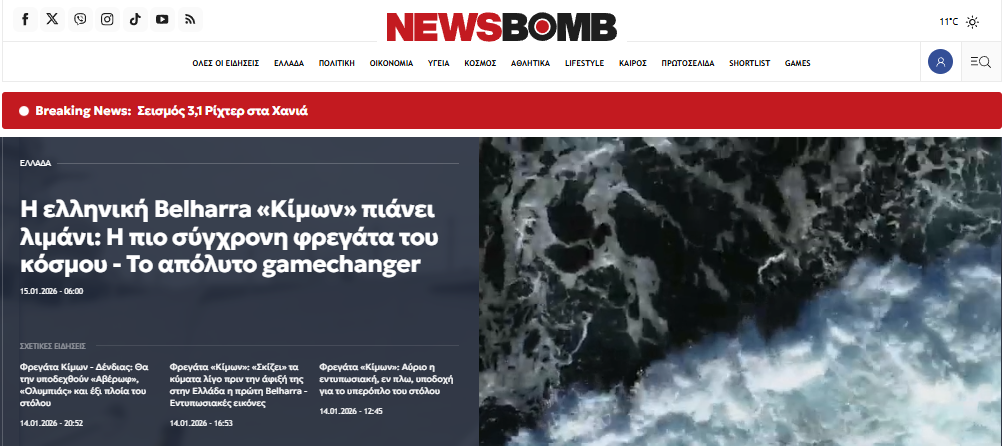
Greece delivers “Kimon”, first FDI frigate
“Kimon”, the first FDI HN “Belharra” class frigate – out of a total of four that will join the Navy in the coming years – will sail on Thursday at noon (just before 12:00 pm) in the Saronic Gulf, bound for the Salamis naval base.
https://www.amna.gr/en/article/962906/Greece-delivers-Kimon–first-FDI-frigate
Hellenic Civil Aviation Authority chief resigns
Infrastructure and Transport Minister Christos Dimas has accepted the resignation of Hellenic Civil Aviation Authority (HCAA) chief George Saunatsos, following the recent blackout in the Greek FIR.
https://www.amna.gr/en/article/962721/Hellenic-Civil-Aviation-Authority-chief-resigns
PM given demonstration of new digital case file system
A new digital application for use in the judicial system will save time, enhance transparency and reduce bureaucracy, Prime Minister Kyriakos Mitsotakis has said, following a demonstration of the digital case file system in an Athens law office.
https://www.ekathimerini.com/politics/1292321/pm-given-demonstration-of-new-digital-case-file-system
ATHEX: Universal growth for local stocks
The main index at Athinon Avenue rebounded on Wednesday to reach highs unseen since January 2010, after a balanced growth registered among local stocks despite the reduction of the daily turnover to the lowest level of the last six sessions. Investor focus may remain on banks, but there is also considerable attention to other blue chips, such as construction company GEK Terna, which will construct the major roadwork of the Crete highway.
https://www.ekathimerini.com/economy/1292370/athex-universal-growth-for-local-stocks



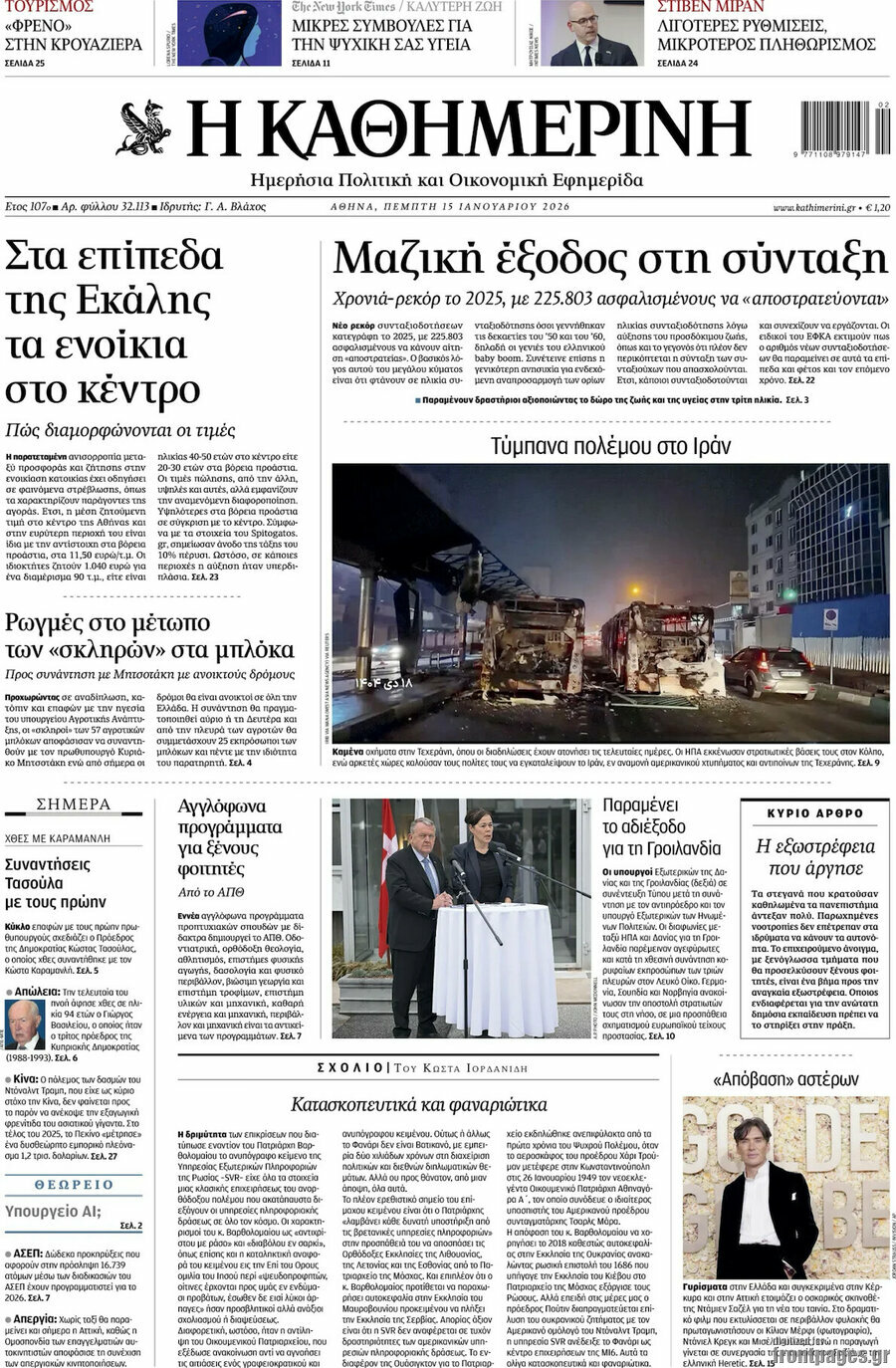
KATHIMERINI: Massive exit to retirement
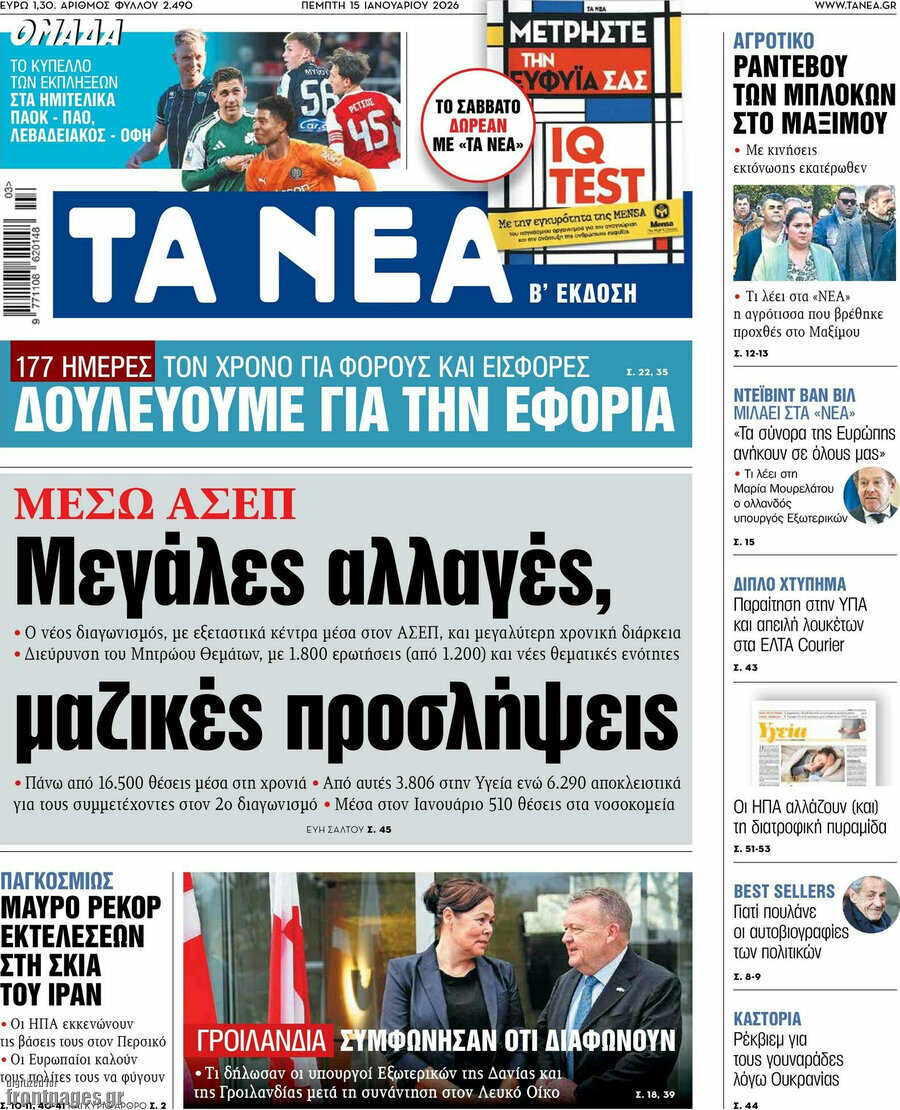
TA NEA: Great changes, new recruitments in the public sector
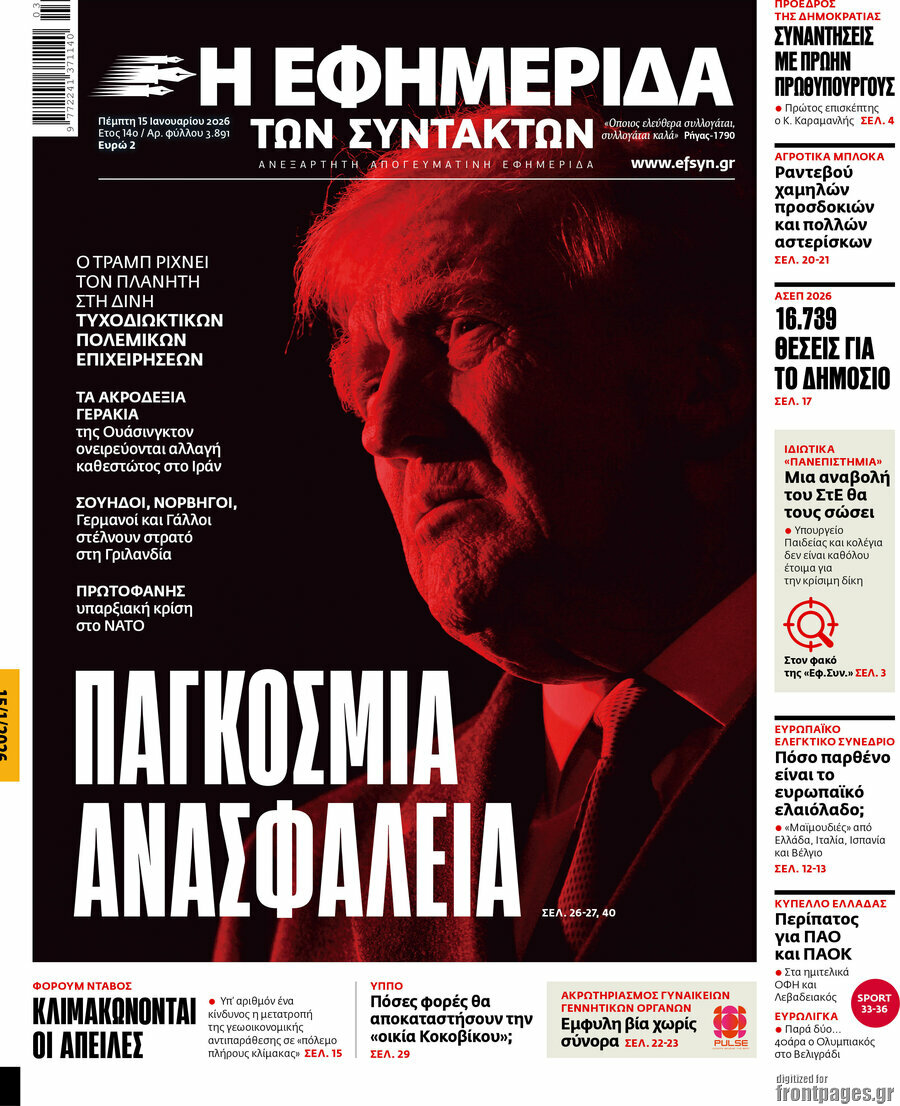
EFIMERIDA TON SYNTAKTON: Global insecurity
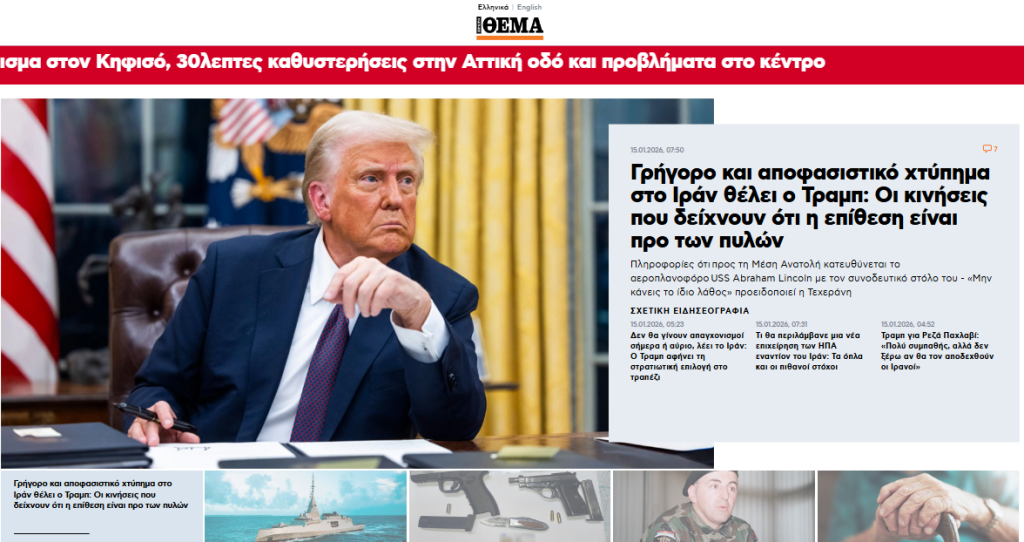
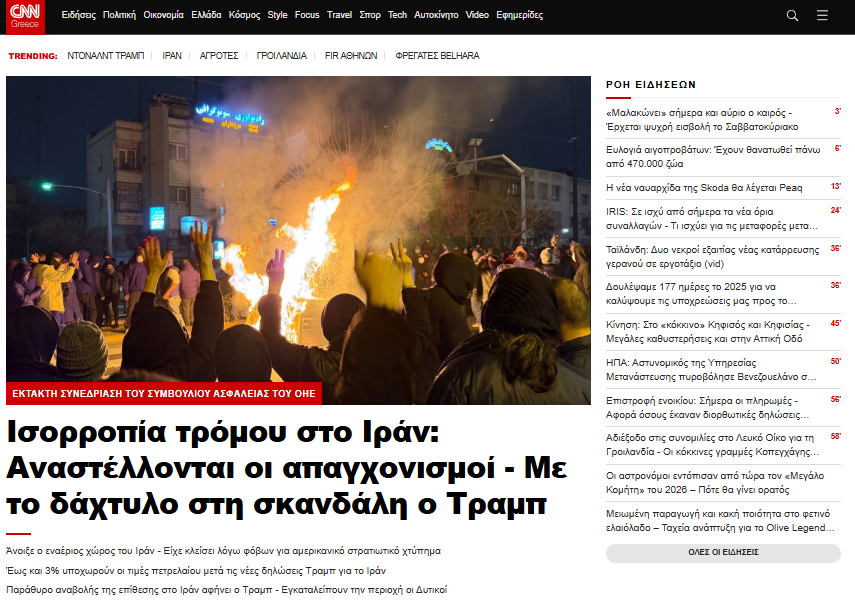
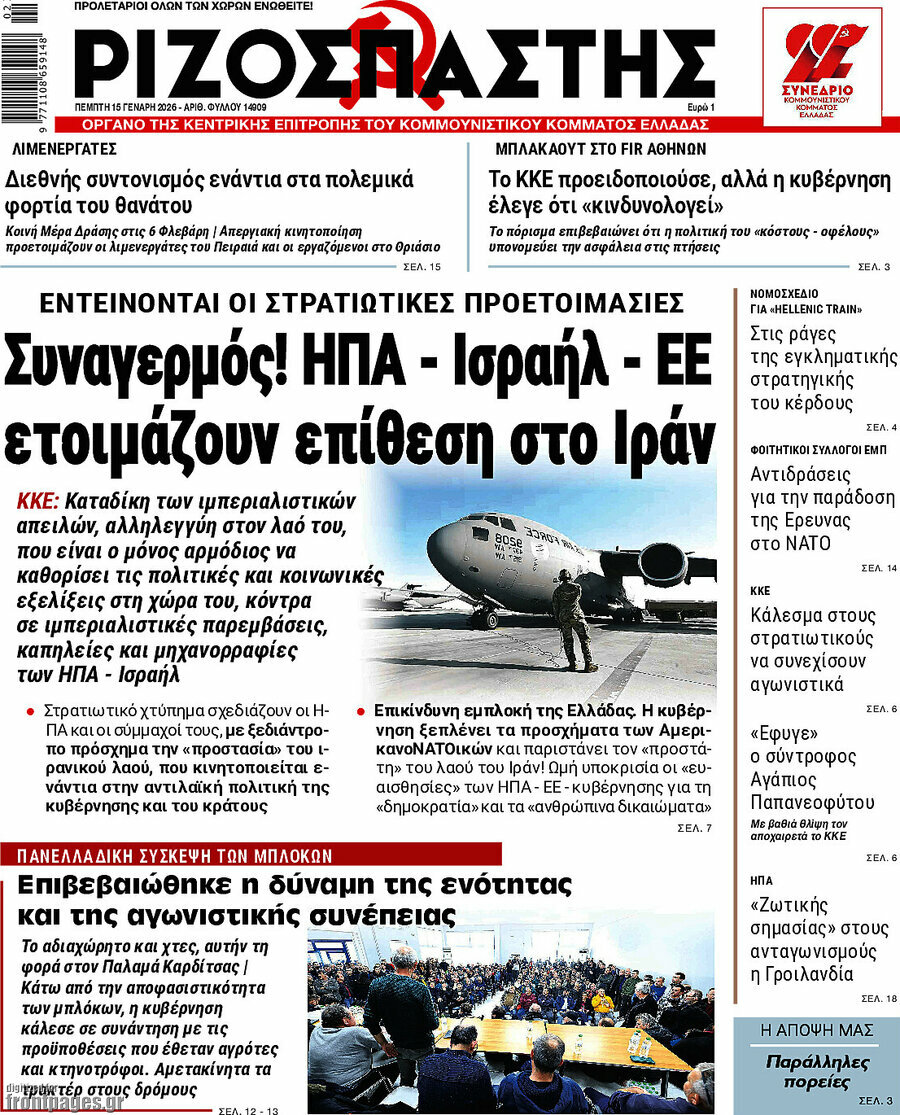
RIZOSPASTIS: Alert! USA-Israel-EU are preparing an attack against Iran
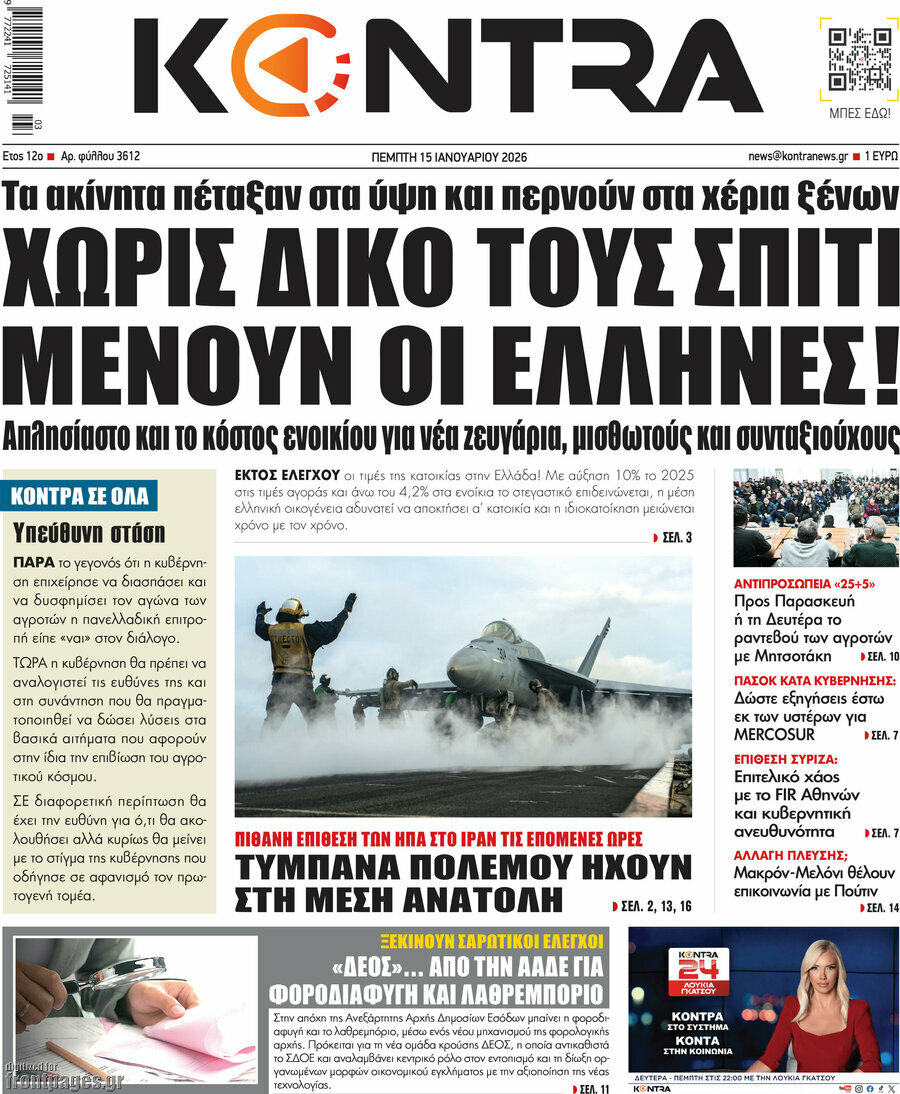
KONTRA NEWS: Greeks are being left without an owned home
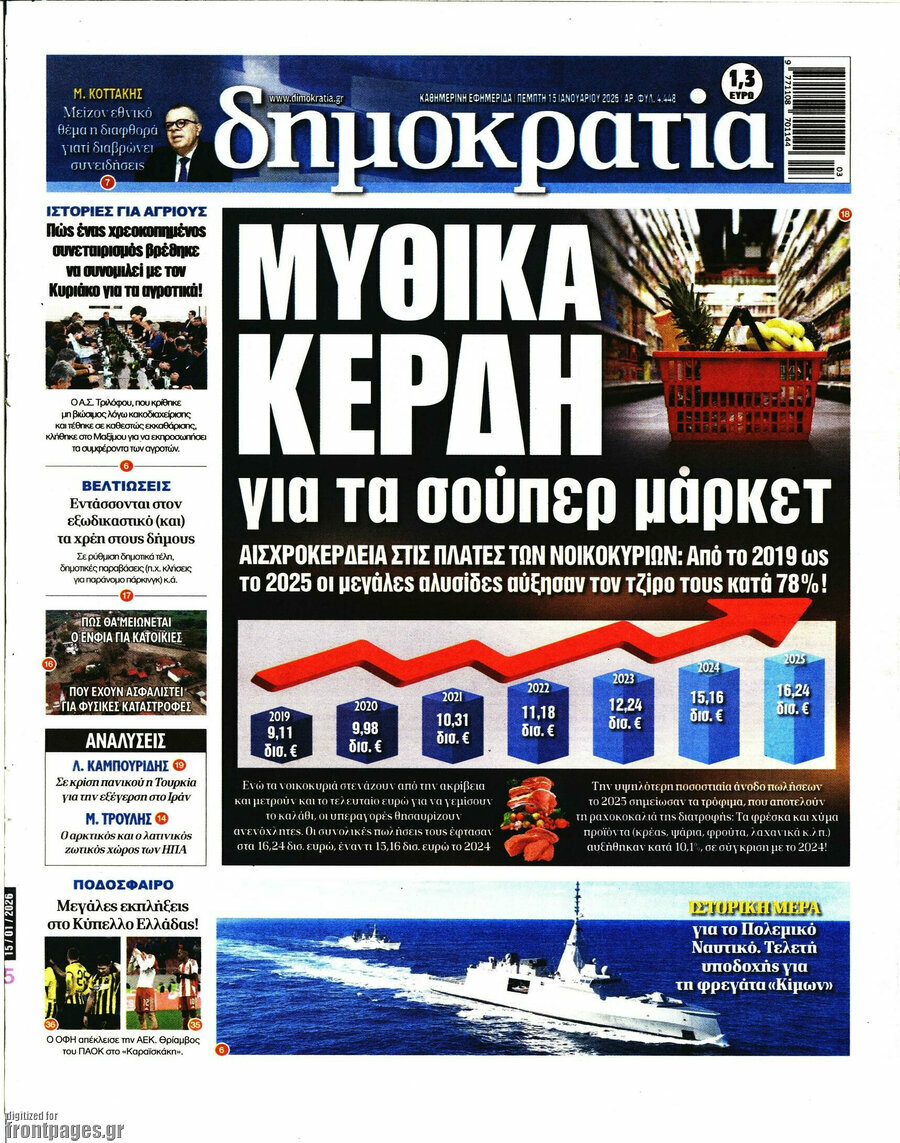
DIMOKRATIA: Mythical profits for super markets
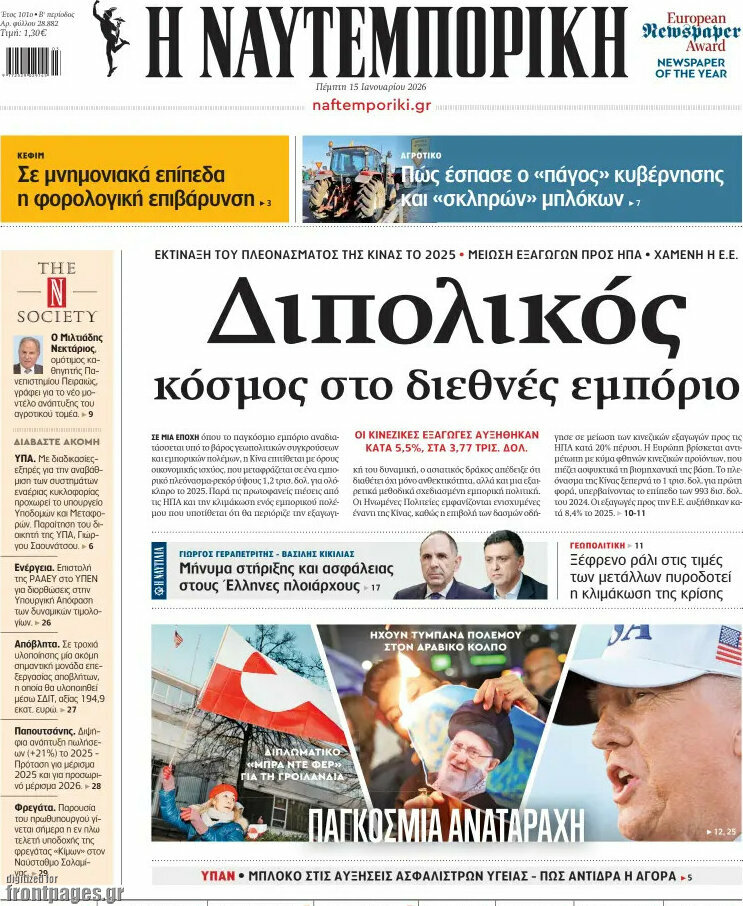
NAFTEMPORIKI: A bipolar world has emerged in international trade

DRIVING THE DAY
FIRST ENCOUNTER ON GREENLAND: The initial reaction to Trump’s Greenland threats was disbelief … but there was also a quick realization that this was no joking matter. Wednesday’s trilateral meeting in Washington between the U.S., Denmark and Greenland marked the start of a more serious — and structured — phase in the dispute.
Could have been worse: Some feared a repeat of the public confrontations of the kind experienced by Ukraine’s Volodymyr Zelenskyy or South Africa’s Cyril Ramaphosa. That didn’t happen. The talks were described as “positive” and “frank” by an EU diplomat briefed on the exchange.
But still bad: The substance of the dispute remains unchanged. Denmark and Greenland “still have a fundamental disagreement” with the U.S. over President Donald Trump’s ambition to control the territory, Danish Foreign Minister Lars Løkke Rasmussen said after the meetings with Vice President JD Vance and Secretary of State Marco Rubio.
Agree to disagree: “We didn’t manage to change the American position,” Rasmussen said. “It’s clear the president has this wish of conquering … Greenland. We made it very clear this is not in the interest of the kingdom.” Our U.S. colleagues covered the comments.
Trump means it: The meeting confirmed that Trump’s Greenland ambitions are neither rhetorical nor tactical and are backed by advisers and lawmakers. “Denmark is under no illusions: Trump clearly wants Greenland,” said the diplomat.
So does Europe: Copenhagen has asked allies to visibly step up their presence around Greenland — and they are responding. Troops from Sweden, the Netherlands, France and Germany are deploying to the island for military exercises starting today and running through Saturday.
Important caveat: The deployments are explicitly not directed at the U.S. Instead, they address Trump’s repeated claims that Denmark has failed to adequately secure the territory — that, at least, is the message coming from EU and NATO diplomatic circles in Brussels.
Sliver of an upside: In what remains one of NATO’s most sensitive internal crises ever, officials see at least one positive: the emergence of a diplomatic track that allows Denmark to address U.S. security concerns without conceding sovereignty.
U.S. Senator Angus King said Washington agreed to a continued dialogue, with Vance and Rubio appearing receptive, according to my colleagues in Washington. However, Vance is seen as unpredictable in Brussels, as Tim Ross and Zoya Sheftalovich report today.
Undercut, again: Any progress was quickly offset by Trump’s subsequent remarks mocking Denmark’s military capacity, joking it had added “a second dog sled” — comments that had already prompted an unusually direct rebuke from Danish Prime Minister Mette Frederiksen. But an EU diplomat cut short the sled-talk, saying rhetoric matters less than facts on the ground.
Not playing well at home … A poll shows most Americans believe Trump has gone “too far” in his international military pursuits.
… nor abroad: A major new global survey by the European Council on Foreign Relations, covering 21 countries, suggests Trump’s transactional “America First” approach is pushing global opinion closer to China, while traditional U.S. allies — especially in Europe — feel increasingly distant. More in today’s POLITICO op-ed by ECFR’s Mark Leonard.
Brussels mood: The atmosphere is sufficiently bleak that EU foreign policy chief Kaja Kallas joked privately with MEPs that it might be “a good moment to start drinking,” POLITICO’s Max Griera reports.
It’s catching on: Latvian Foreign Minister Baiba Braže recommended a bottle of Rig dry gin, while Finnish MEP Mika Aaltola suggested popular Finnish extra-strong beer Sandels — with the caveat that it was important to stay clear-headed. (What’s your poison to cope with a grim outlook on world politics? Let us know!)
New target: Iceland? Greenland was formally discussed for the first time at Wednesday’s College of Commissioners meeting, two Commission officials confirmed. The same day, Iceland’s PM Kristrún Frostadóttir was in Brussels to meet Commission President Ursula von der Leyen, with talks covering “Arctic and North Atlantic security.”(Because, well, no one really knows where Trump’s territorial ambitions may end.)
Move over, Canada! POLITICO’s Congress team reports that former Rep. Billy Long, Trump’s nominee for ambassador to Iceland, joked on the House floor that Iceland would become the 52nd U.S. state — with himself as governor.
COMMISSION IN CYPRUS
BEACH BREAK: Cyprus, which took over the rotating six-month Council presidency at the start of the year, is hosting the College of Commissioners today at the port of Limassol.
Well, almost all of them: Agriculture Commissioner Christophe Hansen will miss out — again! He’s been dispatched to Berlin for Internationale Grüne Woche, one of the food and agriculture sector’s flagship annual events. (He also missed last year’s Danish presidency trip due to a sensitive mission to India.)
What’s on the table: Commissioners (minus Hansen) and members of the Cypriot presidency are set to discuss Ukraine, trade agreements and the Pact for the Mediterranean — an EU initiative aimed at deepening cooperation with neighboring countries across the region. Expect particular enthusiasm for the latter from the Cypriot side, for obvious geographical and political reasons.
Before that in Nicosia, Commission President Ursula von der Leyen and Cyprus President Nikos Christodoulides will visit the Green Line, the buffer zone that divides the island.
Awks: On Wednesday night, Cyprus’ first lady, Philippa Karsera, took reporters, including our own Zoya Sheftalovich, on a tour of the presidential palace’s art collection, despite having been forced to step down from the management committee of a charity fund earlier in the week amid a corruption scandal.
Christodoulides’ chief of staff Charalambos Charalambous also resigned over the saga. Both deny all allegations, which the government has called “hybrid activity.” Last night, an official hinted that Russia could be behind it.
Speaking of Russia: Earlier on Wednesday, reporters had asked Minister of Foreign Affairs Constantinos Kombos about Russian influence in Cyprus. The foreign minister conceded Cyprus had been closely tied to the country in the past, but pointed to steps it had taken in response to the full-scale invasion of Ukraine, including closing 42,728 shell companies and 125,782 bank accounts.
“We have diversified the economic model, the banking model, the defense mix of the country,” Kombos said. “We are not relying on Russian energy, in contrast to other member states. We have aligned ourselves in terms of sanctions.”
Cyprus feels Ukrainian/Dane pain: “When we talk about the importance of respect for territorial integrity, sovereignty and independence, whether that is about Ukraine or whether that is about the Kingdom of Denmark and Greenland, we say it from first-hand experience,” added Deputy Minister for European Affairs Marilena Raouna. “Because Cyprus has been living with the consequences of violation of international law for over 50 years.”
TLC SCOOP: In Brussels, my colleague Mathieu Pollet has seen a leaked draft of the long-awaited EU telecoms overhaul — a hefty 294-page proposal with major implications for companies in Europe, China and the U.S.
Geopolitics baked in: Due to be unveiled by the Commission in Strasbourg next week, the plan is expected to tighten the screws on Chinese vendors such as Huawei and ZTE, while expanding Brussels’ leverage over U.S. Big Tech in disputes (a scenario Washington is unlikely to welcome).
There’s more: Its reach would also extend to satellite operators, potentially bringing Elon Musk and his globally dominant SpaceX into the EU’s regulatory net. Full details in Mathieu’s deep dive (for Pros).
PARLIAMENT CORNER
WHAT NOW? The European Parliament is taking stock after the high-stakes trilateral in Washington on Wednesday. POLITICO’sCamille Gijs and Max Griera write in to report that lawmakers are weighing up whether to freeze the EU’s trade deal with U.S.
In a nutshell: The Parliament’s leading trade-policy lawmakers decided Wednesday to delay, although they opted not to vote on the decision for now. The move centers on whether to go ahead with a vote scheduled for Jan. 26 that would lay out Parliament’s position on lifting tariffs on U.S. industrial goods — one of the key planks of a deal struck between Brussels and Washington last summer.
Any delay would further test the U.S.’s patience over the lengthy process required for the EU to live up to its side of the bargain.
In one camp: The Socialists and Democrats, European Greens, Renew Europe and The Left are in favor of postponing the vote, angered at Trump’s antics ranging from Greenland to Venezuela, as well as the U.S. administration’s strong stance in favor of Elon Musk’s X over European governments’ deepfake concerns.
In the other camp … is von der Leyen’s own party, the European People’s Party, and the European Conservatives and Reformists. Neither of them want to escalate tensions and are against stalling the vote.
They say: The U.S. deal “will not be postponed,” EPP lawmaker Željana Zovko told my colleague Max Griera. ECR spokesperson Michael Strauss said his party does “not see these matters as connected. They should be addressed separately and through the appropriate channels, rather than being bundled together in a way that risks unnecessary escalation.”
But pressure’s mounting. An EPP lawmaker did admit to Max that if tensions keep piling up with Washington, it will be very difficult for the EPP not to follow the other parties in postponing the vote.
Mark your calendars: The lead lawmakers — aka shadow rapporteurs — are expected to reconvene on Jan. 21 to decide on when to schedule the vote.
SPEAKING OF MUSK … X announced it will finally stop its AI bot Grok from making sexualized deepfake images. In a statement, X said Grok would no longer allow the “editing of images of real people in revealing clothing such as bikinis” and that generating images of real people in this way would be blocked in jurisdictions where it is illegal.
RAZOR-THIN ON MERCOSUR: The European Parliament’s consent vote over the hyper-controversial Mercosur trade deal is looking like a “50–50,” four Parliament officials told Max Griera. With farmer pressure mounting in some EU countries, political parties are increasingly fearful of showing public support for the trade deal with the South American bloc.
EPP lawmakers have floated the idea of calling for a secret ballot to allow MEPs to vote without fear of public repercussions, one of the officials said.
Proxy vote: The final consent vote will not come for a few months, but next Wednesday lawmakers are set to vote on whether to refer the deal to the EU Court of Justice to review its legality, in what many see as a test of where majorities stand.
Poland on the case: If MEPs fail in their bid to send the EU-Mercosur deal to the bloc’s top court, Poland is preparing to step in.
Plan B: Government officials told Bartosz Brzeziński Wednesday that if the parliamentary referral is rejected by the court or goes nowhere, Agriculture Minister Stefan Krajewski plans to ask the cabinet to have Poland file its own legal challenge as a member state.
MOTION OF CENSURE WATCH: Parliament President Roberta Metsola on Wednesday declared admissible the motion of censure tabled by the Patriots for Europe, after it secured the required number of signatures. The move triggers a debate on Jan. 19, followed by a vote on Jan. 22 during next week’s Strasbourg plenary.
All present: As flagged in Wednesday’s Playbook, there had been some uncertainty over whether Commission President Ursula von der Leyen would attend. That question now appears settled: The entire College of Commissioners is expected to be present for Monday’s debate, according to an EU official, citing the latest guidance from von der Leyen’s cabinet.
Now read this: In an interview with POLITICO, EPP leader Manfred Weber argues that as Europe shifts to the right, centrists will need to adjust too.
MIGRATION
FRESH DATA TODAY: EU border agency Frontex will publish new figures at 10 a.m. and … Playbook got a sneak peek. The top-line: Irregular border crossings fell by 26 percent last year, meaning they have more than halved compared with 2023.
Yippee Ki-Yay: This is welcome news for the EU executive, which uses irregular arrivals as a key indicator to measure the impact of its migration policy. The timing is politically convenient too, with 2026 looming as the year the new common EU migration framework begins to bite.
Momentum — for now: Susanne Raab, a former Austrian government minister and the newly appointed director general of the International Centre for Migration Policy Development (ICMPD), told Playbook the data indicate a clear improvement in migration management.
Raab pointed to December 2025, when the Pact on Migration and Asylum was adopted by EU ministers under the Danish presidency as a structural turning point — and one of the most far-reaching reforms in years.
ICMPD will publish its migration outlook report next week, confirming both the decline in irregular arrivals and a 21 percent drop in asylum applications EU-wide. For Raab, however, the real test of whether the Pact delivers will be the return rate — currently standing at just 27 percent.
Conflict fallout: While the numbers are moving in the right direction, 2026 will also be defined by record-high global conflict levels. Raab points to several major “black boxes” for EU migration policy, including the evolving situation in Ukraine, the mass displacement driven by the conflict in Sudan and developments in Venezuela.
PLAYBOOK INTERVIEW: GEORGIA’S LAST PRESIDENT
GEORGIA ON OUR MINDS: Relations between the EU and Georgia, once a promising candidate country, have hit rock bottom over the past year, amid accusations its increasingly authoritarian government has silenced the opposition, swayed a parliamentary election and moved to strengthen ties with Russia.
My colleague Gabriel Gavin sat down with Salome Zourabichvili — the fifth and last directly elected president of Georgia. The role was abolished by the ruling Georgian Dream Party last year in a move not recognized by European countries, and the veteran diplomat is now in Brussels to build support for the opposition.
Who’s to blame: Zourabichvili warned the EU hadn’t done enough to explain to the Georgian public the reasons for putting on ice the country’s EU candidacy application. “Most important at this stage is the narrative — not to let [the people] blame Europe for what has happened,” she said.
Counter the narrative: “[Russians] present the situation as if [Georgians] want [closer ties with] Europe, and Europeans do not give us what we deserve because they are asking us to renounce our sovereignty and our values or whatever. It’s the Russian narrative. That has to be countered.”
Pay us a visit: “One of the policies of the European Union is to not have contacts with the authorities, which I understand and I fully share,” she went on, after Brussels scaled back ties following allegations of election manipulation. “But at certain points in time, without changing this policy, you can have a high-level visit that is just designed to bring the word of Brussels to Georgia, because otherwise it’s not heard.”
Calling the Don: President Trump, meanwhile, should also take a tougher line to avoid Georgia falling further into Russia’s grasp, Zourabichvili said. “He should be attracted to the fact that it’s the Caucasus, it’s the Black Sea, it’s the road to Central Asia, it’s the road to Iran.”
Sanctions on Georgian Dream-linked people and businesses, she said, “would be making clear to Russia … that the U.S. and the Europeans consider that they are free to have business in this region and that it’s not a region that goes back under the exclusive influence of Russia.”
TRUMP MOVE: On Wednesday evening, the administration of Donald Trump announced a pause on visa applications from 75 countries — basically, the whole non-EU Western Balkans, Moldova and … Georgia. The measure is set to take effect on Jan. 21 and will remain in place indefinitely. The crackdown is aimed at ensuring that new immigrants “will not extract wealth from the American people,” according to a post published by U.S. Department of State on X.
SILVER SCREEN DEALMAKING
PASS THE POPCORN: Representatives of cinema operators from the International Union of Cinemas (UNIC) will meet DG COMP officials Thursday. On the agenda for the Commission’s antitrust arm: concerns over a potential acquisition of Warner Bros. Discovery and what it could mean for European cinemas — and audiences.
Cinema studies: The entertainment industry is awash with cash as Netflix and Paramount go head-to-head over Warner Bros. Discovery, with reported bids of $81.9 billion and $107.9 billion, respectively. For context, that’s more than experts and media outlets like The Economist once floated as a purchase price for Greenland.
Why Brussels cares: The EU is financially invested in the cinema ecosystem through programs such as Creative Europe MEDIA — yes, you’ve probably seen the logo before the trailers roll. Antitrust scrutiny, however, will be central to any deal, with either outcome likely to reopen direct lines between DG COMP officials and their U.S. counterparts.
No bad blood: The Commission and U.S. antitrust agencies have a long track record of close cooperation on mega-deals, marked by frequent contact, information exchanges and virtual meetings. This case would fit squarely into that tradition.
Or is there? The question is whether that alignment holds under “Trump antitrust 2.0.” The U.S. president has made it clear he favors Paramount over Netflix in this race, adding a political layer to what would otherwise be a textbook competition case — and increasing the risk of diverging transatlantic antitrust reads.
Lobbying in Brussels, after all, is all about meetings — though not all of them are uncontroversial. The Commission is already under pressure from lawmakers to explain its contacts with Big Tobacco and to shed light on recent meetings with China-based fast-fashion giant Shein.
IN OTHER NEWS
If you’ve got this far, here’s your reward: Berlaymont sources suggest the lucky person who found the fève in the galette des rois was Environment Commissioner Jessika Roswall.
GREENLAND, REDUX: Does Trump actually need Greenland to build his mooted missile defense shield, the “Golden Dome”? Not really. Has Trump’s pressure made Greenlandic independence supporters more enthusiastic about a referendum? Also no.
‘WE LOOK LIKE FOOLS’: Croatian President Zoran Milanović has lashed out at France for selling Zagreb second-hand fighter jets while supplying Serbia — Croatia’s regional rival — with a brand-new fleet. Seb Starcevic and Laura Kayali have the story.
LATEST ON UKRAINE: Kyiv has appointed a new defense minister and he’s a tech prodigy. Meanwhile, Ukraine is intensifying efforts with EU allies to pressure Trump to firm up U.S. commitments in Davos.