
Mitsotakis, farmers cite progress after talks as protests continue
Prime Minister Kyriakos Mitsotakis and representatives of protesting farmers said Tuesday that marathon talks had opened a channel for dialogue on electricity, fuel costs and compensation, although agricultural protests and road blockades persist across parts of the country.
Blackout in Athens FIR attributed to ‘digital noise’
The blackout in the Athens Flight Information Region (FIR), which occurred on Sunday, 4 January, has been attributed to “digital noise” caused by desynchronisation across a range of heterogeneous systems and interfaces leading to the Athens-Macedonia Area Control Centre. According to the experts’ report, this resulted in the inadvertent activation and continuous transmission of a critical number of transmitters, as well as the degradation or interruption of essential telecommunications links.
https://www.amna.gr/en/article/962579/Blackout-in-Athens-FIR-attributed-to-digital-noise
Tempe crash advocate Karystianou resigns from victims’ association board
Maria Karystianou announced late Tuesday that she has resigned from the board of the association representing families of victims of the Tempe rail disaster, stepping down from a body she had chaired until recently amid growing internal divisions. She has recently confirmed plans to launch a political party later this year. Despite limited details about the party’s structure, policy platform or ideological orientation, Karystianou has been polling strongly.
Inflation inched up last month to 2.6%
Inflation stood at 2.6% in December, up from 2.4% in November, according to figures the Hellenic Statistical Authority released on Tuesday. On a monthly basis, the ELSTAT consumer price index increased by 0.3%, against a 0.1% increase in the corresponding comparison of the previous year.
https://www.ekathimerini.com/economy/1292240/inflation-inched-up-last-month-to-2-6
ATHEX: Banks could not extend bourse’s rising streak
The rise of the banks index on Tuesday was not enough to avert the extensive profit taking recorded in most other stock prices. That has snapped the four-day rising streak of the benchmark that came off Monday’s 16-year highs with minor losses. Sales accelerated during the latter half of the session at Athinon Avenue, with some of the investors interest predictably deviated toward the issue of the 10-year bond that secured huge bids.
https://www.ekathimerini.com/economy/1292254/athex-banks-could-not-extend-bourses-rising-streak


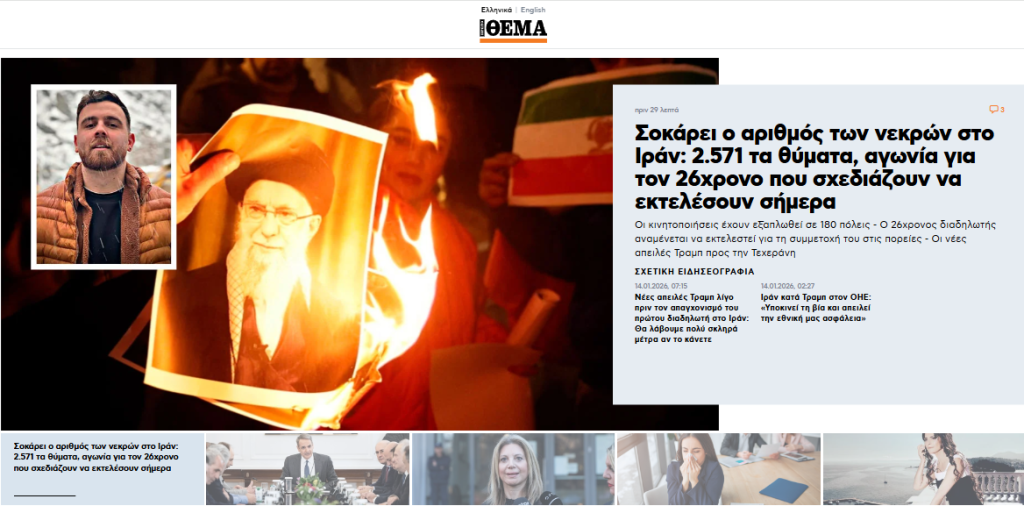
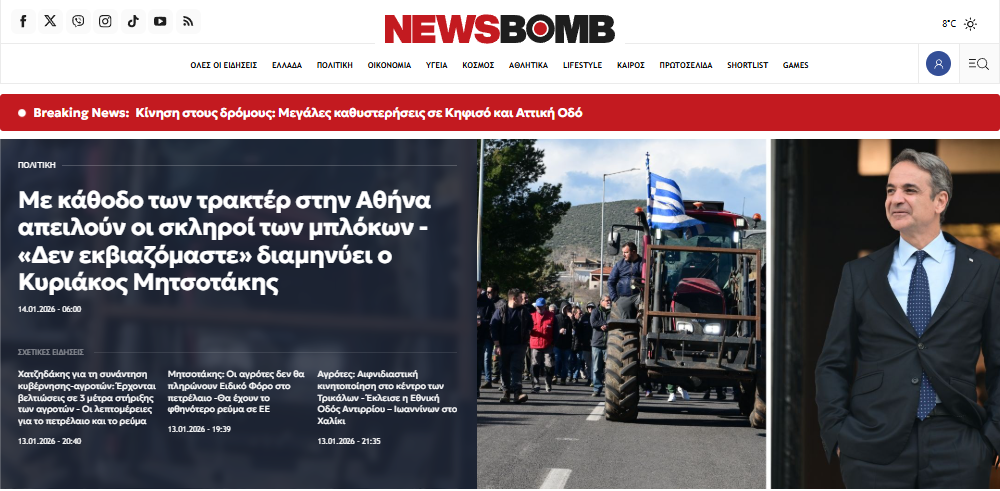
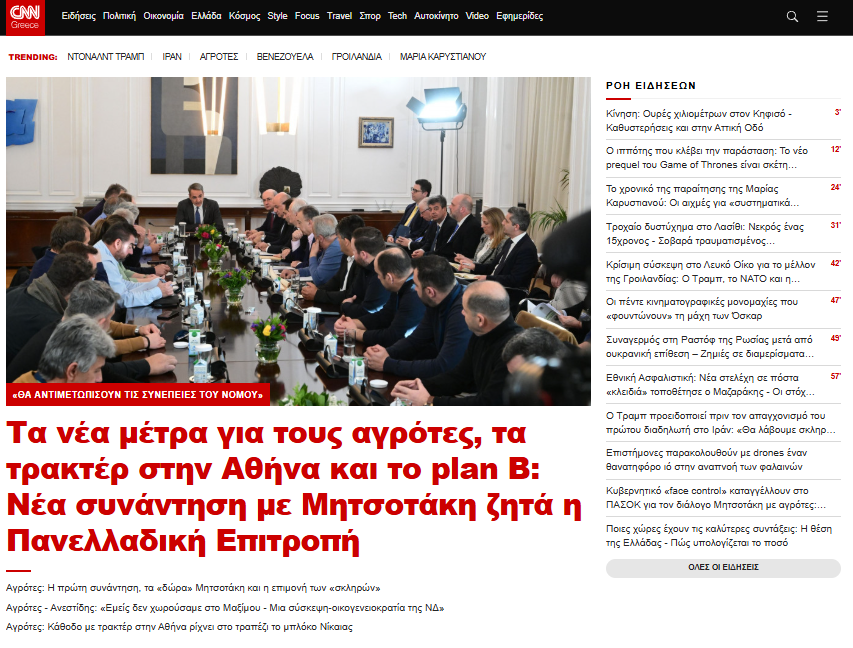
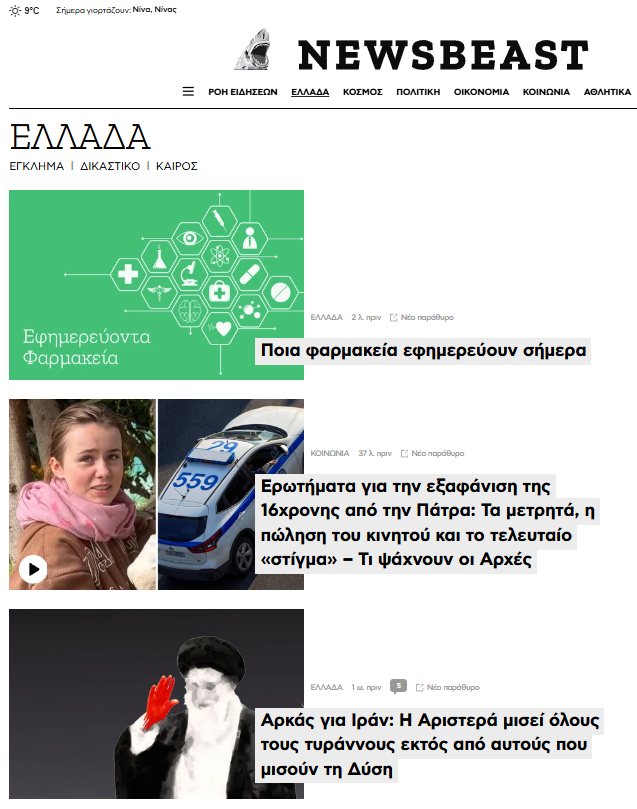

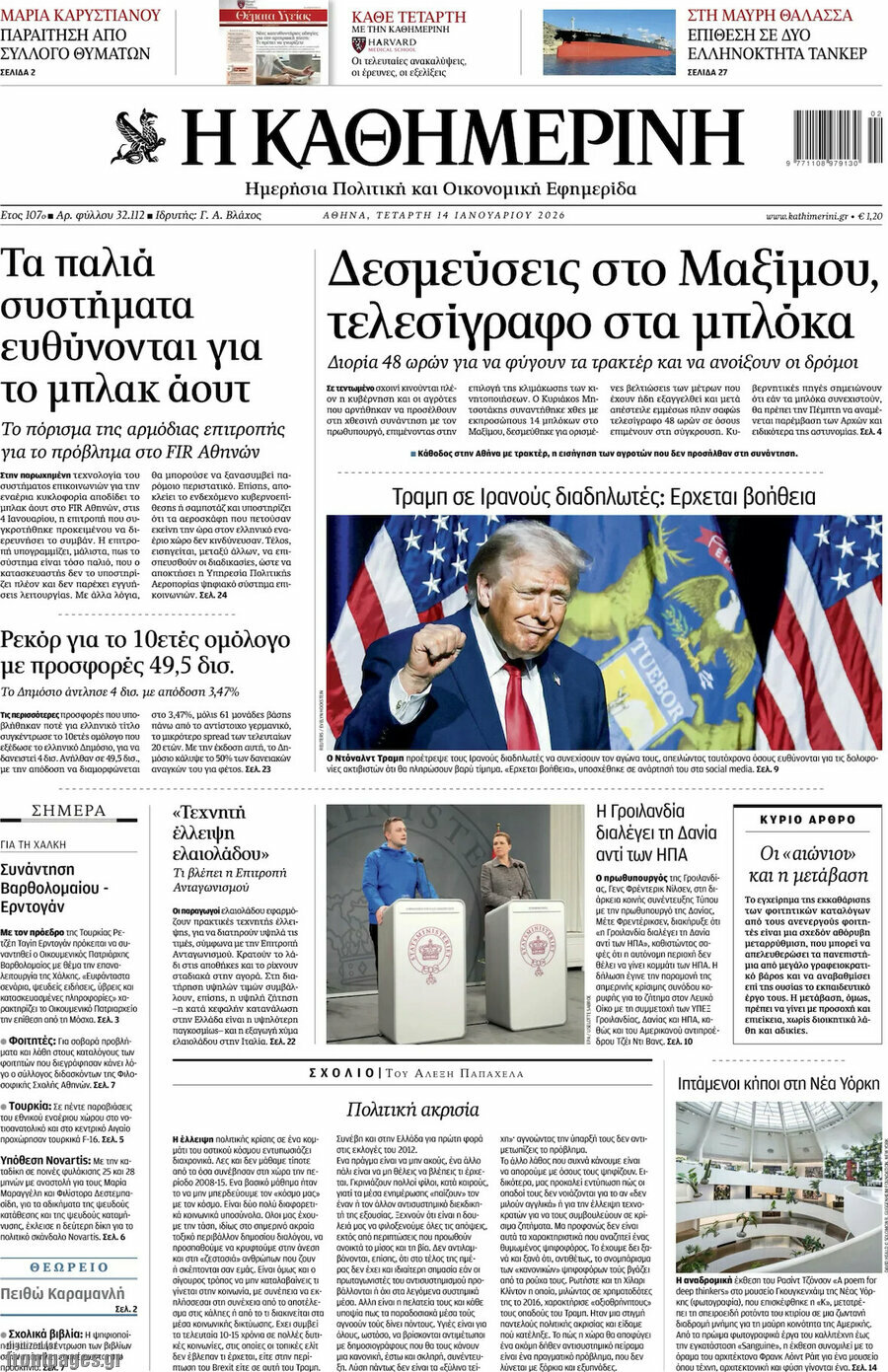
KATHIMERINI: Commitments at the PM’s office; ultimatum addressed at farmers’ blockades
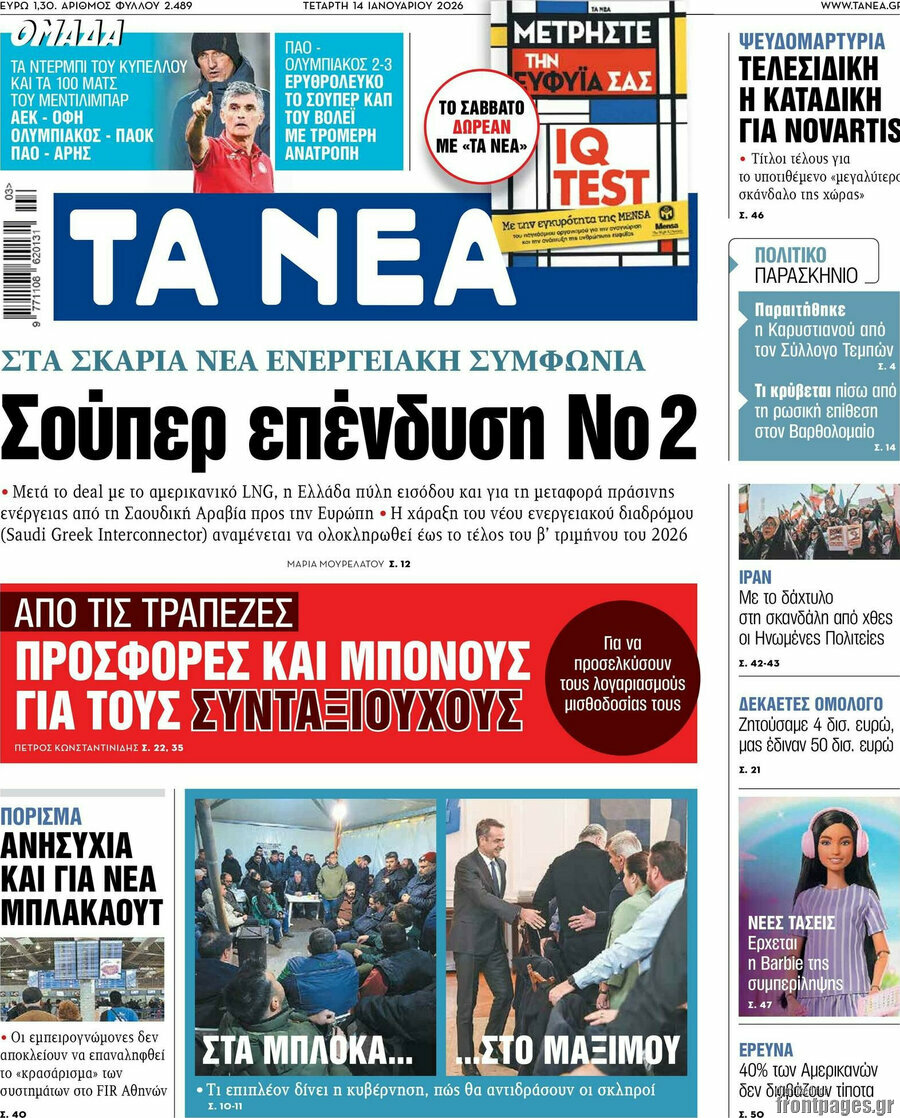
TA NEA: New energy deal ahead: Super investment Nr. 2
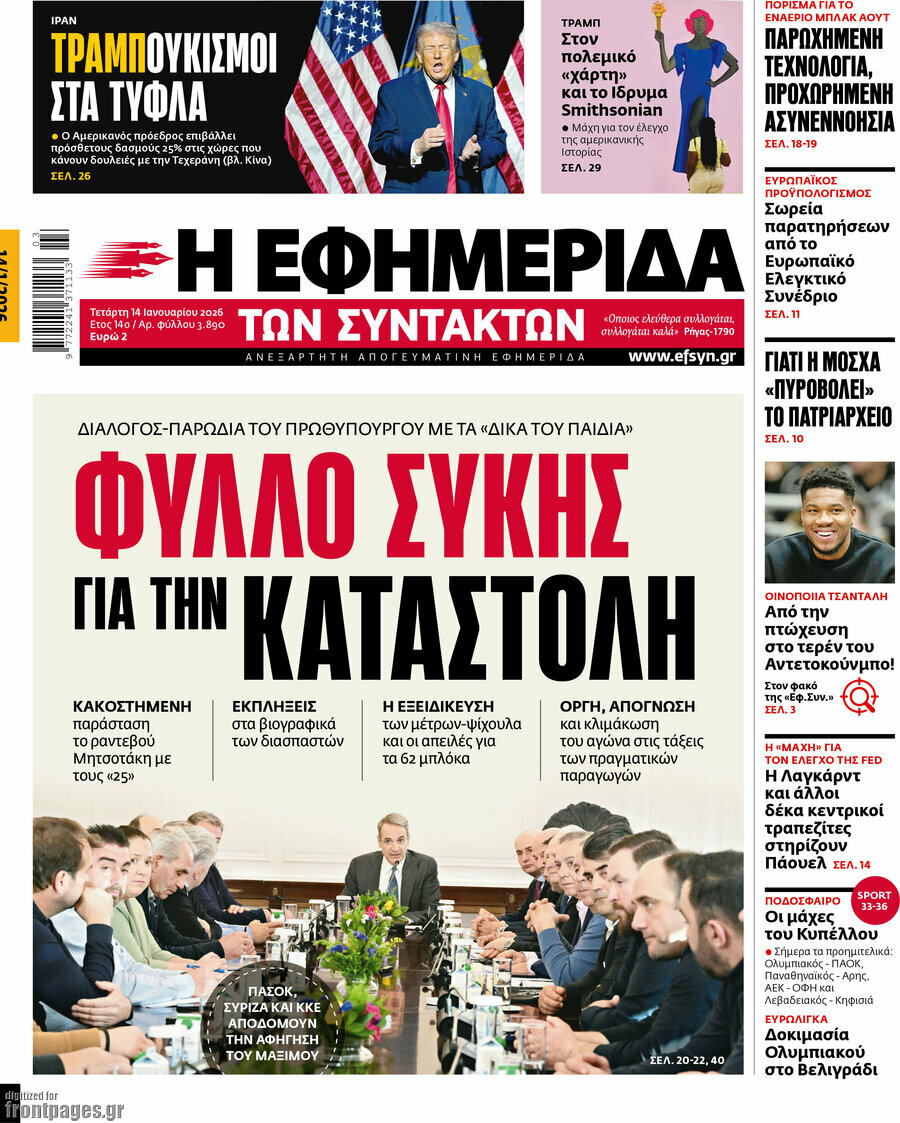
EFIMERIDA TON SYNTAKTON: Fig leaf for the government’s suppression tactics
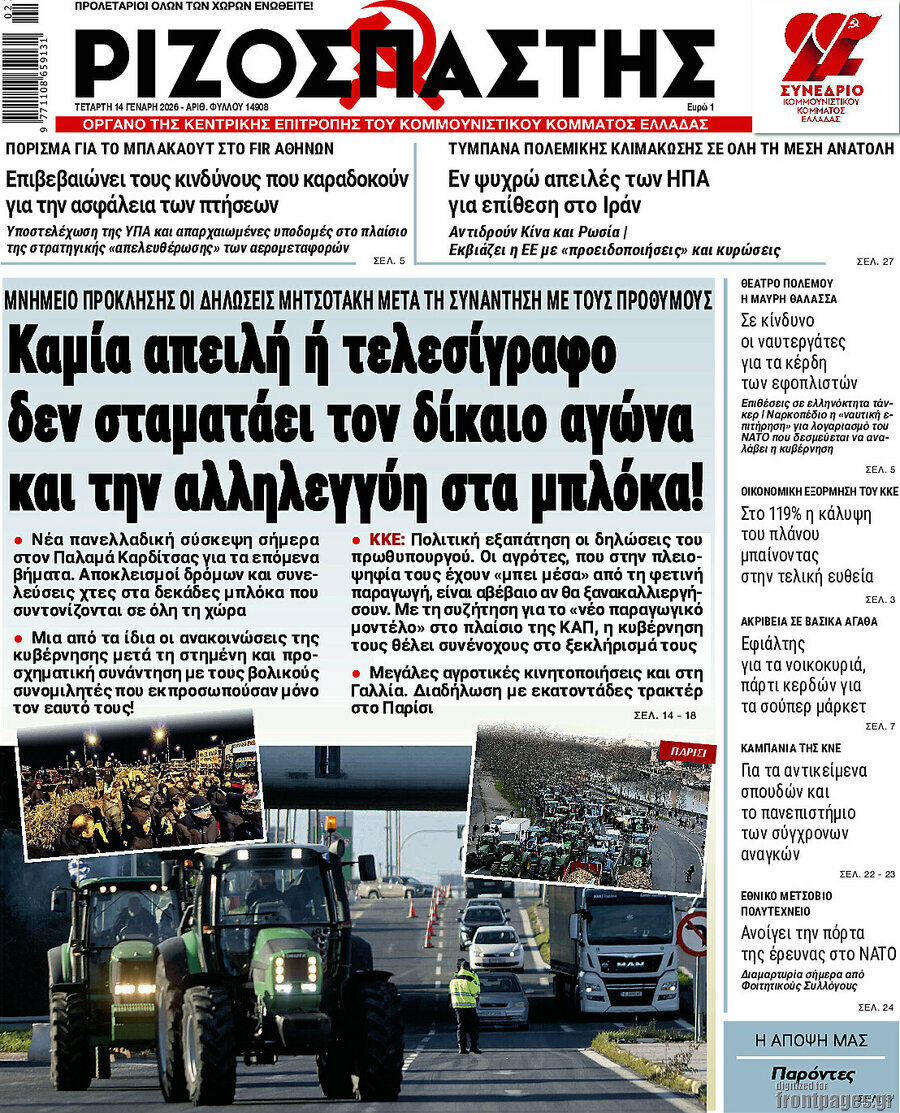
RIZOSPASTIS: Farmers: No threat or ultimatum will stop the righteous fight and the solidarity to famers’ blockades
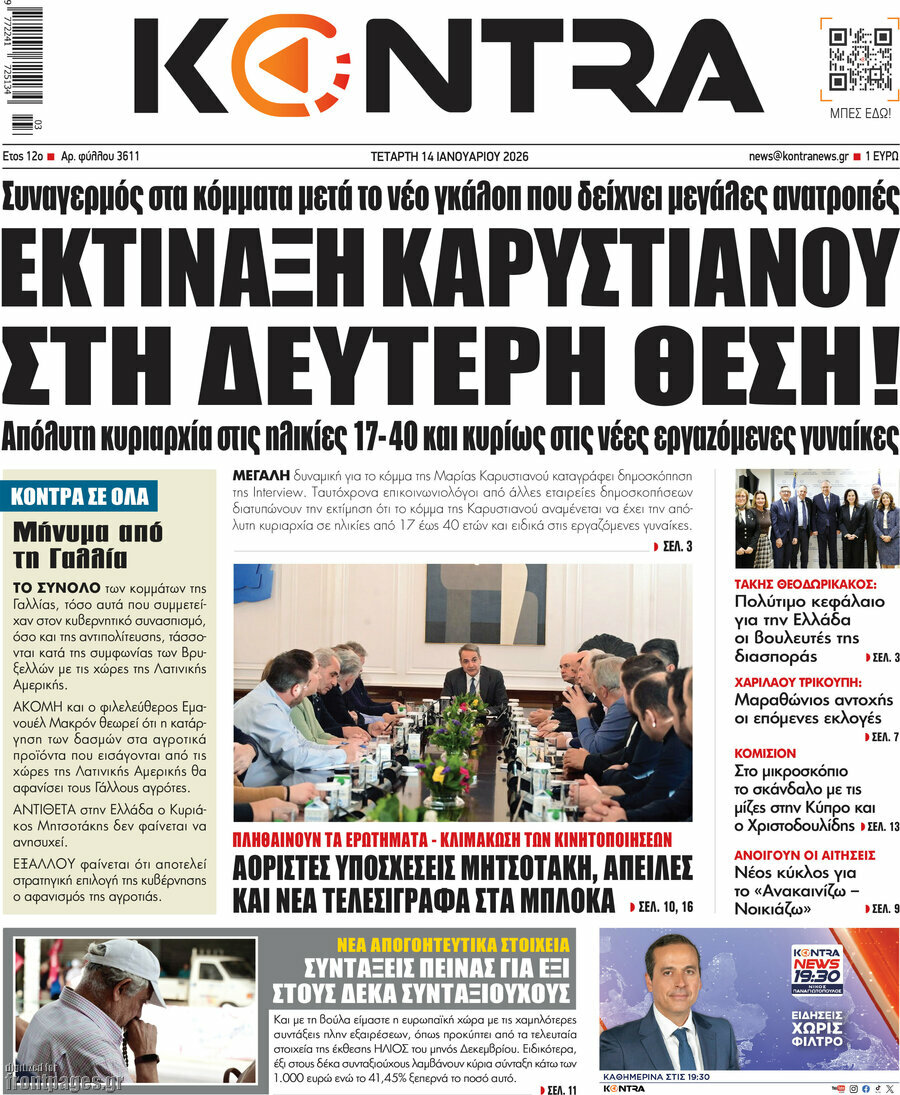
KONTRA NEWS: Karystianou catapults in polls’ second place
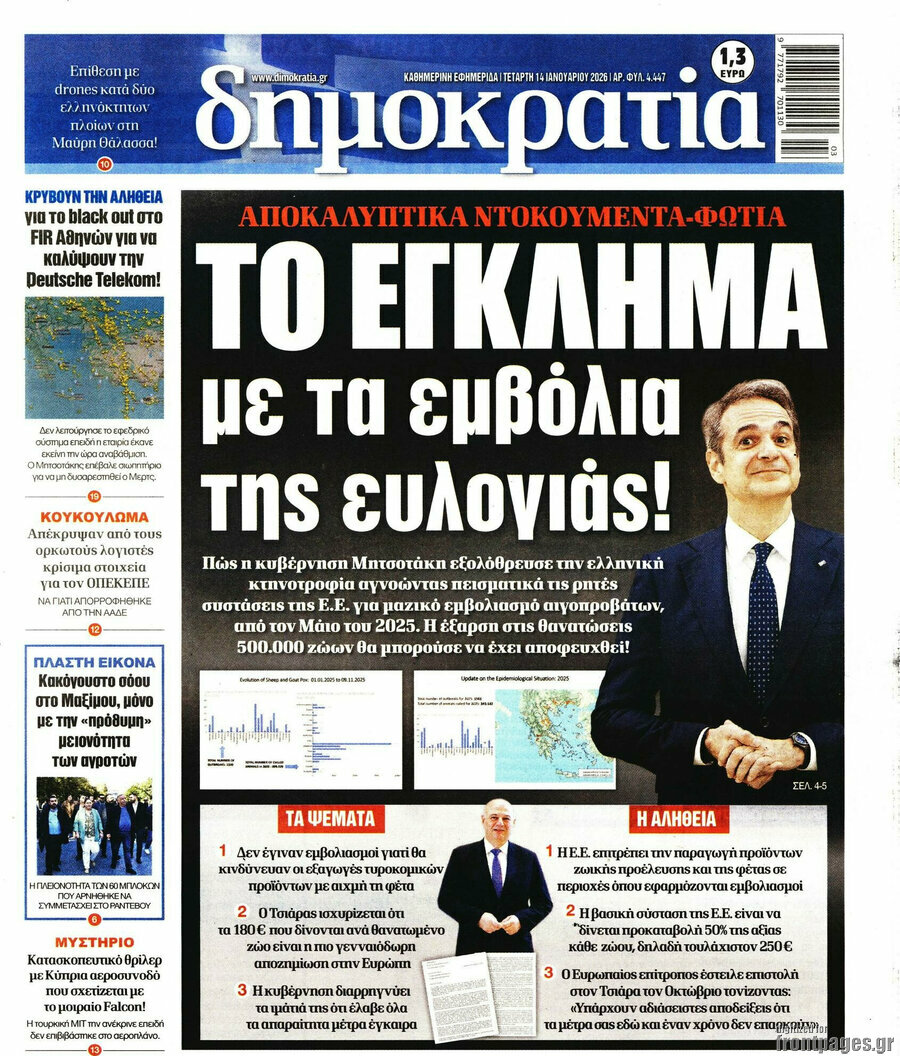
DIMOKRATIA: Crime regarding vaccination of sheep and goat flocks exposed
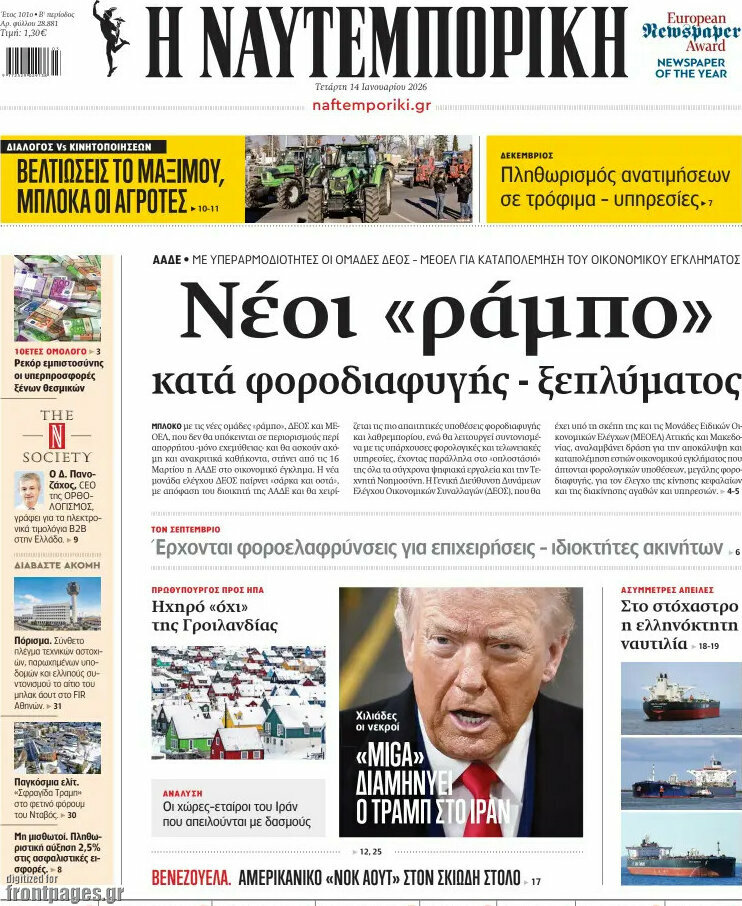
NAFTEMPORIKI: New “Rambos” against tax-evasion and money laundering

DRIVING THE DAY
TRUMP MAKES HIS BID: The time has come to find out what offer The Don(ald) thinks Greenland and Denmark can’t refuse, after days of assertive rhetoric — including the usual hints at taking the Arctic island by force.
What’s happening: The foreign ministers of Denmark and Greenland land in Washington for high-stakes White House talks with U.S. Secretary of State Marco Rubio and Vice President JD Vance, who insisted on being in the room.
The message: Greenland is not for sale — period. That’s the line Danish and Greenlandic officials plan to deliver, an EU diplomat familiar with the prepping told Zoya Sheftalovich. “It’s good to have an honest conversation with the administration,” the diplomat added.
Where this could go: Officials aren’t ruling out that Washington’s opening move will once again be an offer to buy the island — an idea Greenland’s Prime Minister Jens-Frederik Nielsen has already labeled “disrespectful” ahead of the talks.
We are family: Signaling unity, Nielsen and Danish Prime Minister Mette Frederiksen held a joint press conference before the meeting. “We enter the room together,” Nielsen said. “We go out together, and we talk to the Americans together.”
How the tables have turned: I was in Strasbourg when Nielsen visited the European Parliament in October and said Greenland had “no plans” to seek EU membership. On Tuesday, his tone had changed. If forced to choose between the U.S. and Denmark, he said, “we choose NATO, we choose the Kingdom of Denmark, we choose the EU.”
Mixed signals from Capitol Hill: The talks come as a bipartisan group of U.S. lawmakers on Tuesday proposed a bill to prevent U.S. President Donald Trump from invading a NATO country by targeting funding for foreign military incursions. However, another lawmaker introduced the Greenland Annexation and Statehood Act proposing … Well, it would do exactly what it says on the tin.
Preserving NATO remains the bloc’s top priority, one EU diplomat said in this must-read POLITICO piece by Jacopo Barigazzi and Nicholas Vinocur. Trump himself has hinted it “may be a choice” between Greenland and the alliance, with both Frederiksen and EU Defense Commissioner Andrius Kubilius warning military action would spell the end of NATO.
Art of the Greenland deal: Former U.S. ambassador to NATO Kurt Volker, visiting Brussels this week, warned that Trump is deadly serious. “He thinks, as a real estate guy, you don’t invest in something that you don’t own — you have to own it,” Volker told my colleague Gabriel Gavin.
Friendly advice: “I always joke, but it’s not entirely false, that the European default setting is to wait, worry and complain. If you do that, it produces the worst from President Trump,” he added. And indeed, Washington appears, for the moment, content to troll Europe online rather than de-escalate.
EU-U.S. TRADE FREEZE?
SCOOP — PARLIAMENT POISED TO DELAY KEY U.S. VOTE: A crucial vote on lifting tariffs on U.S. industrial goods is facing a delay, four parliamentary officials told POLITICO’s Camille Gijs and Max Griera. It’s being proposed as a tactical response to Trump’s threat to annex Greenland and would almost certainly anger Washington.
The backdrop: Under a deal struck last summer, the EU committed itself to legislation lifting tariffs on U.S. industrial goods and lobster, in exchange for Washington reducing tariffs on European cars. The U.S. has upheld its end of the bargain; the EU, so far, has not. The EU Council, representing national governments, adopted its position in late November; now, all eyes are on MEPs.
Lead lawmakers on the file meet at 9 a.m. to decide whether to postpone the vote, which had been scheduled for the European Parliament’s trade committee on Jan. 26.
Mounting opposition: Socialists and Democrats (S&D), along with the European Greens, support a delay, officials from both groups told POLITICO. And with tensions running high across the Atlantic, many MEPs would vote against the deal if it were put to a vote now, argued one S&D lawmaker.
We can do this the hard way: “We are not in a rush,” Renew leader Valérie Hayer said Tuesday morning. “We can vote very quickly, but we can also decide to vote later if the political situation does not stabilize and if Donald Trump continues to threaten our territorial integrity and our parliamentary sovereignty.”
Cui bono? The European People’s Party (EPP) — Commission President Ursula von der Leyen’s political family and Parliament’s largest group — is against using the vote to send a message to the U.S. “There must be no delay because we have to show certainty for our businesses,” Željana Zovko, the EPP’s lead lawmaker on U.S. trade, told Max. Zovko warned that only Europe’s enemies would benefit from a stalled deal, naming Russia and China.
Crazy voting: There will be a delay “because the left will vote with the far right in this crazy Parliament,” one parliamentary official said, arguing center-left forces can push it through with backing from far-right groups.
Reminder: Before the EU can lift its industrial tariffs, Parliament must adopt its position on the Commission’s proposal — a process that has already tested Washington’s patience. U.S. Trade Representative Jamieson Greer told POLITICO that his country wouldn’t grant further tariff exemptions unless the EU keeps up its side of the bargain.
Paging Metsola: Meanwhile, 24 MEPs are urging European Parliament President Roberta Metsola to intervene and freeze all work on the U.S. deal, according to signatories of a letter drafted by Danish lawmaker Per Clausen. The list includes two Socialists — Dutch MEP Thijs Reuten and Austria’s Andreas Schieder — with backing from the Greens and the Left.
UKRAINE LOAN UNVEILED
SPOTLIGHT ON THE LOAN: The European Commission will today unveil — in full regalia — its €90 billion financing package for Ukraine, clearing the way for EU lawmakers to negotiate the legal text underpinning the loan before Kyiv’s war chest runs dry in April.
The announcement follows the College meeting and will feature von der Leyen alongside Commissioners Valdis Dombrovskis and Marta Kos.
Remember frozen assets? Well, don’t bother. EU leaders opted against using frozen Russian state assets across the bloc to finance loans totaling €210 billion. Instead, the new plan relies on issuing joint EU debt to fund a €90 billion loan, backed by the EU budget. The scheme is expected to cost European taxpayers around €3 billion a year in interest payments from 2028 — with Czechia, Hungary and Slovakia exempted.
The main fight is over defense spending — specifically how Ukraine can use up to €60 billion for military purposes. EU capitals remain divided over how much of that money Kyiv should be allowed to spend on weapons manufactured outside the EU.
Compromise in the air: A draft legal text seen by POLITICO gives preferential treatment to defense companies based in the EU, Ukraine and neighboring countries such as Norway and Switzerland. However, it allows — on an exceptional basis — purchases from non-EU suppliers if the equipment is not immediately available within the bloc. POLITICO’s Gregorio Sorgi and Jacopo Barigazzi obtained the draft and the details for Pro subscribers.
Who wins: The clause will be welcomed by a group of countries led by Germany and the Netherlands, which have argued Ukraine should be free to buy non-European weapons if that’s what it takes to hold back Russian forces. France, by contrast, has mounted a rearguard effort to prevent EU money flowing to Washington.
Conditionality watch: Keep an eye on the governance conditions attached to disbursements — a model that mirrors the EU’s enlargement approach, with Ukraine increasingly framed as a future member state.
FAST-TRACKED LEGISLATURE: The European Parliament could approve the loan as early as next week during the plenary under an urgency procedure requested by the EPP, S&D and Renew groups.
“Any legislative delays would pose a significant risk” to Ukraine’s ability to keep fighting, reads a draft note obtained by Max Griera. Lawmakers aim to wrap up inter-institutional talks by March 2026, allowing the funds to be disbursed in April. A final decision by political group leaders is expected Wednesday afternoon.
EU SANCTIONS ON IRAN
PROGRESS ON SANCTIONS hasn’t been as fast as some may have expected, given the gravity of the situation in Iran — and the potential deterrent effect sanctions could have. But it has still been brisk, by EU standards (nothing ever truly moves quickly with 27 member states). That’s especially true after a milestone, restricted meeting on Tuesday evening.
Reminder: Playbook kicked off the week with news that a new EU sanctions package against Iran was in the works following the violent crackdown by Iranian authorities, which has killed hundreds — or over 2,000, by some estimates — over the past two weeks amid a near-total information blackout.
A quick refresher on sanction rules: The Diplomatic Service of the European Union (EEAS) proposes sanctions, but the final word on what they include rests with the EU27.
Change of tack: While the Iranian ambassador to the EU was summoned to the EEAS on Tuesday evening, EU ambassadors and experts were meeting behind closed doors in an extraordinary session of the Political and Security Committee (PSC).
Zip it: The meeting was held in a restricted format, so lips have remained sealed. All EU diplomats contacted confirmed sanctions were indeed discussed, but few were willing to share details.
Still, we’ve got you covered: According to two EU diplomats, there is now strong momentum and broad backing among member states to step up pressure on Tehran. The starting point is additional listings under the EU’s human rights sanctions regime — currently supported by around 20 member states, including all the heavyweights. But it could go further.
Symbolic escalation: Another option discussed was the coordinated summoning of Iranian ambassadors in EU capitals — a largely symbolic move that has already been carried out, or will soon be, by around 14 member states.
The red line shifting: More significantly, member states are debating the designation of the Islamic Revolutionary Guard Corps (IRGC) as a terrorist organization. The idea is now backed by around 10 member states, including Germany, the Netherlands, Sweden, Austria and Portugal, according to the diplomats. Heavy opposition remains, notably from Italy, France and Spain.
Why it’s tricky: The IRGC is a state body, constitutionally embedded in Iran, raising serious legal and diplomatic concerns. Designation would severely limit engagement with Tehran and would likely add little economic bite, given the IRGC is already subject to extensive asset freezes and travel bans.
“We are prepared to swiftly propose further sanctions,” one EU official told Playbook, noting that “developments on the ground are likely to unfold rapidly in the coming weeks.”
Taking temperature: Officials are staying vague on timing but point to the next gathering of EU27 foreign ministers as a likely waypoint. That said, with the meeting still two weeks away, there’s a clear sense that — if the situation escalates further — decisions could be taken sooner, as has been often the case with Russia sanctions.
Pressure rising: Momentum is also building inside EU institutions. Playbook has obtained a letter sent Tuesday evening by Metsola (quite active on this topic lately) urging her EU institutional counterparts to step up action “across all available avenues,” including listing the IRGC as a terrorist organization.
“Help is on its way,” U.S. President Donald Trump wrote on Truth Social. “Iranian patriots, keep protesting — take over your institutions,” Trump added. The post followed Trump’s comments on Monday threatening 25 percent tariffs on countries doing business with Iran, with military strikes on Tehran not yet ruled out by White House.
PARLIAMENT CORNER
VDL FACES FOURTH CENSURE MOTION: The Patriots for Europe group will table a new motion of censure against the European Commission on Wednesday, according to two parliamentary officials familiar with the process. This means the motion — the fourth in the last seven months — is likely to be scheduled for next week’s plenary, with a debate penciled in for Jan. 19 and a vote on Jan. 22.
The text of the motion, obtained by Max Griera, accuses the Commission of failing to protect European farmers from unfair competition stemming from the Mercosur trade agreement.
Will von der Leyen show up? Still undecided. A Commission official told Zoya Sheftalovich that a decision will be confirmed once the motion is formally scheduled. While a Commission spokesperson told me the President is usually present during Strasbourg plenaries, although next week’s agenda is still being finalized.
Maybe not this time: A third Commission official suggested von der Leyen may be less inclined to attend — and to summon the full College — given this would be her third censure debate. The previous two motions, filed by different groups, were bundled into a single debate followed by two separate votes.
LAWMAKERS BRISTLE AT LEADERS’ POWER PLAY: A decision by political group leaders to cancel a planned rule-of-law visit to Italy has sparked “serious concern” among members of the civil liberties committee, according to a letter signed by its chair, Javier Zarzalejos.
The dispute: The committee had planned observation missions to Madrid and Rome. But at a November meeting, EPP leader Manfred Weber sided with the right-wing European Conservatives and Reformists — which includes Italian Prime Minister Giorgia Meloni’s Brothers of Italy — to overrule the committee and scrap the Italy trip.
While acknowledging leaders have veto power, the committee says the move broke with “long-standing practice” and lacked transparency, as no reasons were recorded in the minutes. The committee is now demanding a “reasoned explanation.”
ECB NO. 2 — RACE ON: Senior MEPs will today grill six candidates for the ECB vice presidency behind closed doors. The final decision rests with eurozone finance ministers, who will choose the winner in a secret ballot on Jan. 19.
IN OTHER NEWS
GERMAN VITALITY: U.S. Ambassador to the EU popped up on X praising Germany as “a vital economic engine in Europe,” after meeting Berlin’s ambassador to the EU Thomas Ossowski. This is a notable change of tone from Puzder who, just weeks ago at POLITICO’s P28 gala, likened Germany’s GDP to that of *checks notes* West Virginia, in a blunt takedown of Europe’s economic decline.
SIGNATURES FOR GAZA: A coalition of European left-wing parties has launched a European Citizens Initiative titled “Justice for Palestine,” calling on the Commission to suspend ties with Israel over what it describes as “genocide” and ongoing violations of international law and human rights.
A VERY SPECIAL ENVOY: European capitals are already competing to shoehorn their preferred candidate into the role of EU representative in negotiations with Ukraine, the U.S. and Russia. That’s despite the job not existing yet and uncertainty over whether Russia actually wants to engage. But as diplomats and officials told our team, Trump’s talks with Russia are pushing EU member countries to get involved.
ANATOMIE D’UNE CHUTE: A political crisis at home, a transatlantic trade war and a blurred position hindered France’s crusade to stop the EU-Mercosur trade deal. My Paris colleague Giorgio Leali spoke with former ministers and high-ranking advisers, who say they saw the defeat coming months ago.