
PM Mitsotakis calls for stronger support for Ukrainian armed forces at Coalition of the Willing meeting in Paris
Prime Minister Kyriakos Mitsotakis participated on Tuesday in the meeting of the Coalition of the Willing for Ukraine in Paris. According to sources, he stressed the need to further strengthen and support the Ukrainian Armed Forces, which constitute the most important security guarantee. Greece had already announced in early December a contribution of 20 million euros as part of NATO’s Prioritized Ukraine List of Requirements (PURL) initiative.
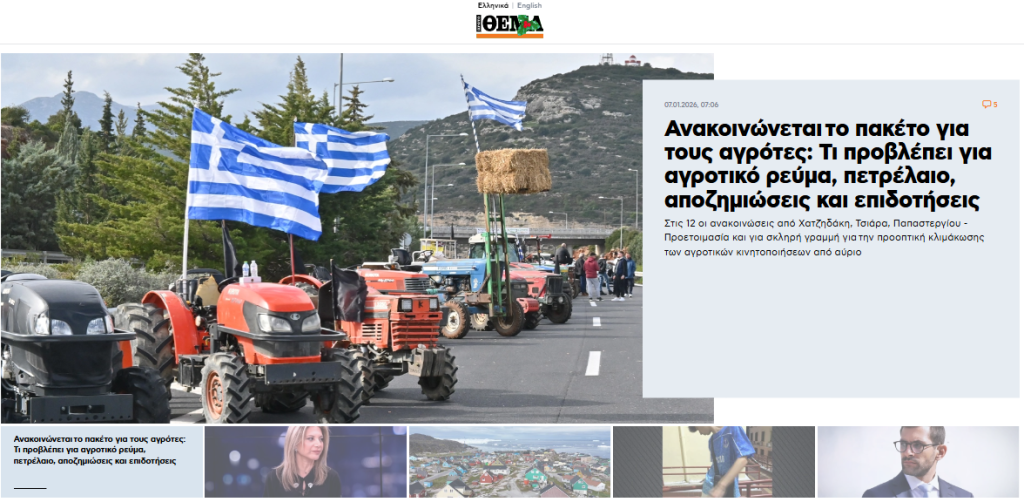
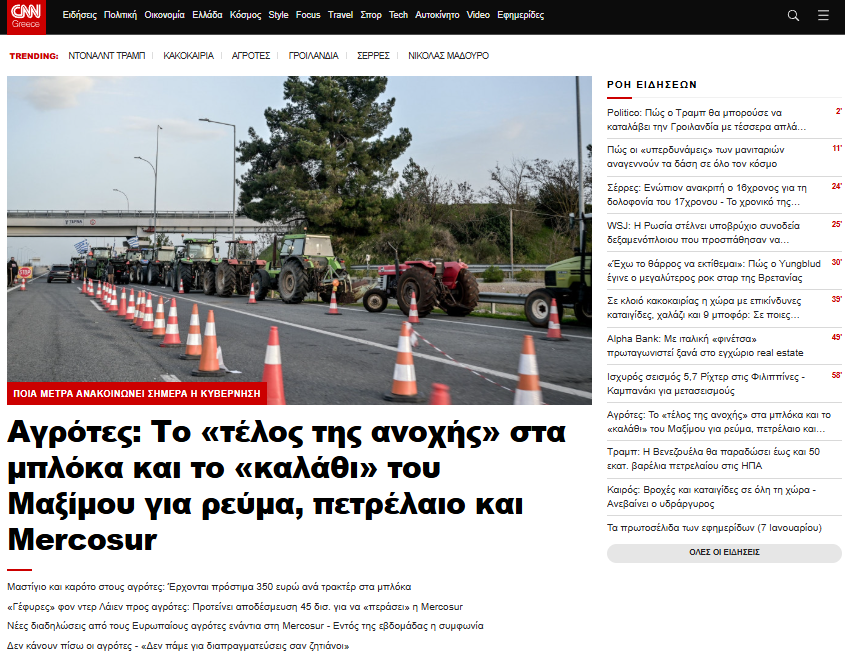
Farmers standoff reaches breaking point
Relations between the government and farmers have reached a breaking point as the holiday period has passed but roadblocks remain in place across the country. The government will detail support measures on Wednesday that have already been announced. If farmers continue refusing dialogue and protests persist, authorities will proceed with Plan B, which is expected to include fines starting Thursday for tractors obstructing traffic.
https://www.ekathimerini.com/economy/1291646/farmers-standoff-reaches-breaking-point
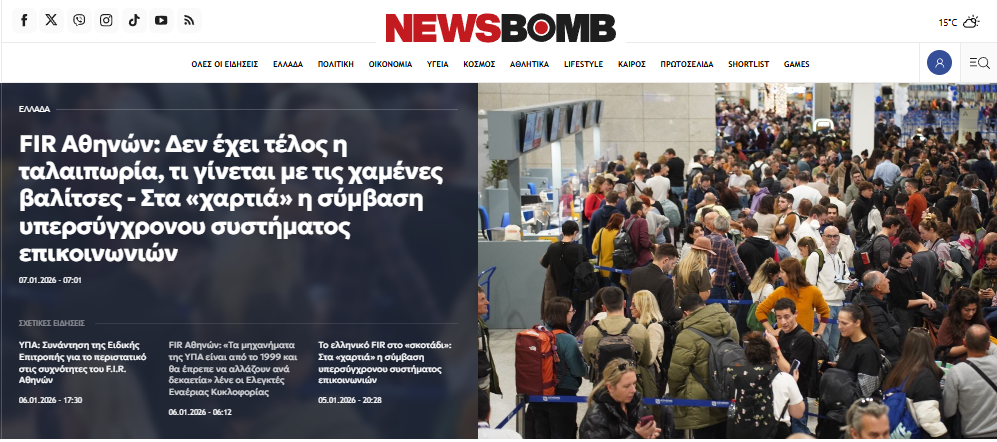
Special committee meets to examine incident on Athens FIR frequencies
The management and relevant executives of the Civil Aviation Authority met at the Athens and Macedonia Area Control Center to clarify the exact causes of the problem that occurred on Sunday on the frequencies of the Athens FIR.
Unemployment falls to 8.2% in Nov 2025
Greece’s unemployment rate fell to 8.2% in November 2025, compared to the upwardly revised 9.7% in November 2024 and 8.6% in October 2025. The unemployed amounted to 395,436 people, marking a decrease of 62,458 people compared to November 2024 (13.6%) and a decrease of 13,900 people compared to October 2025 (3.4%).
https://www.amna.gr/en/article/960256/Unemployment-falls-to-82-in-Nov-2025
ATHEX: Index eases, but growth is on the way
The second session of the year at the Greek bourse on Monday saw the benchmark come off last Friday’s 16-year highs to post moderate losses despite the growth recorded by banks and mid-caps, as well as the majority of stocks at Athinon Avenue. The record highs Wall Street keeps posting this week bode very well for the local market too, that has every reason to continue its rise of the last five years, for the first half of this year at least.
https://www.ekathimerini.com/economy/1291621/athex-index-eases-but-growth-is-on-the-way




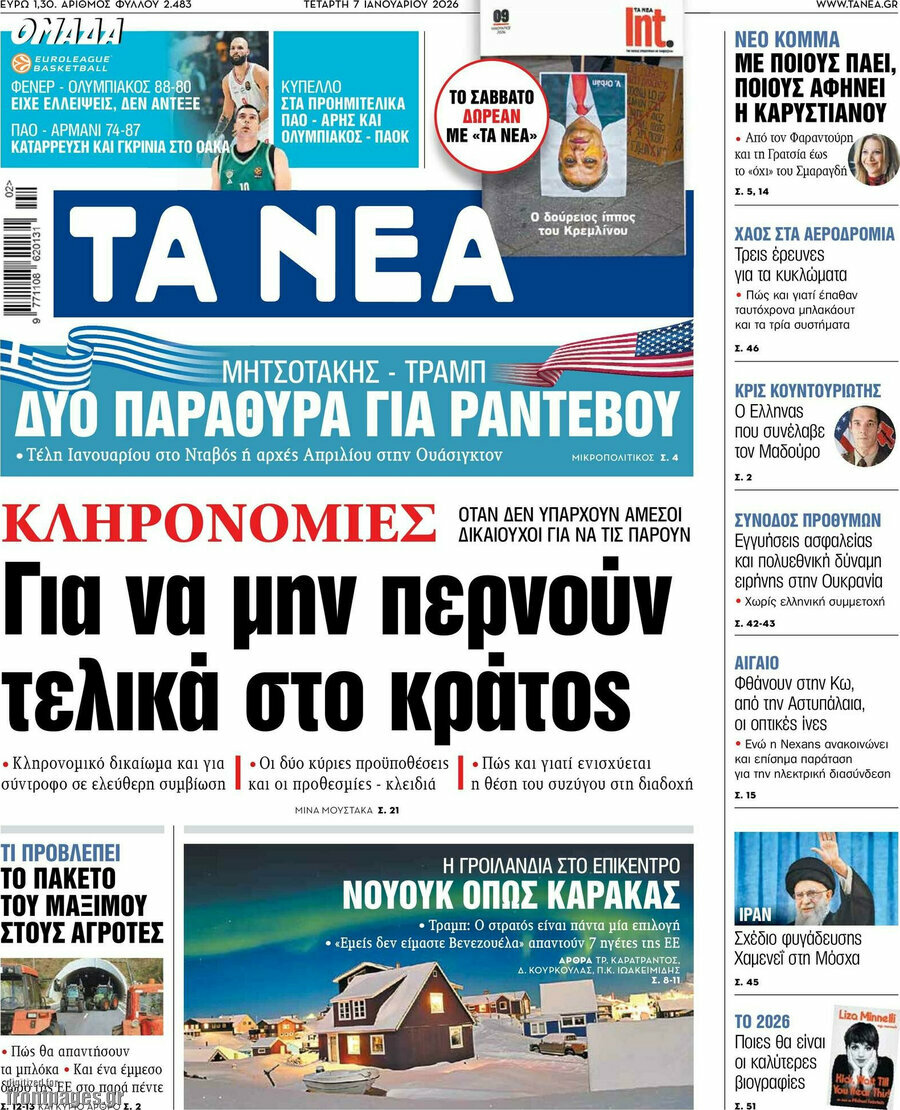
KATHIMERINI: After Venezuela, Trump “points at” Greenland
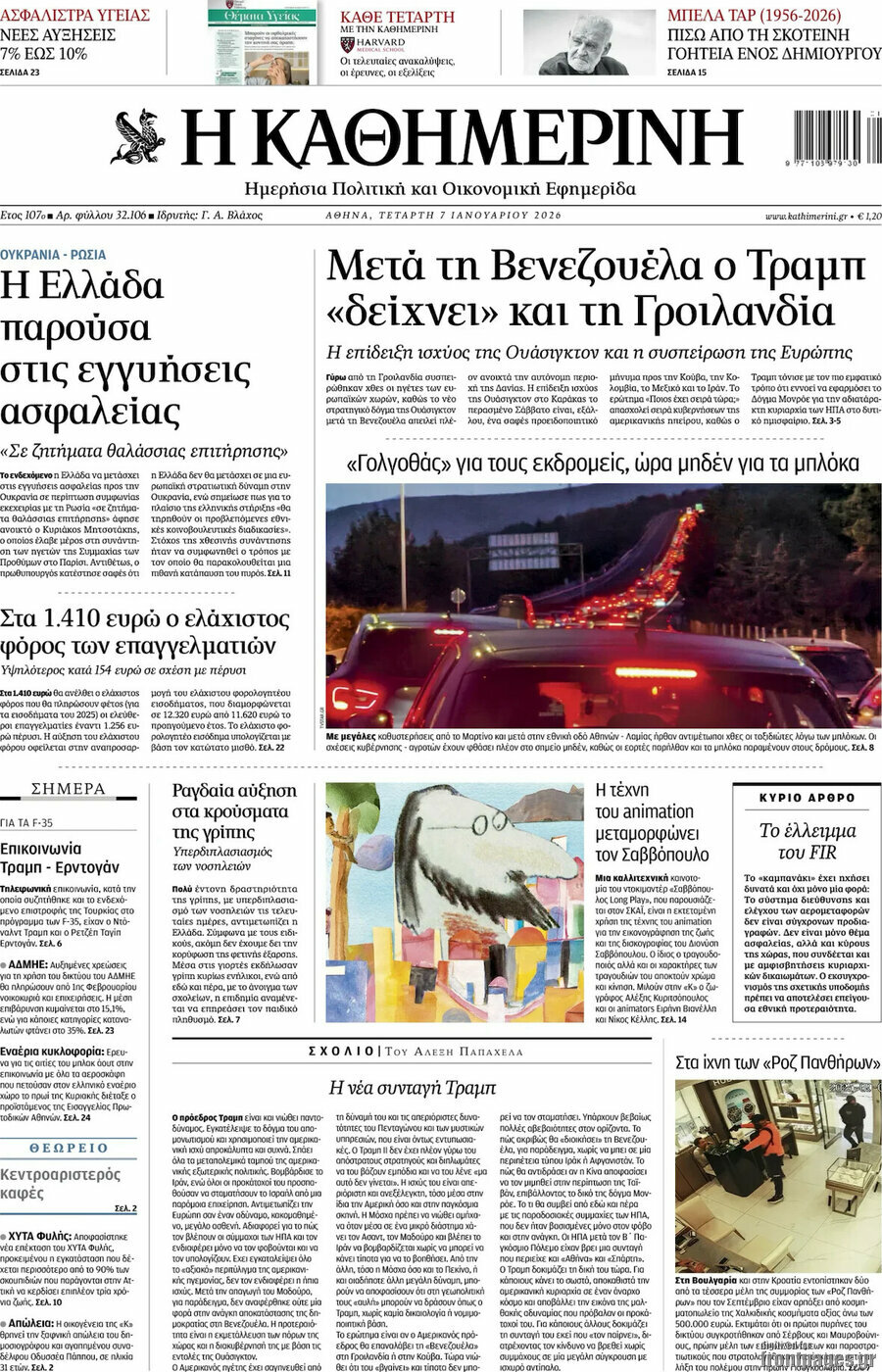
TA NEA: Inheritances: Regulation to avert state-ownership of assets
EFIMERIDA TON SYNTAKTON: The inquiry into the FIR incident hints at a Tempe-like case

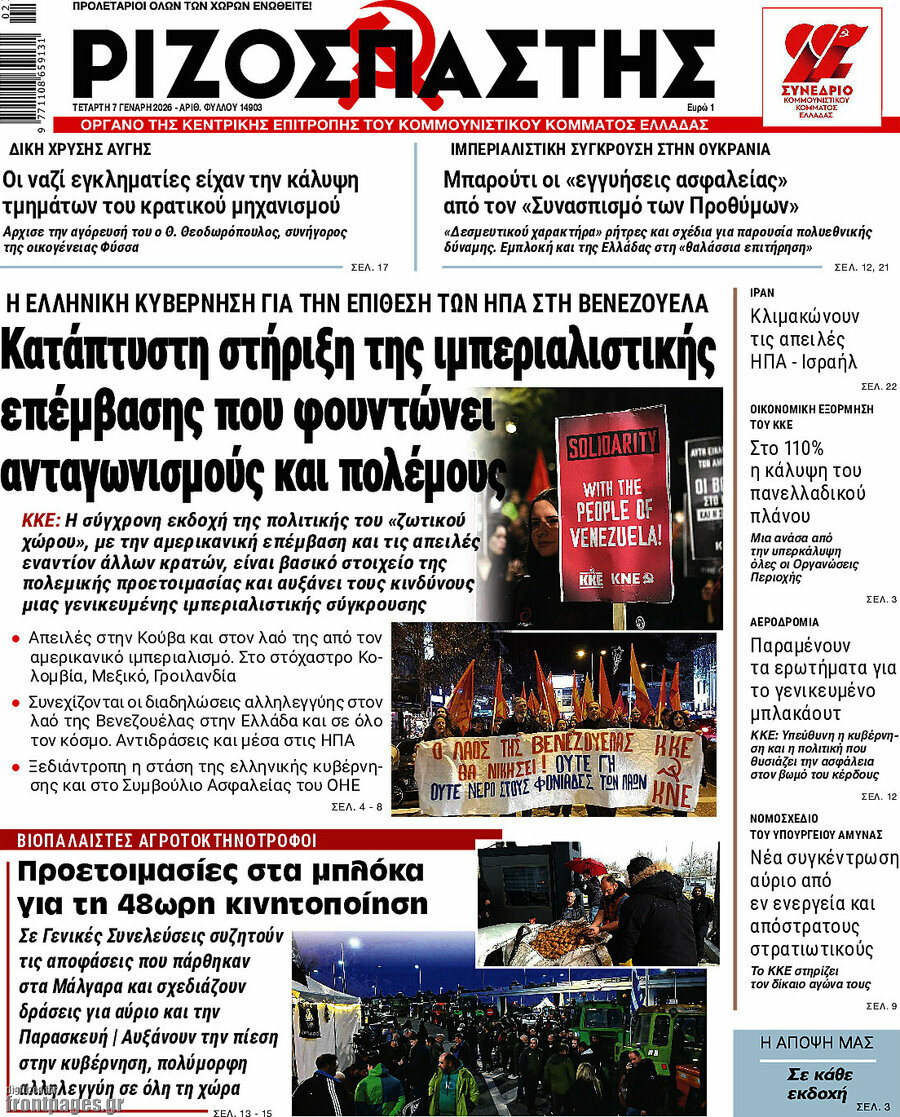
RIZOSPASTIS: Shameful support by the Greek government for the imperialistic invasion in Venezuela
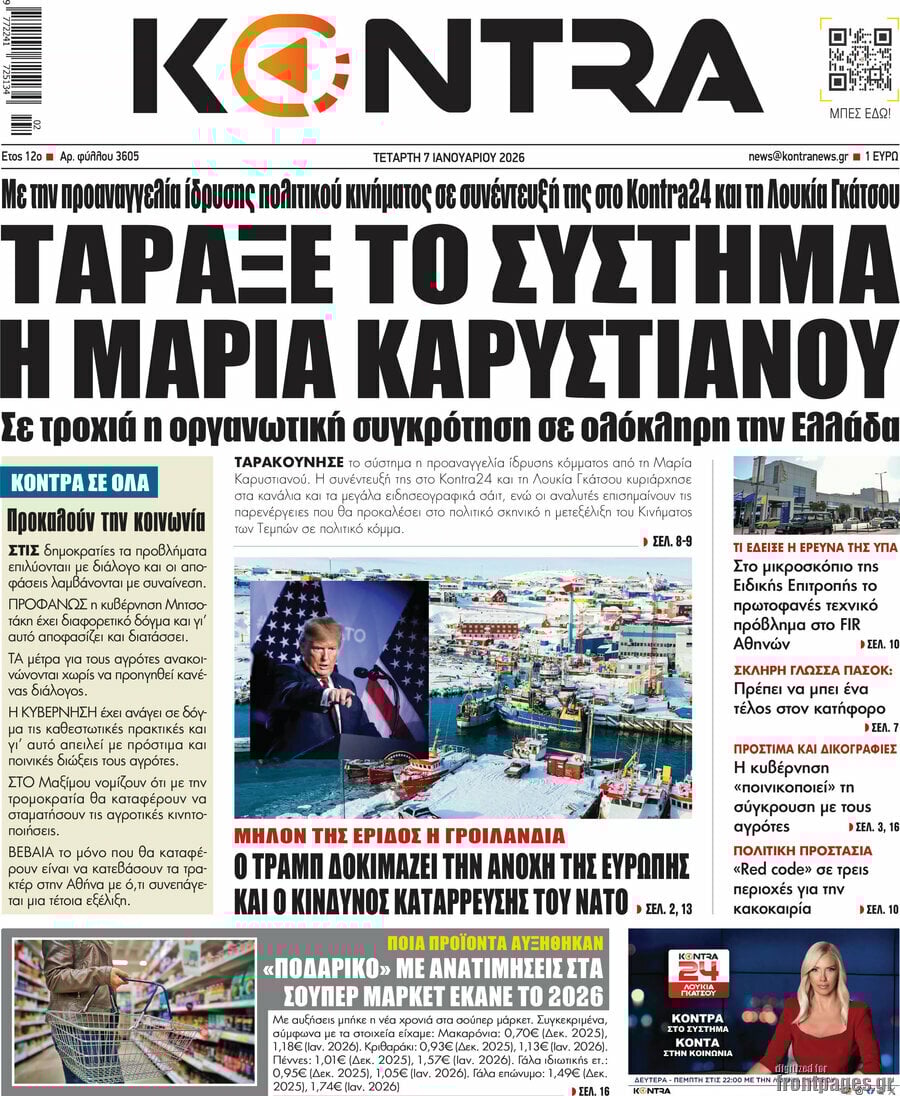
KONTRA NEWS: Political system rocked by the imminent announcement of a new party by Maria Karystianou [represents the families of the 57 victims of the train accident in Tempe]
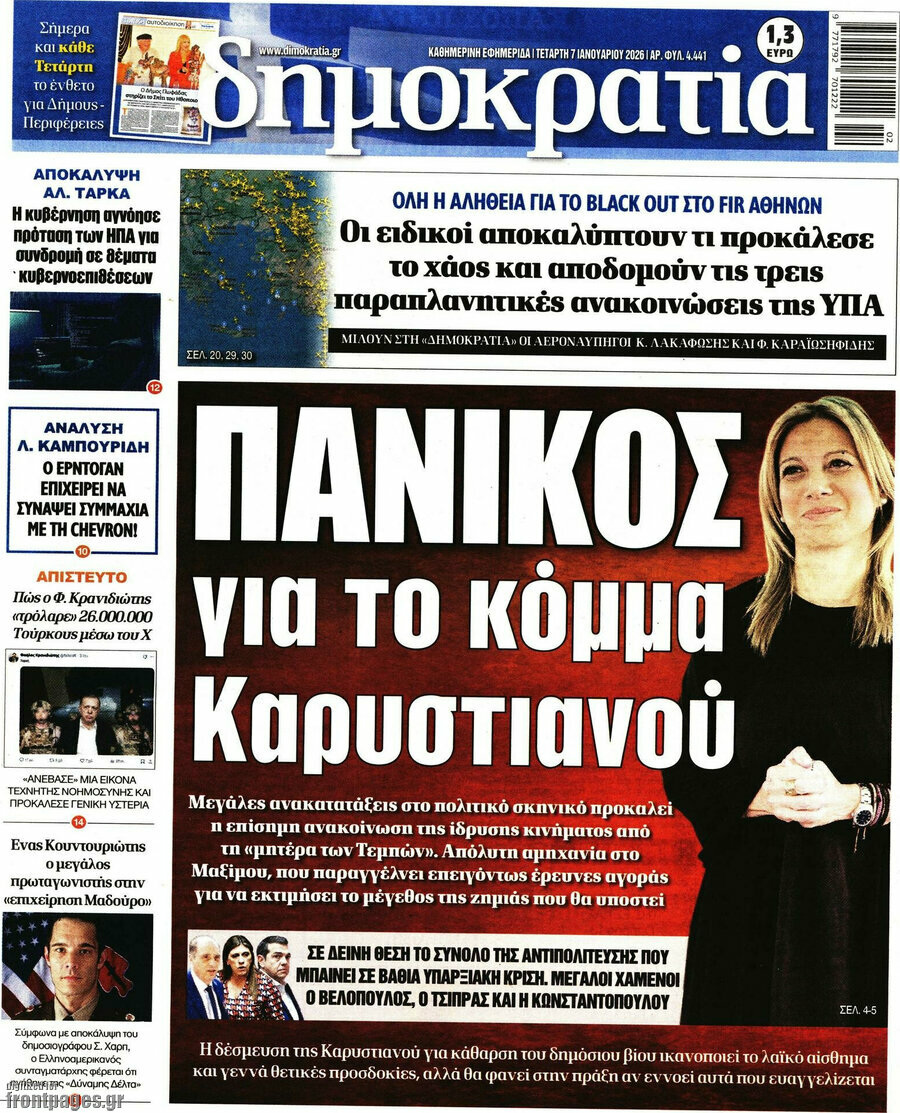
DIMOKRATIA: Panic due to Karystianou’s party
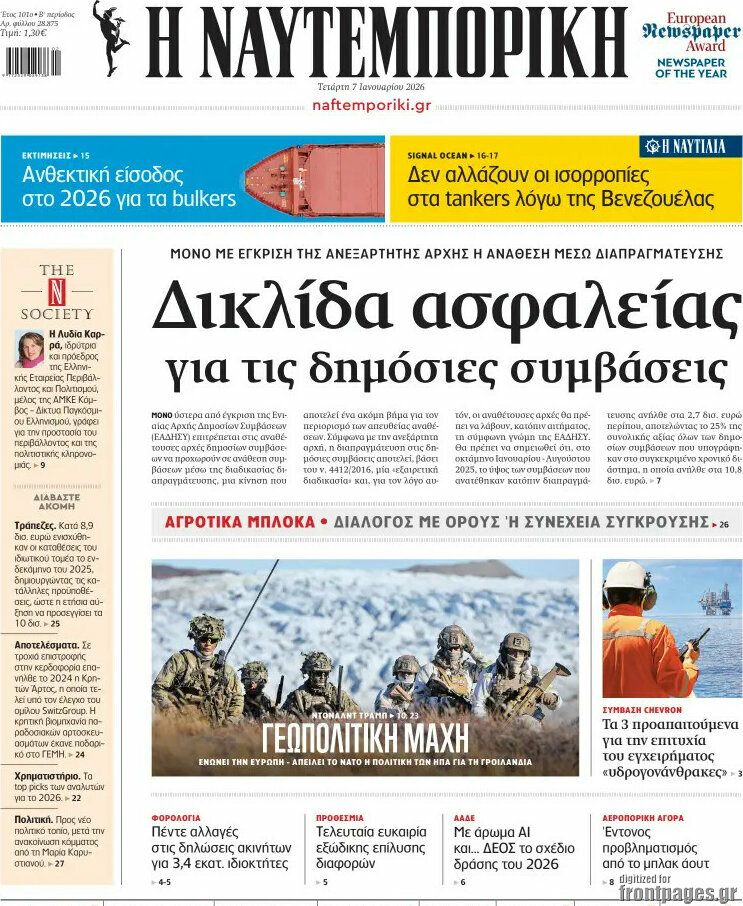
NAFTEMPORIKI: Safety clause regarding public contracts

DRIVING THE DAY
MERCO-SOON: Not to cry wolf, but after several false alarms today really is a make-or-break moment in the push to win over skeptics of the EU’s trade deal with the South American Mercosur bloc, ahead of a decisive vote on Friday. And with Donald Trump’s stunning action in Venezuela further warping the global order, the deal has taken on new geopolitical weight.
What’s happening: Trade Commissioner Maroš Šefčovič, Agriculture Commissioner Christophe Hansen and Food Safety Commissioner Olivér Várhelyi will meet EU agriculture ministers this afternoon, alongside Cypriot Agriculture Minister Maria Panayiotou, whose country holds the Council presidency.
Officially … it’s a “political meeting” about the future Common Agricultural Policy budget and farmers’ grievances after December’s fiery protests.
Unofficially … it’s about Mercosur. The agenda is “nicely camouflaged,” as one diplomat put it to POLITICO’s Lucia MacKenzie, but France and Poland have already made clear they want the trade deal front and center.
Stick to the plan: The goal is to get the green light from EU agriculture ministers and lock in ambassadors’ backing on Friday for the agricultural safeguard — a prerequisite for Commission President Ursula von der Leyen to fly to South America for the formal signing of the deal. (That trip is still penciled in for next week, though doubts are creeping in on logistics and timing.)
Who’s left to convince: Italy remains the kingmaker, though the mood in Rome is now leaning yes. Questions still hang over Romania and Czechia. France and Poland remain openly hostile and are expected to use today’s meeting to air concerns over reciprocity and market protection. My colleagues Bartosz Brzeziński, Giorgio Leali and Nette Nöstlinger have more details on the Commission’s pitch to appease the critics in a must-read piece this morning.
Carrots already served: Much of the groundwork was laid Tuesday. In a letter to the EU Council presidency and European Parliament President Roberta Metsola, von der Leyen offered early access to up to €45 billion in farm funding under the post-2027 budget — widely read as a bid to lock in Italy. The move was warmly welcomed by French President Emmanuel Macron and Italian Prime Minister Giorgia Meloni.
The timing matters: transatlantic tensions have given the deal a sharper geopolitical edge.
Weapon or diversification? The EU-Mercosur deal has been presented as a way for the bloc to diversify its trade in an increasingly volatile and tariff-laden environment that isn’t necessarily adversarial to Washington. But at a moment when the Trump administration, in the wake of its capture of Nicolás Maduro, is talking about protecting “OUR Hemisphere,” doing business in that hemisphere carries significant risks.
“Sticking it right into his Monroe Doctrine,” one EU diplomat quipped, referring to the 19th-century foreign policy under which the U.S. asserted supremacy over the Western hemisphere but stayed out of European affairs. (You have to love Brussels’ diplomatic corps for its quotes.)
Trump has eagerly embraced the 200-year-old Monroe approach — naturally putting his own branding on it as the “Donroe Doctrine” — showing with increasing boldness that he intends to deploy superior U.S. military and economic power to stop competitors gaining a foothold in Washington’s backyard. “American dominance in the Western hemisphere will never be questioned again,” he said this week after the Maduro raid.
How does the EU-Mercosur deal square with that? Commission spokesperson Anitta Hipper didn’t engage when asked how the executive would frame the trade deal amid Washington’s rhetoric. “We remain calm and focused, because we firmly believe in the relevance of this agreement for Europe’s global position,” she said.
A diplomat from an EU country that supports the deal insisted that it shouldn’t be seen as anti-American: “I’ve never heard the U.S. say it doesn’t want its partners and allies to trade with each other.” But another EU diplomat acknowledged that this is a legitimate question — and it’s one that now looms over Brussels.
So far, there’s been no official comment by the Trump administration (or the president himself) on the EU-Mercosur deal, and the U.S. mission in Brussels didn’t respond to Playbook’s request for comment. But it’s not hard to imagine Washington perceiving the EU’s ambition for deeper economic engagement with South America as strategic encroachment into its domain — not unlike how American officials have long viewed China’s infrastructure push in the region.
Brussels insists it needs the Mercosur deal, yet it could end up becoming another fault line in an already strained transatlantic relationship with its most important ally.
STILL AT ODDS ON VENEZUELA: The EU and the U.S. remain out of sync on Venezuela’s transition. The Commission said Tuesday it will not recognize Delcy Rodríguez as part of the new government in Caracas, even after she was sworn in as interim president.
Brussels will instead maintain what a spokesperson called “targeted engagement” with Venezuelan authorities to safeguard EU interests — while stressing that Venezuela’s future must ultimately be shaped by those elected by the Venezuelan people.
Oil deal: Trump said last night that the interim government would turn over between 30 and 50 million barrels of sanctioned crude oil to the U.S., which it will sell at market prices. “That money will be controlled by me … to ensure it is used to benefit the people of Venezuela and the United States!” he posted on Truth Social.
EUROPE’S GREEN LANDS
GREEN ISLAND: For a day at least, a green island in the Mediterranean — with lush mountain forests of pine, cedar and oak, dotted with olive trees and citrus — is hoping to steal the spotlight from that not-actually-green-and-mostly-very-icy territory in the far north that has been troubling the EU in recent days.
Today marks the official opening ceremony of the Cypriot presidency. For residents of the Brussels bubble, confirmation that a new presidency has begun came when the Schuman roundabout logo at Justus Lipsius was changed on Tuesday. Now the presidency will formally begin with a ceremony at 6:30 p.m. from the main stage of the Cyprus Theatre Organisation in Nicosia. (Tune in on EBS, with arrivals slightly earlier.)
Who’ll be there: European Council President António Costa, Commission President von der Leyen and Ukrainian President Volodymyr Zelenskyy, fresh from Paris and the “coalition of the willing” meeting (more on that below). Underlining Cyprus’ position at the crossroads between three continents, other VIPs include Moldovan President Maia Sandu, Lebanon’s President Joseph Aoun and Iraqi President Abdul Latif Rashid.
What to expect: Think Olympics opening ceremony but shorter (roughly an hour), less pomp, more speeches. Still, there’ll be an artistic program in three acts blending music, dance, poetry and digital technology, telling the story of Cyprus through the centuries, with more than 100 Cypriot performers involved.
GREENLAND: Will the fate of Greenland overshadow the festivities? Maybe. EU institutional leaders, including Costa and von der Leyen, have so far kept their heads down — even after Donald Trump doubled down on his assertion that it’s essential for American national security for the U.S. to take over the Danish-held territory.
But but but … Washington is not backing down, despite the discomfort Trump’s insistence is causing in Europe. The White House said in a statement last night that the president and his advisers are “discussing a range of options” in relation to Greenland — adding that, “of course, utilizing the U.S. military is always an option at the Commander in Chief’s disposal.”
How might that happen? POLITICO’s Zoya Sheftalovich spoke with EU officials, NATO insiders, defense experts and diplomats to game out how a U.S. takeover of the mineral-rich and strategically important Arctic island could play out. Worrying for the Danes, it looks like he’s already started …
The pushback in Europe has come from capitals, not Brussels. On Tuesday, the leaders of France, Germany, Italy, Poland, Spain, the U.K. and Denmark put out a statement countering Trump’s claim that Europe isn’t committed to Arctic security and arguing that NATO is collectively responsible, in partnership with the U.S. “Greenland belongs to its people,” the leaders said.
Sharing is caring: Dutch Prime Minister Dick Schoof, Greek Prime Minister Kyriakos Mitsotakis, Luxembourg Prime Minister Luc Frieden and Slovenian Prime Minister Robert Golob all posted on X backing the statement. Belgian PM Bart De Wever said he supported Danish PM Frederiksen’s call for “respect for sovereignty among NATO allies.”
Commission-ese: Asked by POLITICO why no EU institutional figure had spoken out, a Commission spokesperson said the EU’s principles are still “very clear.” That means support for Greenland’s territorial integrity, and cooperation with the U.S. — “an essential partner” — on Arctic security.
Meanwhile, in Nuuk: Greenland’s government has requested an urgent meeting with U.S. Secretary of State Marco Rubio to discuss Washington’s “significant statements” about the Arctic territory.
COALITION OF THE WILLING
THE U.S. BACKS UKRAINE (FOR NOW): For all those transatlantic tensions, Europe and the U.S. presented a rare united front on Ukraine in Paris on Tuesday, my colleagues Clea Caulcutt, Laura Kayali and Nicholas Vinocur report.
Warm words on security guarantees: In an unusual show of alignment, U.S. envoys Steve Witkoff and Jared Kushner backed European-led efforts to agree on security guarantees for Kyiv, including a long-term plan to bolster Ukraine’s defenses.
Boots — maybe — on the ground: Monitoring and verification of any future peace deal with Russia would be led by the U.S., with contributions from countries including the U.K., France and Germany, according to a statement endorsed Tuesday by the coalition of the willing, a group of 35 countries backing Ukraine.
What Europe signed up to: The coalition endorsed long-term support for Ukraine’s armed forces — which French President Macron said could reach 800,000 troops — the deployment of a European-led multinational force in Ukraine in the event of a peace settlement, and “binding” commitments to support Kyiv in case of renewed Russian aggression.
Germany, cautiously in: German Chancellor Friedrich Merz opened the door to deploying German troops in a NATO country near Ukraine, stressing that a ceasefire is a prerequisite. “I will only make proposals to the Bundestag once there is a ceasefire and the coalition of the willing has agreed on the procedure,” he said.
Others, less keen: Some European capitals remain reluctant. Greek Prime Minister Mitsotakis said Greece will not take part in a European military force in Ukraine, though officials said Athens has not ruled out other forms of support, including maritime surveillance.
Washington’s blessing — verbally: Witkoff said after the summit that President Trump “strongly stands behind security protocols,” saying they are meant to deter “any further attacks in Ukraine.” He called them, “as strong as anyone has ever seen.”
But but but … The nature of American participation in security guarantees is still very unclear, a person close to the negotiations told our U.S. colleagues. “It’s uncertain as to what length the U.S. is willing to go in terms of its commitments,” said the person, granted anonymity to discuss sensitive conversations.
Watered-down reality: The final statement was significantly diluted compared with earlier drafts circulating Tuesday. References to a direct U.S. role — including American intelligence, logistics and commitments to support a multinational force if attacked — were stripped out.
Lock it in: Reflecting lingering doubts about Washington’s staying power, Ukrainian President Zelenskyy said he wants American security guarantees to be made legally binding by the U.S. Congress.
Reality check: Most of what was agreed on Tuesday won’t materialize until there is a ceasefire between Russia and Ukraine — and it’s very unclear when (or if) that’ll happen.
IN OTHER NEWS
NETHERLANDS DIALS BACK: Dutch defense forces traditionally worked closely with the U.S. on naval missions to counter drug trafficking in the Caribbean but are balking after U.S. attacks on suspected smuggling boats, Chris Lunday reports.
BREXIT RESET: The U.K. government is preparing a bill establishing a legal framework for U.K.-EU alignment to be introduced to Westminster by this spring or summer.
MEP PERMISSION SLIP: EU ambassadors on Friday will craft a letter requesting the European Parliament’s permission to legislate a €90 billion loan to Ukraine — agreed in December — without Czechia, Hungary and Slovakia, according to two EU officials.
IRAN PROTESTS: Demonstrators angry at Iran’s ailing economy staged a sit-in at Tehran’s Grand Bazaar Tuesday, prompting security forces to fire tear gas. Violence surrounding protests in recent days has killed at least 36 people and authorities have detained more than 2,000 others, the Associated Press reports.
MELONI MOVE: Italian PM Giorgia Meloni wants to overhaul Italy’s voting system to boost the changes of her right-wing coalition being returned to power in the 2027 election, the Financial Times reports.