
Farmers decide to continue and escalate protests; pledge to ease travel for Christmas
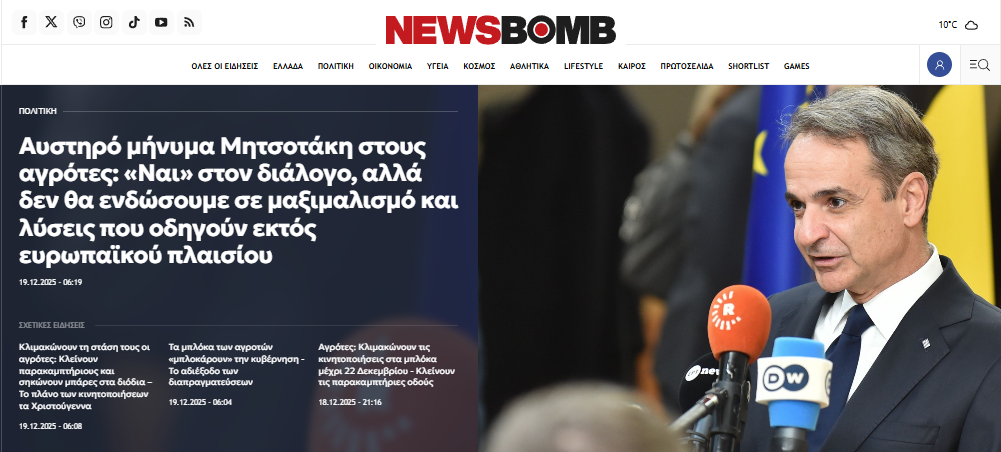
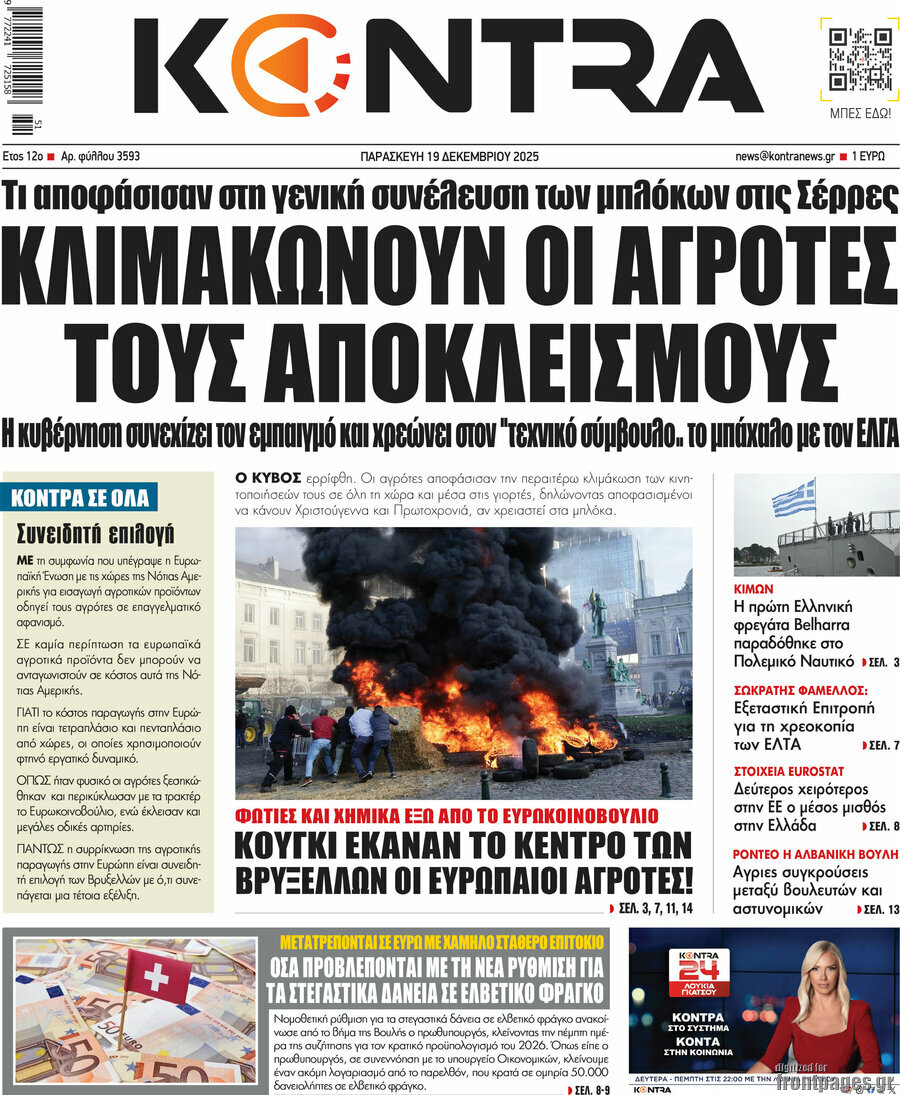
Sixty-one representatives of farmers, livestock breeders, fishermen, and beekeepers who participated in the meeting of the Panhellenic Blockade Committee in Lefkonas, Serres, decided to further escalate their protests, stating that they are disappointed with the government’s failure to respond to their demands.
Greece and France move toward extending strategic defense cooperation
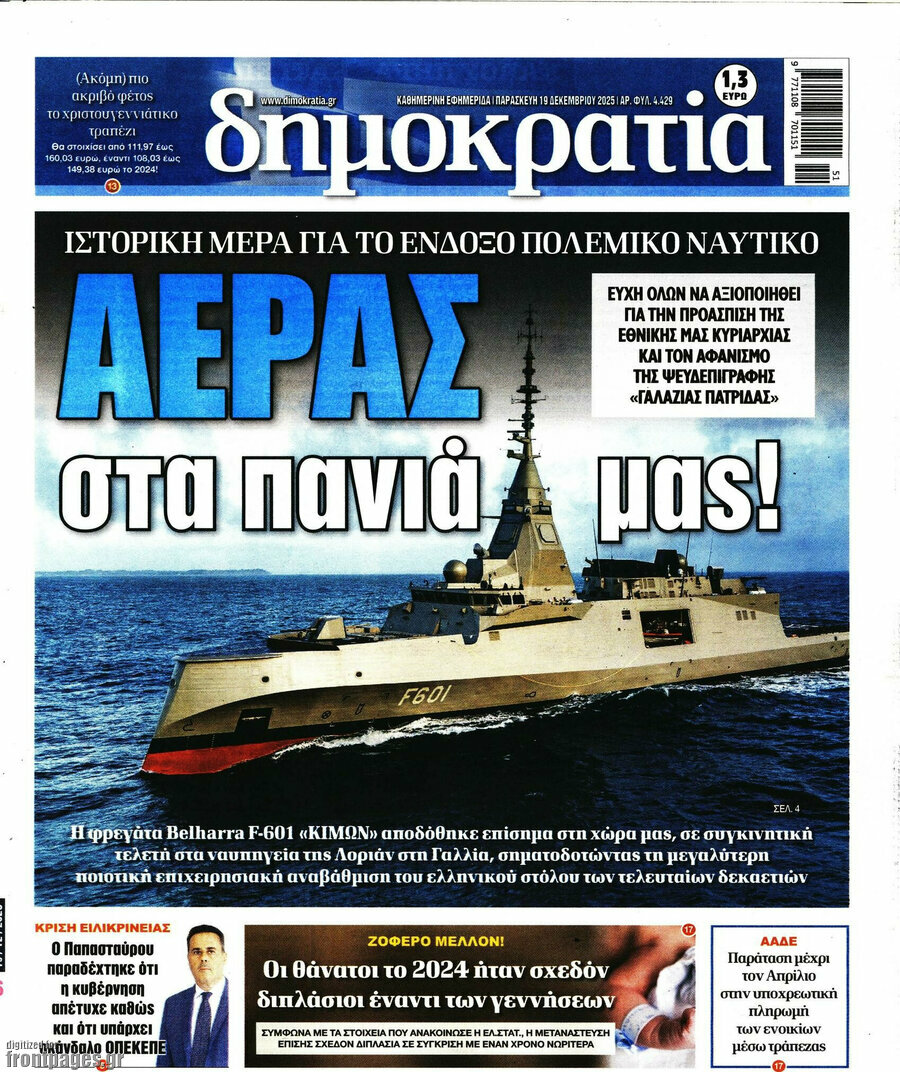
Defense Minister Nikos Dendias and his French counterpart, Catherine Vautrin, met on the sidelines of the delivery ceremony for the first French-built FDI frigate, the F-601 Kimon, where they discussed extending the strategic cooperation agreement between the two countries. Athens aims to sign the new defense agreement by June 2026, with a five-year term.
Greece, Albania sign agreement in Brussels on EU transport, customs ‘Green Corridor’
Greece and Albania signed memorandum of cooperation (MoC) in Brussels on Thursday related to the EU’s ‘Green Corridors’ initiative, in the presence of European Commissioner for Enlargement Marta Kos, on Thursday.
Greek PM calls for ‘secure’ solution at key EU summit on support for Ukraine
Greece favors a reparation loan for Ukraine, and European leaders meeting on Thursday in Brussels should reach a solution which will be “legally and fiscally secure” to address Ukraine’s financing problems, Greek Prime Minister Kyriakos Mitsotakis said.
ATHEX: Index keeps hovering near year-highs
The local stock market recovered on Thursday from the losses of the previous days to return the benchmark to the 2,100-point level, while daily turnover remains at a remarkably high rate with just five sessions left till the end of the trading year.
https://www.ekathimerini.com/economy/1290253/athex-index-keeps-hovering-near-year-highs



KATHIMERINI: Holiday break for farmers’ blockades
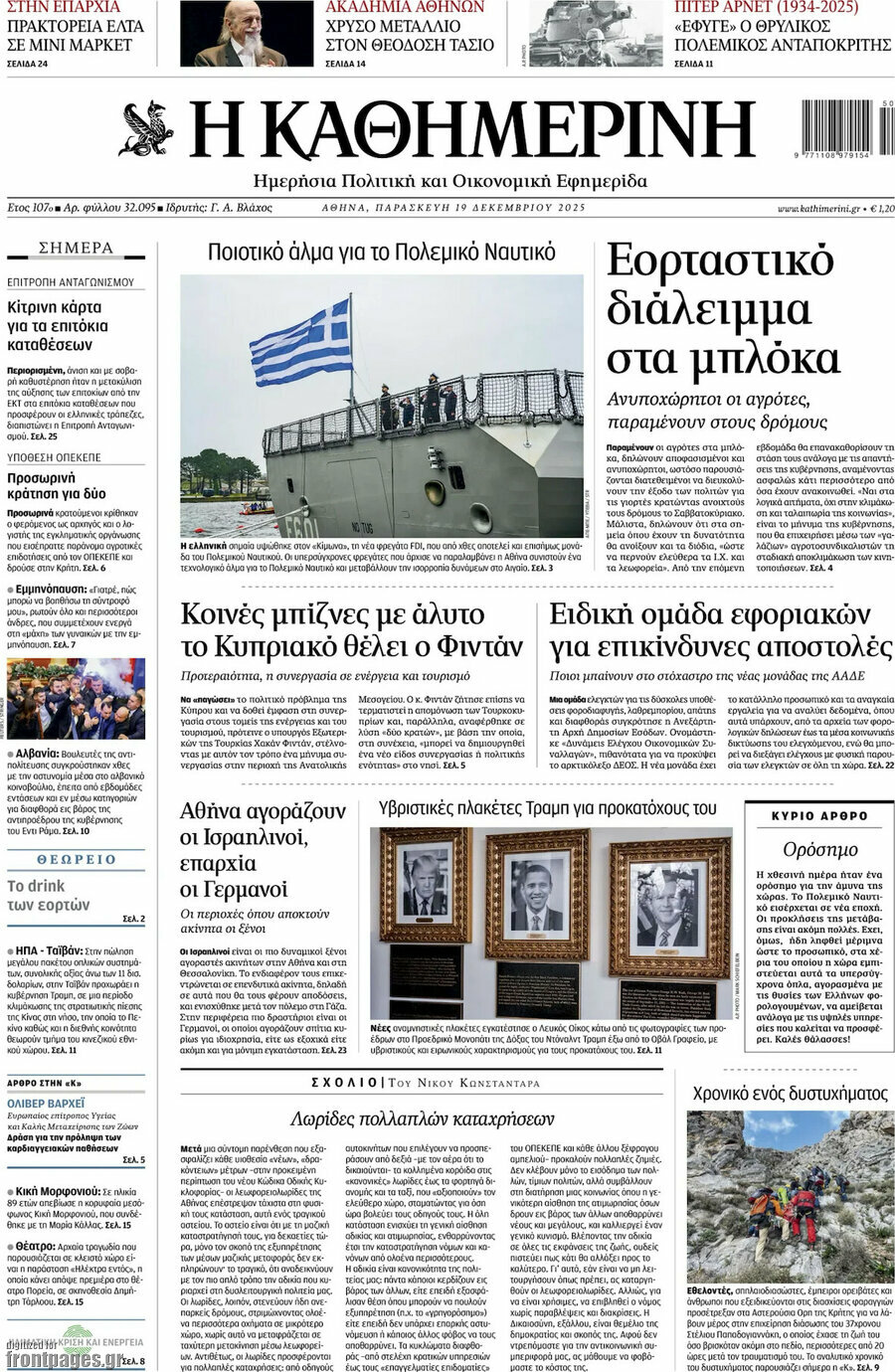
TA NEA: New operational plan: Hellenic Post has been saved
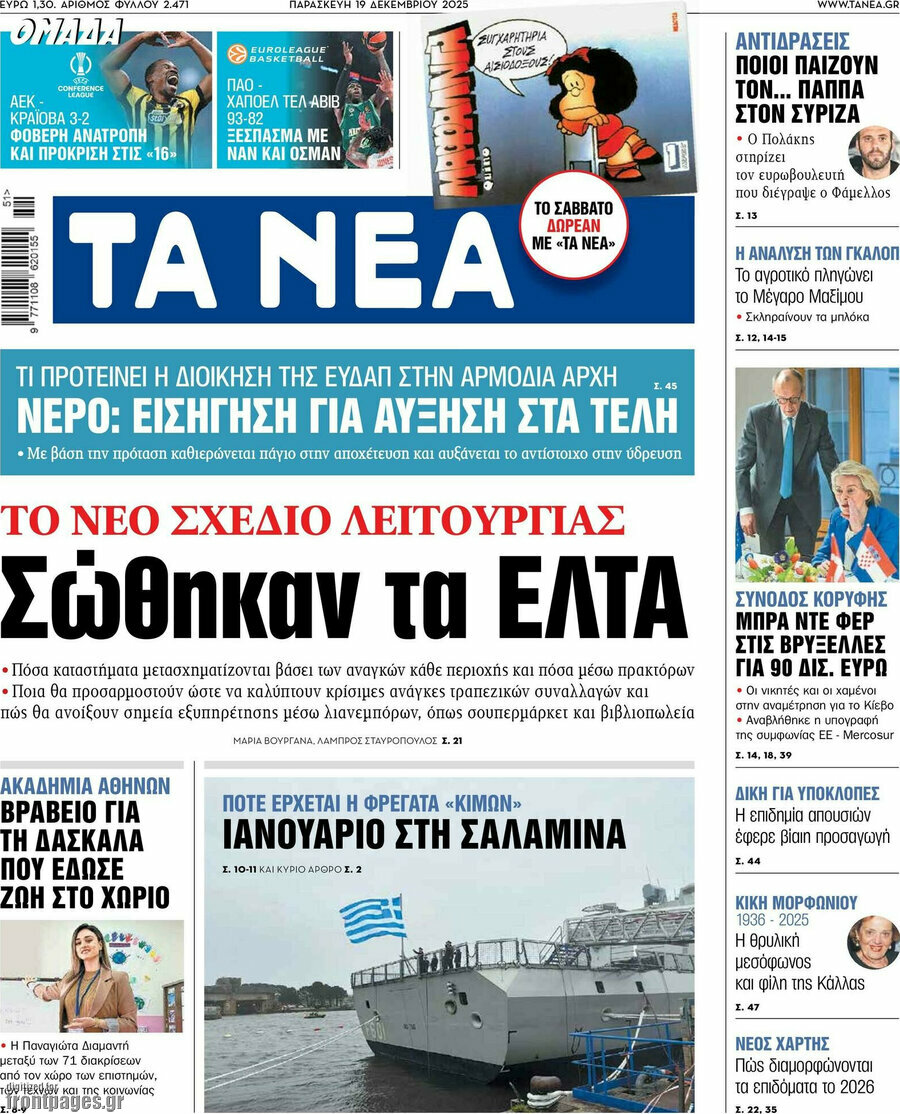
EFIMERIDA TON SYNTAKTON: Farmers’ protests: From Serres to Brussels. Same problems, same… solutions
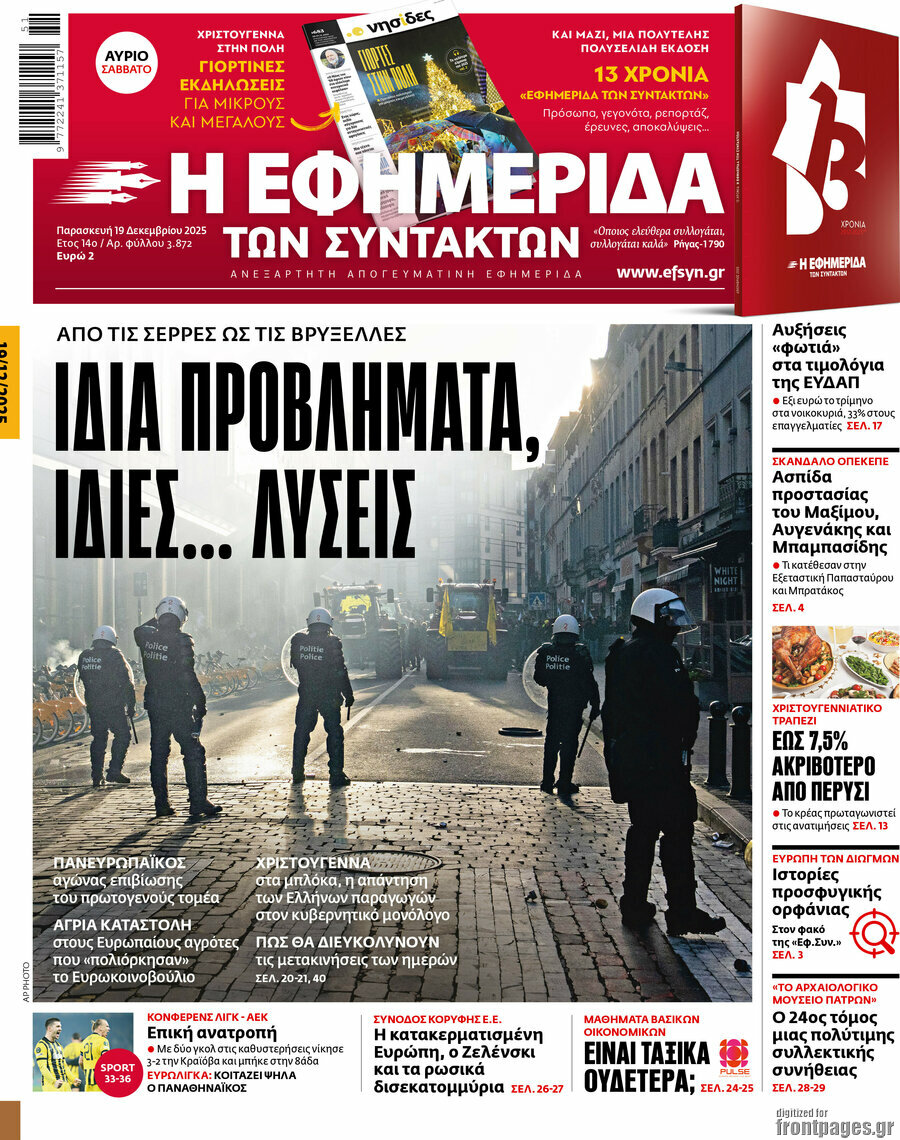
RIZOSPASTIS: Farmers continue jointly as if they were a single block
KONTRA NEWS: Farmers escalate blockades
DIMOKRATIA: Wind in our sails!
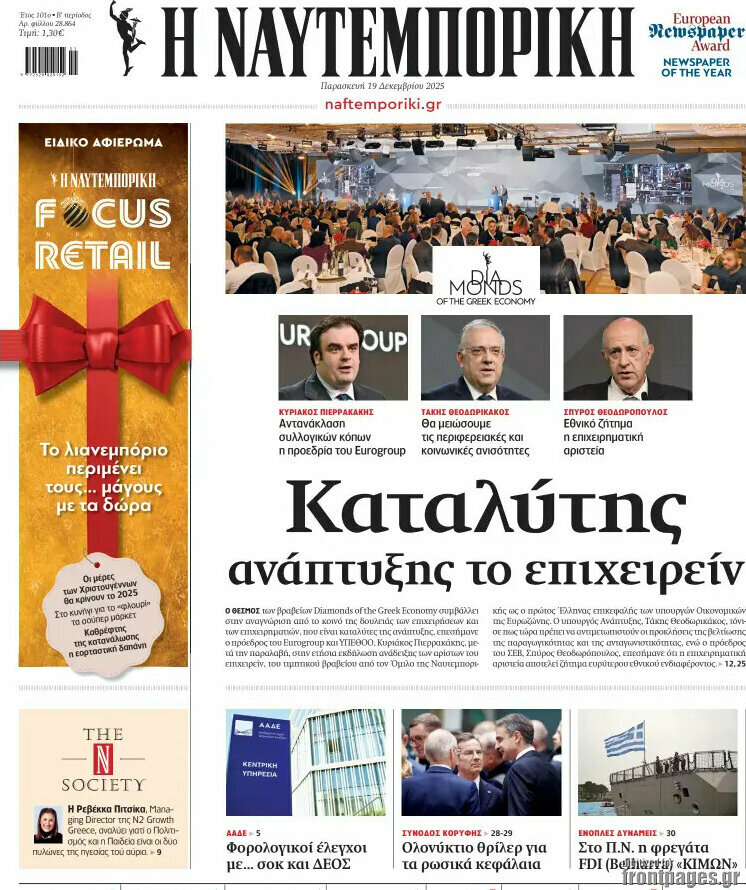
NAFTEMPORIKI: Entrepreneurship is a catalyst for growth

DRIVING THE DAY
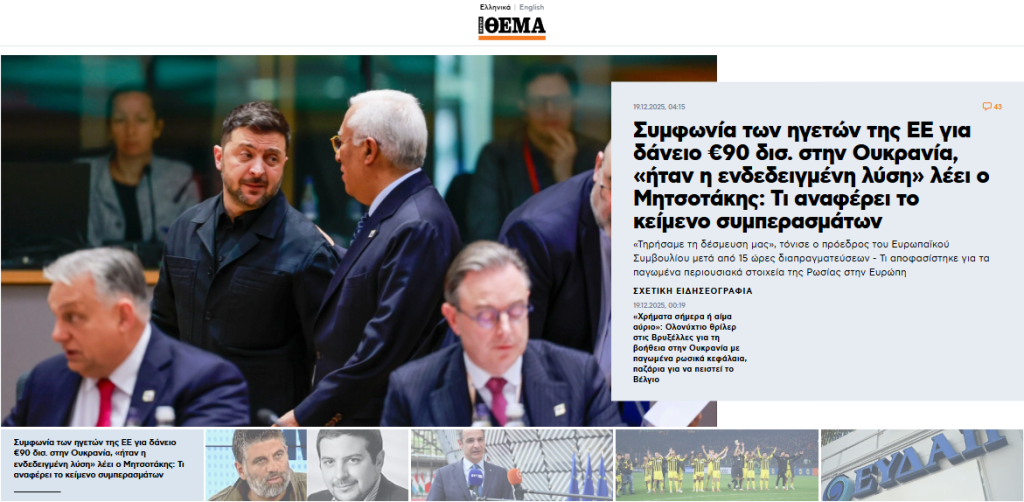
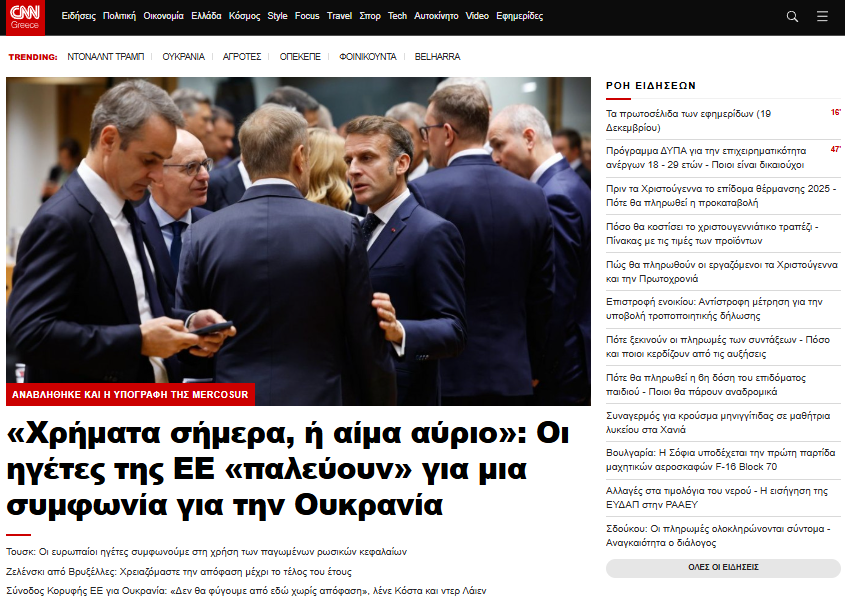
EU PIVOTS ON UKRAINE FUNDS: After 17 hours of talks, European Union leaders struck a deal to jointly raise €90 billion for Ukraine but moved away from plans to use Russia’s frozen assets for Kyiv, dealing a setback to German Chancellor Friedrich Merz and other leaders who had backed that solution.
That was then: Merz and leaders of other so-called frugal nations had insisted that using €185 billion in assets stored with the Brussels-based securities depository Euroclear was the best way to keep Ukraine financially afloat. Several leaders, including Merz, had also touted the importance of striking a deal on Mercosur, a major EU trade deal with South America.
This is now: By the early hours of Friday morning, the “reparations loan” put forward by the European Commission had become Plan B. Meanwhile, a deal on Mercosur was postponed until next month, following objections from Italian Prime Minister Giorgia Meloni (more on that below).
How it happened: The reparations loan unraveled shortly after 10 p.m., when a two-page legal document addressing Belgium’s concerns about the loan was circulated among leaders, per an EU diplomat. Meloni quickly started picking holes in the text. Then French President Emmanuel Macron chimed in, followed by Luxembourg PM Luc Frieden.
The brighter side: Speaking to reporters in the early hours of Friday, Merz brushed off the Mercosur delay as a minor obstacle and insisted Ukraine was the night’s big winner. “With our decision today, Ukraine is financed for the next two years. That is good news for Ukraine and pretty bad news for Russia,” he said.
The new deal: With the assets plan off the table, 24 of the 27 EU countries will now move ahead with plans to jointly raise €90 billion in zero-interest loans to keep Ukraine financially afloat over the next two years. Hungary, Slovakia and Czechia all obtained opt-outs from the joint-borrowing plan — a blow to European unity in supporting Ukraine. My colleagues Gregorio Sorgi, Victor Jack and Bjarke Smith-Meyer have more details.
Big picture: “The bottom line, after today, is that our support for Ukraine is guaranteed,” said Danish Prime Minister Mette Frederiksen, who had also backed the Russian assets plan.
Belgium’s victory lap: Belgian Prime Minister Bart De Wever — who had faced pressure from other leaders to agree to the reparations loan — emerged as an unlikely winner from the night’s talks. During a 3 a.m. press conference, he said that “countries that live close to Russia … found it emotionally satisfying” to use Russia’s frozen assets. But “politics is not an emotional job,” he added. “Rationality has prevailed.”
Beating the EU machine: De Wever held out for more than two months and, even as late as Thursday afternoon, many EU governments believed he’d back down, POLITICO’s Zoya Sheftalovich reports. In the end, the Flemish nationalist “basically got everything he wanted,” as one EU diplomat put it after the summit broke up in the early hours.
How it’s playing in Moscow: Kirill Dmitriev, the head of Russia’s sovereign wealth fund, posted on X that the EU’s pivot is a “major win for LAW + common sense—and for the voices of reason in Europe.”
Spreading the load: Speaking to Playbook, an EU diplomat argued that the deal’s upside was the divvying up of the financial burden for supporting Ukraine more evenly among European states and strengthening Kyiv’s hand in ongoing peace talks. “Instead of having 10 countries financing Ukraine you have 24,” the diplomat said. “Ukraine is coming out stronger from this deal.”
New Plan B: EU leaders refused to take the reparations loan off the table, however. If Russia fails to pay reparations to Ukraine, the bloc reserves the right to pay itself back using the frozen assets.
It’s a wrap: The agreement means leaders can now head home. No second (or third) day of meetings required. Whether a 3 a.m. finish can be chalked up as a win for Council President António Costa and his one-day-summit rule is another question.
MERCOSUR DELAYED
MELONI BUYS TIME ON MERCOSUR DEAL: The EU has been waiting for 25 years to sign a major trade deal with South America. Now the bloc will take a bit longer to ink its Mercosur trade agreement, after Meloni made a last-minute push for more time, Camille Gijs reported exclusively late on Thursday.
Party pooped: The delay derails Commission President Ursula von der Leyen’s plan to fly to Brazil on Saturday to sign the deal, which several countries had cast as a major geopolitical play to diversify the EU’s trade relationships and offset Donald Trump’s trade tariffs.
Merz on the ropes: Taken together with the failure to strike a deal on Russian assets, the Mercosur delay caps a bad evening for the German chancellor.
Spare a thought: The Commission had already dispatched a photographer to Brazil to capture the planned signing, per an EU official. Now that poor person will have plenty of time to explore the waterfalls of Foz do Iguaçu, famous for giant anteaters, howler monkeys and ocelots found in the surrounding nature reserve.
Just a flesh wound: Despite heady talk leading into the summit about Mercosur’s geopolitical importance, diplomats from countries that support the deal were quick to minimize the setback. “It seems certain that it [the Mercosur deal] will be signed in mid-January,” a senior German official told reporters.
Accommodating: The official added that an agreement had been struck among leaders to grant Meloni three weeks to sell the deal to farmers at home.
The state we’re in: The odds of getting an agreement on the Mercosur deal at Thursday’s summit were always slim. Paris is dead set against the deal, with Macron telling reporters on his way into the summit there was no way he could sign it in its current state. This would have been music to the ears of the protesting farmers around the Justus Lipsius building, if only they could hear over the noise (read more in Brussels Corner).
Meloni on Line 1: The tie-breaking vote came down to Meloni, given trade deals need only to be approved by a qualified majority of EU states. Her position remained in the balance until halfway through the evening, when she called up the current chair of Mercosur, Brazilian President Luiz Inácio Lula da Silva, seeking his approval to delay the signing by a few weeks.
Bearer of bad news: The hammer came down shortly before leaders sat for a Danish-style dinner around 9 p.m. Von der Leyen delivered the news herself, telling the leaders there would be no signing ceremony on Saturday and the deal would have to wait until next month, Camille reported.
Sad face emoji: Bernd Lange, chair of the European Parliament’s trade committee, wrote in a statement that the delay “creates further uncertainty and prolongs the stalemate,” Max Griera writes in to report.
KYIV’S DEMANDS
UKRAINE DIGS IN: President Volodymyr Zelenskyy of Ukraine is digging in his heels on what Kyiv will accept in a potential peace deal with Russia, rowing back on recent comments indicating he was ready to drop his country’s NATO bid.
No guarantee specifics: The Ukrainian leader also threw shade on the robustness of security guarantees being offered by Kyiv’s allies, saying that even he has no precise idea of what they might look like, Victor Jack writes in to report.
Over the weekend, Zelenskyy had hinted he would be ready to put his country’s NATO accession on ice, provided he received robust security guarantees from his European and American counterparts. Then, on Monday, he added that the U.S. was “considering Article-5-like guarantees” as part of a deal — referencing NATO’s collective defense pledge.
However, speaking to reporters in Brussels, Zelenskyy said he does not want to change Ukraine’s constitution in a way that precludes the country from joining NATO. “Our position remains unchanged,” he said. “Maybe the position will change in the future; [or] maybe somebody will come to realize that a strong Ukrainian army strengthens NATO.”
Insecure guarantees: Zelenskyy said Ukraine’s European partners had “not told [him] directly” what their commitment to protect the country would look like in practice. “We don’t say that in the event of the recurrence of Russian aggression, Europe will have to fight against Russia,” he argued. However, the presence of European troops would “decrease the probability” of another attack.
Putin’s musings: Anyone wanting an insight into what Russian President Vladimir Putin thinks of all of this would do well to follow the live blogging of POLITICO’s Russia experts, who will cover the Kremlin leader’s annual marathon Q&A with reporters and the general public.
IN OTHER NEWS
POLISH POWER STRUGGLE: A clash between Polish Prime Minister Donald Tusk and President Karol Nawrocki over who gets to represent Warsaw on the global stage is spilling over, Bartosz Brzeziński reports. Tusk on Thursday sharply rebuked Nawrocki’s office for moving to take control of the preparations for Poland’s participation in next year’s G20 summit, saying on the sidelines of the European Council in Brussels: “I will not allow the presidential palace to violate the constitution.”
COMBUSTION-BAN DELAY HELPS CHINA: The Commission’s reversal on the combustion-engine ban risks putting European automakers further behind Chinese competitors that are already years ahead in developing all electric vehicles, analysts and left-leaning political parties warn.
Mixed investments: Allowing plug-in hybrids to be made beyond 2035 — a frequent car-industry request — risks rerouting automakers’ investments from EVs back to combustion engines. And even there, they face Chinese competition. To circumvent the made-in-China EV duties, Chinese automakers have shifted their imports to plug-in hybrids and are gaining market share.
Look around: Europe is just one piece of the puzzle for automakers wanting to sell globally. Emerging markets like Southeast Asia and Latin America are leapfrogging hybrids, going straight from pure combustion engines to all-electric vehicles. POLITICO’s Jordyn Dahl explains that, with EV sales continuing to grow, those markets are impossible to ignore.
VOTERS ARE FED UP: Cost-of-living pressures continue to ripple across the world’s largest democracies, punishing incumbents and upending longstanding alliances. Polling by POLITICO and Public First in five major economies — Canada, France, Germany, the U.K. and U.S. — illustrates the uphill battle many leaders face in trying to contain the intertwined economic and political unrest. Erin Doherty has crunched the numbers.
**Europe’s omnibus fever. In its flagship report, our POLITICO Research & Analysis Division takes a deep-dive into the European Commission’s growing reliance on omnibus packages and how it reshapes EU policymaking, governance, and regulatory scope. Read it here.**