
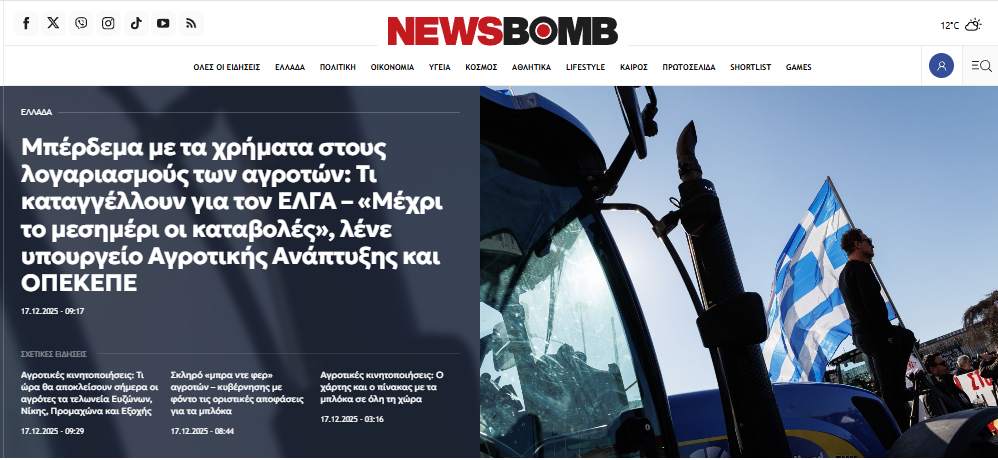
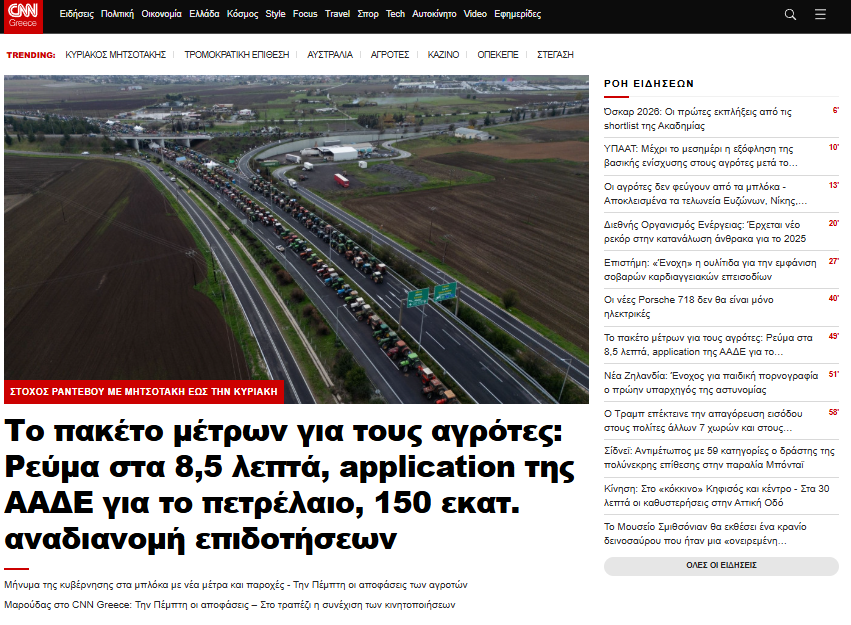
Farmers pledged €160 mln to reopen roads
A pledge of 160 million euro to reopen the roads set the political tone as Prime Minister Kyriakos Mitsotakis defended the 2026 state budget and announced additional support for farmers during a contentious parliamentary debate that ended with the budget’s approval.
https://www.ekathimerini.com/politics/1290017/farmers-pledged-e160-mln-to-reopen-roads
Androulakis at budget debate: Greece needs political change, not a third term of New Democracy
Highly critical of the entire government policy, especially the economy, PASOK-Movement for Change (KINAL) leader Nikos Androulakis charged the New Democracy government of successes that do not truly improve the financial state of many Greeks, during a debate in the Parliament plenary on the draft 2026 State Budget on Tuesday.
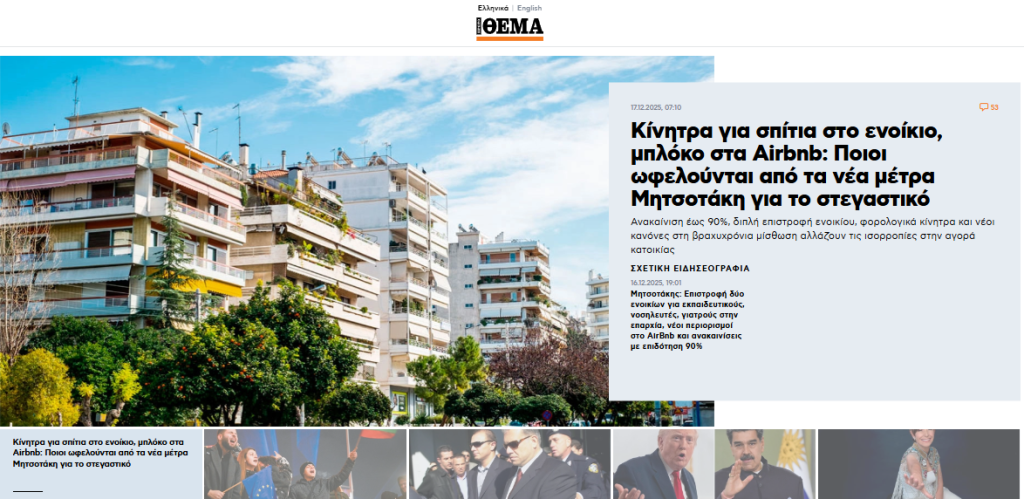
Greece unveils housing measures to boost supply, curb short-term rentals
Prime Minister Kyriakos Mitsotakis on Tuesday announced a package of six measures aimed at easing a deepening housing crisis, offering tax incentives to developers, curbs on short-term rentals and subsidies for renovations to boost the supply of affordable homes.
Sanctions force Jet Oil to suspend its operation
Jet Oil’s parent company Cetracore was forced to proceed with the suspension of the Greek fuel enterprise’s operation, under the burden of new European sanctions against Russia.
https://www.ekathimerini.com/economy/1290009/sanctions-force-jet-oil-to-suspend-its-operation
ATHEX: Eurobank fall drags index lower, too
Eurobank remained the protagonist of proceedings at the Greek bourse on Tuesday, but this time the trend was clearly that of decline, taking the benchmark back below 2,100 points, while turnover soared. The lender accounted for more than half of the day’s turnover, but its price almost returned to the level it had rejoined transactions on Monday. The day’s drop was in line with most other eurozone stock markets.
https://www.ekathimerini.com/economy/1290020/athex-eurobank-fall-drags-index-lower-too



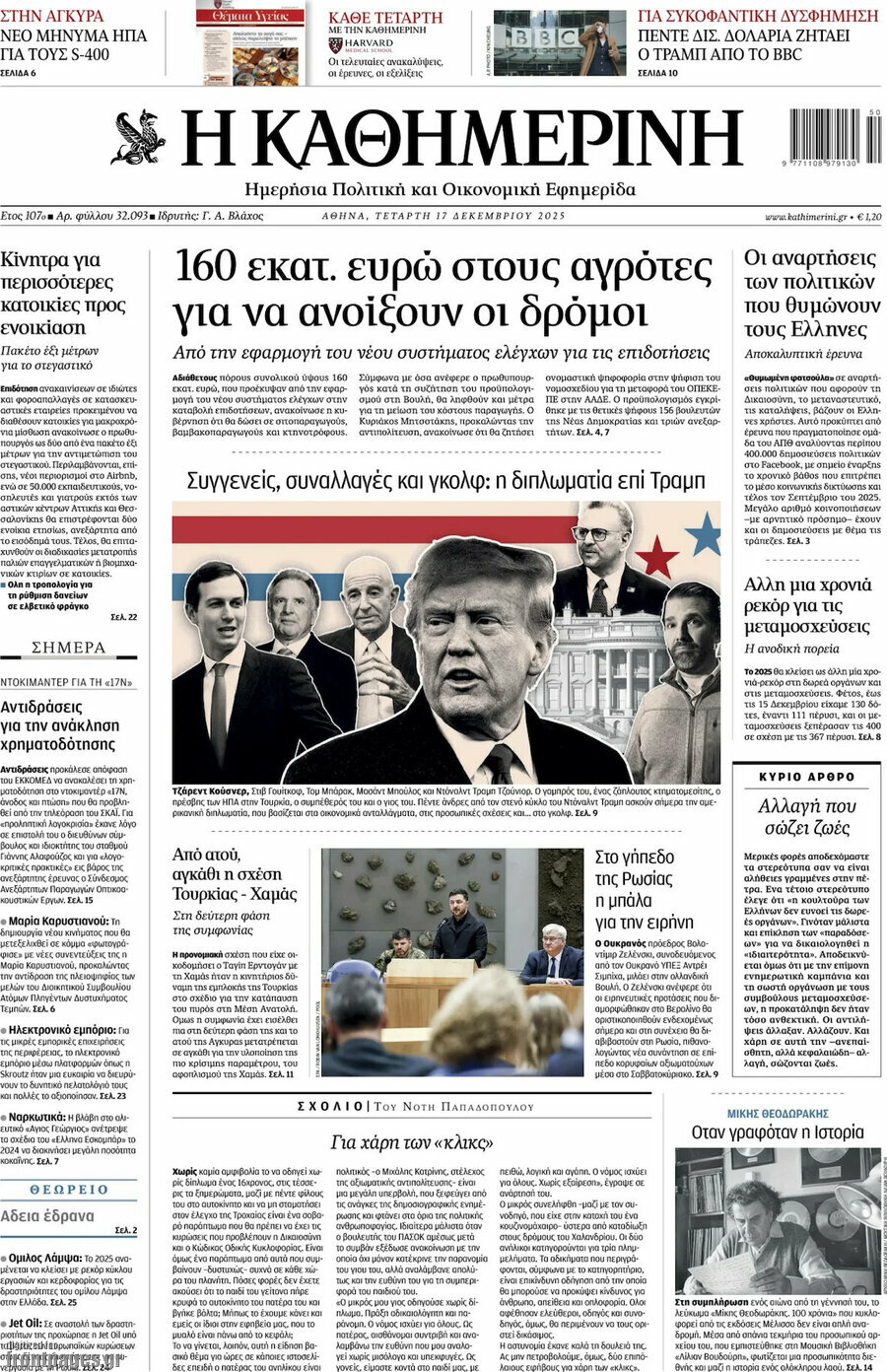
KATHIMERINI: 160 million for farmers in order for blockades to stop
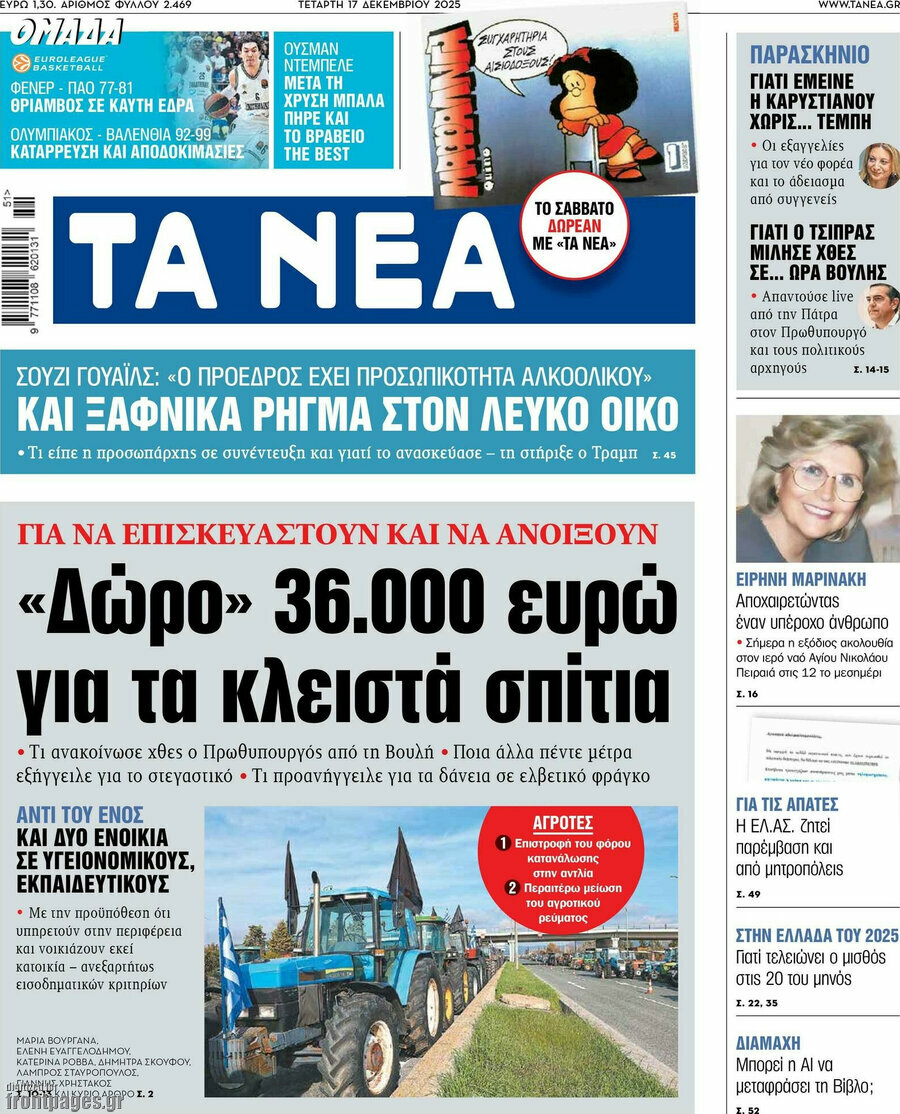
TA NEA: 36-thousand-euro “gift” for closed houses
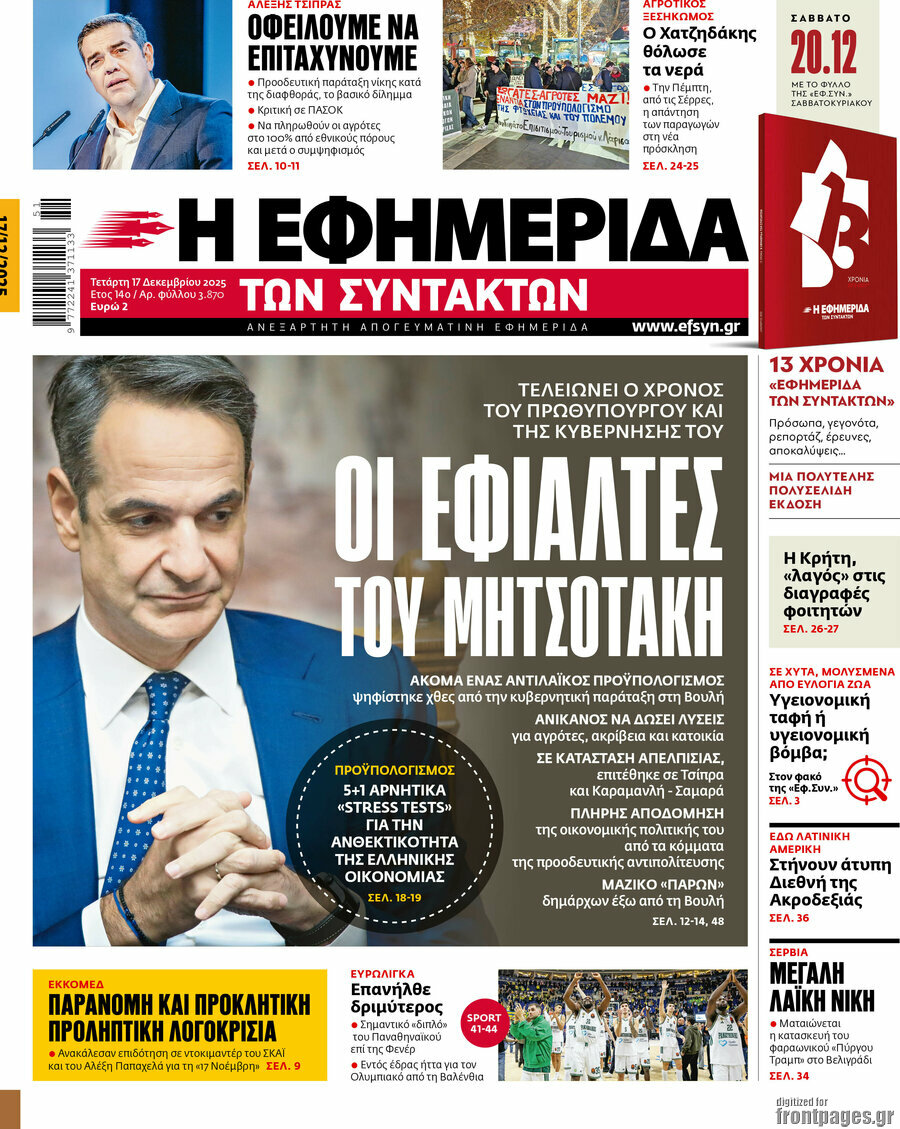
EFIMERIDA TON SYNTAKTON: Mitsotakis’ nightmares
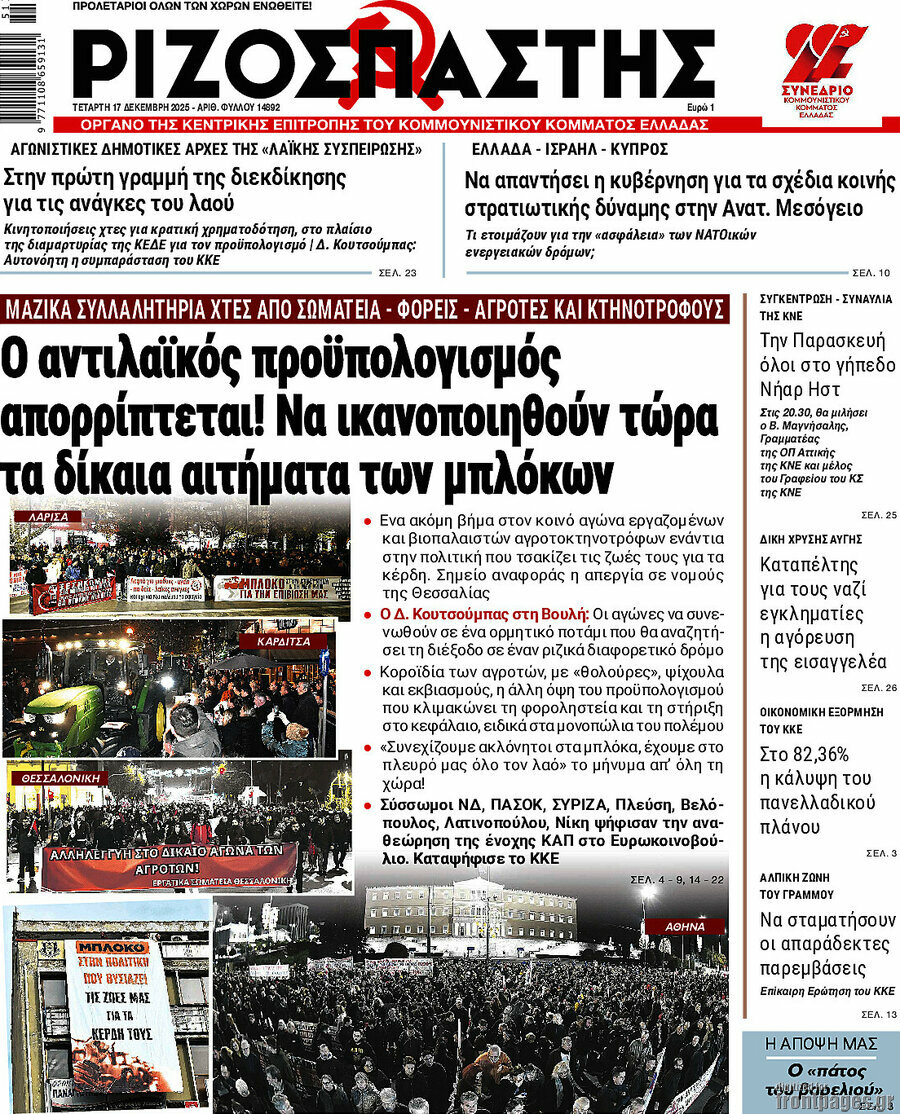
RIZOSPASTIS: The anti-popular budget is rejected!
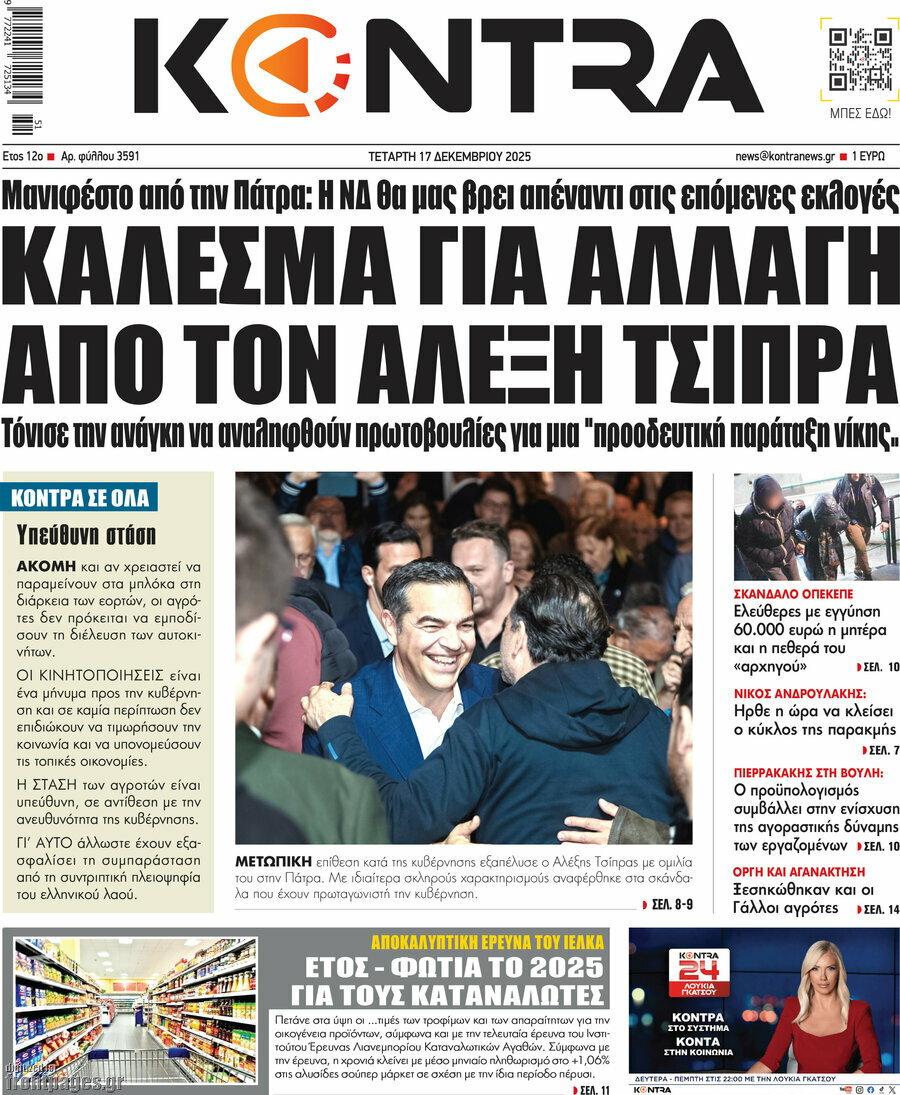
KONTRA NEWS: Alexis Tsipras calls for change
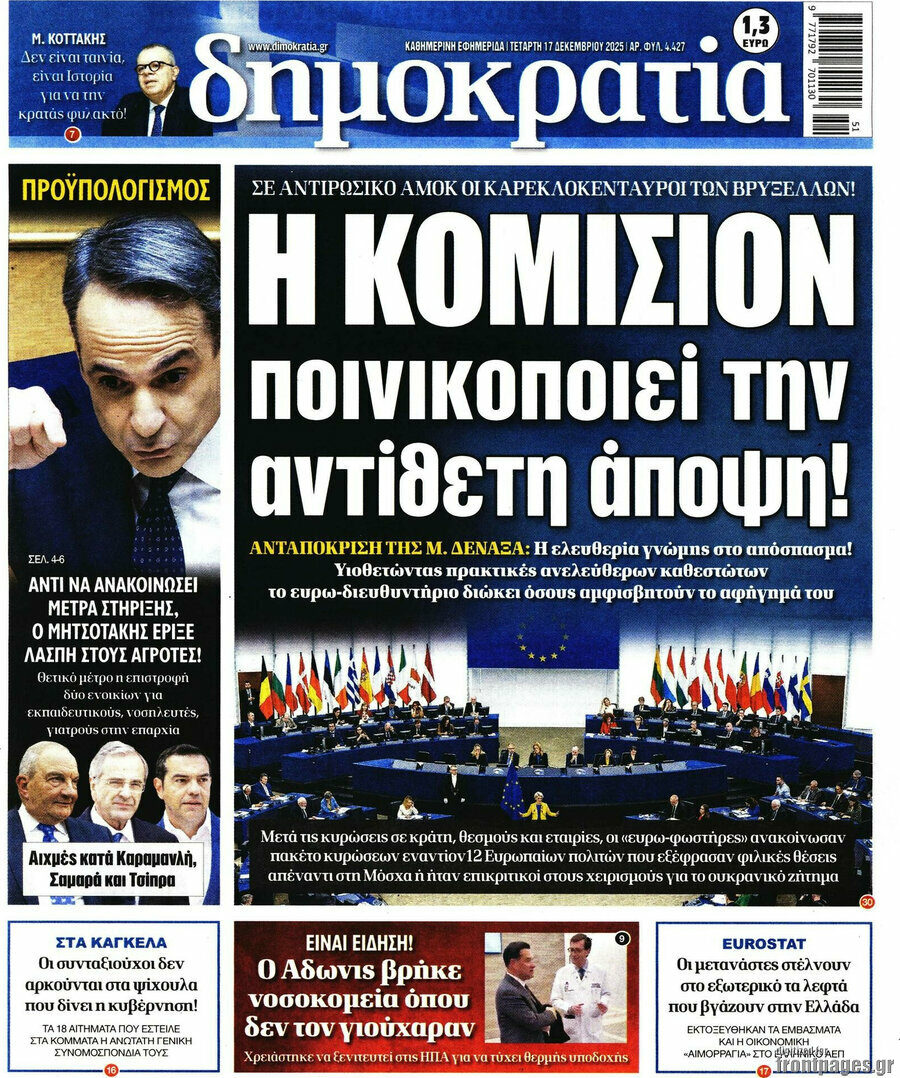
DIMOKRATIA: EU Commission penalizes difference of opinion
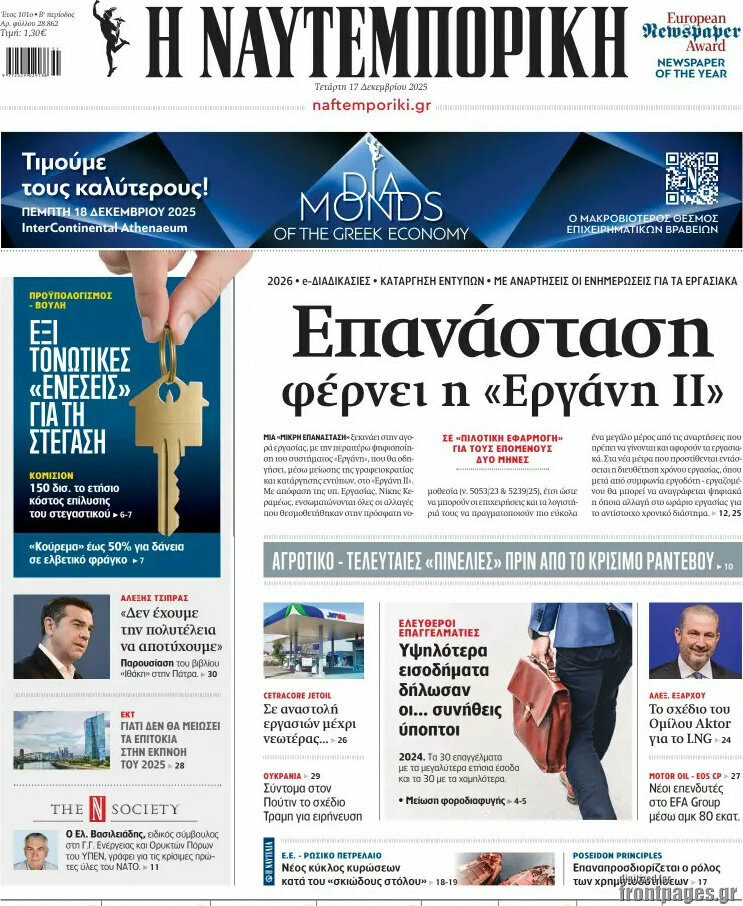
NAFTEMPORIKI: “Ergani II” revolutionizes labor procedures

DRIVING THE DAY
FROZEN ASSETS NUCLEAR OPTION: With just one day to go before what EU insiders call the most consequential European Council since the pandemic, there’s still disquiet in the room. The unresolved — and destabilizing — issue remains whether to grant Ukraine access to frozen Russian assets to bankroll its war efforts over the next two years. And it all comes down to Belgium.
Crunch time, minus the crunch: The Commission’s plan to tap the assets is still facing opposition from the very EU country that holds most of those assets. But ambassadors haven’t given up: They reconvene today at 9 a.m. in a last-ditch effort to lock in as much detail as possible before leaders converge on Brussels for Thursday’s make-or-break summit.
“It’s still quite early — which is a strange thing to say on a Tuesday before a Thursday EU summit,” one diplomat told Playbook after another inconclusive meeting Wednesday night. (Serving wine to exhausted ambassadors, as Playbook was informed, didn’t help.) “This is evolving almost hour by hour.”
The Trump element: Casting a shadow over the talks is Washington, with the outcome increasingly seen as a test of whether the EU can hold together under U.S. pressure. There’s also the question of whether President Donald Trump could exploit divisions. That’s why, as POLITICO’s Zoya Sheftalovich and Victor Jack explain this morning, some are now contemplating the unthinkable: pushing the reparations loan through by qualified majority voting.
Gasp! That would effectively sideline Belgium and the other capitals using Prime Minister Bart De Wever’s intransigence to hide their own disquiet. Yet the nuclear option is now being discussed openly — Ukraine’s staunchest allies are prepared to move without Belgium. “It is important to have Belgium in … but let’s see, if this [a qualified majority vote] will be the only [option], why not?” Latvian Prime Minister Evika Siliņa told Victor.
Majority rules: Outvoting a member state on an issue this sensitive is widely seen as a last resort, with officials warning it could deepen fractures and trigger a broader crisis. “Legally, it’s possible,” one diplomat said. “Politically, it opens the door to doing things simply because the numbers are there.”
The feasibility of Plan B: Germany and the Commission insist that leveraging frozen Russian assets is the only workable solution. All other options, including EU debt, would be torpedoed by Kremlin-friendly leaders, such as Hungarian Prime Minister Viktor Orbán. Yet De Wever hasn’t given up: He’s expected to float a legal workaround at Thursday’s summit that would allow joint EU borrowing for Ukraine, four diplomats told Gregorio Sorgi and Bjarke Smith-Meyer.
Forget it: The borrowing idea has some cred, given it was first aired by ECB President Christine Lagarde last week and has since received the support of Italy. The proposal would be designed to neutralize veto threats on common debt while also offering an alternative to messing around with frozen Russian assets held at the Brussels-based Euroclear. Yet by Tuesday the idea had been shot down in flames, with officials dismissing it as legally unviable. “Non-starter,” one diplomat said.
Can. Road. Kick: There is, however, a familiar fallback. According to a diplomat who has seen internal “room documents,” leaders could settle on language that keeps the reparations loan alive while tasking the Council and Parliament with finalizing the technical details — agreeing in principle on the use of Russian assets, without closing the file.
MERCOSUR LATEST
LIGHTNING ROUND: A parallel fight is underway — not formally tied to the EU summit, but very much about Europe’s credibility. Crucial interinstitutional negotiations on the EU–Mercosur deal will determine whether France and (surprise!) Italy ultimately back the agreement in a separate member-country vote, or scuttle it just short of the finish line.
Last-minute scramble: Parliament, Council and Commission reps will meet mid-afternoon for high-stakes talks (known in Brussels as trilogues) that could define the deal’s fate. The meeting follows the European Parliament’s vote on Tuesday to strengthen safeguard measures, lower investigation thresholds, accelerate procedures and tighten reciprocity on production standards.
Ghost of a chance: Tensions are expected, not least because the Council has left the Commission’s proposal untouched — unlike Parliament. Bernd Lange, chair of the Committee on International Trade, said negotiations would run “this afternoon, with open end.” If a compromise emerges on safeguards, EU ambassadors are expected to vote on the overall deal on Friday, three diplomats told POLITICO’s Camille Gijs.
Italian maneuvers: French and Polish opposition isn’t a surprise. Italy, however, has become the wild card. Rome’s posture has grown increasingly ambiguous, with earlier reporting suggesting it was ready to align with Paris. Prime Minister Giorgia Meloni’s silence has fueled speculation in Brussels that the Italians are seeking leverage — and possibly additional funding for farmers in the next seven-year EU budget.
Clear as mud: On Tuesday evening, Agriculture Minister Francesco Lollobrigida said Italy is “not prejudicially opposed” to what he called “a good agreement,” while cautioning against “urging things” or “rushing into a tug-of-war between nations” at a moment of European weakness.
Trying Lula’s patience: Mercosur isn’t enjoying the Europeans’ political dithering, Lange told journalists during a dinner in Strasbourg on Tuesday. That frustration was evident, he said, during a phone call between Meloni and Brazilian President Luiz Inácio Lula da Silva, described as “not exactly a friendly conversation,” Max Griera reports.
All roads lead … Meloni may offer hints of Italy’s direction when she appears before the Italian parliament later today. Yet many say the bad optics won’t be easy to forget. Socialist MEP Brando Benifei dismissed Rome’s stance as “theatrical,” adding: “How can Meloni explain a delay to [Argentinian President Javier] Milei? How can she explain it to Italian industry?” A German government official said if there’s no deal this week, it’s all over. “We’re already seeing it start to unravel.”
Paris pushes back: France rejects any artificial deadline. “The issue is whether conditions are met — not declaring the agreement dead after a certain date,” an Élysée official said. “What is clearly desired is to be able to assess whether all of these conditions are in place or not — not saying the agreement is supposedly dead after a certain date.”
WESTERN BALKANS SUMMIT
KEEN TO JOIN: The EU–Western Balkans Summit kicks off at 6 p.m., following doorsteps from 4:30 p.m. and the traditional family photo (watch for Albanian Prime Minister Edi Rama’s trademark suit-and-white-sneakers look). A press conference follows at 7:30 p.m., before leaders sit down for dinner with top EU officials, including Ursula von der Leyen and Kaja Kallas.
Muted enlargement vibes: December European Council meetings usually place enlargement discussions at center stage. Not this year. With no substantive conclusions expected, leaders will instead hold a strategic discussion Thursday — making today’s summit simply a chance to mingle with the waiting six: Albania, Serbia, Montenegro, Kosovo, Bosnia and Herzegovina and North Macedonia.
Well, not all of them: Serbian President Aleksandar Vučić signaled he’d skip today’s events and wouldn’t send any representative at all. Two officials told my colleague Gabriel Gavin that Belgrade is also expected to opt out of the EU’s Green Lanes initiative — another strain on Serbia’s already brittle relations with the bloc.
Maybe he’s busy? Vučić has threatened reprisals after protesters and a prosecutor thwarted plans for a Trump Tower in Belgrade, the Guardian reports. The $500 million development by a private equity company run by Trump’s son-in-law Jared Kushner was abandoned this week after a government minister was indicted on suspicion of abusing his office to support the project.
Marriage material: The late withdrawal casts a shadow over what was meant to be a convivial wine-tasting event at Albania’s embassy on Wednesday evening. “I don’t feel well … that Serbia is not here,” Rama said. Yet Albania has been on a roll of late, opening all 33 chapters in just over a year and now moving into technical negotiations. “Imagine you’re in love,” Rama tried to explain at the same event. “You don’t have to imagine. Look at me and Marta,” he added, pointing to Enlargement Commissioner Marta Kos. “I’m already on my second husband,” Kos shot back.
Hajde bre: Rama wants all chapters closed by 2027 and political negotiations underway soon after. Meloni upped the ambition, floating early 2028 — during Italy’s EU presidency — as a target to begin talks.
Front-runner alert: For now, Montenegro appears to be first in line, POLITICO’s Jakob Weizman writes in to report. The country is making swift progress, with Prime Minister Milojko Spajić betting the small Adriatic state could join the bloc by the end of the Commission’s term in 2029. With all chapters now opened and 21 left to close, Montenegro is widely seen as the closest to EU membership.
Right direction: Danish European Affairs Minister Marie Bjerre called Montenegro’s progress “a significant step forward on the country’s path towards European integration.”
HARD MIGRATION STANCE
NEW SENSATION: Migration is back on leaders’ radar. Even if the European Council draft conclusions circulating in Brussels remain embryonic (for the moment), like-minded capitals are determined to show that the political weather in Brussels has changed. In a letter sent to the Commission (and scooped by POLITICO), 19 member states argue that momentum has turned and that “innovative solutions” — including return hubs — should now be implemented.
There’s a law for that: Long pushed by Italy, Denmark and the Netherlands, these ideas were folded into EU legislation with last week’s approval of new rules. The message now: It’s time to “operationalize.” The signatories want the Commission to spell out how existing and future EU funds can be mobilized and to examine “necessary legislative and policy changes” — including tweaks to Frontex’s mandate.
Highway to rejection: Parliament and Council are expected to clinch a deal tonight allowing EU member states to deport migrants to third countries where they are not nationals, and to designate “safe” destinations where asylum claims can be fast-tracked for rejection.
STRASBOURG CORNER
SAUDI TWIST: The European Parliament on Tuesday backed a non-binding resolution in favor of negotiating a strategic partnership with Saudi Arabia. Yet the subsequent controversy had little to do with Riyadh. Buried in the “whereas” clauses is a reference to the “ongoing case before the International Court of Justice” on the alleged breach of the Genocide Convention in Gaza — language that set off alarms in Israel.
What’s going on? For now, it’s unclear why a reference to the unrelated Court of Justice case was inserted in the text. Israeli officials say they’re being turned into a bargaining chip in an unrelated parliamentary fight. Israeli Ambassador to the EU Avi Nir-Feldklein told Playbook: “We have no issue with Saudi Arabia. The issue is that we find ourselves in a report about EU-Saudi Arabia relations. It’s almost a red line for us.” Citing the recent terrorist attack in Sydney, he said that people “should be far more careful with Hamas propaganda.”
MEP fires back: Contacted by Playbook, the file’s rapporteur, Spanish Socialist Hana Jalloul Muro, dismissed the criticism, noting the wording mirrors language from earlier parliamentary resolutions — including those backed by the center-right European People’s Party (EPP). What’s more, it appears only in the preamble, not the actual text.
ABORTION RIGHTS SPLIT THE HOUSE: MEPs vote today on a resolution calling for wider access to abortion across the EU. However, the outcome is uncertain after center-right and far-right groups tabled competing texts, my colleague Claudia Chiappa writes in to report. The text, tabled by Renew’s Abir Al-Sahlani for the women’s rights committee, stems from the European Citizens’ Initiative “My Voice, My Choice.” It proposes a voluntary, opt-in EU funding mechanism to help women access abortion care when it’s unavailable at home.
Mariah move: Tuesday’s plenary debate laid bare the fault lines: Supporters framed the vote as a public health and equality issue; opponents dismissed it as ideological overreach. The debate was punctuated by heckling and reprimands. “All I want for Christmas is for this vote to pass tomorrow,” Greens MEP Terry Reintke said, exiting to applause.
GERMANY KILLS COMBUSTION-ENGINE BAN: Just three weeks ago, Berlin was staring down the possibility of abstaining on a vote on the biggest file impacting its automakers. Now, Chancellor Friedrich Merz and the EPP are enjoying a victory lap after securing their campaign promise to overturn the 2035 de facto combustion engine ban, as Max Griera writes.
Surgical strike: “Six months ago, it was unthinkable that the Commission would make this course correction,” an EU diplomat told Jordyn Dahl, calling Germany’s “decisive intervention” a game changer in the fate of the law.
IN OTHER NEWS
WORLD CUP BACKLASH: Keir Starmer is the latest leader to weigh in on the escalating backlash against ticket prices for the 2026 men’s football World Cup, warning FIFA that it risks alienating “genuine supporters who make the game so special,” my Stateside colleagues write.
TRUMP’S WAR AGAINST THE BBC: Donald Trump’s $10 billion lawsuit against the BBC, filed late Monday, is good news for a rival British broadcaster: GB News, an upstart right-wing network whose presenters include Nigel Farage. Annabelle Dickson and Dan Bloom look at how the outlet has defied a shaky start to build a loyal audience and a foothold in Westminster.
Poland’s biggest right-wing broadcaster is also planning an English-language channel inspired by MAGA, and claims to have had talks with American investors linked to the pro-Trump movement, the Financial Times reports.
WELCOME BACK: British ministers are expected to announce today that the U.K. will rejoin the Erasmus student scheme as part of its “reset” of relations with the EU, the BBC reports.