
PM holds talks with senior officials on farmer payments plan as protests escalate
Prime Minister Kyriakos Mitsotakis convened senior government officials at Maximos Mansion on Wednesday to assess the timetable for disbursing more than €1 billion in subsidies and compensation to farmers by year’s end. The launch of formal talks between the government and farmers appears imminent, with an initial meeting expected early next week. The government has urged farmers to appoint a representative committee to participate in the dialogue.
Disbursements to farmers in 2025 to total 3.8 bln euros in EU, state funds, ministry says
Funds credited to farmers’ bank accounts will total 3.8 billion euros by the end of 2025, the Rural Development & Food Ministry said in a briefing note on Wednesday. So far, the ministry said, a total of 2.6 billion had been disbursed, while another 1.2 billion euros are expected to be disbursed by December 31.
Greek, Belgian finance ministers vie for Eurogroup presidency
Greek Finance Minister Kyriakos Pierrakakis and his Belgian counterpart Vincent Van Peteghem, both members of the center-right European People’s Party (EPP), are competing to become president of the Eurogroup in a vote scheduled for Thursday.
House prices beat 2008 record
The housing market is now at a level that exceeds the previous high of 2008, confirming the full recovery of prices after the economic crisis. According to the data resulting from the processing of the housing price indices of the Bank of Greece, at the end of the third quarter of 2025, prices across the country are at a level 7.14% higher compared to 2008, having recorded a total increase of 86% since the low of 2017.
https://www.ekathimerini.com/economy/real-estate/1289280/house-prices-beat-2008-record
ATHEX: December slowdown for bourse
After a narrow session at the Greek bourse, the benchmark closed with marginal losses, as sellers dominated the closing auctions, although the majority of stocks ended the day in the black. For want of any significant fiscal or corporate developments, stocks are trading on speculation about future mergers and acquisitions or expansion, while turnover is in constant decline ahead of the festive season.
https://www.ekathimerini.com/economy/1289393/athex-december-slowdown-for-bourse


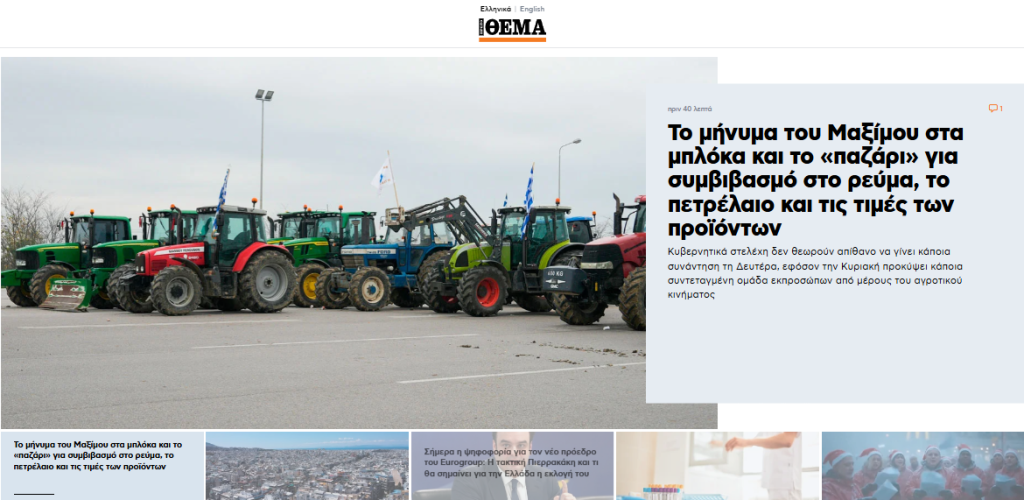
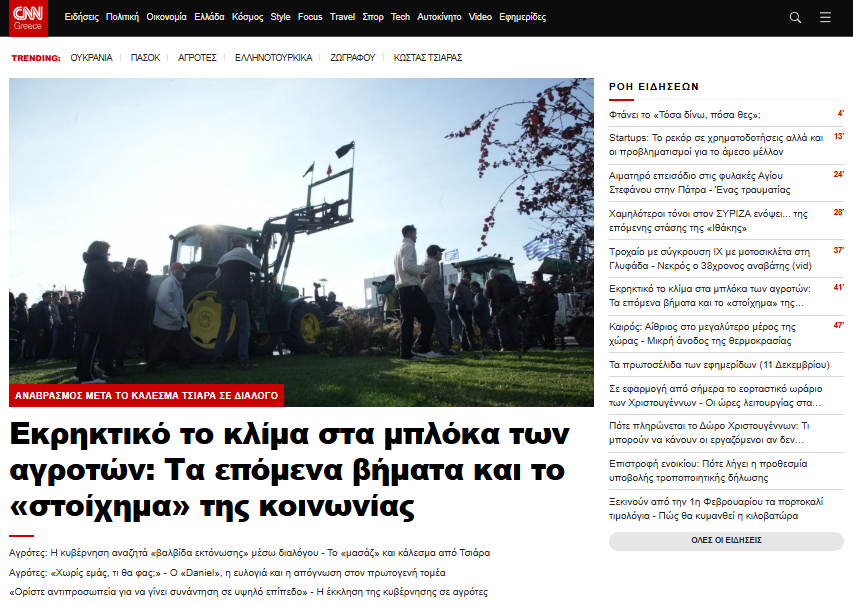

KATHIMERINI: Farmers at extremes while ruling party MPs “hit the trenches” slamming the government
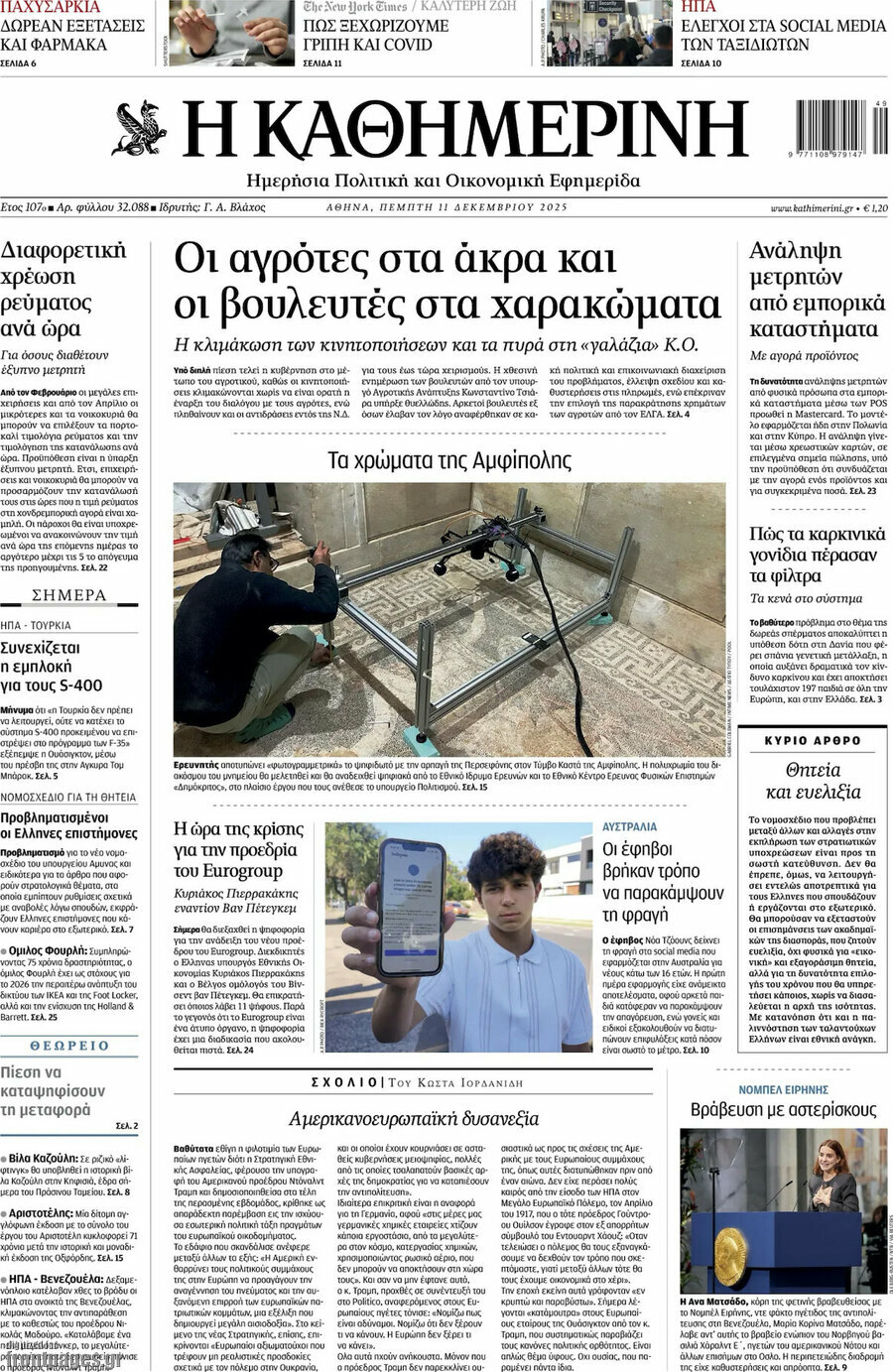
TA NEA: Drugs: either price increases or market shortages

EFIMERIDA TON SYNTAKTON: The government cannot convince even its own MPs

RIZOSPASTIS: The heart of the fight and solidarity is beating at farmers‘ blockades

KONTRA NEWS: Government “Waterloo” in farmers’ blockades
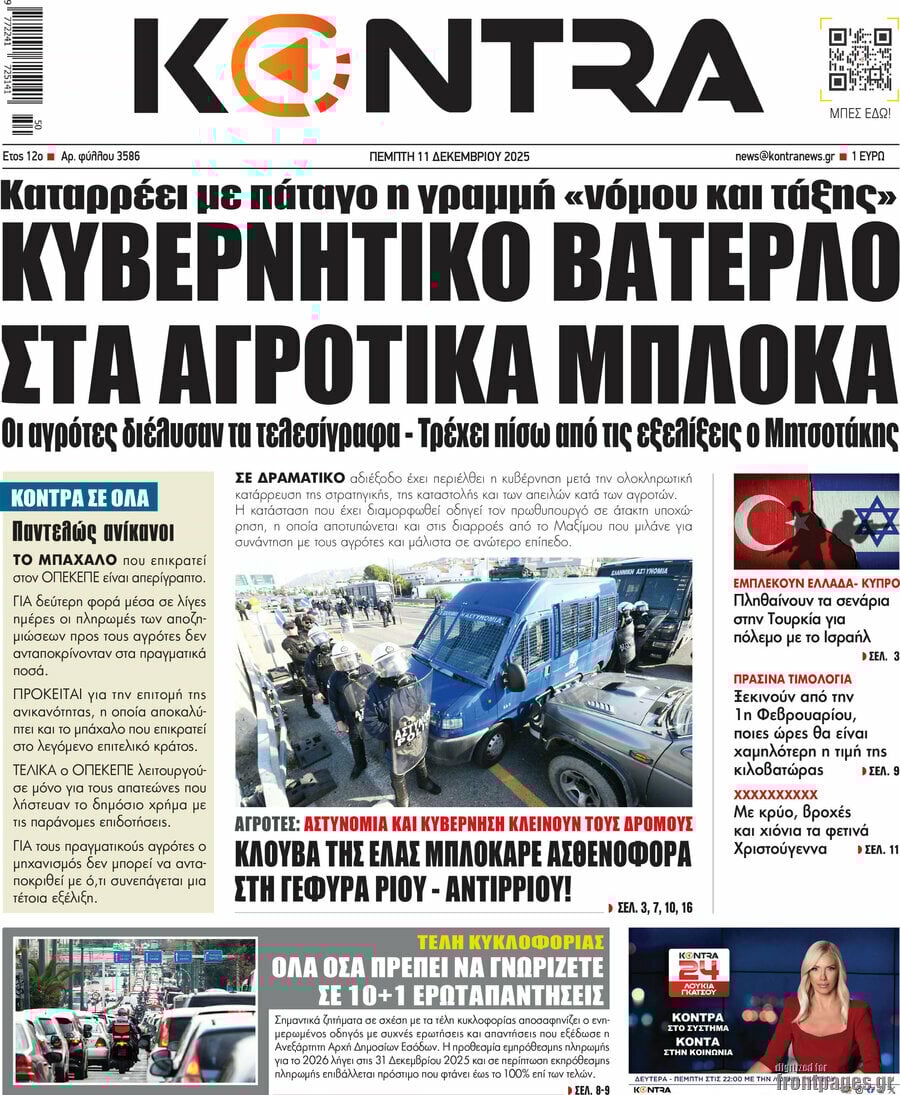
DIMOKRATIA: Ruling party MPs complain to Agriculture Minister: “We are getting slammed by society”

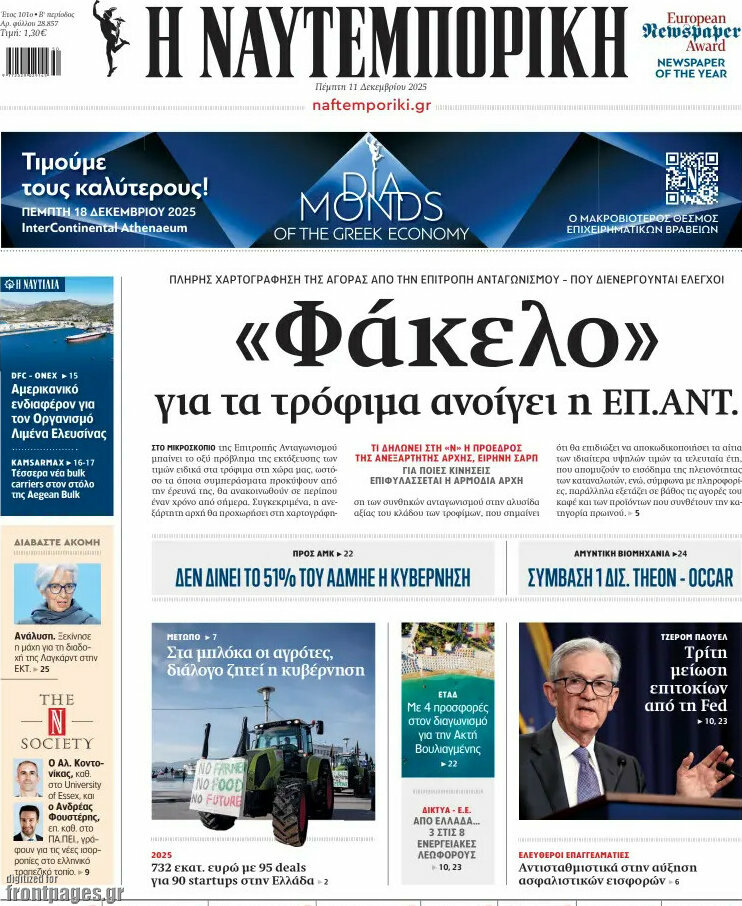
NAFTEMPORIKI: Competition watchdog opens “file” on food products

DRIVING THE DAY: POWER PLAYERS
VDL STEPS INTO THE SPOTLIGHT: Ursula von der Leyen will take the stage at tonight’s annual POLITICO 28 Gala Dinner for an interview that promises to deliver fresh insights into the future of the EU executive — and, more pointedly, its leader.
It will be the Commission president’s first substantial public appearance since that POLITICO interview with Donald Trump on Tuesday jolted Brussels and escalated the transatlantic trash talking to a new level. How will she respond to the American leader’s scathing portrayal of Europe as weak, floundering and in existential peril?
She won’t be alone: Sharing the stage is Commission Executive Vice President Teresa Ribera, whose profile is rising at the same time that whispers of internal pushback inside the Commission have become harder to ignore. The backdrop to all this is a year marked by von der Leyen’s campaign to centralize power.
Friendly fire? Hovering over von der Leyen is whether tonight’s narrative will reflect the transatlantic shockwaves or simply drill down on the usual intra-Brussels sniping.
Donald J. Trump, top of the P28: The U.S. president, who topped our annual ranking of the people most likely to shape European politics in the coming year, will be the elephant in the ballroom. It marks the first time that a non-European has taken the No. 1 spot, edging out every EU contender (something the White House celebrated in a post on X).
An example of his power? The second Trump administration is seen as more consequential for Germany, France and the U.K. than the election of those countries’ own leaders, according to a major international survey of 10,000 voters conducted for POLITICO by Public First.
Seeing red: Ribera’s presence adds yet another layer of interest. Sure, von der Leyen and the competition commissioner will no doubt be civil as they share the same stage. Yet the Spanish Socialist has at times pushed back against the Commission line, which tends to reflect the outlook of the president’s center-right European People’s Party (EPP). Just don’t mention green issues or Israel.
It’s verticalization, baby: There was a time when commissioners (especially those from heavyweight member countries, such as France and Italy) doubled as their home governments’ political antennae. However, they’ve increasingly been sidelined, as EU capitals engage directly with the Berlaymont’s top floor.
Cutting out the commissioner: As one EU diplomat, speaking anonymously, put it:“A commissioner’s political weight has always depended on their government’s clout — plus their direct line back home.” In von der Leyen’s Commission, that second part matters less and less.
In the name of efficiency: “If you have a good relationship [with Emmanuel Macron, Giorgia Meloni or Pedro Sánchez directly], why go through the commissioner?” an EU official told us. The result of this is more power concentrated in the president’s cabinet, and far less space for debate within the College of Commissioners.
Expect also praise: Von der Leyen’s first term carried the weight of fragile legitimacy. But one diplomat told POLITICO that the top Commission official had since “grown into the role.” Another diplomat said she had pulled off a “qualitative leap,” pointing to her ability exactly to forge direct relationships — including with Donald Trump.
Something’s moving: But small signs of rebellion have surfaced — and it’s not just Ribera. Officials and diplomats who spoke to Playbook in recent months suggested High Representative Kaja Kallas and Executive Vice President Roxana Mînzatu are increasingly unhappy with the leadership on offer.
Know thyself: No recalcitrant commissioner would have the leverage to break ranks, as one EU official acknowledged. But frustrations are seeping through. Another Commission official noted that sometimes von der Leyen is more afraid of what’s happening outside the EU than inside the bloc. Could it be time for her to turn her gaze inwards?
All of this sets the stage for an evening that will bring together around 300 guests — ministers, CEOs, ambassadors and European Parliament group leaders, as well as current and former commissioners. Other speakers include U.S. Ambassador Andrew Puzder, economist Yulia Navalnaya and EU Tax Observatory Director Gabriel Zucman.
GROUNDHOG DAY
ENVOYS DISCUSS ASSETS SUPERFREEZE: EU ambassadors will today weigh up whether to hand the Commission emergency powers to keep Russia’s state assets frozen indefinitely. Envoys will examine updated legal texts after Wednesday’s inconclusive discussion, three EU diplomats told POLITICO’s Gregorio Sorgi.
What’s that: The mechanism is a cornerstone of the Commission’s plan to mobilize €210 billion in frozen Russian assets for Ukraine — most of which are held by the Belgian-based Euroclear. It would overhaul the current system that compels EU countries to unanimously reauthorize the sanctions every six months.
That means Kremlin-friendly countries such as Hungary and Slovakia would lose the power to release the sanctioned money with a simple no vote, leaving EU capitals on the hook to repay the loan to Russia.
The light at the end of the tunnel: The diplomats said late Wednesday that the proposal could be “stripped down” in a bid to win Belgium’s support and adopt the plan by the end of the week. Hopefully.
Yes, it’s still all about Belgium: PM Bart De Wever is holding out over concerns that Belgium could be financially exposed if the money needs to be repaid and has now asked for more safety nets. In an interview with VRT NWS Wednesday, De Wever even refused to rule out legal action if the EU moves ahead with seizing the assets.
“No jurisdiction”: A legal memo circulated among diplomats Wednesday by law firm Covington & Burling rejects Belgium’s argument that it would face major legal retaliation from Russia.
The four-page document says the risk of litigation is “minimal,” insisting Russia wouldn’t be able to challenge an EU reparations loan in the International Criminal Court or “any comparable international adjudicative body.”
More stick than carrot: Europe’s strategy to sway Belgium may be to warn the kingdom that it could be treated like Hungary if it doesn’t come on board — with its diplomats, ministers and officials losing their voice around the EU table, reports Zoya Sheftalovich.
ASSET FIGHT SPILLS INTO EUROGROUP RACE: Belgium’s obstruction of the frozen-assets plan is now hurting the bid by the country’s deputy PM, Vincent Van Peteghem, to become Eurogroup president, POLITICO’s Giovanna Faggionato hears. Irritation over Belgium’s stance may tip votes toward his rival, Greek Finance Minister Kyriakos Pierrakakis. “No one wants to do Belgium a favor,” one diplomat said.
ANOTHER MIGRATION MILESTONE
MIGRATION “BREAKTHROUGH” ON EUROPEAN CONVENTIONS: It was previewed in Wednesday’s Playbook and it’s now official: 27 members of the Council of Europe have approved a joint declaration, pushed by Denmark and Italy, on the European Convention on Human Rights (ECHR). This could have major consequences for migration policy.
Under current jurisprudence from the European Court of Human Rights, foreigners convicted of serious crimes often cannot be deported. The new declaration aims to “rebalance public interest and individual rights,” its backers say.
In practice: That means enabling the deportation of convicted criminals even when they invoke rights such as family life, thus terminating residency rights for foreigners who “abuse” those rights by committing serious offenses.
The breakfast club: In a tradition started at the June 2024 EUCO, Italy’s Giorgia Meloni, Denmark’s Mette Frederiksen and the Netherlands’ Dick Schoof have kept up their informal “migration breakfasts” on the margins of European Councils, swapping ideas for tougher border and asylum policies. However, what happened in Strasbourg “wouldn’t have happened” without these breakfasts, two diplomats told Playbook.
“Things are moving quickly now” … was the verdict of another diplomat. With this declaration — and the comprehensive EU migration package adopted earlier this week — Europe is witnessing a significant shift toward a tougher migration approach (not least as mainstream parties try to reclaim a topic long dominated by the far right).
HUMAN RIGHTS
EU RIGHTS ENVOY SLAMS TRUMP: Donald Trump has encouraged autocrats and populists in Europe and around the world to “undermine” human rights, the EU’s top human-rights envoy told POLITICO’s Sebastian Starcevic, in an interview marking Human Rights Day (Dec. 10).
“I think that the Trump administration emboldens and strengthens authoritarian regimes around the world,” Kajsa Ollongren told POLITICO, citing Russia and China. Ollongren is the former Dutch defense minister who became the EU’s special representative for human rights in July.
Ripple effect: The impact, she said, is visible even within the EU, where some member countries “do not care very much for human rights.” That, she added, should push Europe to reaffirm its commitment to the international human rights architecture. The EU must “be very strong” and “use the power that we have” to defend minorities at home and abroad.
Filling the void: Ollongren also sharply criticized the Trump administration for its sweeping cuts to foreign aid, which she said had left a “huge gap” in humanitarian programs that Brussels was struggling to remedy. “It’s very important that the EU steps up, but we cannot completely fill it.”
IRAN’S GRISLY RECORD: The European Parliament on Wednesday hosted a conference on what speakers described as Iran’s rapidly worsening human rights crisis. According to Amnesty International, Ayatollah Ali Khamenei’s regime carried out 64 percent of all documented executions worldwide in 2024.
The situation has deteriorated sharply, according to the National Council of Resistance of Iran (NCRI), which organized the event that was attended by former Belgian and Italian PMs Guy Verhofstadt and Matteo Renzi. The NCRI estimates that more than 1,950 executions have taken place in Iran so far this year. Its President-elect Maryam Rajavi urged the EU to designate Iran’s Revolutionary Guards (IRGC) as a terrorist organization.
GEOPOLITICS IN PARLIAMENT
ALBANESE’S TRAVEL VICISSITUDES: The European Parliament is switching travel providers for sanctioned individuals, according to an email exchange seen by Playbook. This follows a decision by Parliament’s current agency, CWT, to cancel bookings for Francesca Albanese, the U.N. special rapporteur on the occupied Palestinian territories, who had been invited to speak at the Parliament last month.
What happened: CWT was recently acquired by American Express, a U.S. company, and is therefore now obliged to comply with U.S. sanctions law — even when handling travel for the European Parliament.
Little room to maneuver: In the internal emails, Parliament officials concede they have limited ability to prevent such cancellations unless they change agencies. They have now decided to use an alternative Belgian travel provider for individuals affected by U.S. sanctions to ensure their trips are not blocked again.
MEPS’ RUSSIAN PARLIAMENT CHIT-CHAT: MEPs have been invited to a video meeting with members of the Russian Duma in mid-December, according to an internal message seen by Kathryn Carlson.
And look who’s hosting: The video conference is being organized by Luxembourgish MEP Fernand Kartheiser, who was expelled by the European Conservatives and Reformists Group for visiting Moscow earlier this year at the Duma’s invitation. It’s the second dialogue that has been organized, according to the invitation, and all MEPs have been invited. Kartheiser’s team says the goal is to conduct “normal parliamentary diplomacy” in the absence of any official engagement.
IN OTHER NEWS
VICTIMS’ RIGHTS DEAL: Parliament and the Council reached a provisional agreement Wednesday evening to update the 2012 EU law on the rights, support and protection of crime victims. The overhaul aims to make it easier (and less traumatic) for victims to seek justice.
While you were sleeping … negotiators from the Parliament, Council and Commission finally struck a deal on the EU’s overhaul of its 20-year-old pharma rules, Giedrė Peseckyte writes in to report.
More deals in sight: EU negotiators are expected to clinch a political agreement this morning on overhauling the bloc’s foreign direct-investment screening rules, according to people familiar with the talks. It’s also a big day for Europe’s automakers: EU institutions are gearing up for a final round of talks tonight on the end-of-life vehicle regulation, which would set new waste-reduction rules for the automotive sector.
U.S.-LESS NATO: Donald Trump’s escalating attacks on the European Union are forcing its leaders to grapple with the previously unthinkable: a future in which America is no longer Europe’s primary security guarantee. This scenario would suggest that the continent must organize its own defense far sooner than anyone had planned, my colleagues write.
EPP AND VIRKKUNEN MEET GERMAN CEOs: The EPP’s top brass in the European Parliament is meeting Thursday to Friday in Heidelberg to plan and brainstorm about the group’s priorities. According to a draft agenda seen by Max Griera, it will include panel sessions on “innovation policy” and “the future of the car industry” with heavyweights from German industry and the Commission’s tech chief Henna Virkkunen.
SPOTTED IN OSLO: Nobel Peace Prize winner María Corina Machado greeted crowds from a hotel balcony in Norway’s capital during the night, having made a daring escape from Venezuela by boat. It was the opposition leader’s first public appearance in months, and came only hours after her daughter accepted the peace prize in Oslo on her behalf, the Associated Press reports.