
Farmers plan blockade of Volos port amid nationwide protests over delayed aid
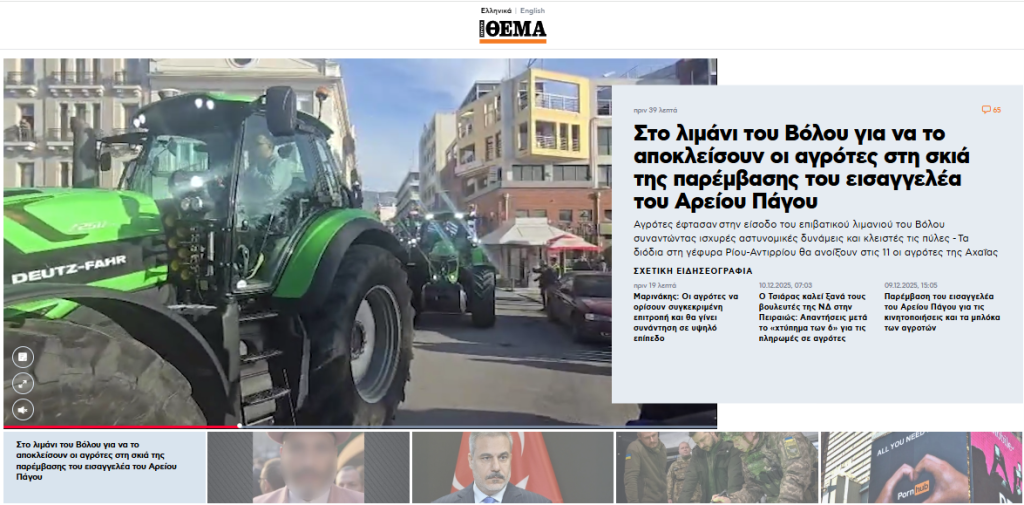
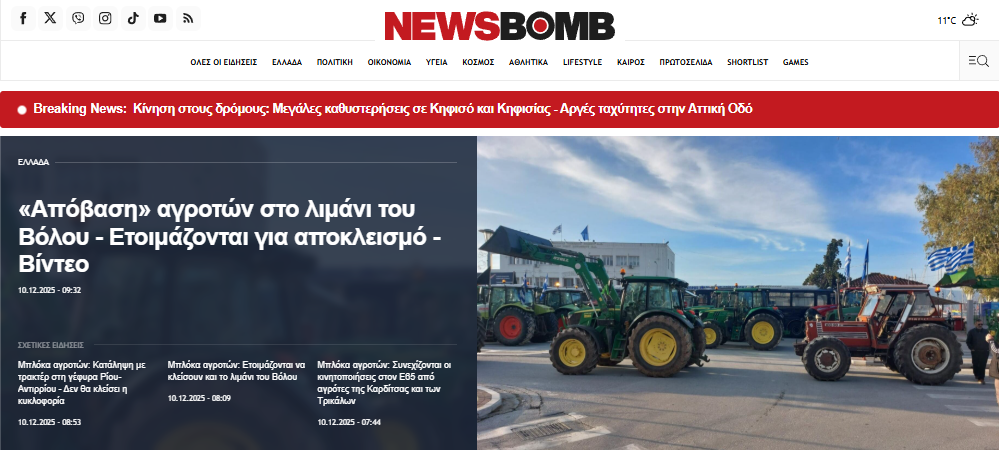
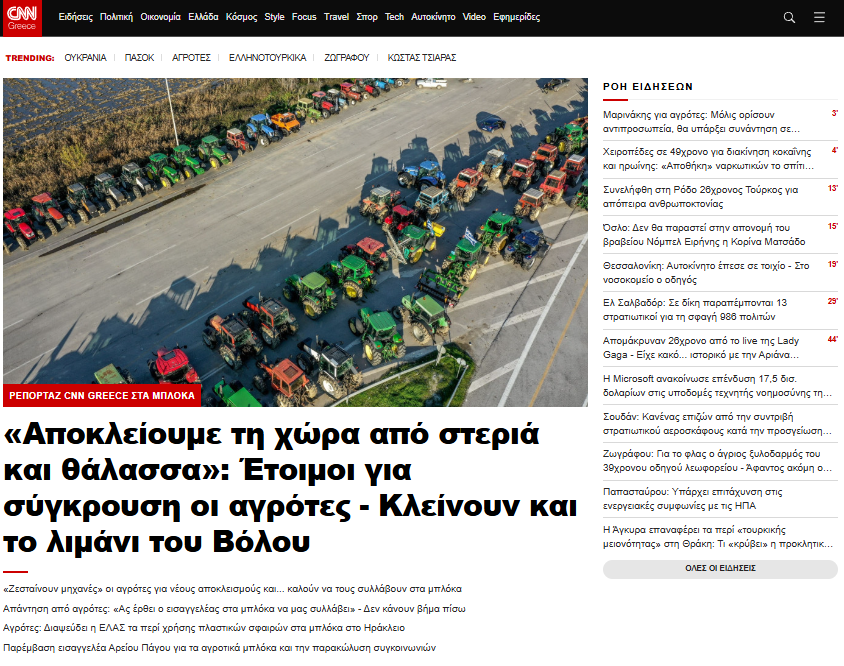
Farmers protesting delays in farm aid payments were expected to step up nationwide blockades on Wednesday by obstructing the freight terminal at the port of Volos in central Greece.
Greek Supreme Court Prosecutor orders intervention in farmers’ protests
The Prosecutor of the Greek Supreme Court Constantine Tzavellas, has issued directives to lower-ranking prosecutors to intervene in ongoing farmers’ demonstrations, with the support of the relevant police authorities. The aim is to investigate and document offences that are automatically prosecuted under Greek law, as well as potential acts of violence against individuals, public officials, property used for public benefit, and cases of unprovoked damage to private property.
Androulakis: Farmers are paying a high price for ND’s corruption and incompetence
Main opposition PASOK-KINAL party leader Nikos Androulakis visited protesting farmers at the road blocks of Karditsa and Trikala on Tuesday afternoon, discussing problems besetting the farming community, including the problems of young farmers, rising production and energy costs, delays in the payment of basic subsidies and huge losses of livestock to animal epidemics. Androulakis presented a plan prepared by PASOK after a nationwide dialogue with representatives of farmers in Larisa a few weeks before, expressing his support for the farmers’ struggle and their demands, which he described as justified.
Competition watchdog raids electricity companies over suspected market manipulation
The Hellenic Competition Commission has carried out dawn raids on electricity production and wholesale supply companies as part of an ongoing investigation into potential anti-competitive practices in Greece’s energy market. According to the commission, the inspections aim to determine whether companies have engaged in conduct that could restrict competition, distort prices or undermine the proper functioning of the electricity market.
ATHEX: Taking stock of the recent stock gains
After the recent growth of prices on the Greek stock market, investors predictably reaped some of their profits, focusing especially on the four systemic banks and resulting in the benchmark diving below the 2,100-point mark once again on Tuesday. As the flight of small funds (those eyeing developing markets) continues from the local bourse, large funds are preparing to position themselves as of next year, and some may be ready to test the waters from the start of the new year.
https://www.ekathimerini.com/economy/1289277/athex-taking-stock-of-the-recent-stock-gains



KATHIMERINI: Alcohol tests and penalties reduced deadly road accidents
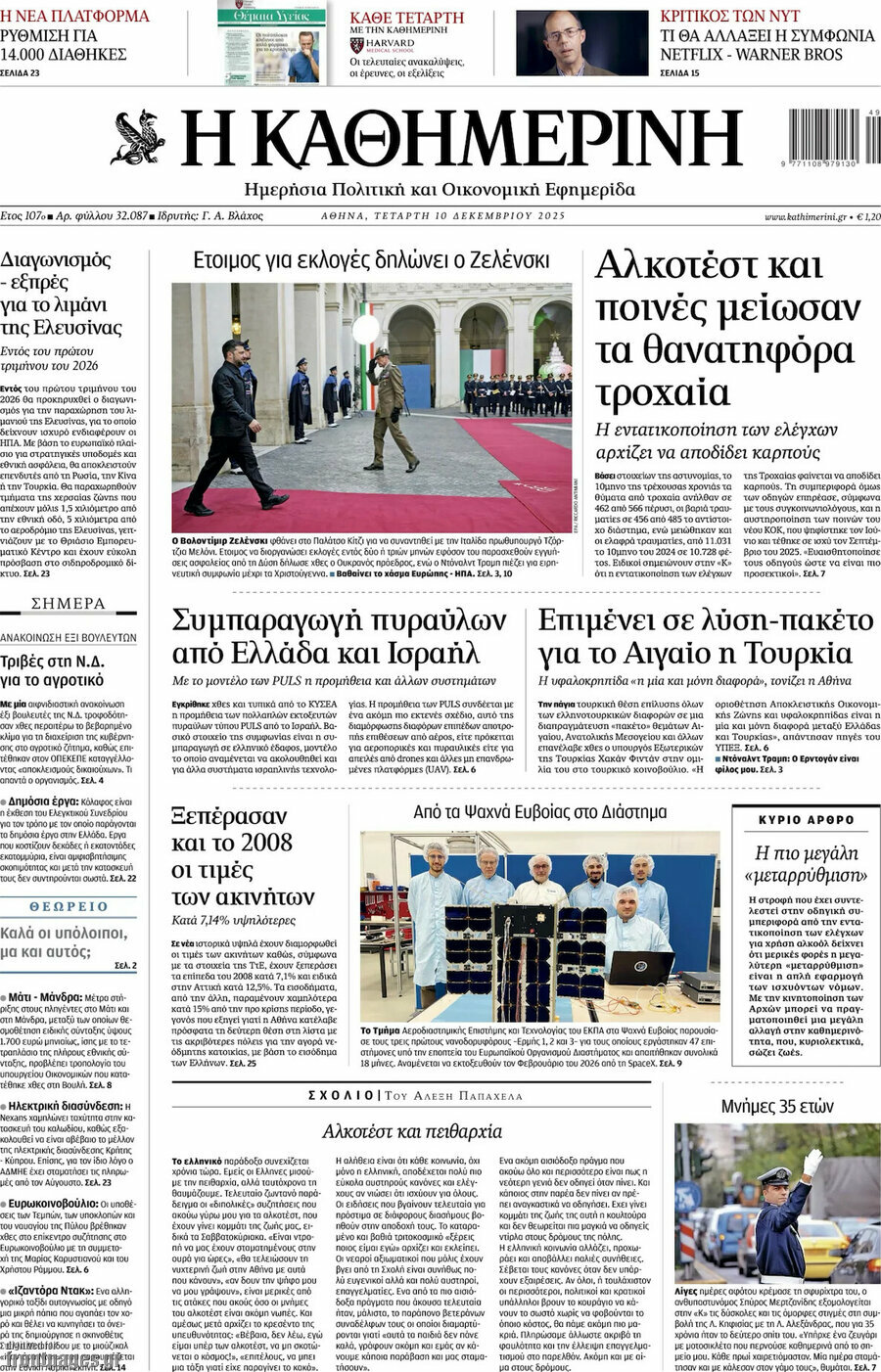
TA NEA: Greek UN Peacekeepers at the Gaza Strip
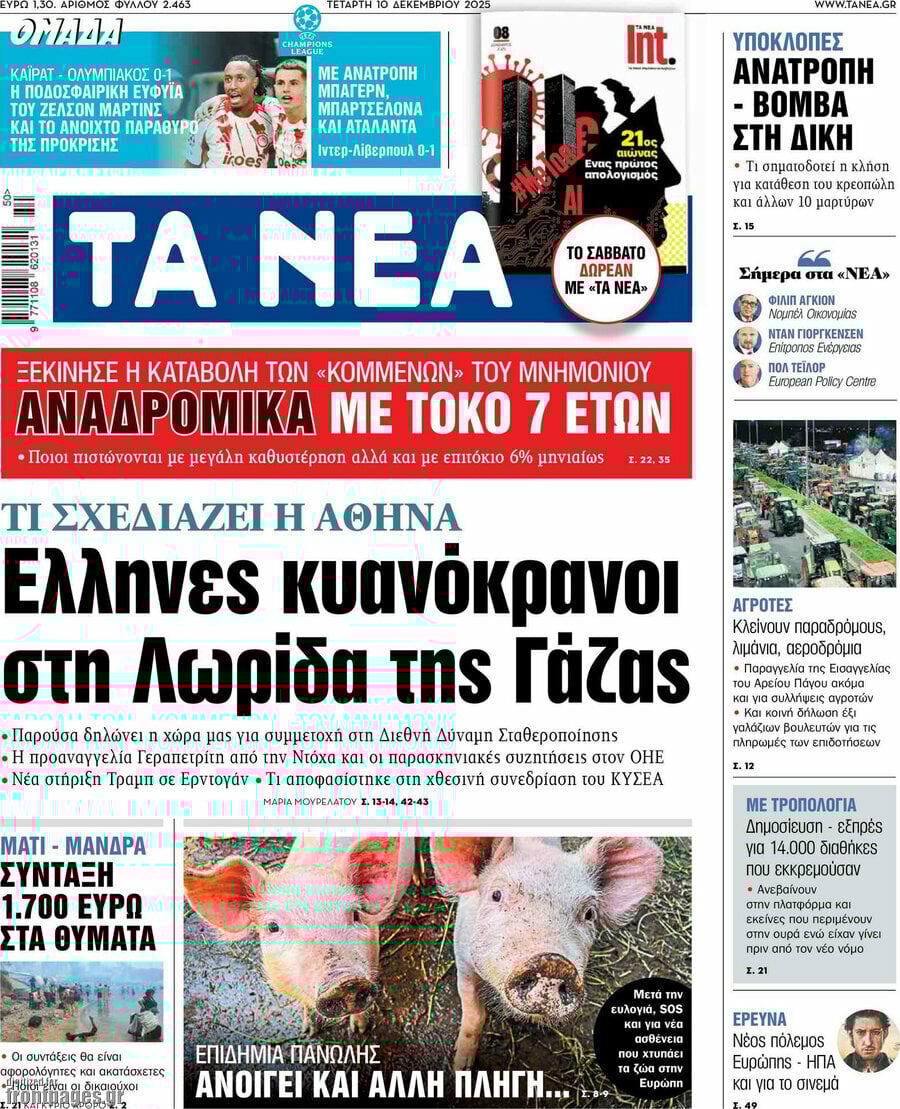
EFIMERIDA TON SYNTAKTON: The government threatens farmers with legal prosecutions
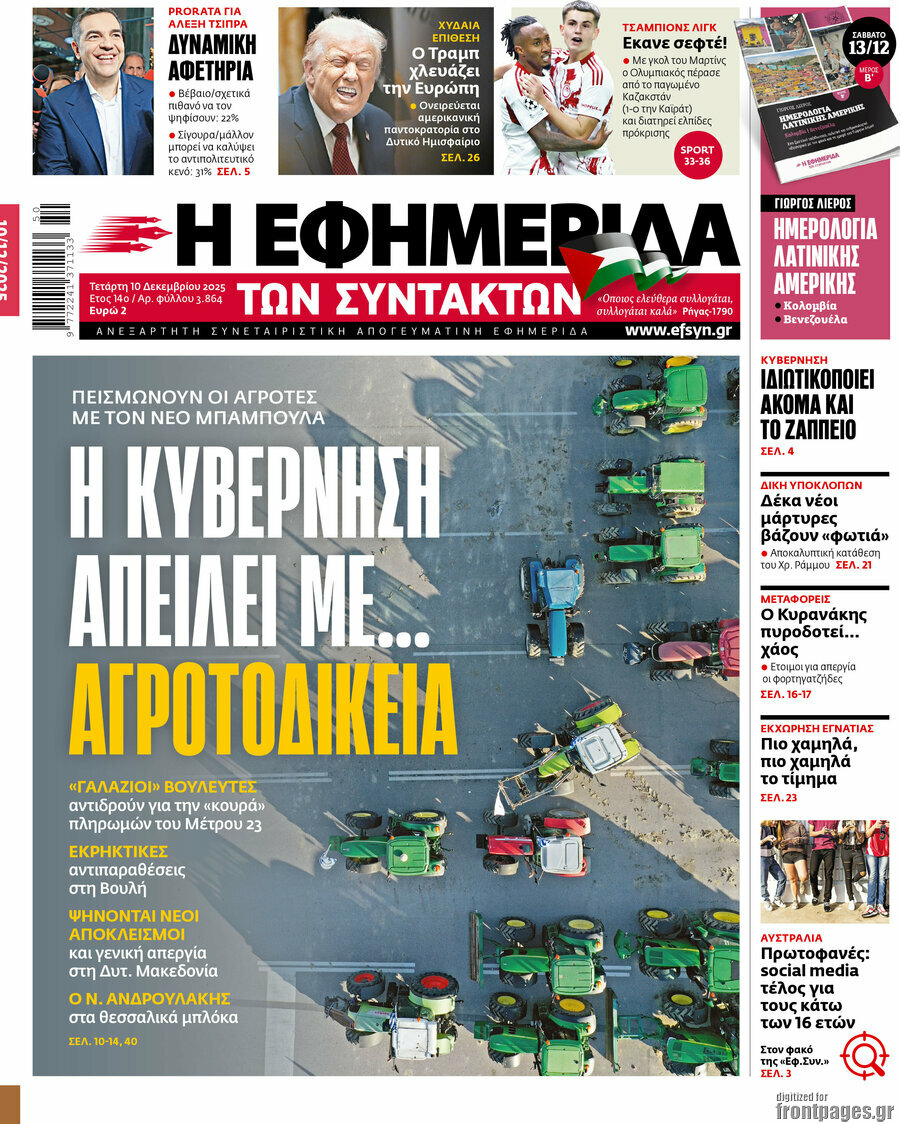
RIZOSPASTIS: The government’s vile threats of violent suppression and prosecutions will not stop farmers
KONTRA NEWS: Government mulling arrests in order to break farmers’ blockades

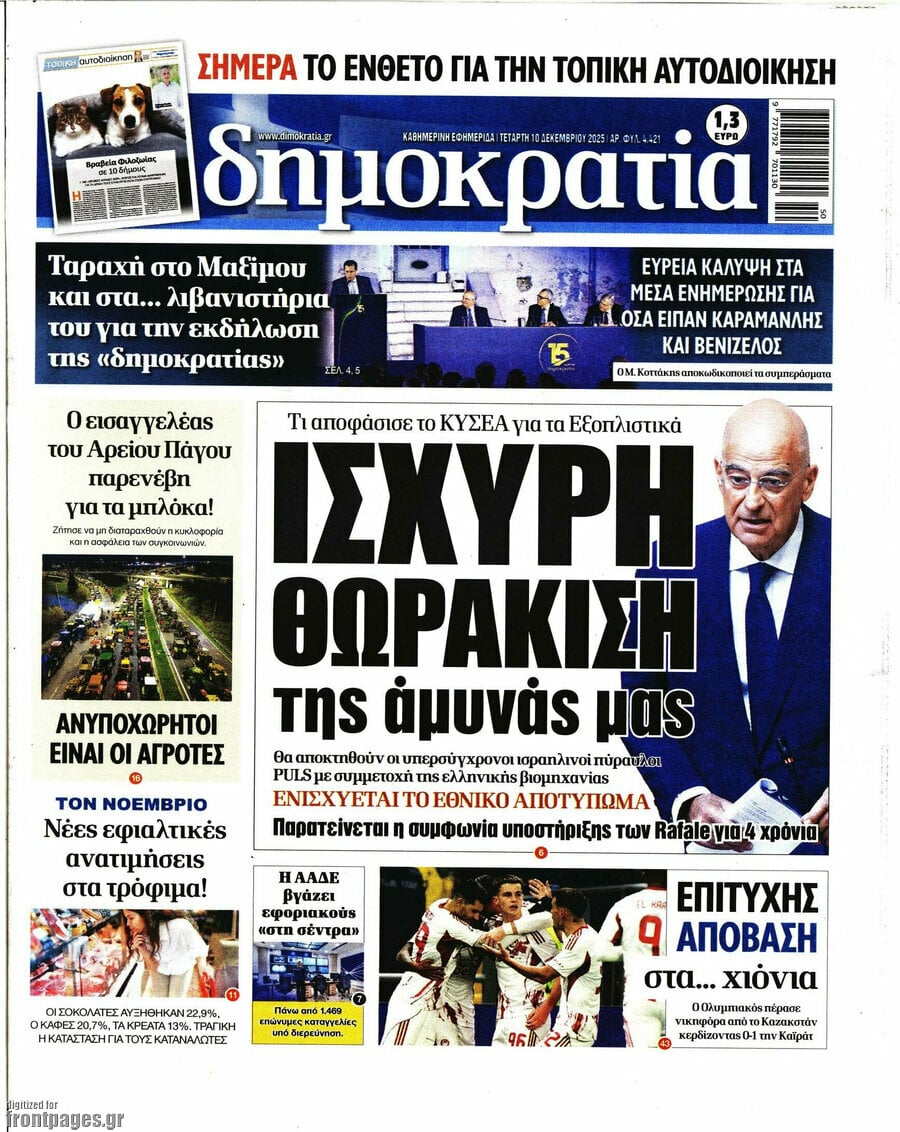
DIMOKRATIA: Greece moves to reinforce and shield its defence
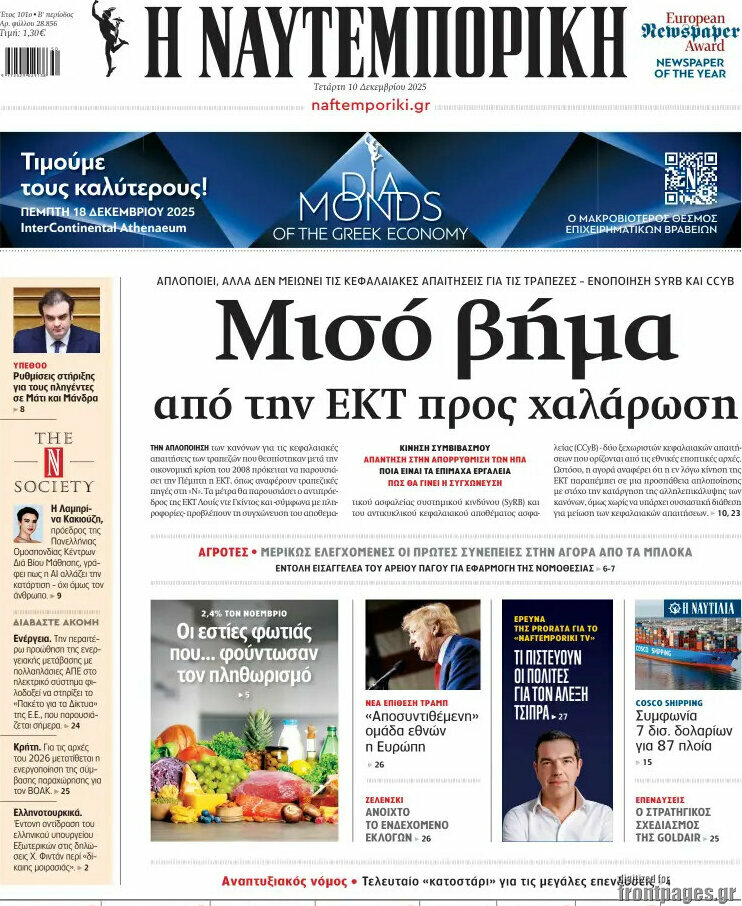
NAFTEMPORIKI: ECB makes half-step towards easing capital demands for banks

DRIVING THE DAY: TRUMP INTERVIEW FALLOUT
TRUMP — THE INTERVIEW: U.S. President Donald Trump’s stinging criticism of Europe in his interview with POLITICO’s Dasha Burns Tuesday is dominating conversations in Brussels — and has shaken policymakers even more than Washington’s warnings in its National Security Strategy on the weekend. This time, the continent’s entire political class was in the firing line.
Ouch: Trump’s picture of Europe couldn’t have been more brutal: A “decaying” group of nations led by “weak” people. Also: “Europe doesn’t know what to do.” And: “They talk, but they don’t produce, and the war just keeps going on and on.” It’s well worth reading the full transcript of the interview.
The most powerful figure in Europe: The interview came alongside POLITICO’s announcement that the American president is its pick for the most powerful person shaping European politics in the year ahead. Past recipients have included Volodymyr Zelenskyy, Giorgia Meloni and Viktor Orbán. Inclusion is not a POLITICO endorsement but a clear-eyed, unbiased assessment of who will shape Europe in the year to come. (The full criteria guiding our selections are here.)
So — why Trump? Love him or loathe him, no political figure is having so great an impact on our continent. Trump’s decisions have forced shifts in defense spending, approaches to trade, thinking on tech regulation — and a whole lot more in each EU member state.
The fightback begins: Journalists are used to the European Commission giving them a bunch of not-a-lot when foreign leaders say unpleasant things about the bloc. “We don’t comment on comments,” is the usual refrain. This time, though, there’s been a shift. Spokesperson Paula Pinho delivered an unusually forceful response when POLITICO’s Chief EU Correspondent Zoya Sheftalovich pressed her on Trump’s comments, just minutes after the interview went live.
Not weak, I think you’ll find: “We are very pleased and grateful to have excellent leaders, starting with the leader in this house, President [Ursula] von der Leyen, who we are very proud of,” Pinho said at the Commission’s daily midday briefing. (Zoya and I were there when the interview dropped and watched the spokes-folks whipping out their phones to check Trump’s latest mauling.)
R-E-S-P-E-C-T: Then the reactions started to roll in. “We are allies and allies must act as allies,” said European Council President António Costa, adding that Trump “must respect” EU leaders. Ukraine President Volodymyr Zelenskyy, accused by the U.S. president of avoiding democracy by failing to hold elections, said he has been “ready forever” to go to the polls.
There was more than just indignation, though. Some urged a constructive response, with one Commission official even linking the comments to the trade deal with South American countries. “Signing the Mercosur deal in December would be the strongest possible response to President Trump’s recent attacks on the EU,” the official told Playbook.
More to come: Costa’s invitation letter to leaders ahead of next week’s European Council summit warns that “rules-based economic relations and traditional partnerships can no longer be taken for granted.” He asks how the EU can best protect itself from external economic and political pressure (which is what he accused the U.S. of exerting).
MEET THE FULL P28 CLASS OF 2026: It’s not just about Trump. Position No. 2 on our ranking this year is taken by Danish PM Mette Frederiksen, coming off a six-month presidency of the Council of the EU that was considered a success by many officials in Brussels. No. 3 is German Chancellor Friedrich Merz, increasingly active at the EU level, as shown by last week’s dinner in Brussels, which he used to buttonhole Belgium’s Bart De Wever on his approach to a loan for Ukraine.
Some familiar names: Past P28 chart-toppers still appearing in the power parade include Ursula von der Leyen (#7 — BTW, she’ll be at the P28 gala for an exclusive interview on Thursday), Giorgia Meloni (#9), Zelenskyy (#14), Mario Draghi (#20). And, of course, Vladimir Putin (#5).
New kids on the bloc: Gabriel Zucman (#15), Daniel Ek (#18), Rima Hassan (#26), Rob Jetten (#27) and Gianni Infantino (#28) all make an appearance. View the full ranking here.
UKRAINE MOMENTUM
LIVE IN LVIV: EU European affairs ministers are gathering in western Ukraine for a symbolic meeting designed to reassure the locals that, despite Hungarian Prime Minister Viktor Orbán’s determination to veto the move, Ukraine belongs in the bloc.
The Danish Council presidency organized the visit to Lviv in the dying days of its six-month stint in the EU driver’s seat, in a bid to keep up momentum on Ukrainian membership. (Kyiv got the political green light to start accession talks in 2023, but without legal sign-off from all 27 member countries, it can’t formally begin negotiations.)
Cluster details: In the course of the Lviv visit, the EU is expected to present Kyiv with the details of what it needs to do in three negotiating “clusters” — the legal steps on the path to membership. For the record: Cluster 1 is the rule of law and democratic institutions; Cluster 2 is the internal market; and Cluster 6 is external relations. While the cluster chatter is informal and not binding, this should give Ukraine a head start. The takeaway? If and when Hungary lifts its veto, Kyiv will be closer to the finish line.
“A bigger EU is a stronger and more secure EU,” Danish Minister for European Affairs Marie Bjerre told Zoya from Ukraine last night. Denmark’s presidency has “succeeded in securing support from the other member states to front-load the work with Ukraine, so when we one day have the required unanimity we can move forward quickly.”
What’s on the agenda: The two-day meeting kicks off today with various visits and a dinner, allowing the ministers to chat among themselves. On Thursday, they’ll gather for a working session followed by lunch, according to an agenda seen by Playbook. In a presidency discussion paper, the Danes say the meeting “will send a strong political message” and “validate at [a] political level the progress made so far.”
BACK IN BRUSSELS: EU ambassadors will be working overtime this week trying to get Belgium on board with the plan to tap frozen Russian assets to fund Ukraine. Envoys will meet three times, starting this morning and then on Friday and Sunday. They plan to go through the Commission’s proposal, published last week, line by line to concretely respond to De Wever’s concerns.
Deadline looms: Yes, you’ve heard it before — but this time it’s a make-or-break week, for real. The envoys need to get the prep work done ahead of the Foreign Affairs Council next Monday, which will be followed the next day by the General Affairs Council. Then there’s the crucial EU leaders’ meeting on Dec. 18. Reminder: Ukraine will run out of money in April if this deal doesn’t get done.
A three-day EUCO? That’s why Council President Costa told reporters on Tuesday that leaders would continue to meet on Dec. 19 and Dec. 20 “if necessary — until we reach a positive conclusion.” (This is a rare break from Costa’s golden rule that a good summit is a single-day summit).
Sharing the pain: Those steering the negotiations see reasons for optimism in the readout from De Wever’s Friday meeting with von der Leyen and Merz. Their key line: “Belgium’s particular situation regarding the use of the frozen Russian assets is undeniable and must be addressed in such a way that all European states bear the same risk.”
Bypassing Orbán: EU countries are rushing to indefinitely immobilize the Russian assets — a key step to providing a loan to Ukraine — to circumvent Hungarian resistance even before next week’s summit, the Financial Times reports this morning.
SOCIALIST CHIEF SLAMS VDL
GARCÍA’S OMNIBUS GRUMBLES: The Commission’s simplification packages — the so-called omnibuses — are unpredictable, lack impact assessments and are being drafted without consulting all political groups, Socialists and Democrats leader Iratxe García told POLITICO’s Max Griera in the wake of group’s leadership retreat in Antwerp.
Making deregulation great again: “This dynamic of omnibuses with an absolute deregulation zeal is buying into Trump’s agenda,” García said, referring to the six packages revising EU rules across green policy, agriculture, digital and defense.
Omni-shrooms: Using simplification as a disguise, von der Leyen and the center-right European People’s Party (EPP) are unilaterally pushing for a major backtracking on EU laws, García argued. “Until now, there has been a dynamic of presenting an omnibus every 15 days … Suddenly, they appear on the table like mushrooms.”
Omnibus moratorium? At the Antwerp retreat, many Socialist leaders asked García to call on the Commission to halt further omnibuses, according to two people present. But the leader doesn’t have full backing for that, since some national delegations within the S&D want the simplification drive to continue.
Or at least, involve us: Instead, draft conclusions seen by POLITICO call on the Commission to consult political groups before proposing new packages and to conduct impact assessments for past and future omnibuses.
Taking the Commission to court? Two weeks ago, the EU Ombudsman Teresa Anjinho found “procedural shortcomings” in the Commission’s handling of the omnibuses — amounting to “maladministration” — potentially opening the door to legal action. Asked if the S&D would sue, García said for now she wants to “give them the benefit of the doubt and see if the Commission understands the message we are sending.”
Sharing is caring: García argued that future omnibuses — and any major legislative file — should be “shared and worked on” in advance with the centrist majority of the EPP, S&D and Renew to avoid the EPP striking ad hoc alliances with the far right, such as the one that helped pass the first omnibus to slash green rules.
Metsola’s third term: Asked about the EPP’s plan to reclaim the Parliament presidency for Roberta Metsola in the second half of the mandate, García insisted that the role belongs to them under a written deal, though she declined to show POLITICO the document or comment on its exact wording.
SÉJOURNÉ’S SETBACKS
MEETING UNENCUMBERED: Today’s College of Commissioners’ meeting was, as recently as last week, billed as an action-packed affair. Instead, the agenda has been stripped back to an environmental omnibus (another one) and the European Grids Package, with everything else shunted (tentatively, as always) to next week.
Included on the postponed to-do list: the Clean Industrial Deal and the automotive package, featuring the politically sensitive revision of CO2 standards for cars and vans.
The biggest casualty of the delay … is Commission EVP Stéphane Séjourné. He had been gearing up to present the Industrial Accelerator Act — originally part of the Clean Industrial Deal — only to see the file pushed not just to next week, but all the way to the end of January.
It remains unclear whether the frustration comes from the delay itself or from the swirl of speculation around it. One EU official insisted the substance hadn’t changed but acknowledged the communications misfire: “The delay is linked to the vertical decision-making process and a bottleneck.” This creates a false political interpretation, when the reality is that there’s nothing to see, the official said.
Why this is tricky: The original objective of the act had been the fast-tracking of permits for green industrial investment, as a pro-business counterbalance to the red-tape-heavy Green Deal of von der Leyen’s first term. Yet this goal has become entangled in two politically charged additions: a definition of “Made in Europe” and new conditionality for foreign investment.
Coalition of concern: That prompted a grouping of nine countries, led by the Czech Republic, to urge caution in a note to industry ministers on Monday. The group warned that the “European Preference” concept risks undermining the EU’s international trade relations.
All this lands at a delicate moment for Séjourné, who is also sparring with Health Commissioner Olivér Várhelyi over the upcoming Biotech Act. Várhelyi has long made clear his opposition to the non-health parts of the package — and the complaints haven’t gone away. Many insiders have been comparing notes as the Hungarian commissioner positions himself against the broader vision backed by Séjourné.
PRIORITIES FOR 2026: POLITICO obtained a list of the legislative proposals being prioritized by the Commission, Parliament, and Council next year.
MIGRATION STAYS ON THE AGENDA
MORE MOVEMENT ON MIGRATION: Despite Monday’s major breakthrough on the migration files, the week is far from done. Today the Commission hosts an international conference on countering migrant smuggling, led by Migration Commissioner Magnus Brunner. Von der Leyen delivers a keynote at 1 p.m. with closing remarks from Executive Vice President HennaVirkkunen expected at 6 p.m (both live on EBS).
In the room: More than 80 delegations — EU agencies, partner countries and international organizations — are gathering to coordinate and deepen cooperation in the fight against migrant smuggling. “For us in the EU, it is clear: If we want to stop smugglers, we need to work together at a global level,” Brunner said.
Let’s get digital: Delegations will adopt a joint declaration reaffirming their commitment to strengthen cooperation along migration routes and tackle the digital dimension of smuggling. The text addresses prevention measures such as cracking down on online ads promoting human smuggling and disrupting illicit payments.
Virkkunen’s line — a sneak peek: “In the digital age, we must also go digital to beat digital — by boosting investigations, stepping up cooperation with platforms and deploying advanced technology to disrupt criminal networks and protect vulnerable people.”
DEFENDING THE ECHR: The Council of Europe is hosting a gathering in Strasbourg today to push back against the European Convention on Human Rights being used as a punching bag by leaders struggling to get a handle on migration. (Case in point: Keir Starmer and Mette Frederiksen have a joint op-ed calling for reform in the Guardian this morning.) Representatives from around 40 of the 46 CoE members are expected to attend, including U.K. Deputy Prime Minister David Lammy.
The CoE wants to counter the narrative that the ECHR is standing in the way of action on migration, including returns. “This is our chance to bring that discussion where it belongs — within the walls of the Council of Europe — and to chart a way forward,” CoE boss Alain Berset told Zoya last night. The goal is to get cracking on a political declaration to be adopted in Chișinău in May.
IN OTHER NEWS
RESET TALKS: British EU Relations Minister Nick Thomas-Symonds is in Brussels today to meet Trade Commissioner Maroš Šefčovič to accelerate work on the new strategic partnership. The pair will take stock of progress on key strands of the agreement — expect the food-and-drink part and plans to link carbon markets to be name-checked.
PUSHING FOR NEW TECH INQUIRY The S&D is collecting signatures starting today for a committee of inquiry to scrutinize the implementation of the Digital Services Act in the EU Parliament, two officials told my colleagues Eliza Gkritsi and Max Griera. They need 180 signatures for a committee to be established, but an EPP official said its members wouldn’t support the proposal.
MEETING THE POPE: Lawmakers from the European Conservatives and Reformists in Rome for the party’s study days will get an audience with Pope Leo XIV at 9 a.m., Playbook has learned.
SPLIT ON TRUMP: The EU’s biggest far-right parties, the Alternative for Germany and National Rally, are divided on whether Donald Trump’s overtures are a blessing or a curse, Nette Nöstlinger and Victor Goury-Laffont write.