
Farmers block border crossings
Farmers across Greece intensified their protests, expanding blockades at key border crossings while tensions with the government deepened after a canceled meeting between Crete’s farmer representatives and senior officials.
https://www.ekathimerini.com/economy/1288805/farmers-block-border-crossings
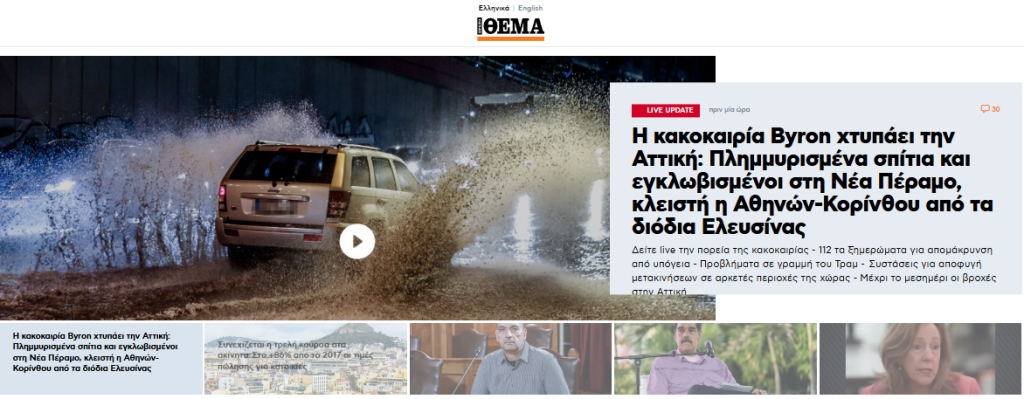
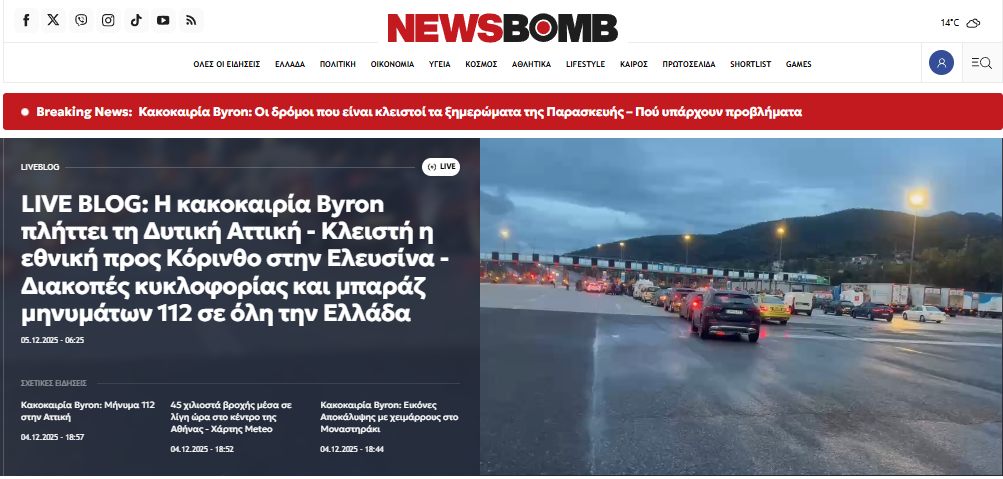
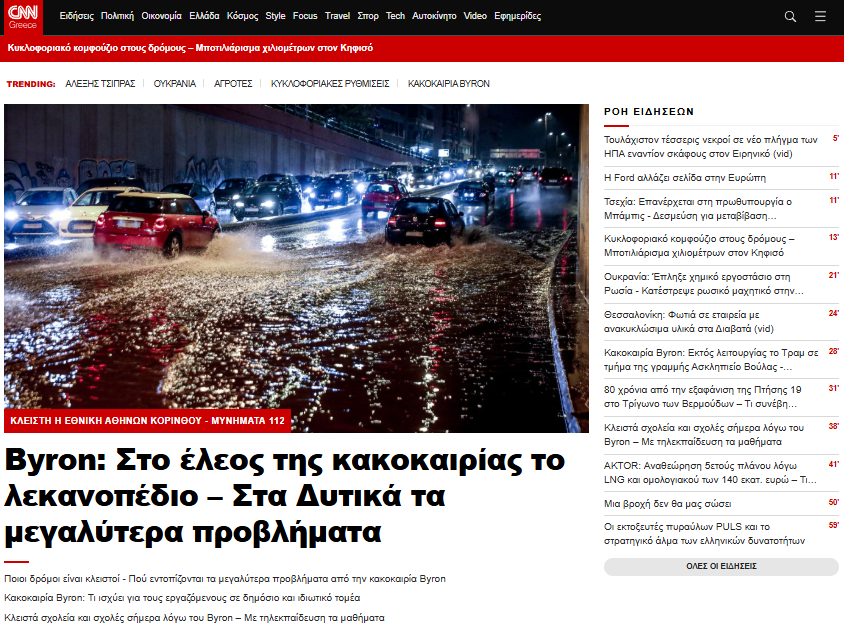
Storm Byron batters Greece, triggering school closures and widespread flooding
A powerful weather system named Byron swept across much of Greece on Friday, forcing widespread school closures, disrupting public services and causing severe travel delays as heavy rain and thunderstorms lashed large parts of the country. Intense downpours hit Attica, the southern and eastern Peloponnese, Crete, eastern Central Greece, Evia, the Sporades, eastern Thessaly, central Macedonia and islands of the eastern and northern Aegean from the early morning hours.
Greece says defensive posture necessary amid Turkish warnings
Greece must maintain its deterrent capabilities, acting as needed to protect itself in a constantly shifting geopolitical environment, Greek Defense Ministry officials said Thursday, responding to a statement by Turkey’s Defense Ministry. “It is obvious this cannot be interpreted as a ‘provocation’ by anyone,” the officials said. Turkey’s ministry said it is “closely monitoring” Greek military activity and warned that its armed forces have “the strength and determination to eliminate any threat against our country.” It also called on Greece to “show the same constructive stance” in the Aegean.
Partner of former politician testifies in OPEKEPE subsidy inquiry
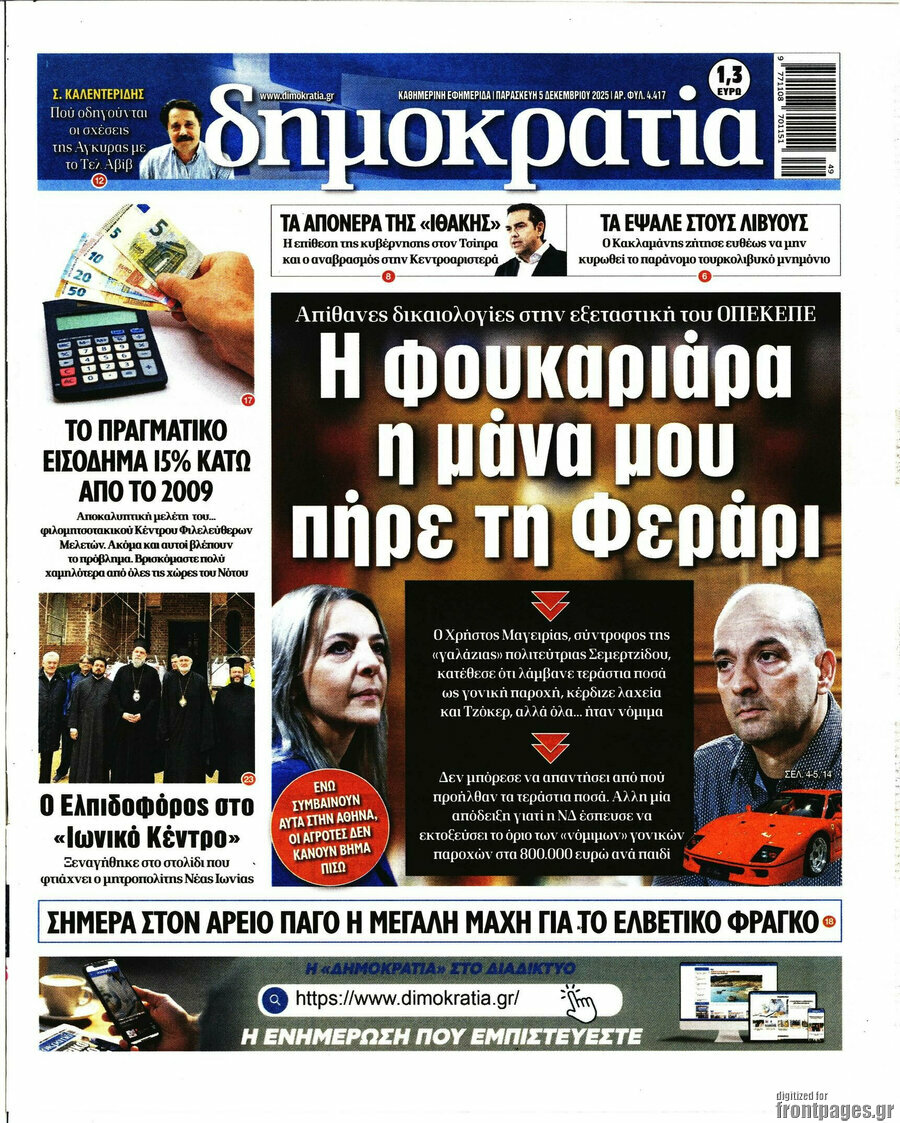
Christos Mageirias, partner of former New Democracy politician Popi Semertzidou, testified Thursday before the parliamentary inquiry investigating alleged misuse of agricultural subsidies through OPEKEPE, Greece’s agricultural payments agency. The hearing comes after reports that Semertzidou, Mageirias and family members had their assets frozen amid allegations that €1.5 million of subsidies received between 2019 and 2024 were misused. Assets include 11 properties, farmland, two luxury cars and 30 vehicles used for rental purposes. The European Public Prosecutor’s Office (EPPO) is investigating. Mageirias denied wrongdoing and claimed his Ferrari was acquired after the expropriation of a family plot in Igoumenitsa.
ATHEX: Quiet rise for bourse benchmark
Greek stocks took one step higher on Thursday, after a mixed session that saw blue chips notch up gains, led by banks and a handful of holdings companies. So far this month there has been no clear direction in the market, but volatility is low and the benchmark seems able to retain the growth it recorded in previous months, to close the year with remarkable returns.
https://www.ekathimerini.com/economy/1288815/athex-quiet-rise-for-bourse-benchmark



KATHIMERINI: Hunters of tax-evaders abroad
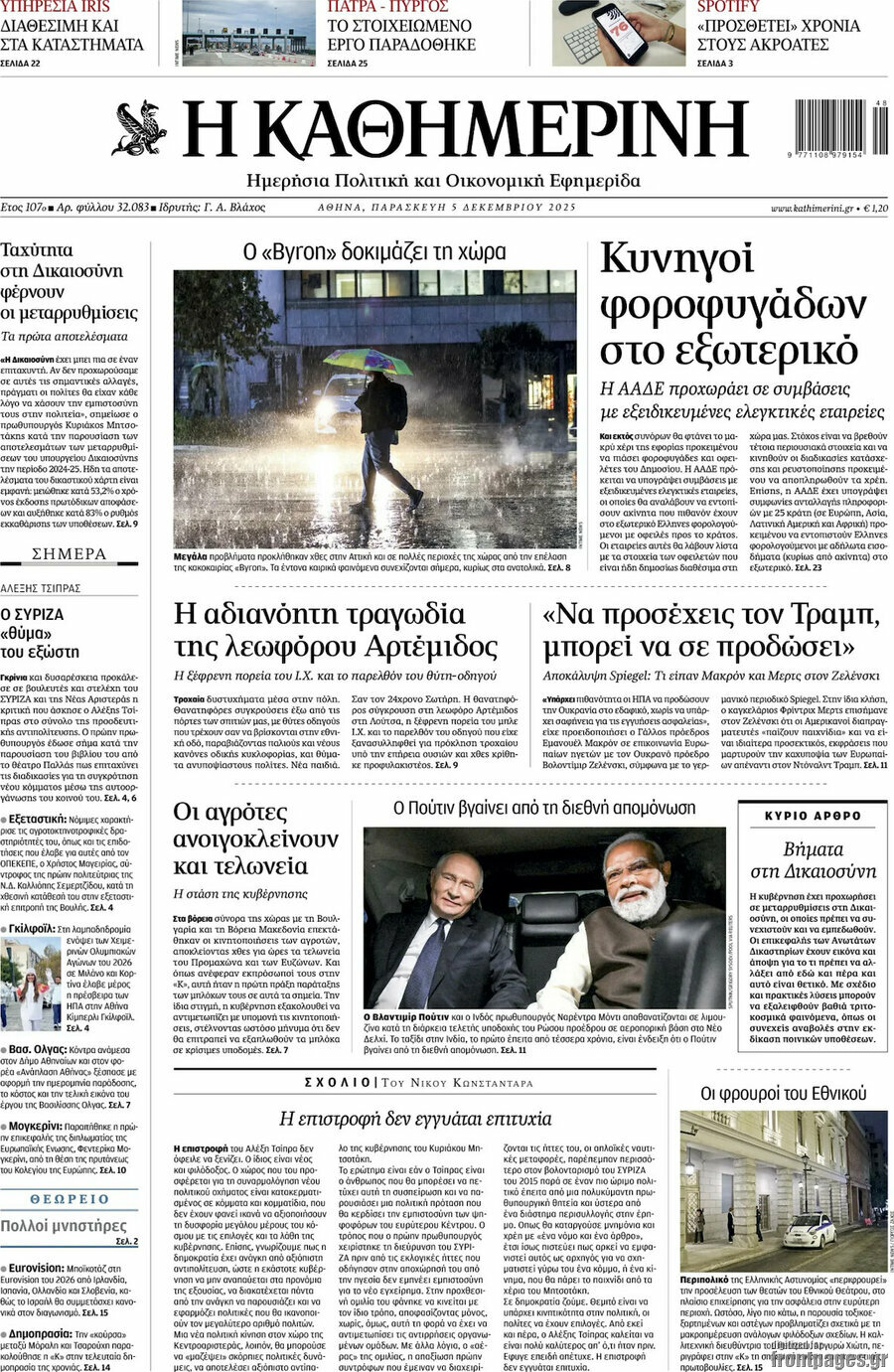
TA NEA: Wiretappings scandal: Those handling the equipment were listening in for their own interest
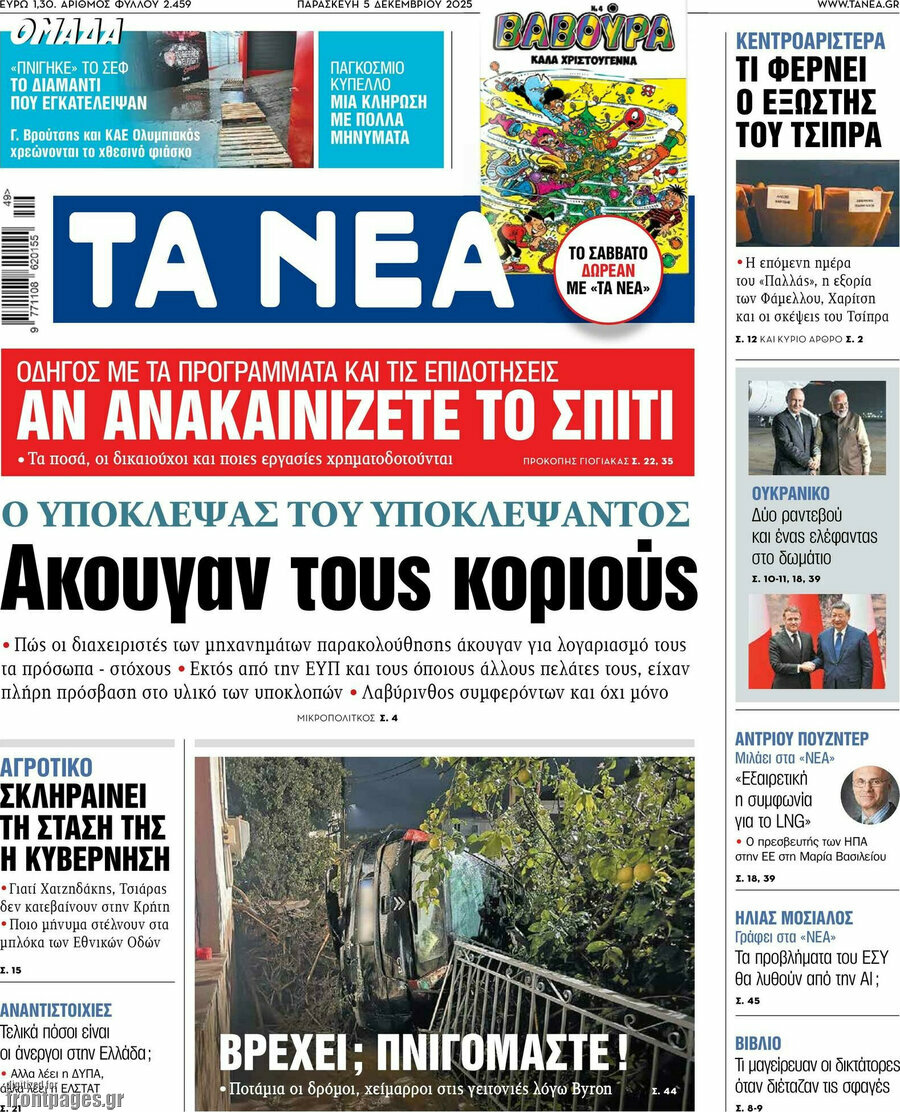
EFIMERIDA TON SYNTAKTON: “Tsipras storm” hits the political scenery
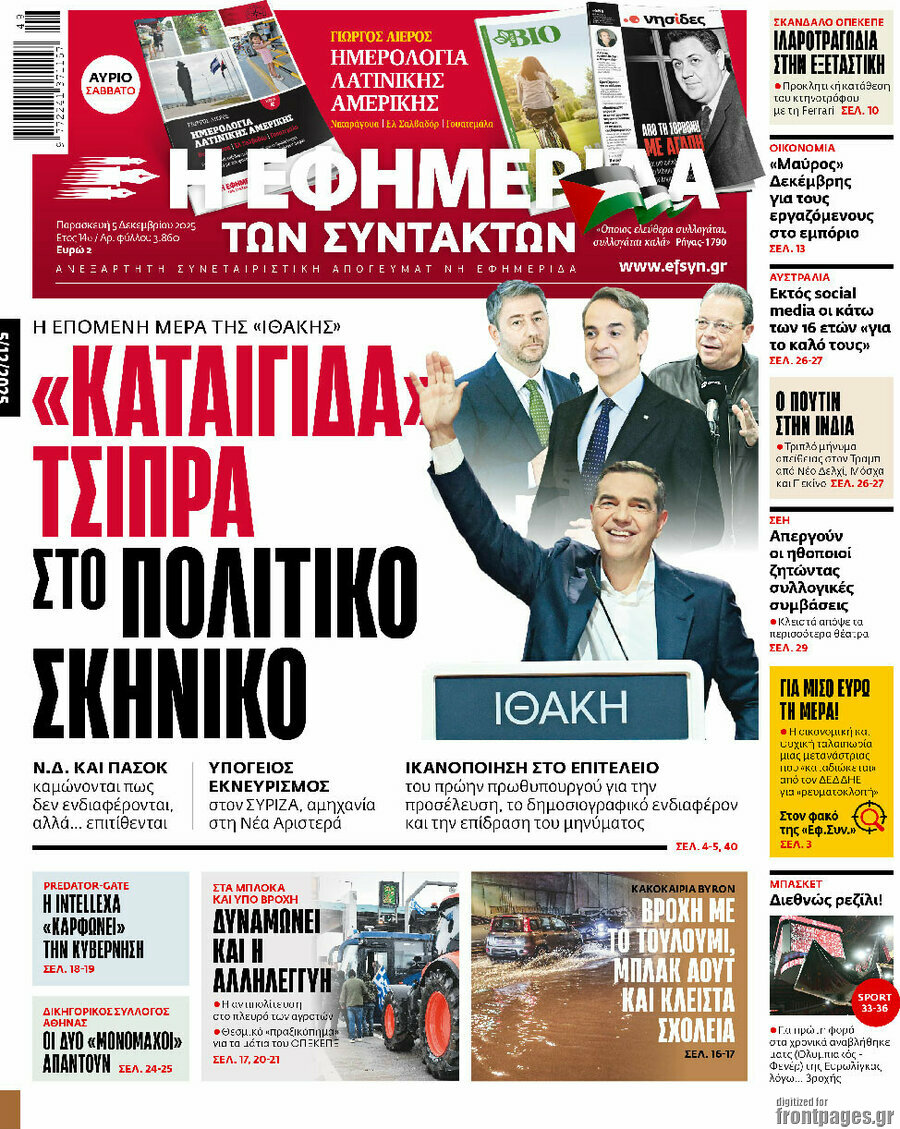
RIZOSPASTIS: All justified claims of struggling farmers and livestock breeders must be satisfied here and now
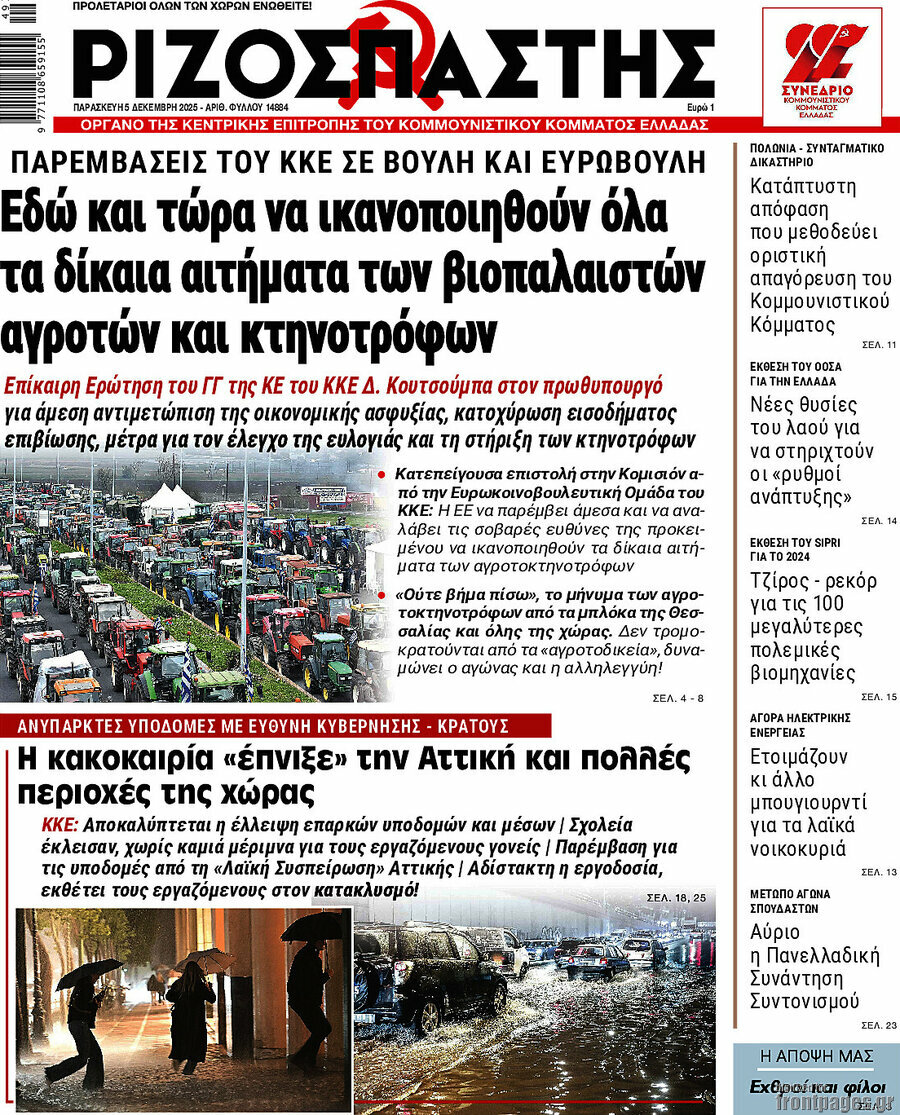
KONTRA NEWS: The government is sending district attorneys to farmers’ blockades

DIMOKRATIA: OPEKEPE scandal: My poor old mother got me a Ferrari
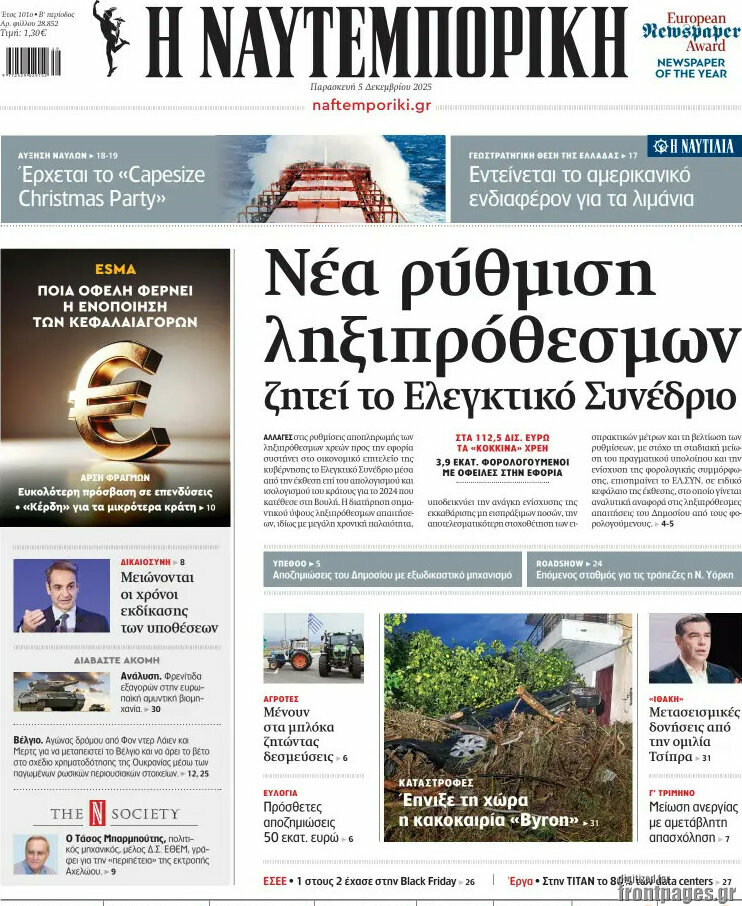
NAFTEMPORIKI: The Court of Auditors is asking for a new regulation regarding expired debts

DRIVING THE DAY: TECH SHOWDOWN
INTERNET ANGER: What’s the point of having the best car in the neighborhood if you never take it out for a spin? That’s the question European telecom and digital affairs ministers are ready to put to the Commission, as they ponder what they see as the sluggish enforcement of the Digital Services Act (DSA) — which even the Council branded “insufficiently effective.”
European tech ministers will meet in Brussels today for a Council session on competitiveness, simplification and rules for internet giants, with cybersecurity and other issues dominating the afternoon. France pushed the topic of DSA enforcement onto the agenda after a headline-grabbing case involving child-like sex dolls and weapons sold on Chinese-owned shopping site Shein.
Need for speed: France’s President Emmanuel Macron has been among the loudest voices complaining about the time it’s taking to hit rule-breakers with financial consequences — but he’s hardly alone. Cyprus, which takes over the influential presidency of the Council of the EU next month, also wants to accelerate DSA enforcement.
“I agree with President Macron, and anyone else that says that and anyone else that says that it’s going too slow,” Cypriot Digital Minister Nicodemos Damianou said in an interview with POLITICO ahead of the session. “We want to speed things up.”
The problem is … this desire within the EU to ramp up enforcement is colliding with resistance from the Trump administration, which has blasted the DSA as a cash grab unfairly targeting American companies.
The face of Europe’s tech crusade, Commissioner Virkkunen, has the tough task ahead of her defending the next round of DSA fines against U.S. tech companies, expected imminently. According to Capitol Forum, Elon Musk’s social media site X could face major financial penalties as early as today.
The Finnish commissioner — who’ll attend today’s council meeting, with a press conference expected around 5.30 p.m. — insisted she’s not fazed about taking on the Trump administration. “I’m quite calm in different situations. I’m not surprised about anything,” she told Playbook on the sidelines of last night’s Women of Europe awards, referring to her negotiating style.
Ready for the onslaught: “I’m protecting our laws. But at the same time we are going to make Europe faster and simpler and easier for businesses,” Virkkunen said. Asked if she was afraid of American retaliation, the commissioner was adamant: “No.”
Timely talks: Meanwhile, Commission officials have been invited to take part in a “lunch and learn” today, according to an internal note seen by Playbook, focusing on “negotiating under intimidation.” Good luck!
RUSSIAN ASSETS
TEA FOR THREE: Touching down in Brussels is German Chancellor Friedrich Merz, in an effort to convince Belgian Prime Minister Bart De Wever to relent on the use of frozen Russian assets to underwrite a €165 billion reparations loan for Ukraine. A Berlin official confirmed to POLITICO the pair would have a private dinner to discuss the issue, alongside Commission President Ursula von der Leyen.
Top priority: In a sign of how seriously leaders are taking the issue, ahead of a crunch-time decision expected at the European Council summit on Dec. 18, Merz canceled a trip to Norway to make a beeline to the EU capital. De Wever’s refusal to support the plan, which depends largely on funds immobilized in Belgium, has sparked fears Kyiv could be left without the money it needs to protect its people against Russian aggression.
THROWING DOMBROVSKIS UNDER THE OMNIBUS
RIBERA VS. RED TAPE: The Commission’s second most powerful official, Spanish socialist Teresa Ribera, has sparked institutional anger after decrying Brussels’ new deregulation push as a “terrible political spectacle.”
Too Trumpy: A series of forthcoming simplification omnibuses, Ribera said Thursday, would undercut safeguards, cost taxpayers, create uncertainty and discourage investment. “It’s a kind of Trumpist approach against being stable, reliable and predictable,” Ribera claimed.
If she wants to keep her job, one senior official pointed out, Ribera will have to go out and not just defend but actually present the Commission’s forthcoming simplifications packages. “Ribera is going to have to stand next to [Productivity Commissioner Valdis] Dombrovskis to unveil an environmental omnibus in the coming days after having slated the entire process,” the official said.
DIPLOMATIC INCIDENTS
DOWN AND OUT: Former EU foreign policy chief Federica Mogherini resigned Thursday as head of the College of Europe, following her arrest by Belgian police linked to the growing scandal over tendering processes now haunting the European External Action Service (EEAS).
Long goodbye: “In line with the utmost rigour and fairness with which I always carried out my duties, today I decided to resign as Rector of the College of Europe and Director of the European Union Diplomatic Academy,” Mogherini said in a statement.
A plague on all our houses: Brussels’ response to the detention of Mogherini and others over the investigation has left many worried about the institutional optics. “The Commission is blaming the EEAS; the EEAS is blaming the Commission,” said one long-time bubble insider. “But ordinary citizens don’t care. For them, it’s all the EU and the institutions should be coordinating their response rather than blaming each other.”
POACHER TURNED GAMEKEEPER: It’s true that the EU’s current top diplomat, Kaja Kallas, failed to bring Martin Selmayr back from the cold as a rival to Ursula von der Leyen’s chief of staff Bjoern Seibert. But the former Estonian prime minister has succeeded in bringing in her own answer to the Commission president’s comms aide Alexandra Henman.
Get me an Alex! Alexandra Brzozowski is joining the high representative’s communications team, three officials told Playbook. The long-time foreign affairs reporter, formerly of Euractiv, is joining the EEAS to help get Kallas’ message out, amid feuds between the high representative and the national capitals, as well as her own colleagues.
“Alexandra brings strong journalistic experience, in-depth knowledge of EU foreign affairs and a clear way of writing,” an EEAS official told Playbook. “She’ll be supporting a full range of communication work, including the HRVP’s public engagements.”
ALBANESE WINS BIG: The U.N.’s special rapporteur on the occupied Palestinian territories, Francesca Albanese, was named “Woman in Action” at last night’s Women of Europe awards, co-organized by the EU-funded European Movement. In a video appearance that was met with applause from attendees, Albanese accused Israel of “genocide,” “apartheid” and “settler colonialism.”
Albanese has been sanctioned by the U.S. and the decision to honor her has drawn fury in pro-Israeli quarters. Eylon Levy, former spokesperson for the Israeli foreign ministry, told Playbook that the top U.N. official should not have been offered the award by a EU-funded group. “Her efforts to aid Hamas’ narrative war are unforgivable. The U.S. was right to sanction her and the EU should follow suit.”
Singing praises: The row comes after broadcasters in Spain, Ireland, the Netherlands and Slovenia said on Thursday night that they would pull out of the Eurovision Song Contest, following a decision to allow Israel to compete. Sascha Roslyakov and Ellen O’Regan have covered the offstage drama.
REVIEW SEASON
SHAKING UP THE BERLAYMONT: With EU institutions absorbed by the finger pointing between the European Commission and the EEAS over the College of Europe probe, the Berlaymont’s efforts to modernize its structure may have been overlooked. Yet the revamp has already drawn the ire from officials about how open and accountable the process is.
The large-scale review, led by top official Stephen Quest, is now fully underway. In fact, according to what Playbook gleaned from a lengthy discussion with a Commission spokesperson, the process has already tasked 15 separate work streams with the delivery of “bold recommendations to help shape a future-ready” administration.
“With the ongoing geopolitical volatility as a backdrop, we need to rethink our structures, processes, resources, and culture.”
In their own words: According to the team behind “the most significant overhaul of the Commission’s organisation and operations in 25 years,” now is the time to “get even better at shifting our internal resources rapidly to emerging priorities, also reducing unnecessary complexity in our processes,” they told Playbook.
Some staff are uneasy about the process: Two officials who spoke to POLITICO said they feared they would be asked to do more without addressing the massive burden already placed on certain teams, while more junior workers would be at risk. In a bid to paper over those fault lines, Piotr Serafin, the public administration commissioner tasked with overseeing the program, wrote to the more than 33,000 employees who will be affected by the move, in a note seen by Playbook.
Time for change? “A lot of the questions raised touched on working conditions in general. While this is not the main focus of the review, some work streams will inevitably look at certain aspects of working conditions,” Serafin wrote. Staff representatives have already complained that the redesign is happening without their input.
A spokesperson for the Commission insisted that “this is the most inclusive process the Commission has ever built to review the way it operates, with our staff actively shaping the outcome of the review. ” But, with far-right political forces trying to capitalize on public fears that Brussels officials are out of touch and subject to far more relaxed conditions than ordinary workers, they have their work cut out for them.
GREENS GET-TOGETHER
POLITICAL DILEMMA: Green politicians from across Europe are gathering in Lisbon for an annual congress, with two opposing factions at each others’ throats. Some want their group to work with the increasingly hostile European People’s Party (EPP) to salvage what they can of the Green Deal, while others want to break ranks and oppose Ursula von der Leyen’s governing coalition more openly.
The congress will adopt a resolution, seen by POLITICO, name-checking the EPP as the top issue the Greens need to address in Brussels, accusing it of “doing the far right’s dirty work by undermining climate protection, social rights and democratic principles.” Max Griera has been reporting on the ground in Portugal.
Tough questions: “On the one hand we have a responsibility to salvage legislation from the last term,” Parliament Vice President Nicolae Ștefănuță, a Greens lawmaker from Romania, said in comments to POLITICO. “On the other hand … we protest this practice of doing coalitions with the extreme right.”
SOUL-SEARCHING SOCIALISTS: The Socialists and Democrats (S&D) top brass will gather Monday and Tuesday in Antwerp for high stakes “strategy days,” where they too will question their ties with the EU’s governing coalition.
Make or break: “We can no longer ignore the dramatic change of the political landscape in the European Parliament since the 2024 elections,” reads a letter sent by S&D chief Iratxe García to top Socialist MEPs and seen by POLITICO. “Across the European institutions, we see new forms of alignment and new challenges that affect the ability of our Group to advance its priorities.”
MIGRATION
SUBJECTIVE SOLIDARITY: Diplomats are stretching Europe’s capacity to agree on migration rules to the extremes as they negotiate the Annual Solidarity Pool mechanism, which dictates that countries accept relocated migrants, or pay a per-person fee if they refuse.
Sensitivities: The Danish presidency is hoping to agree a deal for next year’s Solidarity Pool at Monday’s Justice and Home Affairs Council. But “we’re not there yet,” an EU diplomat said Thursday. The mechanism is “politically very sensitive, both in frontline-member states and in member states that are on the receiving end of secondary migration.”
“The understanding of what solidarity is may differ from one country to the next,” the diplomat said.
Outstanding issues include how much solidarity, exactly, countries can be expected to offer during next year’s round, which will kick in from July. The Commission proposed minimum thresholds are of 30,000 relocations and €600 million for financial contributions. However, since the first solidarity round would apply for less than a year, some countries demand that the threshold be lowered.
Ministers also have to decide who will be exempt from extending a helping hand. The Commission listed Poland, Austria, Bulgaria, Croatia, Czech Republic and Estonia as countries that can request an exemption, but it’s up to ministers to sign off on that list.
IN OTHER NEWS
THE MOST WONDERFUL TIME OF THE YEAR: Some of Europe’s most influential figures will be on show at POLITICO’s P28 winter gala dinner in Brussels next week for a string of on-stage interviews streamed to an audience of over 75,000 people.
You heard it here first: Playbook can confirm that President von der Leyen will give the keynote address, appearing alongside new U.S. Ambassador Andrew Puzder, Russian opposition leader Yulia Navalnaya and influential director of the European Tax Observatory Gabriel Zucman.
CZECH IT OUT: Populist billionaire Andrej Babiš has cemented his role as the next prime minister of the Czech Republic after agreeing to “irrevocably give up” his massive agricultural empire before taking office. The move paves the way for another potentially difficult Central European leader around the European Council table.
AMERICA — WHO DAT? U.S. troops aren’t essential for the defense of Europe, NATO’s Supreme Allied Commander Europe Gen. Alexus Grynkewich told colleagues Thursday, my colleague Victor Jack reports.
RUSSIA’S WAR CHEST: The EU will tighten restrictions on Russian gas tankers docking in Belgium on their way to sell dirty fuel around the world, diplomats told energy reporter Ben Munster.
GOING FOR GOLD: Ben and central-banker whisperer Carlo Martuscelli also have this must-read story on the surprisingly political row over Italy’s reserves of precious metals, which are becoming a lightning rod for anti-EU sentiment.
In the vault: America’s own beleaguered central bank is in no better shape. The potential appointment of Kevin Hassett, an ally of U.S. President Donald Trump, to lead the Federal Reserve has European capitals worried, according to Johanna Treeck and Carlo Boffa.
CHEEKY CHEESE CONFESSION: The British ambassador to the EU, Lindsay Croisdale-Appleby,is relieved that a post-Brexit agrifood deal is moving forward. “It would make my smuggling of cheddar across the Channel legal again,” he said at Thursday night’s BritCham gala. Under existing rules, there is a ban on taking fresh dairy products from the UK to the EU for personal use.
LISTEN UP — HAPPY ANNIVERSARY … ? One year in, how would you rate the current Commission on a scale of one to 10? On this week’s edition of the EU Confidential podcast, POLITICO’s trade, defense and climate experts weigh in. Plus, Zoya Sheftalovich makes her podcast debut as chief EU correspondent, joining host Sarah Wheaton and Parliament reporter Max Griera to explain the scandal rocking the EU’s diplomatic service and the College of Europe. Listen and subscribe to EU Confidential here.