
New farmers’ blockade shuts Evzoni border crossing
Farmers and livestock breeders from the municipality of Paionia and other areas staged a new blockade at the Evzoni customs post on the border between Greece and North Macedonia.
The farmers blocked both lanes at 6:30 pm on Tuesday and planned to maintain the blockade until midnight.
https://www.amna.gr/en/article/953320/New-farmers-blockade-shuts-Evzoni-border-crossing
Agricultural funds fraud probe targets ‘lottery winners’
The ruling New Democracy party sparked fresh political tensions Tuesday by proposing to refer testimony from key witnesses in an agricultural subsidies investigation to prosecutors and anti-money laundering authorities. The proposal targets three individuals connected to the OPEKEPE inquiry: Andreas Stratakis (known as “the Butcher”), Kalliopi Semertzidou (dubbed “the farmer with the Ferrari”), and her partner Christos Mageirias, who is scheduled to testify Wednesday. All three have political ties to New Democracy and made statements about lottery winnings during their testimonies.
https://www.ekathimerini.com/politics/1288542/agricultural-funds-fraud-probe-targets-lottery-winners
ESM, EFSF approve early loan repayment of 5.29 bln euros by Greece
The European Stability Mechanism (ESM) and the European Financial Stability Facility (EFSF) gave the go-ahead to Greece’s early repayment of loans worth 5.29 billion euros, in a statement released on Tuesday.
Inflation jumps to 2.9% in Greece, outpacing eurozone increase
The European Union-harmonized index of consumer prices in Greece soared to 2.9% in November, according to Eurostat estimates, from 1.6% in October, with price increases in food and services being the main causes for the resurgence of inflationary pressures. This development comes even as the implementation of the much-discussed “Price Reduction” initiative has begun in over 2,000 supermarket codes and proves once again that inflation in Greece is persistent.
ATHEX: Index hits highs unseen since August
It may be December already, but bourse watchers might be forgiven for having that summer feeling, as on Tuesday the benchmark at Athinon Avenue reverted to levels not seen since August. The recent trend in the market has been unmistakably upward, and this session employed a number of trendsetters to maintain its momentum; therefore banks underperformed but technology stocks fared well and mid-caps fared even better.
https://www.ekathimerini.com/economy/1288558/athex-index-hits-highs-unseen-since-august


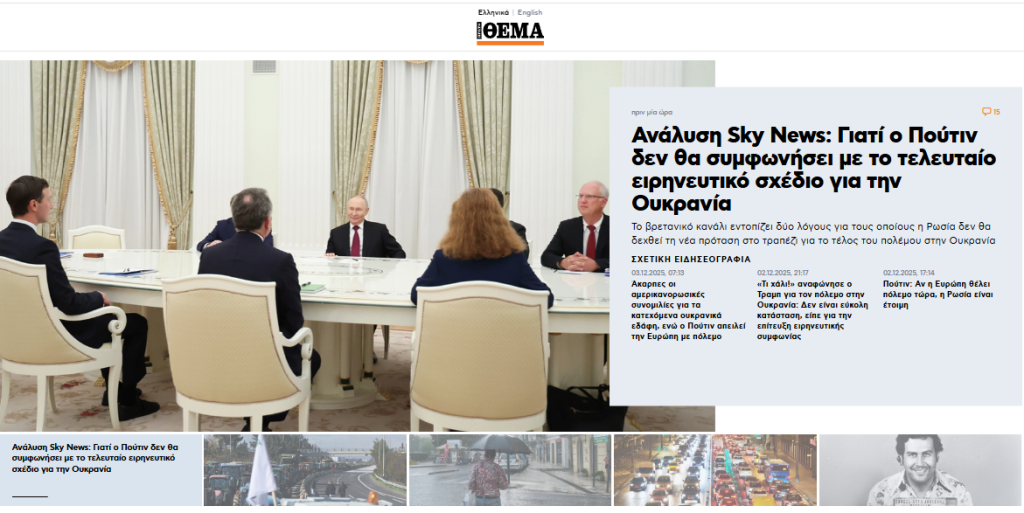
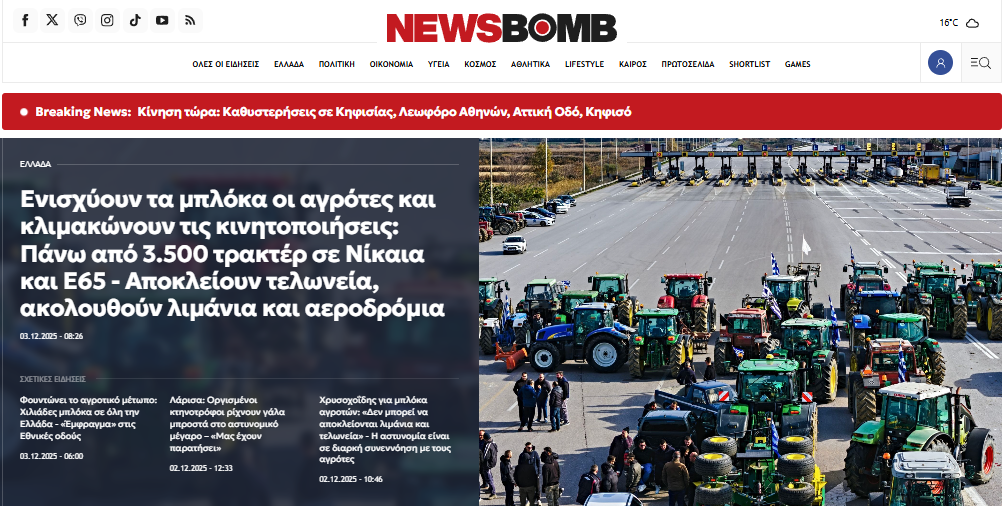
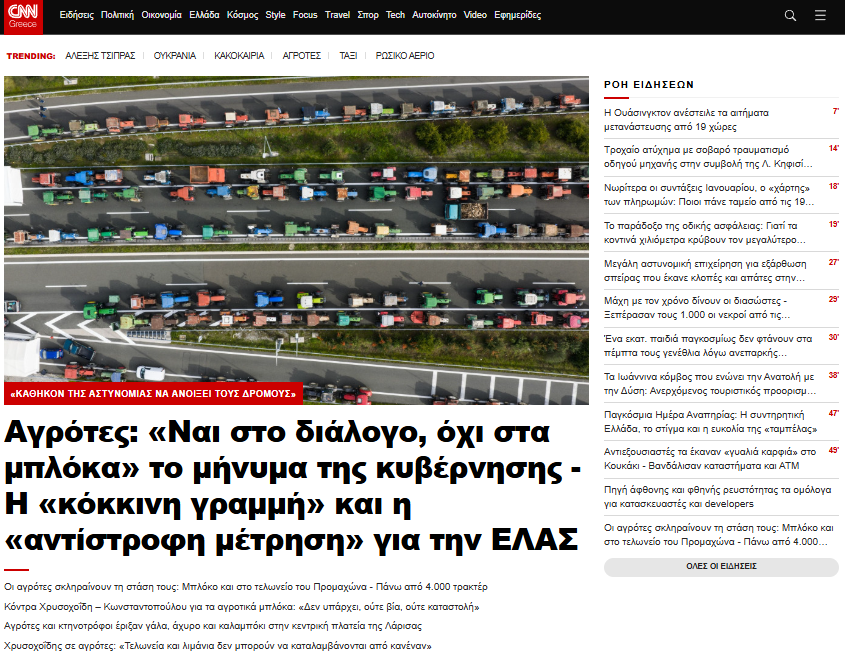

KATHIMERINI: The 10 Commandments of the new inheritance law
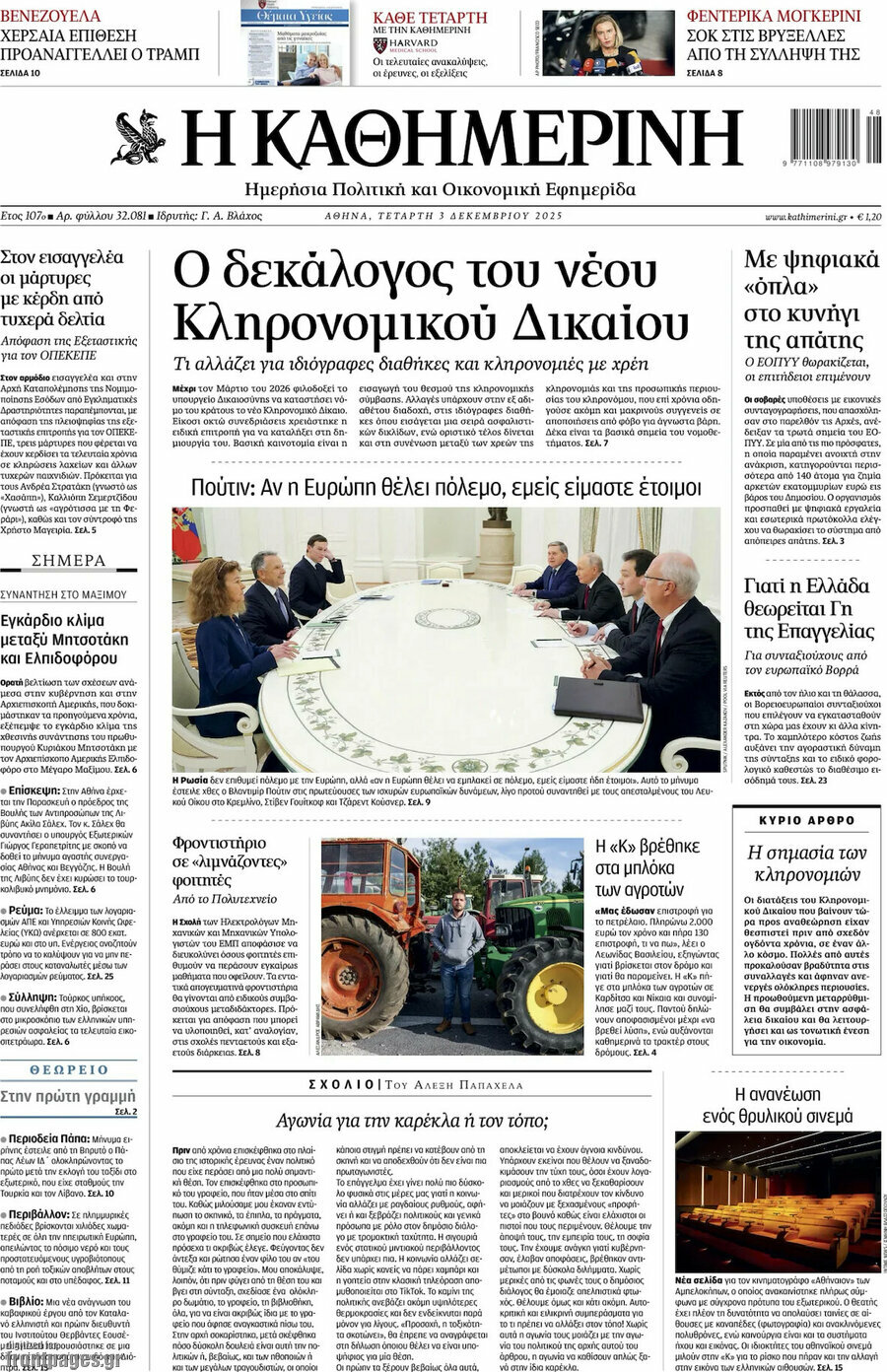
TA NEA: Plan B regarding farmers’ blockades
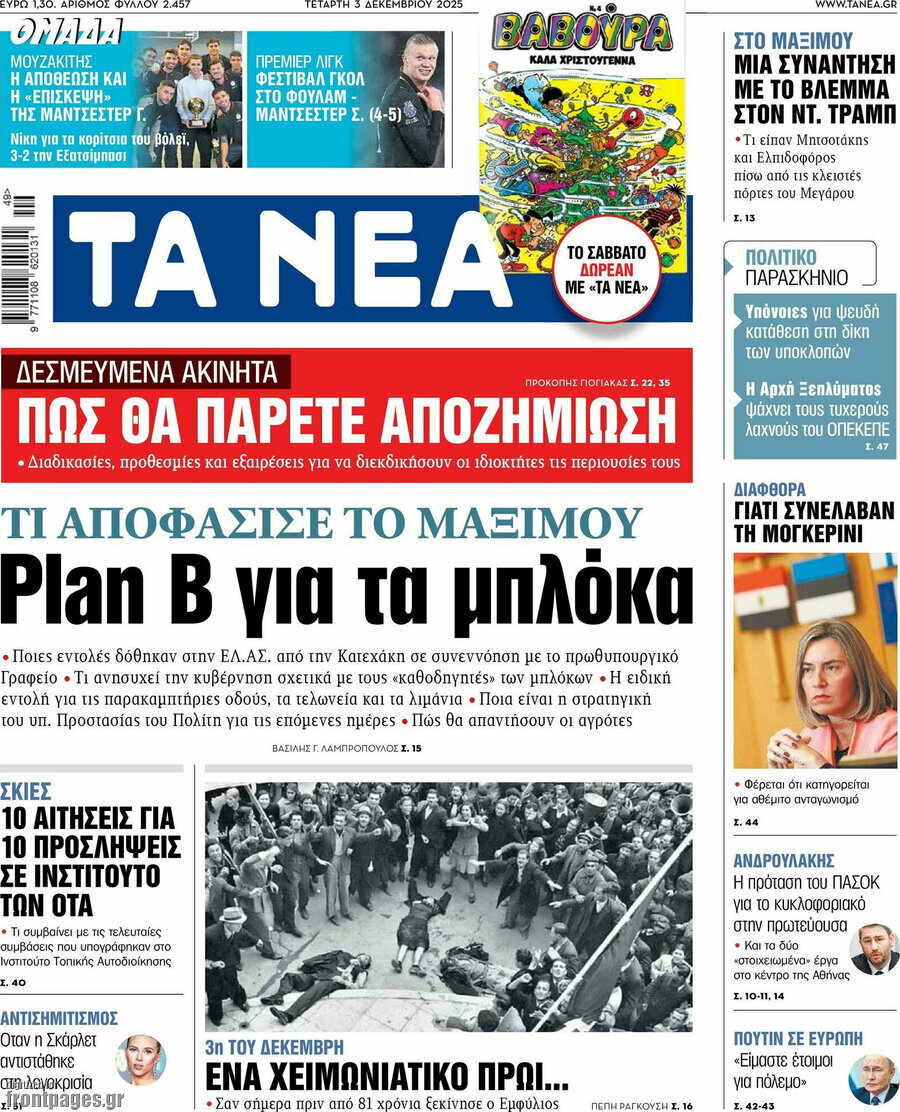
EFIMERIDA TON SYNTAKTON: The burning of garbage sets our pockets ablaze
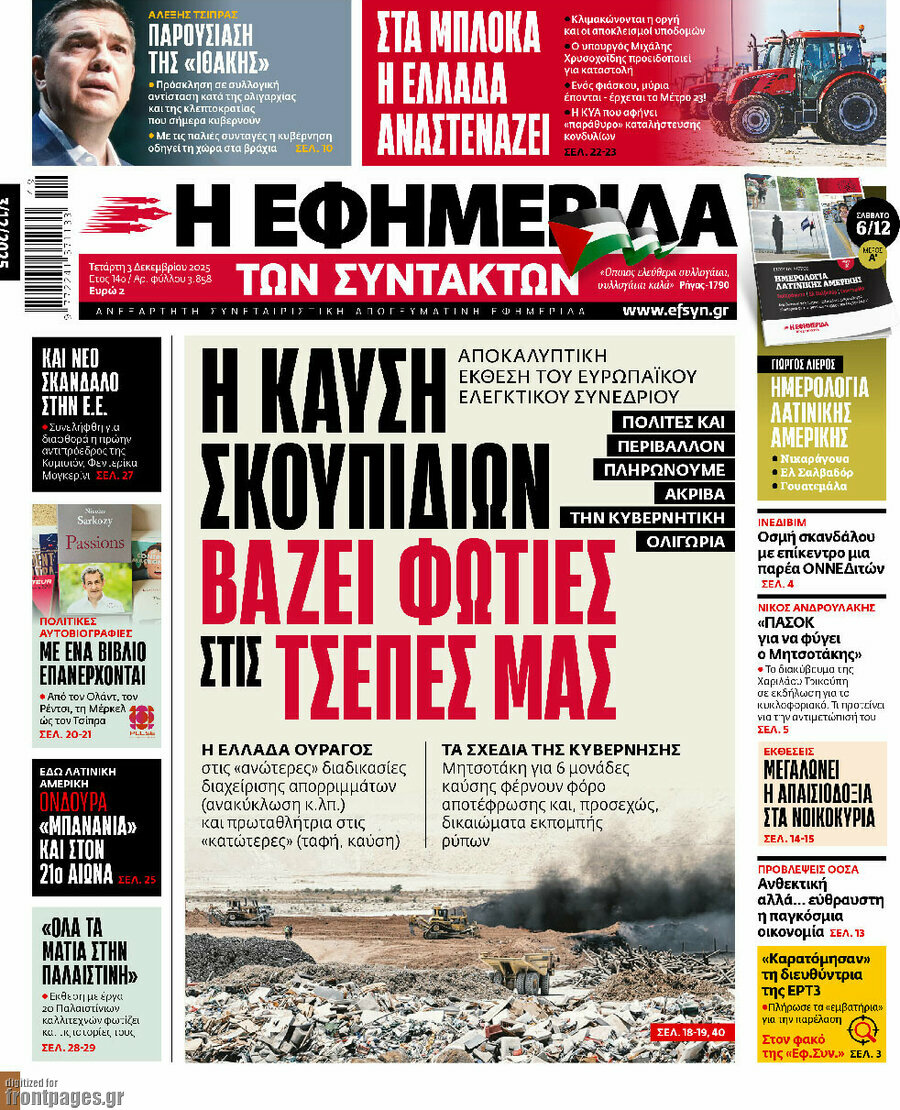
RIZOSPASTIS: The justified uprising of farmers and blockades constitute a struggle of Greek society as a whole
KONTRA NEWS: Farmers will not back down and the PM’s office is worrying about it

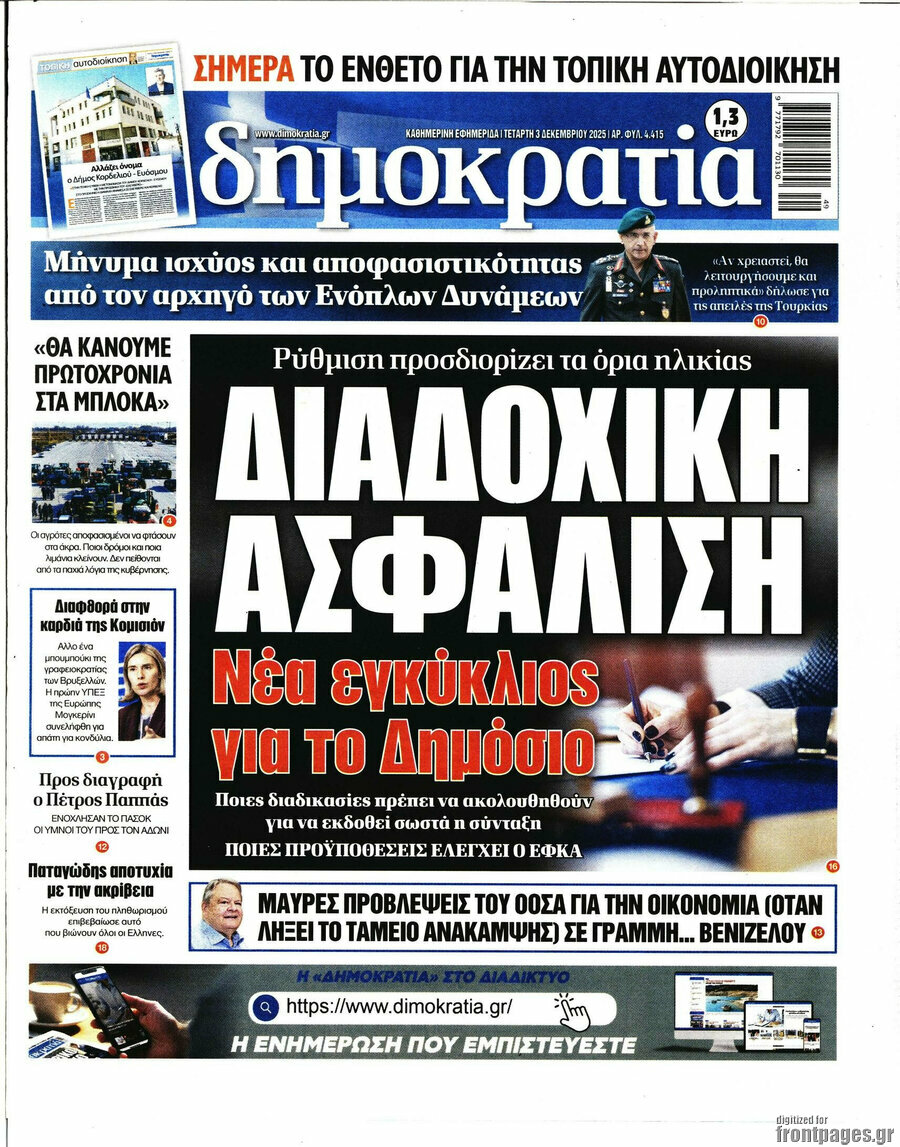
DIMOKRATIA: Consecutive social insurance: Regulation defines age limits
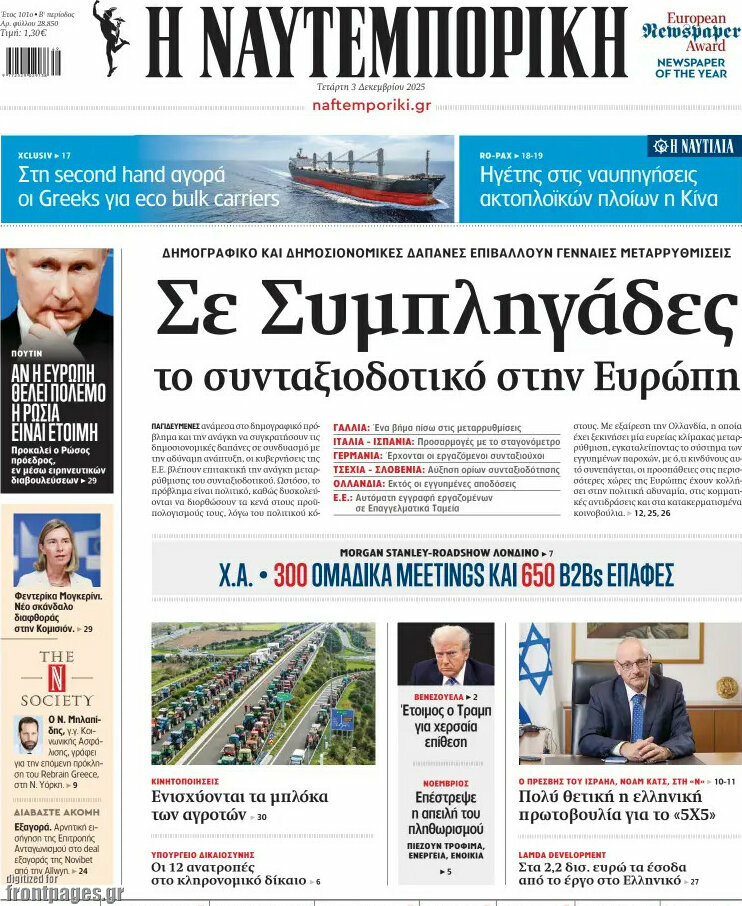
NAFTEMPORIKI: Europe’s pension system between grinding stones

DRIVING THE DAY
FRAUD PROBE ROCKS EU INSTITUTIONS: A fraud investigation that has ensnared Europe’s former top diplomat Federica Mogherini and senior Commission official Stefano Sannino has sparked outrage among EU staff — and reignited turf wars between Commission President Ursula von der Leyen and top diplomat Kaja Kallas over which institution should be calling the shots on foreign affairs.
Brussels was shaken Tuesday by news that Belgian police had raided European External Action Service (EEAS) offices, private homes and the elite College of Europe in connection with a fraud probe. The revelation that Sannino and Mogherini had been held for questioning elevated the scandal to one of the most serious in recent memory.
The fallout spreads: In the hours after the news broke, several current and former European EEAS staffers told Playbook they feared the unfolding allegations involving the 2021-2022 tendering process to establish a diplomatic academy attached to the College of Europe would tarnish their reputations and that of the agency they worked for, which Mogherini led at the time.
“I’ve already gotten tens of messages sharing the frustration of the staff to be again the victims of reputational damages,” Cristiano Sebastiani, a member of the EU staff union Démocratie et Renouveau, wrote via WhatsApp. The dawn police raids on the EEAS, private homes and the elite College of Europe in Bruges had had a “disastrous impact on the credibility of the institutions concerned,” he added.
“The perception is, of course, shock and dismay,” added a recently retired official.
What’s alleged: Mogherini and Sannino are being quizzed over the establishment of a training academy for diplomats, with the searches carried out on the request of the European Public Prosecutor’s Office and approved by the Belgian police. Mogherini, Sannino and another individual detained in the investigation have not been charged and have not commented on the allegations.
Key context: Mogherini, a former Italian foreign minister, served as the EU’s high representative, the EU’s highest diplomatic role, from 2014 until 2019. Sannino was secretary-general of the EEAS, a powerful internal post, until he was replaced earlier this year.
The probe threatens to aggravate the already tense relationship between von der Leyen and Kallas. Several staffers linked Sannino’s departure from the EEAS in 2024 to a broader effort by von der Leyen to weaken the EU’s diplomatic arm and strengthen her executive branch. Sannino was awarded a new role at the Commission overseeing relations with the Middle East and Africa, which overlapped with existing services at his former employer. Adding to the blow, Sannino brought several diplomats with him to the Commission.
Kallas distanced: Now that Sannino is engulfed in scandal, the current high representative, Kallas, may be feeling vindicated. An EEAS spokesperson was quick to distance the former Estonian prime minister from Tuesday’s unfolding controversy, pointing out that the investigation into Sannino and Mogherini predated Kallas’ arrival at the EEAS. As to whether Kallas knew of the impending probe and was advised to part ways with Sannino — Commission officials who spoke to POLITICO weren’t sure.
Blowback for VDL? One EU official said that while it’s easy to point the finger at von der Leyen every time something goes wrong, responsibility in this case lies with the EEAS. “[I]it’s not fair that she would face a motion of censure for something the External Action Service may have done. She’s not accountable for all of the institutions.” The official added: “I know the people who don’t like von der Leyen will use this against her. But they use everything against her.”
But with the Commission president already plagued by questions over her commitment to transparency, the developing crisis could become the starkest challenge to the EU’s accountability in a generation, POLITICO’s Zoya Sheftalovich and colleagues write in a must-read analysis this morning.
SEEN FROM PARLIAMENT
NOW WE GOT BAD BLOOD: The investigation is playing out against the backdrop of a poor relationship between MEPs and Belgium’s finest, as well as the country’s judiciary, which may be why lawmakers are treading carefully. Belgian authorities can be “a bit exaggerated,” a European People’s Party (EPP) official told our colleague Max Griera. “Let’s see how this develops.”
Too quick, too little: “The relationship between Belgian prosecutors and the Parliament is in such a bad state,” argued a second centrist MEP. “Belgian authorities come too early with little evidence, while other prosecutors come later on in the process with tighter cases built.”
Why the beef? Parliament may not be center-stage in this week’s drama, but the scars from Qatargate and the Huawei cash-for-influence affair are still fresh. On Qatar, MEPs are sore that, after three years of investigation, there is still no judgment. They’re afraid that the whole case could fall through at a hearing in December after the defendants challenged the legality of the proceedings.
Sloppy memories: On Huawei, resentment in Parliament flared up in May when Belgian prosecutors made headlines for asking that an MEP’s legal immunity be lifted over alleged bribery, only to withdraw the request hours later when they figured out the politician wasn’t in office at the time of the wrongdoing. Lawmakers blasted the move as “sloppy.”
Tarnished reputations: The Belgian authorities’ actions even prompted Parliament President Roberta Metsola to publicly call out Belgium — and other countries — for “tarnishing” MEPs’ reputations without “a solid basis.” In June, Metsola said Parliament would require a much higher standard of evidence before announcing requests to lift immunity.
Immunity nudge: “A letter was sent to all permanent representations in September to remind them about the information that would need to accompany a request for immunity,” Metsola’s spokesperson Jüri Laas told POLITICO.
DEPLOY QATARGATE SHIELD! That fraught backdrop helps explain why political groups in the European Parliament’s Committee on Legal Affairs are expected this morning to shield Socialists and Democrats MEP Elisabetta Gualmini — recently welcomed back into the Socialist group after a suspension — from prosecutors, who accuse her of bribery in the Qatargate probe. Two MEPs argued that there’s simply not enough evidence of wrongdoing.
Not so lucky: However, MEPs are likely to lift the immunity of Socialist Alessandra Moretti, a frontrunner to chair the environment committee, who is also allegedly implicated in the case. EPP and Renew are expected to back stripping Morett of her immunity, while the Socialists will push to shield her, with last minute attempts to convince EPP and Renew on Tuesday evening, according to one official.
Quiz time: The committee will also grill Renew’s Nikola Minchev, S&D’s Daniel Attard and EPP’s Salvatore De Meo — all alleged to have participated in an unlawful lobbying scheme linked to Chinese tech giant Huawei. A fourth MEP under investigation, Italian EPP delegation chief Fulvio Martusciello, did not respond to a request for comment on why he is skipping the hearing. MEPs will decide on the immunities in January.
PERFECT TIMING: All this lands as Parliament and EU countries on Tuesday night sealed a deal on the bloc’s first anti-corruption law, harmonizing definitions of corruption offenses, minimum penalties and prevention measures. Member states will have two years to implement the law and an additional year to deliver their anti-corruption strategies to the Commission.
Will this actually help? The lead MEP on the file, Renew’s Raquel García Hermida-van der Walle, told POLITICO that the bill’s crime definitions and penalties also apply to EU officials. This will oblige Belgium (and all EU countries) to “think about how they deal with anti-corruption taking place within their borders” and present a first national anti-corruption strategy to the Commission within three years.
POLITICAL ADVERTISEMENT
CRUNCH TIME FOR REPARATIONS LOAN
TODAY IS THE DAY: Or at least, it should be. A full proposal from the Commission on the so-called reparation loans — the plan to leverage €140 billion of Russian assets frozen in Brussels to support Ukraine — is expected to finally drop.
Under-a-rock recap: Belgium is still holding out, worried that Moscow could end up off the hook if the cash flow is disrupted. That means that this month’s EU summit is shaping up as a decisive moment. Yet the question remains: How do you win over Belgium?
Belgium’s line in the sand: The EU executive has a last-minute fix to calm Belgian nerves on one of the country’s biggest fears: a Council sharpshooter. With loans linked to the sanctions regime, a single pro-Russia government — looking at you, Budapest and Bratislava — could blow up the whole deal and leave Belgium legally exposed, as custodian of the frozen assets.
Escape hatch: Von der Leyen is preparing to lean on Article 122: the “solidarity in economic emergencies” clause that allows governments to adopt measures “in a spirit of solidarity between Member States” in response to serious economic challenges.
What that means: Diplomats briefed on the talks say the clause could also be deployed to extend the sanctions-renewal period from the current six months to three years. This route could bypass the unanimity requirement, on the premise that a sanctions reversal would wreak havoc on the EU’s economy.
Will Belgium buy it? Go figure. (POLITICO asked the Belgian PM’s office; no reply yet.) One EU diplomat told us that ambassadors have brought forward today’s meeting from 6:45 p.m. to 2:30 p.m. and the Commission’s presentation will follow the usual highly restricted format: ambassadors only, no sherpas, no phones.
Liquid commitments: Economic experts will also be looking out for the details of the “liquidity mechanism” that is meant to ensure that EU governments can immediately stump up the cash if Russia reclaims the assets. The idea is that the Commission could lend the money to allow countries to meet their financial obligations within a short notice.
Climbing Paperwork Mountain: We’re talking about as may as 11 legal texts, with the Commission likely to go hard on the frozen-assets plan or a combination of the three options previously presented.
Paging Ursula: Belgium has taken some heavy criticism, but insiders also note that it took the Commission nearly three months to put legal flesh on the bones of the asset-use plan announced in early September. “We have wasted a lot of time” in the overall process, Jonatan Vseviov, secretary-general of the Estonian Foreign Ministry, told our Berlin Playbook colleague Hans von der Burchard.
The sooner the better: “Our focus has been solely on the Commission president, asking her to present the proposal,” Vseviov said. He welcomed the fact that the texts are now coming — but added that earlier would have been “even better.”
Making history: “We are preparing the most consequential of all European Councils,” Vseviov argued, describing the next two weeks ahead of the summit “of pivotal importance.” While concerns must be addressed (“some are obviously legitimate, some in our opinion less so”), he urged “not to lose sight of what’s important here. This is not an accounting exercise. We are not working on footnotes. We are trying to ensure that Europe gets a seat at the table where history is being made.”
SPEAKING OF SEATS AND TABLES … NATO foreign ministers will discuss the peace plan in Brussels today demanding a say over what role the military alliance will play in any future peace agreement with Ukraine, after being largely sidelined in talks so far.
European countries were blindsided by a peace plan brokered by the U.S. and Russia last month, which was widely seen as favoring Moscow. Since then, the Europeans have floated their own counter-proposal — but, so far, a deal has remained elusive.
Having our say: Now, some allies are insisting on several lines in the sand requiring that they be consulted before a deal is agreed, according to four NATO diplomats. The key issues: Kyiv’s accession to the alliance; the placement of troops and arms on allied soil; and respect for international law. Behind closed doors, some allies also felt the U.S. could have consulted them more on the peace process. Read the full story from POLITICO’s Victor Jack.
Killing time in the Kremlin: U.S. envoys Steve Witkoff and Jared Kushner were left twiddling their thumbs for several hours in Moscow ahead of a meeting with Russian President Vladimir Putin, POLITICO’s Eva Hartog and Sascha Roslyakov report. As the two Americans took a stroll through Moscow and had lunch at an upscale restaurant, Putin instead addressed the press, fulminating against Europe about its hostility to the peace process.
FOSSIL-FUEL PHASEOUT: In late-night talks Tuesday, MEPs and the Danish EU presidency struck a deal to phase out imports of Russian natural gas, as well as a separate agreement on the REPowerEU regulation to boost Europe’s energy resilience. As part of the latter, the Commission committed itself to propose a ban on Russian crude imports “as soon as possible, but not later than by the end of 2027,” according to a final compromise seen by POLITICO’s Ben Munster.
IN OTHER NEWS
FLYING SOLO IN CHINA: French President Emmanuel Macron lands in China today for a three-day visit. But unlike his last trip in 2023 and Xi Jinping’s visit to France last year, he is leaving European Commission President Ursula von der Leyen behind.An Elysée Palace official said this visit was more “bilateral” this time. Sure. But with EU-China relations now at rock bottom, this might not be the right time to be spotted together.
HAPPY ECONOMIC-SECURITY DAY! The EU executive will unveil two new plans: a “doctrine” on economic security and a communication on the bloc’s efforts to diversify its supply of critical minerals
In a nutshell: With the economic-security plan, Brussels is expected to outline how to respond more decisively in rolling out its trade-defense arsenal — from export restrictions to safeguard measures and tougher inbound and outbound investment-screening mechanisms. The communication on raw materials is broadly considered a plan to accelerate the EU’s path toward its diversification of supply.
CLEANING UP EU STREETS: The College of Commissioners is set to sign off on new measures it hopes will curb the flow of drugs into the EU. The measures (which we previewed last month, and which will be announced Thursday) come as Europe grapples with a surge of cocaine, synthetic chemicals and opioids on its streets, along with rising drug-related violence, particularly in Belgium and the Netherlands.
 |
A STAR IS BORN: Kimberly Guilfoyle’s arrival in Greece has triggered a level of attention usually reserved for pop stars or prime ministers. Nektaria Stamouli reports that the newly appointed U.S. ambassador has fused tabloid-level fascination with high-stakes geopolitics.