
Athens, Cairo move to extend sea deal
Greece and Egypt have agreed in principle to begin talks on extending their exclusive economic zone agreement eastward, responding to Libya’s ratification of a maritime memorandum with Turkey, the Greek government said. Greek Foreign Minister George Gerapetritis and Egyptian Foreign Minister Badr Abdelatty agreed on the initiative during a telephone conversation, rejecting the ratification by Libya’s parliament, according to the Greek account of their discussions. The two countries signed their existing maritime boundary agreement in August 2020 after years of negotiations. It delineated an exclusive economic zone between the 26th and 28th meridians, following Turkey’s 2019 maritime memorandum with Libya. The proposed extension would cover waters east of the 28th meridian, which runs through Rhodes. Kastellorizo lies farther east.
https://www.ekathimerini.com/politics/foreign-policy/1319004/athens-cairo-move-to-extend-sea-deal
Androulakis: Greece ‘charting a course without a compass’ in foreign policy
Main opposition PASOK leader Nikos Androulakis on Thursday criticised the government’s handling in relation to the Turkish-Libyan memorandum, saying that it had been “caught napping” and that the outcome “illustrates and confirms the consequences of a foreign policy that lacks a plan and strategic foresight, and is limited to superficial, communications-driven management.”
Pizza Fan faces €25 million tax probe
Police arrested 19 people in an investigation into an alleged tax fraud scheme at Pizza Fan, a pizza delivery chain, in which investigators estimate €25 million in value-added tax went unpaid. The investigation began after an anonymous complaint submitted to the Financial Police in April. The complainant alleged employees were declared as working fewer hours than they actually worked, reducing employer contributions, and that software was used to avoid issuing receipts for some orders. Investigators found that the software allegedly recorded one in every four pizzas sold as a “complimentary” item, but only when customers said they would pay in cash rather than by card. The practice concealed 25% of cash sales, allowing the company to avoid value-added tax. Authorities believe the scheme operated since at least 2022.
https://www.ekathimerini.com/economy/1319032/pizza-fan-faces-e25-million-tax-probe
Match-fixing probe engulfs Greek basketball
Greek basketball has been rocked by a corruption investigation involving six people, including Greek Basketball Federation president Vangelis Liolios, over alleged match-fixing spanning a decade. Liolios, three current and former referees, a senior refereeing official and a businessman and former athlete were arrested Wednesday. They are expected to appear before an investigating magistrate Thursday and may request additional time to prepare their statements. Investigators are examining approximately 50 games played between 2016 and 2026, reportedly ranging from the top domestic division to youth and school competitions. The allegations include bribery, receiving bribes and manipulating sporting contests.
https://www.ekathimerini.com/news/1318896/match-fixing-probe-engulfs-greek-basketball
ATHEX: War concerns put pressure on stock market
The Euronext Athens (ATHEX) general index closed at 2,587.93 points, shedding 2.11% from Wednesday’s 2,643.62 points. The large-cap FTSE-25 index contracted 2.29% to end at 6,617.21 points.
https://www.ekathimerini.com/economy/1319034/athex-war-concerns-put-pressure-on-stock-market


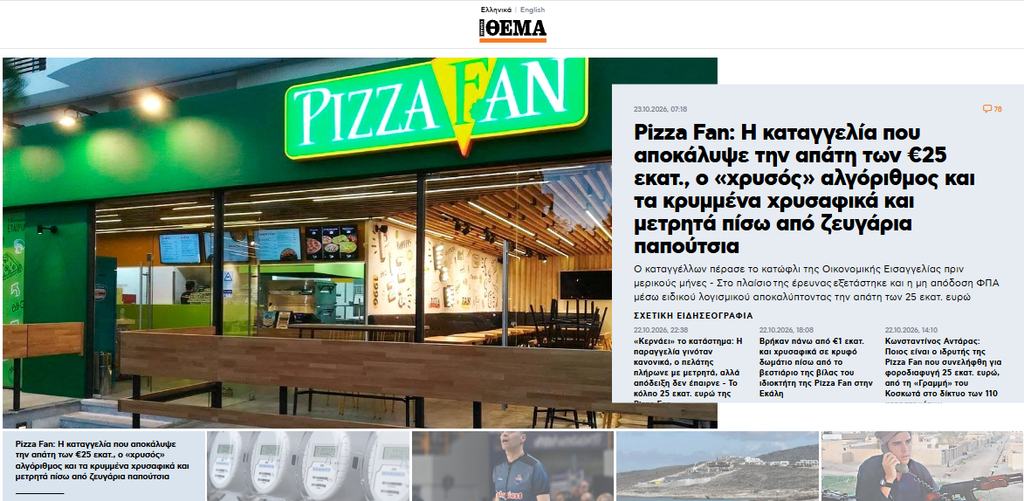
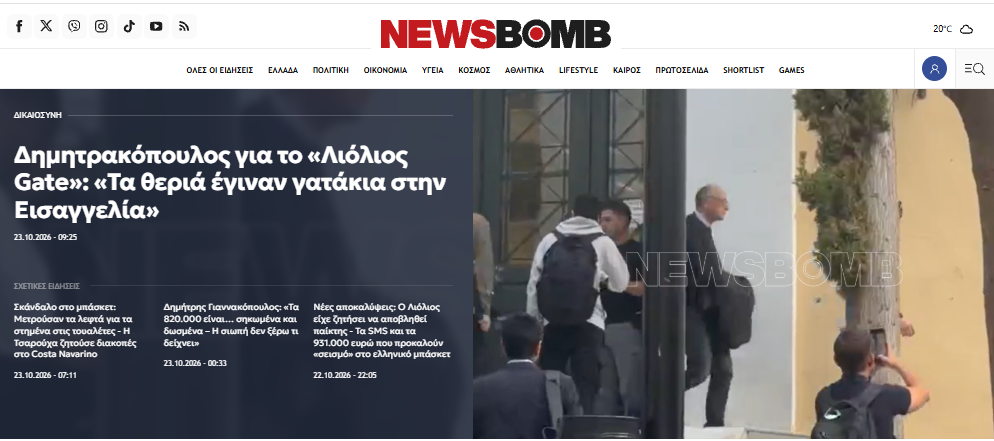
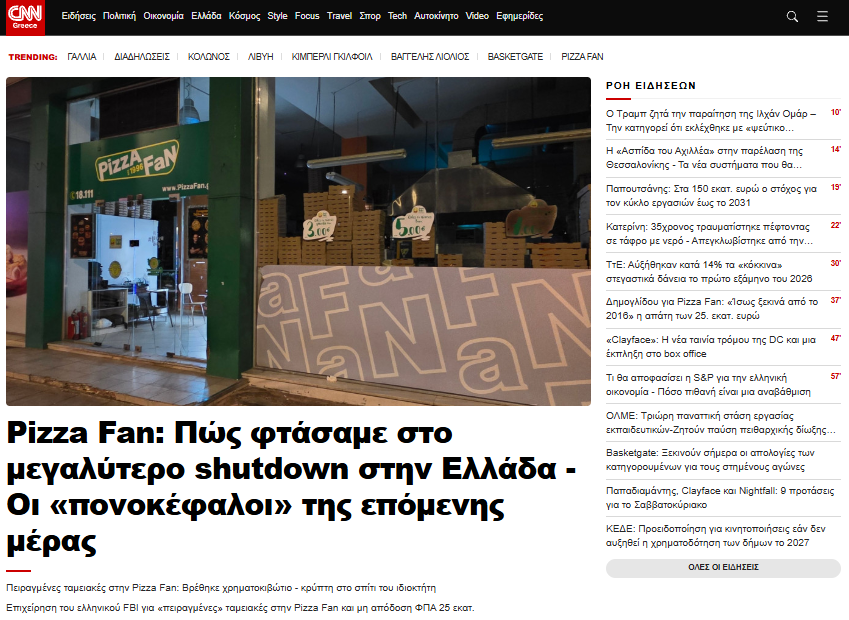


KATHIMERINI: They stole 25 million with pizzas “on the house”
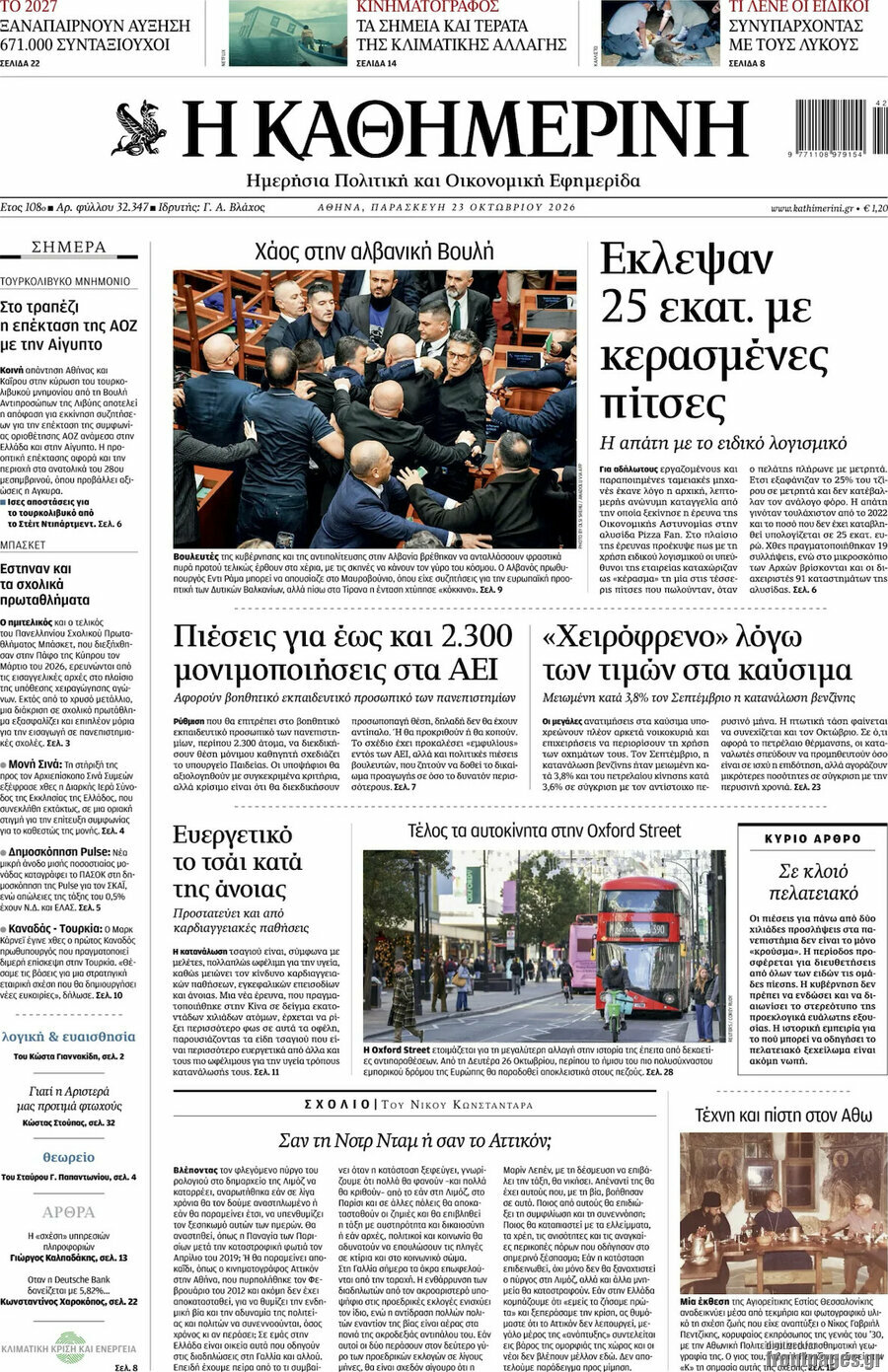
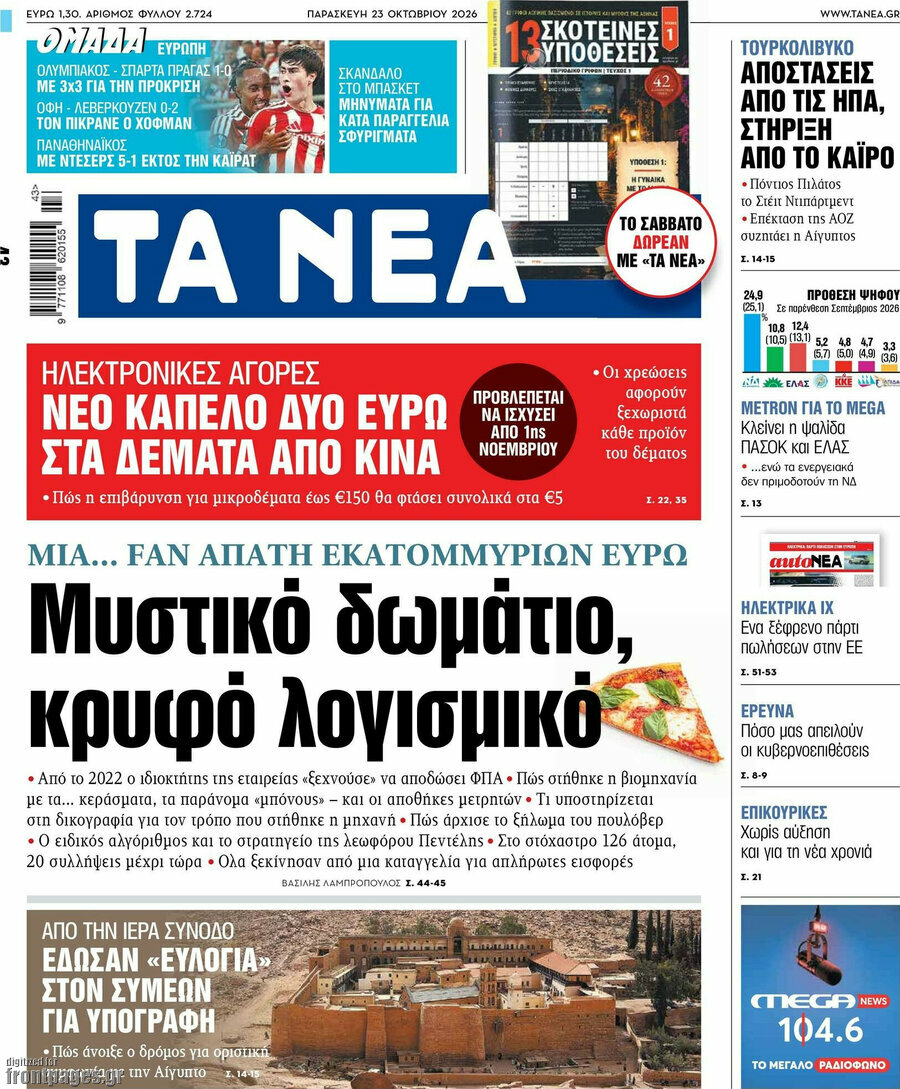
TA NEA: Pizza fan scam: a secret room, a hidden software
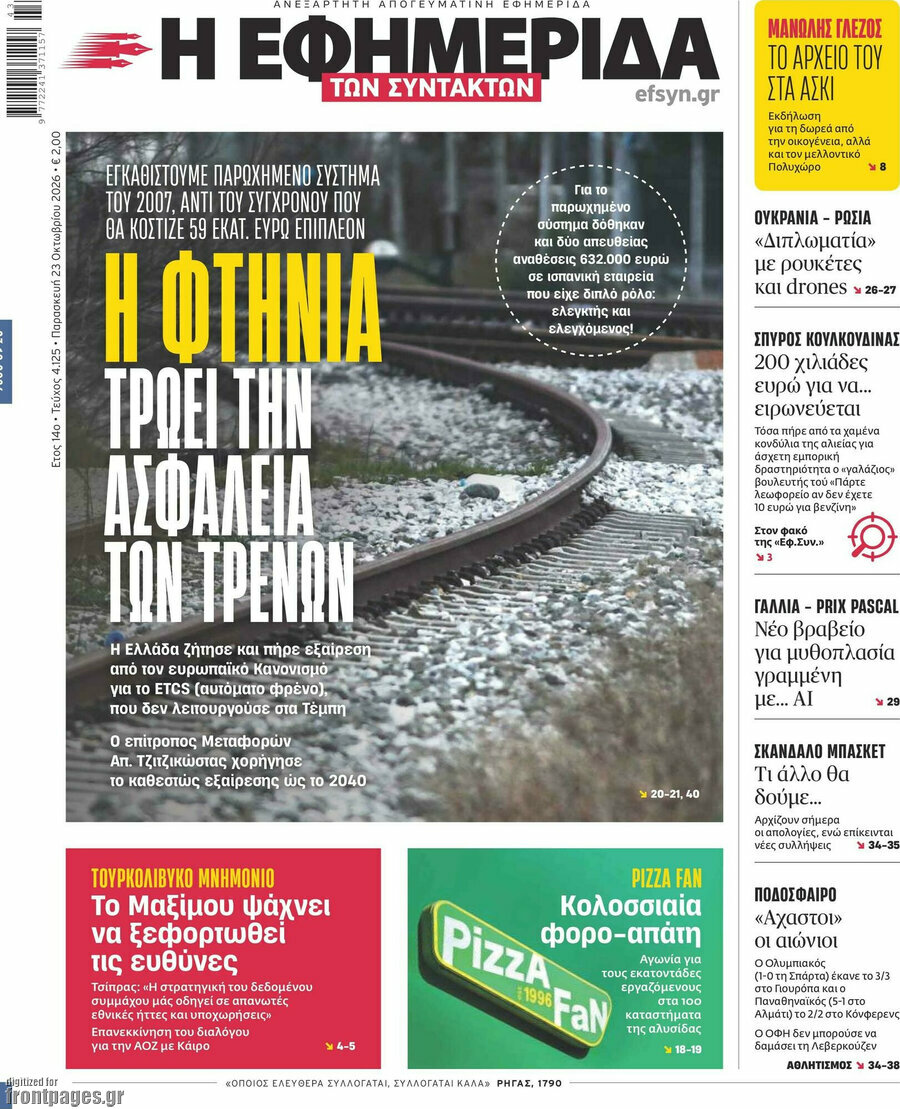
EFIMERIDA TON SYNTAKTON: Cheap systems undermine the safety of trains
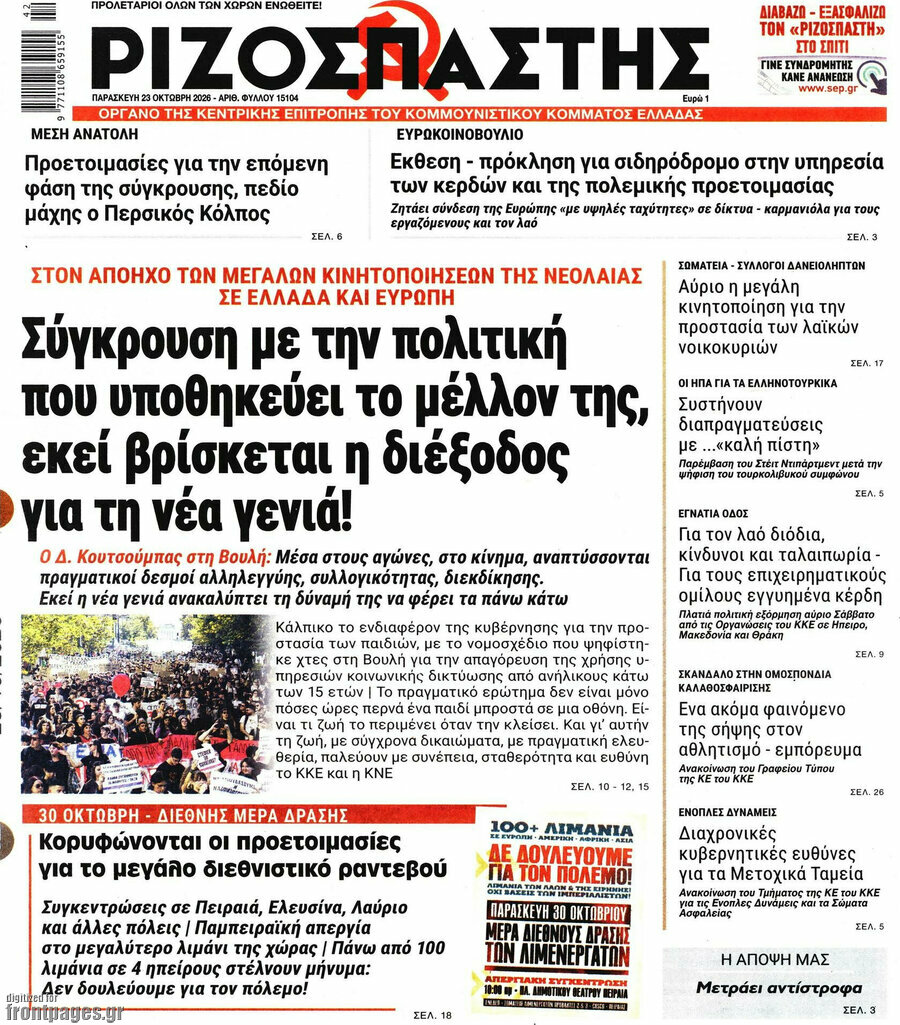
RIZOSPASTIS: The way out for the young is to clash with a policy that undermines their future
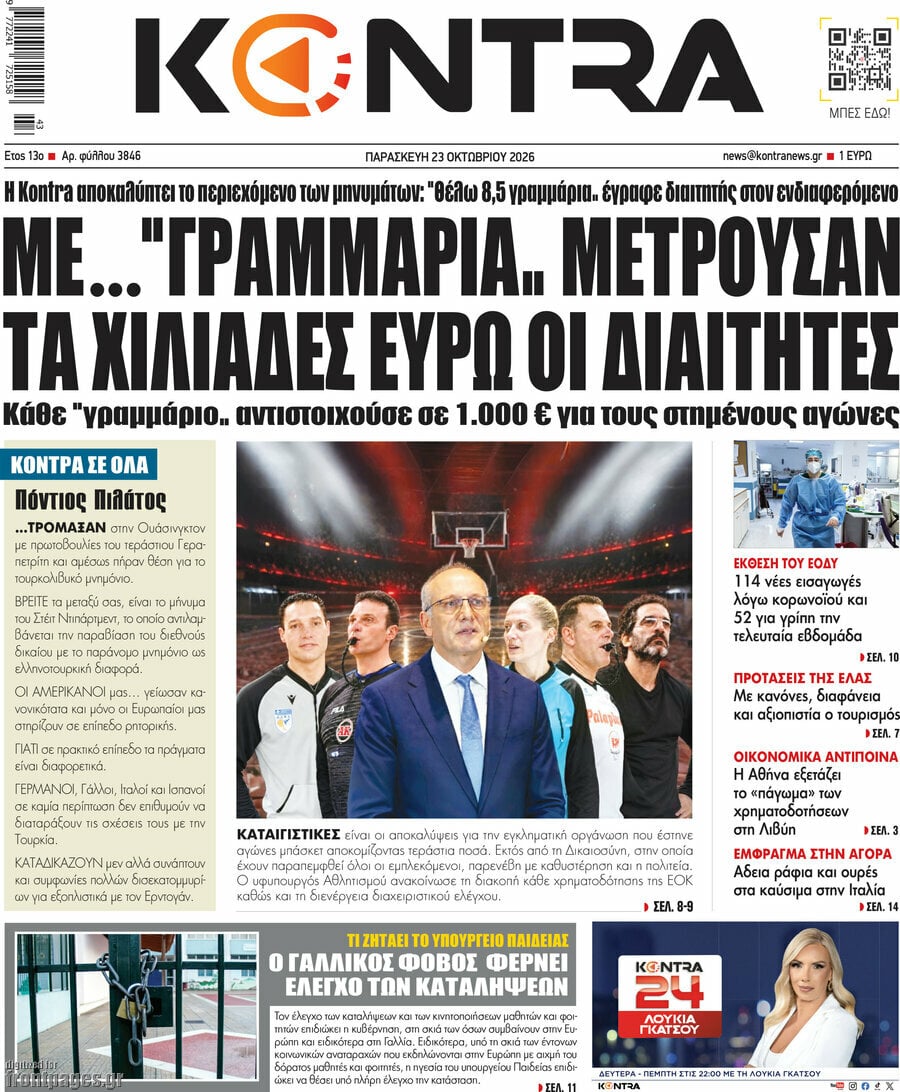
KONTRA NEWS: The referees were counting the thousands of euros with “grams”
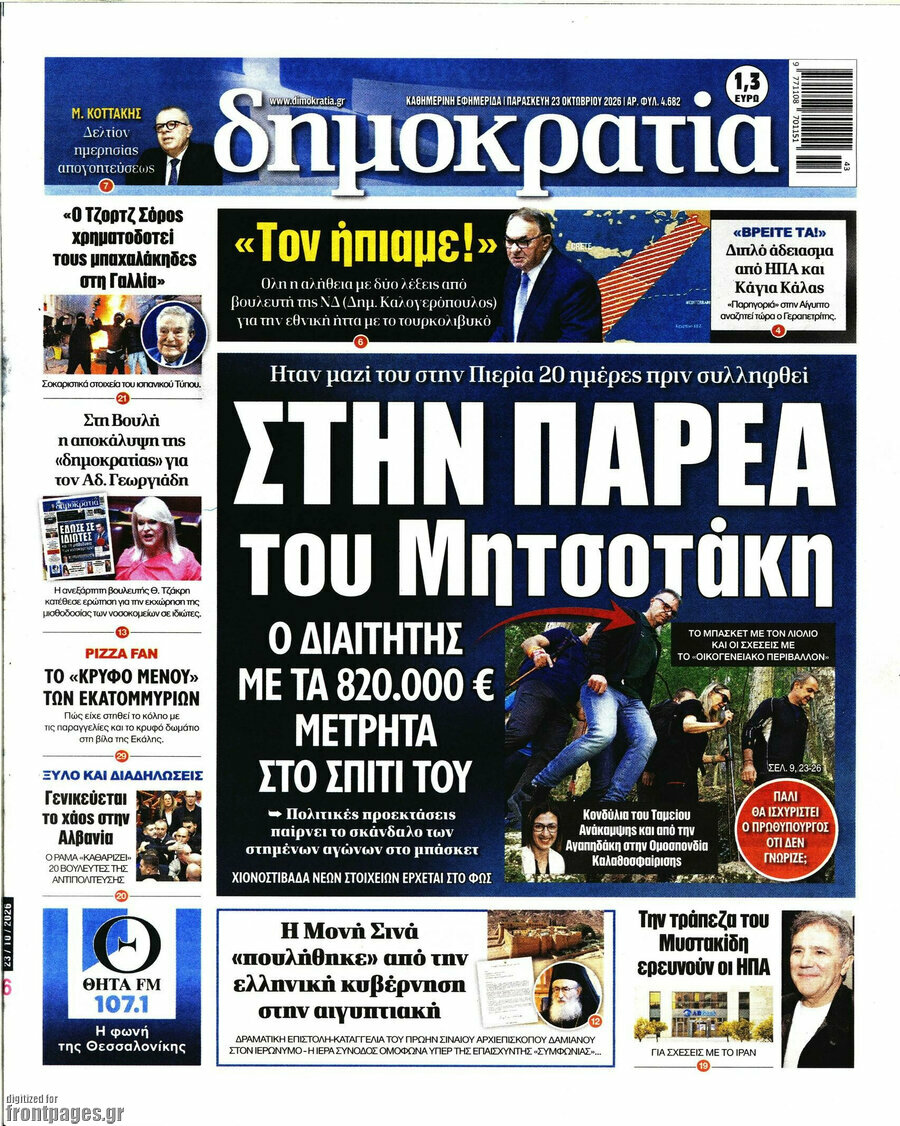
DIMOKRATIA: The referee caught with 820,000 euro at his home was part of Mitsotakis’ entourage
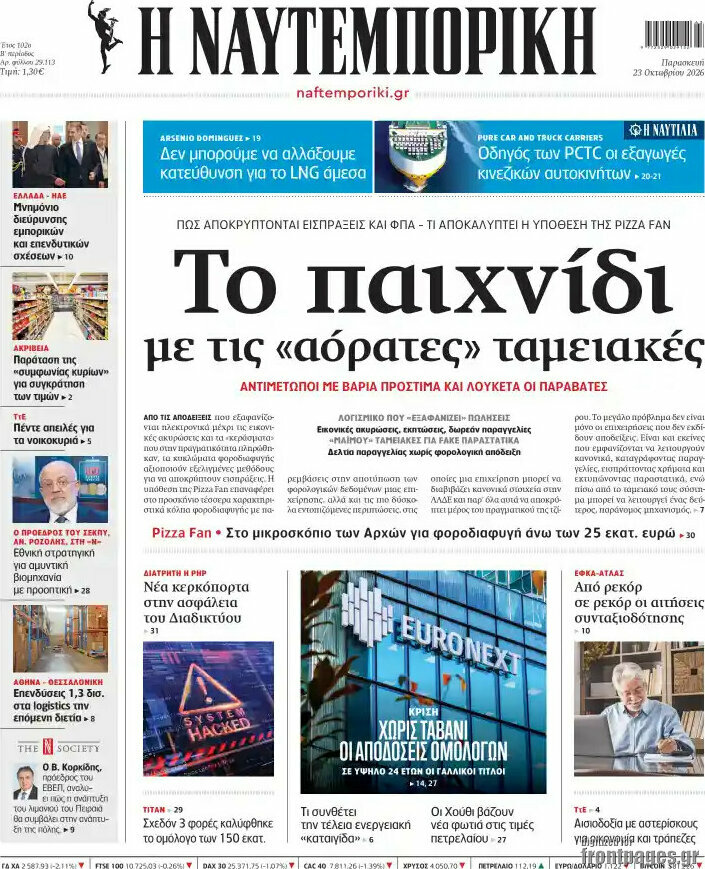
NAFTEMPORIKI: The game with “invisible” cash registers

DRIVING THE DAY
HOW’S THAT RESET GOING? Ursula von der Leyen and António Costa are heading to Budapest today to mark progress in EU-Hungary relations — but they’re not bringing promises to unfreeze any more funds, three EU officials and a diplomat familiar with the trip preparations told me.
Good riddance, Khrushchev (and Orbán): Von der Leyen and Costa are in Budapest to mark the 70th anniversary of Hungary’s 1956 uprising against Soviet rule. Von der Leyen will praise the election that ended Viktor Orbán’s 16 years in power, while Costa will separately address the Hungarian parliament, Playbook has learned.
Money talks: Brussels unlocked more than €4 billion last month that was frozen during Orbán’s rule over concerns about democratic backsliding — but billions of euros remain tied up. Prime Minister Péter Magyar is pushing for the release of the remaining funds, as well as an extra €2 billion from the EU’s next seven-year budget to make up for money permanently lost under Orbán’s government.
Fat chance: An EU official was scathing about the odds of the latter happening. Everyone wants something from the budget, the official said, but that doesn’t mean they’ll get it. And while the European Commission is eager to “reward” Hungary by unlocking the cash, it remains cautious, an EU diplomat said. “There’s a reason we froze that money.”
Taking stock: Almost 200 days after Orbán’s defeat, an EU diplomat said there is a “huge difference in style and attitude” under Magyar, particularly around the European Council table. “He isn’t trying to make life for the other leaders more difficult.” But Hungary’s positions on Ukraine and migration remain much the same, the diplomat said, adding it’s just that “they are put forward in a different way.”
Same sticking points: Magyar is still sometimes obstinate on Ukraine’s financing and EU membership, another EU diplomat said. At last week’s summit, Magyar and the leaders of other Central European countries said they won’t pay interest rates on any new Ukraine loan, angering some of the other leaders, according to two diplomats. (Magyar’s representatives didn’t respond to Playbook’s request for comment.)
A simpler time: Estonian Prime Minister Kristen Michal told me back in April, on the sidelines of the first leaders’ summit since Orbán’s defeat, that the mood among leaders was jubilant. “You can feel it,” he said. “Everybody’s talking about what will happen in Europe next.”
Six months on, that optimism has been dented. Brussels remains deadlocked on everything from its €2 trillion budget to energy policy. Those ideological divisions were on full display at last week’s summit, which at times devolved into “shouting,” two diplomats said — no Orbán required.
BIG AND BREAKING
WINTER OF DISCONTENT: Europeans are raging over the cost of living — and cash-strapped governments from Paris to Rome are helpless to fix the situation.
FRANCE ON EDGE: Emmanuel Macron’s government is stepping up security ahead of another weekend of mass demonstrations, with around 70,000 police and gendarmes to be deployed across the country. Tens of thousands of protesters are expected in Orléans alone ahead of far-right leader Marine Le Pen officially launching her presidential campaign on Sunday, Paris Playbook reports.
O NO CANADA: Germany is leading a push against using Ursula von der Leyen’s “associate membership” label as the EU negotiates closer ties with Ottawa, diplomats tell Playbook’s Zoya Sheftalovich.
FIFA ESCAPES A RED CARD: The EU’s influential competition regulators have taken on some of the planet’s most powerful companies, from Google to Gazprom, but are steering clear of opening a case against football’s governing body.
VUČIĆ ON THE ROPES: A student-led movement stands a real chance of edging out Aleksandar Vučić’s Serbian Progressive Party in Sunday’s parliamentary election, according to an independent poll.
TESTING THE CENTER
WEBER’S CENTRIST RESET HITS A WALL: European People’s Party chief Manfred Weber is on a mission to steer his group back to the center and avoid clashes with his traditional coalition partners. While both Renew and the Socialists and Democrats are on board and pushing for a recommitment to the centrist majority in the mid-term carve-up, Weber has a bigger challenge — his own lawmakers, Max Griera reports.
This week’s plenary session started out looking promising. On Monday, the EPP struck a compromise with the centrist groups on a car package. Its negotiators could have joined the groups to its right to weaken carmakers’ CO2 targets, two EPP insiders told Playbook. (They were granted anonymity, like others cited here, to discuss internal group strategy.) Weber pushed them to cut a deal with the center instead.
That got hopes up: “I am confident in our ability to continue striking deals, including on difficult but sensitive and absolutely necessary issues like this one,” Renew chief Valérie Hayer said Tuesday.
But old habits die hard: On Thursday, the EPP joined the right to delay rules requiring fossil fuel companies to monitor and report methane emissions. Tougher tests are ahead, including a Frontex overhaul, an EPP push to reopen the Birds and Habitats Directives and calls to scrap the EU’s carbon market.
No strings attached: Several EPP lawmakers say the group should keep its freedom to work with different majorities. One senior MEP said it would continue working with the S&D and Renew “but without conditions.” Another called demands for a pledge not to work with the right “not realistic,” while a third said they regretted Weber’s centrist turn on the cars package.
In response, the Socialists are starting to link files the EPP can pass with the right to legislation where it needs the center left. They’re tying support for the cars package to negotiations on the Industrial Accelerator Act and its priorities on that, an S&D official said.
20-SECOND PLAYBOOK PRIMER
European Parliament negotiators have reached agreement on what they want to see in the European Competitiveness Fund — but what is that? It’s a proposed €400 billion fund to boost industry, research and innovation as part of the EU’s next seven-year budget. The European Commission proposed that the fund consolidate 14 existing EU programs covering everything from clean technologies to defense. Many fraught budget negotiations are to come, of course.
BACKING THE ICC
KALLAS HEADS TO THE HAGUE: Chief EU diplomat Kaja Kallas is visiting the International Criminal Court today in a show of support after the U.S. sanctioned the body, her office told Nick Vinocur.
The EU is banking on being able to negotiate with President Donald Trump’s administration to stop the sanctions that are due to come into effect in six months. But Kallas’ visit suggests the bloc is throwing its weight behind the court, which won the European Parliament’s Sakharov prize on Thursday. It’s shaping up to be a major transatlantic face-off.
Operational aid: Kallas touted the EU’s “keep calm and negotiate” stance during an address to the Parliament this week. But she’s also working to ensure the court can keep operating if the sanctions do kick in, as they already have for 13 ICC officials, including former chief prosecutor Karim Khan. That includes preparing to assist with payments and IT systems “so the court can continue its work.”
Backup: Kallas’ visit “is a clear show of support,” an EU official told Playbook. “The six months period announced by the U.S. offers a window for diplomacy, and we want to find a solution.”
On the menu: Kallas will meet with ICC President Tomoko Akane while in The Hague. She’ll also drop in on Eurojust and the Council of Europe’s Register of Damage for Ukraine, which has already received 200,000 claims over Russia’s invasion.
BUDGET CORNER
AGRI GOES ROGUE: António Costa’s budget tightrope is already wobbling after EPP lawmakers pushed for extra money for farmers in the bloc’s next seven-year budget, Gregorio Sorgi reports.
Costa took over the MFF negotiations last week, but he’s already facing a parliamentary revolt in the agriculture committee led by the EPP’s Norbert Lins. He threatened to derail negotiations unless Costa puts more money for farmers in the next budget — despite many governments pushing for cuts across the board.
This adds to Costa’s concerns as he scrambles to put forward new budget figures ahead of a leaders’ summit on Nov. 26-27. The EPP’s gripe is that the previous negotiating document from Ireland, which steered the budget talks under its rotating presidency of the Council of the EU, earmarked extra funding for “rural areas” — but offered no guarantees that the money would go to farmers.
Better news from Parliament: Parliament’s negotiators agreed to grant companies from non-EU countries access to the €400 billion European Competitiveness Fund if certain conditions are met. More details here for subscribers.
4 MORE THINGS GETTING US TALKING
REMEMBER 42.7? Cyprus’ President Nikos Christodoulides is urging the EU to keep talking about its mutual defense clause, according to a letter seen by Playbook.
GOING AFTER GRAFT: Brussels needs a new sanctions regime that will allow it to pursue corrupt foreign officials, 70 MEPs wrote in a letter backed by campaigner Bill Browder and seen by Playbook’s Nick Vinocur.
REVOLT AGAINST RED TAPE: European political foundations are lobbying the Commission and Council to pare back financial compliance obligations they say are too burdensome, Mari Eccles and Max Griera report in this week’s EU Influence.
NOT SO GRATE: Italy and France are having cheese problems. Chief fondue correspondent Paul Dallison has more in this week’s Declassified column.
DASHBOARD
Scientists estimate that extreme heat killed more than 50,000 Europeans this summer and that climate change was responsible for two-thirds of the deaths. Zia Weise has the full story.
 |